Imogen Foulkes
Geneva correspondent, BBC News
AUGUST 2, 2025
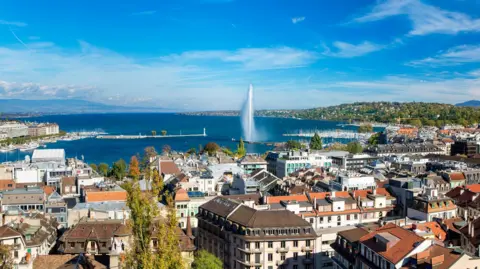
39%? For Switzerland, this is a huge shock, and worse than the worst-case scenario – these are the highest tariffs in Europe.
Globally, the fourth highest, behind only Syria, Laos, and Myanmar, (although if President Trump follows through on his 50% tariff threat then Brazil will jump to the top of the list).
It's the one story dominating the news and the airwaves on Friday. One newspaper, Blick, described it as the country's biggest defeat since French victory in the battle of Marignano in 1515.
Just weeks ago, Switzerland's government was exuding confidence.
In May, a Swiss facilitated meeting between the US and China in Geneva, aimed at preventing a trade war between the two economic superpowers, allowed Switzerland's president Karin Keller-Sutter to grab a meeting with US trade secretary Scott Bessent.
She came out smiling. She had been told, she said, that Switzerland was likely to be second on the list after the United Kingdom to strike a trade deal with Washington. 10%, she hinted, was the tempting tariff offer, far lower than the 31% Donald Trump had unveiled for Switzerland on his 'liberation day' in April.
Now, those illusions are shattered. Just hours before the August first deadline, one last telephone call between Ms Keller-Sutter and President Trump yielded nothing. Hours later came the news that the tariffs would not be 31% as originally threatened, but a punitive 39%.
Trump's global tariffs 'victory' may come at high price
Why? Some Swiss politicians are already arguing that Switzerland's negotiating tactics were not up to scratch – but some say too tough, others say too obsequious. The reality may be more straightforward: Trump was keen to make big deals, and Switzerland just isn't that big. It's not even clear how many discussions the Swiss trade negotiators were able to have with their US counterparts.
The sticking point, the Swiss government says now, is the trade deficit it has with the US.
Trump sees trade deficits - when a country sells more to the US than it buys - as inherently a problem for the US, although this is a view not widely shared by economists. He believes tariffs can help protect the US manufacturing sector, which for decades has lost jobs to companies overseas.
The Swiss trade deficit with the US was $47.4 billion in 2024, though if service industries are included, which Trump conveniently ignored, the deficit shrinks to $22 billion. Switzerland sells more (primarily in pharmaceuticals, gold jewellery, watches and machine tools) to the US than it buys.What tariffs has Trump announced and why?
How much cash is the US raising from tariffs?
To try to compensate for that, the Swiss government reduced its own tariffs on US industrial good to zero, and multiple Swiss companies (Nestle, Novartis) promised multibillion dollar investments in US plants. Switzerland is already the world's 6th largest investor in the US, creating, the Swiss say, 400,000 US jobs.
But balancing the deficit looks impossible. The population of Switzerland is just 9 million, and, bluntly, many of them don't want to buy US products. The gas guzzling cars are too big for alpine roads, US cheese and chocolate…well, let's just say they're not really to Swiss taste.

Switzerland's president Karin Keller-Sutter
Jan Atteslander, head of foreign trade at EconomieSuisse which represents businesses, told Swiss broadcasting: "We need reliable relations with the United States."
This could be a signal of frustration that one of Switzerland's most important export markets has adopted an on/off trade policy, stripping Swiss business of the certainty it needs.
So what can Switzerland do now? There is a small window of opportunity, until August 7th, when the tariffs are due to come into force. Until then, the Swiss government will feverishly try to negotiate. Swiss businesses are warning of thousands of job losses if the 39% can't be reduced.
But it's hard to see what the wiggle room is.
With the investment promises, and the zero tariffs, Switzerland had already offered everything it could. The only tactic now would be punitive - withdraw the investment offer, introduce reciprocal tariffs, and, the nuclear option, cancel Switzerland's order for US F35 fighter planes.
Across Switzerland, there is confusion - and anger.
Friday is Swiss national day, the equivalent of July 4th. After giving her traditional speech, Swiss President Karin Keller-Sutter was asked about the US tariffs.
She told reporters the talks with the US went well but that for Donald Trump, the trade deficit was the obstacle. The inference was that the US president was the problem.
Instead of the usual patriotic celebrations, many Swiss feel they are being punished for having one of the world's most competitive and innovative countries.
Others say the country has survived economic shocks before, and will be able to use that innovation to survive this one.
'Art of the Stupid Deal': Trump's Japan Trade Pact Bashed by Automakers, Unions, Economists
“American workers are once again being left behind,” said the United Auto Workers.
U.S. President Donald Trump Front attends a press conference following the NATO summit in The Hague, the Netherlands, on June 25, 2025. (Photo by Zhao Dingzhe/Xinhua via Getty Images)
Brad Reed
Jul 25, 2025
COMMON DREAM
President Donald Trump this week announced that he had cut a deal with Japan that would lower tariffs on Japanese cars to 15%, which was a cut from the 25% tariffs that he'd originally placed on them.
However, many of the parties whom Trump claimed he was trying to help are not happy with the deal, including major automakers and unions representing hundreds of thousands of workers.
Matt Blunt, president of the American Automotive Policy Council that represents America's "Big Three" automakers, told The Associated Press this week that the deal Trump struck with Japan leaves U.S. automakers "at a disadvantage" compared to their Japanese competitors given that "this is a deal that will charge lower tariffs on Japanese autos with no U.S. content."
The United Autoworkers (UAW) similarly blasted the deal, saying it makes clear that "American workers are once again being left behind."
"This deal hands a win to transnational automakers that rely on low-road labor practices: Substandard wages, excessive temps, and union-busting," said UAW in a press statement. "Now, those same companies stand to benefit from lower tariffs, while unionized automakers—who could quickly create tens of thousands of good jobs using existing capacity—are left with fewer incentives to do so. Once again, American workers are being forced to suffer the consequences."
As Nobel Prize-winning economist Paul Krugman explained on his Substack page on Friday, these stakeholders have good reason to feel burned by what he calls Trump's "art of the stupid deal."
In the first place, the current arrangement leaves in place 25% tariffs on car components produced in Canada and Mexico, both of which are vital parts of the American manufacturing chain. Trump has also left in place 50% tariffs on foreign steel and aluminum, which will further drive up U.S. automakers' input costs and leave them at a disadvantage with Japanese competitors who can still access foreign steel and aluminum at much cheaper prices.
"Overall, the interaction between this Japan deal and Trump's other tariffs probably tilts the playing field between U.S. and Japanese producers of cars, and perhaps other products, in Japan's favor," Krugman explained. "If this sounds incredibly stupid, that's because it is."
Krugman then speculated that "Trump's negotiators probably had no idea what they were doing, and didn't realize that in their frantic rush to conclude a deal they were agreeing to tariffs that would be highly unfavorable to U.S. manufacturing." He added that negotiators were under so much pressure due to the ridicule he's faced for "having made big promises about his ability to negotiate trade deals, then coming up empty month after month."
University of Michigan economist Justin Wolfers appeared on MSNBC earlier this week and outlined why Trump's Japan deal was still a net loss for American consumers even though Trump was lowering the earlier tariffs he had set on Japanese cars.
"If you began by saying that [the] tariff on Japan has gone from 25% to 15%, it would feel like he'd negotiated a great deal," Wolfers said. "That's not what happened here."
He then explained that tariffs on Japanese goods before Trump took office were just 2%, which means that "the biggest thing Trump has done is he's raised taxes on Americans who import goods from Japan from 2% to 15%."
“American workers are once again being left behind,” said the United Auto Workers.
U.S. President Donald Trump Front attends a press conference following the NATO summit in The Hague, the Netherlands, on June 25, 2025. (Photo by Zhao Dingzhe/Xinhua via Getty Images)
Brad Reed
Jul 25, 2025
COMMON DREAM
President Donald Trump this week announced that he had cut a deal with Japan that would lower tariffs on Japanese cars to 15%, which was a cut from the 25% tariffs that he'd originally placed on them.
However, many of the parties whom Trump claimed he was trying to help are not happy with the deal, including major automakers and unions representing hundreds of thousands of workers.
Matt Blunt, president of the American Automotive Policy Council that represents America's "Big Three" automakers, told The Associated Press this week that the deal Trump struck with Japan leaves U.S. automakers "at a disadvantage" compared to their Japanese competitors given that "this is a deal that will charge lower tariffs on Japanese autos with no U.S. content."
The United Autoworkers (UAW) similarly blasted the deal, saying it makes clear that "American workers are once again being left behind."
"This deal hands a win to transnational automakers that rely on low-road labor practices: Substandard wages, excessive temps, and union-busting," said UAW in a press statement. "Now, those same companies stand to benefit from lower tariffs, while unionized automakers—who could quickly create tens of thousands of good jobs using existing capacity—are left with fewer incentives to do so. Once again, American workers are being forced to suffer the consequences."
As Nobel Prize-winning economist Paul Krugman explained on his Substack page on Friday, these stakeholders have good reason to feel burned by what he calls Trump's "art of the stupid deal."
In the first place, the current arrangement leaves in place 25% tariffs on car components produced in Canada and Mexico, both of which are vital parts of the American manufacturing chain. Trump has also left in place 50% tariffs on foreign steel and aluminum, which will further drive up U.S. automakers' input costs and leave them at a disadvantage with Japanese competitors who can still access foreign steel and aluminum at much cheaper prices.
"Overall, the interaction between this Japan deal and Trump's other tariffs probably tilts the playing field between U.S. and Japanese producers of cars, and perhaps other products, in Japan's favor," Krugman explained. "If this sounds incredibly stupid, that's because it is."
Krugman then speculated that "Trump's negotiators probably had no idea what they were doing, and didn't realize that in their frantic rush to conclude a deal they were agreeing to tariffs that would be highly unfavorable to U.S. manufacturing." He added that negotiators were under so much pressure due to the ridicule he's faced for "having made big promises about his ability to negotiate trade deals, then coming up empty month after month."
University of Michigan economist Justin Wolfers appeared on MSNBC earlier this week and outlined why Trump's Japan deal was still a net loss for American consumers even though Trump was lowering the earlier tariffs he had set on Japanese cars.
"If you began by saying that [the] tariff on Japan has gone from 25% to 15%, it would feel like he'd negotiated a great deal," Wolfers said. "That's not what happened here."
He then explained that tariffs on Japanese goods before Trump took office were just 2%, which means that "the biggest thing Trump has done is he's raised taxes on Americans who import goods from Japan from 2% to 15%."

No comments:
Post a Comment