Bret Stephens brings an unprecedented power over the editorial board at The New York Times because he is seen as the voice of the Israeli government-can-do-no-wrong domestic lobby.

Republican U.S. presidential hopeful, Sen. Lindsey Graham (R-S.C.) (R)
TRUMP'S GUNSEL
participates in a discussion with moderator Bret Stephens, then of The Wall Street Journal, during a Christians United for Israel summit July 13, 2015 in Washington, D.C. (Photo: Alex Wong/Getty Images)
Ralph Nader
Aug 02, 2025
Ralph Nader
Aug 02, 2025
Common Dreams
After the long-time skittish New York Times published a lengthy essay by the renowned genocide scholar, Prof. Omer Bartov of Brown University, titled “I’m a Genocide Scholar, I Know It When I see It,” the Palestinian-hater, Times columnist Bret Stephens, immediately jumped into the Netanyahu‑style rebuttal mode. His column was titled “No, Israel is Not Committing Genocide in Gaza.” His cruel and specious assertion, contradicted by many genocide scholars, was that if the Israeli regime was truly genocidal, they would have committed “hundreds of thousands of deaths” in Gaza instead of the mere 60,000 deaths reported by the Hamas‑run Health Ministry.
Get real, Mr. Stephens, the Israeli military has destroyed the lives of at least one out of four Palestinians there, or about half a million at least, from the daily bombing since October 7, 2023, of civilians and their infrastructure. Saturation aerial and artillery bombardments of 2.3 million defenseless Palestinians, also under constant sniper fire, crammed into an area the geographic size of Philadelphia. (See The Lancet, “Counting the Dead in Gaza: Difficult But Essential”, my column “The Vast Gaza Death Undercount—Undermines Civic, Diplomatic, and Political Pressures” and my article in the August-September 2024 Capitol Hill Citizen). American doctors back from Gaza have repeatedly observed that almost all the survivors are sick, injured, or dying.
Seizing on the Hamas regime’s self‑interest in a low death count, to not arouse further the ire of the residents of Gaza against their lack of bomb shelters and other protections, Stephens constructs the usual fictions, reflecting the American Israel Public Affairs Committee (AIPAC) and Israeli Prime Minister Benjamin Netanyahu’s regime, that Israel does not “deliberately target and kill Gazan civilians.” [Former United Nations Ambassador and Foreign Minister Abba Eban wrote of Israel under then Prime Minister Menachem Begin that Israel “is wantonly inflicting every possible measure of death and anguish on civilian populations in a mood reminiscent of regimes which neither Mr. Begin nor I would dare to mention by name.”] Look at the reports by Times journalists from the area, see the pictures of the mass murder, the slaughter of babies, children, mothers, and fathers that comprise Netanyahu’s Palestinian holocaust.
Listen to the former Israeli Minister of Defense Yoav Gallant’s October 9, 2023 enforced declaration that Israeli demolition of Gaza would include “…no electricity, no food, no fuel, everything is closed.” “We are fighting human animals, and we are acting accordingly.”
Stephens is immovable. Over a year ago, he shockingly wrote that the Israeli military is not using enough force on the Palestinians.
And so indeed has the Israeli military targeted innocent families, journalists, and U.N. Relief and Works Agency for Palestinian Refugees in the Near East staff. To quote Professor Bartov, “the systematic destruction in Gaza not only of housing but also of other infrastructure—government buildings, hospitals, universities, schools, mosques, cultural heritage sites, water treatment plants, agriculture areas, and parks…” Bartov grew up in Israel, served four years in the Israeli army, and knows the situation there in great detail.
Bret Stephens brings an unprecedented power over the editorial board at the Times because he is seen as the voice of the Israeli government-can-do-no-wrong domestic lobby inside the Times who is always ready to frivolously accuse anybody at the paper of antisemitism to shut them up or water down their content.
As Will Solomon reported July 25, 2025 in Counterpunch, Stephens is the “minder” of what is unacceptable criticism of the Israeli regime and has succeeded significantly in his censorship. If you wonder for example why it took the Times editorial board so long to condemn the Israeli regime’s starvation of Gazans, especially the most vulnerable infants and children ( See July 31 editorial and The New York Times July 27, 2025 opinion piece “The World Must See Gaza’s Starvation” by Mohammed Mansour), it is likely the climate of fear or weariness generated by Stephens.
Stephens is given remarkable latitude by the Times editors. His falsifications and antisemitic rage against Palestinian semites (see, “The Other Antisemitism” by Jim Zogby) escape his editors’ pen. He is given unusual space, including a recently concluded weekly column with Gail Collins, which replaced valuable editorial space, with repartees that had become shopworn over the years. He also is given special writing projects.
Consider his background. A former hard-line editor of The Jerusalem Post, then for years a warmongering columnist for The Wall Street Journal. Especially vicious against Palestinians and their supporters, Stephens came to the Times for a singular reason. The Times wanted a right-winger who did not like the new president, Donald Trump. What the Times got was a cunning censor of their journalistic integrity and editorial respect for the regular devastating reports the Times was getting from their own journalists operating out of Jerusalem. They were not allowed into Gaza to report independently on what was being done with U.S. tax dollars and the unconditional support from former U.S. President Joe Biden and now Trump.
Imagine, for example, the Times not writing an editorial following the Israeli booby-trapping of thousands of pagers in Lebanon. This was called a clear war crime by former Secretary of Defense Leon Panetta.
While the Times has published op-eds critical of Israeli aggressions, it has maintained a list of words and phrases that could not be used in its reporting, such as “genocide.” It has avoided doing features on the many Israeli human rights groups sharply taking Netanyahu to task, or groups in the U.S., such as the very active Veterans for Peace with 100 chapters around the U.S. By contrast the Times devoted extensive space to repeated false propaganda by the Israeli regime.
Even coverage of the omnipresent Jewish Voice for Peace and If Not Now requires dramatic nonviolent civil disobedience, as with the October 24, 2023 sit-in at Grand Central Station, to get into the Times pages.
Throughout the months since October 7, and the mysterious total collapse of the multitiered Israeli border security apparatus on the Gaza border, still denied an official investigation by its perpetrators, the defiant presence of Stephens persists, though it is being countered by the sickening pictures of skeletal, starving Palestinian infants. (A survey last year by a British civic association had 46% of Palestinian children wanting to die and 97% expecting to be killed.)
Credit Stephens with covering his self-designated, intimidating role of policing what should not be appearing by staff in the Times’editorial pages. In his column with Collins, he used humor and praise of Times reports and book reviews not connected with the Israeli domination of the Middle East. Recognizing a no-win situation for herself, Gail Collins agreed not to raise the Israeli-Palestine issue in any of the hundreds of columns she wrote with Stephens, who is disliked by many at the Times.
Stephens is immovable. Over a year ago, he shockingly wrote that the Israeli military is not using enough force on the Palestinians. He refuses to disavow the most racist, vicious descriptions of Palestinians over the years by high Israeli government officials. He refuses to support opening Gaza to foreign journalists, including Israeli journalists. He even declines to support the airlifting of amputated and horribly burned Palestinian children to ready and able hospitals in the U.S.
The New York Times does not fear Donald Trump. But it does fear or is very wary of the smiling, internal censorious presence of this AIPAC clone and the attention he demands because of the forces he represents. The editorial board and Times management need to reject this affront to the freedom of its journalists and the paper’s institutional integrity.
Our work is licensed under Creative Commons (CC BY-NC-ND 3.0). Feel free to republish and share widely.
Ralph Nader is a consumer advocate and the author of "The Seventeen Solutions: Bold Ideas for Our American Future" (2012). His new book is, "Wrecking America: How Trump's Lies and Lawbreaking Betray All" (2020, co-authored with Mark Green).
Full Bio >
After the long-time skittish New York Times published a lengthy essay by the renowned genocide scholar, Prof. Omer Bartov of Brown University, titled “I’m a Genocide Scholar, I Know It When I see It,” the Palestinian-hater, Times columnist Bret Stephens, immediately jumped into the Netanyahu‑style rebuttal mode. His column was titled “No, Israel is Not Committing Genocide in Gaza.” His cruel and specious assertion, contradicted by many genocide scholars, was that if the Israeli regime was truly genocidal, they would have committed “hundreds of thousands of deaths” in Gaza instead of the mere 60,000 deaths reported by the Hamas‑run Health Ministry.
Get real, Mr. Stephens, the Israeli military has destroyed the lives of at least one out of four Palestinians there, or about half a million at least, from the daily bombing since October 7, 2023, of civilians and their infrastructure. Saturation aerial and artillery bombardments of 2.3 million defenseless Palestinians, also under constant sniper fire, crammed into an area the geographic size of Philadelphia. (See The Lancet, “Counting the Dead in Gaza: Difficult But Essential”, my column “The Vast Gaza Death Undercount—Undermines Civic, Diplomatic, and Political Pressures” and my article in the August-September 2024 Capitol Hill Citizen). American doctors back from Gaza have repeatedly observed that almost all the survivors are sick, injured, or dying.
Seizing on the Hamas regime’s self‑interest in a low death count, to not arouse further the ire of the residents of Gaza against their lack of bomb shelters and other protections, Stephens constructs the usual fictions, reflecting the American Israel Public Affairs Committee (AIPAC) and Israeli Prime Minister Benjamin Netanyahu’s regime, that Israel does not “deliberately target and kill Gazan civilians.” [Former United Nations Ambassador and Foreign Minister Abba Eban wrote of Israel under then Prime Minister Menachem Begin that Israel “is wantonly inflicting every possible measure of death and anguish on civilian populations in a mood reminiscent of regimes which neither Mr. Begin nor I would dare to mention by name.”] Look at the reports by Times journalists from the area, see the pictures of the mass murder, the slaughter of babies, children, mothers, and fathers that comprise Netanyahu’s Palestinian holocaust.
Listen to the former Israeli Minister of Defense Yoav Gallant’s October 9, 2023 enforced declaration that Israeli demolition of Gaza would include “…no electricity, no food, no fuel, everything is closed.” “We are fighting human animals, and we are acting accordingly.”
Stephens is immovable. Over a year ago, he shockingly wrote that the Israeli military is not using enough force on the Palestinians.
And so indeed has the Israeli military targeted innocent families, journalists, and U.N. Relief and Works Agency for Palestinian Refugees in the Near East staff. To quote Professor Bartov, “the systematic destruction in Gaza not only of housing but also of other infrastructure—government buildings, hospitals, universities, schools, mosques, cultural heritage sites, water treatment plants, agriculture areas, and parks…” Bartov grew up in Israel, served four years in the Israeli army, and knows the situation there in great detail.
Bret Stephens brings an unprecedented power over the editorial board at the Times because he is seen as the voice of the Israeli government-can-do-no-wrong domestic lobby inside the Times who is always ready to frivolously accuse anybody at the paper of antisemitism to shut them up or water down their content.
As Will Solomon reported July 25, 2025 in Counterpunch, Stephens is the “minder” of what is unacceptable criticism of the Israeli regime and has succeeded significantly in his censorship. If you wonder for example why it took the Times editorial board so long to condemn the Israeli regime’s starvation of Gazans, especially the most vulnerable infants and children ( See July 31 editorial and The New York Times July 27, 2025 opinion piece “The World Must See Gaza’s Starvation” by Mohammed Mansour), it is likely the climate of fear or weariness generated by Stephens.
Stephens is given remarkable latitude by the Times editors. His falsifications and antisemitic rage against Palestinian semites (see, “The Other Antisemitism” by Jim Zogby) escape his editors’ pen. He is given unusual space, including a recently concluded weekly column with Gail Collins, which replaced valuable editorial space, with repartees that had become shopworn over the years. He also is given special writing projects.
Consider his background. A former hard-line editor of The Jerusalem Post, then for years a warmongering columnist for The Wall Street Journal. Especially vicious against Palestinians and their supporters, Stephens came to the Times for a singular reason. The Times wanted a right-winger who did not like the new president, Donald Trump. What the Times got was a cunning censor of their journalistic integrity and editorial respect for the regular devastating reports the Times was getting from their own journalists operating out of Jerusalem. They were not allowed into Gaza to report independently on what was being done with U.S. tax dollars and the unconditional support from former U.S. President Joe Biden and now Trump.
Imagine, for example, the Times not writing an editorial following the Israeli booby-trapping of thousands of pagers in Lebanon. This was called a clear war crime by former Secretary of Defense Leon Panetta.
While the Times has published op-eds critical of Israeli aggressions, it has maintained a list of words and phrases that could not be used in its reporting, such as “genocide.” It has avoided doing features on the many Israeli human rights groups sharply taking Netanyahu to task, or groups in the U.S., such as the very active Veterans for Peace with 100 chapters around the U.S. By contrast the Times devoted extensive space to repeated false propaganda by the Israeli regime.
Even coverage of the omnipresent Jewish Voice for Peace and If Not Now requires dramatic nonviolent civil disobedience, as with the October 24, 2023 sit-in at Grand Central Station, to get into the Times pages.
Throughout the months since October 7, and the mysterious total collapse of the multitiered Israeli border security apparatus on the Gaza border, still denied an official investigation by its perpetrators, the defiant presence of Stephens persists, though it is being countered by the sickening pictures of skeletal, starving Palestinian infants. (A survey last year by a British civic association had 46% of Palestinian children wanting to die and 97% expecting to be killed.)
Credit Stephens with covering his self-designated, intimidating role of policing what should not be appearing by staff in the Times’editorial pages. In his column with Collins, he used humor and praise of Times reports and book reviews not connected with the Israeli domination of the Middle East. Recognizing a no-win situation for herself, Gail Collins agreed not to raise the Israeli-Palestine issue in any of the hundreds of columns she wrote with Stephens, who is disliked by many at the Times.
Stephens is immovable. Over a year ago, he shockingly wrote that the Israeli military is not using enough force on the Palestinians. He refuses to disavow the most racist, vicious descriptions of Palestinians over the years by high Israeli government officials. He refuses to support opening Gaza to foreign journalists, including Israeli journalists. He even declines to support the airlifting of amputated and horribly burned Palestinian children to ready and able hospitals in the U.S.
The New York Times does not fear Donald Trump. But it does fear or is very wary of the smiling, internal censorious presence of this AIPAC clone and the attention he demands because of the forces he represents. The editorial board and Times management need to reject this affront to the freedom of its journalists and the paper’s institutional integrity.
Our work is licensed under Creative Commons (CC BY-NC-ND 3.0). Feel free to republish and share widely.
Ralph Nader is a consumer advocate and the author of "The Seventeen Solutions: Bold Ideas for Our American Future" (2012). His new book is, "Wrecking America: How Trump's Lies and Lawbreaking Betray All" (2020, co-authored with Mark Green).
Full Bio >
NYT Condemned for Clarifying Starving Palestinian Child's 'Preexisting Health Condition'
"If a publication ran an editors' note to 'clarify' that some portion of Nazi death camp victims had preexisting conditions, it would rightfully be accused of Holocaust denialism," said one observer.

Muhammad Zakariya Ayyoub al-Matouq, an 18-month-old child in Gaza City, Gaza, faces life-threatening malnutrition as the humanitarian situation worsens due to ongoing Israeli attacks and blockade, on July 21, 2025.
(Photo: Ahmed Jihad Ibrahim Al-arini/Anadolu via Getty Images)
Julia Conley
Jul 30, 2025
COMMON DREAMS
As the U.S. corporate media stepped up its coverage last week of the impact Israel's near-total blockade on Gaza is having on Palestinians, at least 154 of whom have now starved to death, Israeli officials zeroed in on just one of the children featured in a New York Times report.
After suggesting that his case showed reports of starvation in Gaza are overblown, they evidently managed to convince the newspaper to issue a clarification.
The Times mentioned Atef Abu Khater, a 17-year-old whose father said he was "not responding to the treatment" he was getting for severe malnutrition, and four-month-old Yahia al-Najjar, who died on July 22 after his mother, who was subsisting on one serving or lentils or rice per day, was unable to nurse him.
But the Israeli media and the Coordinator of Government Activities in the Territories (COGAT), which facilitates humanitarian aid in Gaza, focused on the story of 18-month-old Mohammed Zakaria al-Mutawaq, whose mother told the Times, "I look at him and I can't help but cry."
I24 News reported Wednesday that after the story was printed, COGAT "publicized records showing the child suffered from severe preexisting medical conditions."
Al-Mutawaq was born with cerebral palsy, The Jerusalem Post reported Tuesday, adding that the Israeli government had uncovered another photo of the child's family in which his older brother looked "distressed but relatively healthy."
"Their mother also does not appear to be suffering from any symptoms of starvation," the outlet mused.
Children are most at risk for being severely impacted by hunger and starvation, and often die at twice the rate of adults, according to the International Rescue Committee.
As images of Al-Mutawaq's mother holding his skeletal body were published by other outlets, the U.S.-based pro-Israel media watchdog HonestReporting also took notice.
The photos, said the website, were being used "as visual proof of a humanitarian catastrophe. More than that, as proof that Israel is deliberately starving the people of Gaza."
Israeli officials themselves have said they are deliberately starving the people of Gaza, with Finance Minister Bezalel Smotrich saying in May that Israel would let only the "tiniest amount" of aid into the enclave so the world would "continue providing us with international protection." International human rights groups and experts have assessed that Israel is carrying out a policy of deliberate starvation.
Nonetheless, HonestReporting demanded that "every outlet that promoted this false narrative must update their coverage to reflect the full truth: Mohammad has a medical condition."
Late on Tuesday, the Times appeared to respond to the outcry.
In addition to publishing an addendum to its initial reporting, the newspaper's communications department issued an official statement.
It emphasized that children in Gaza are malnourished and starving, and noted that it had learned of Al-Mutawaq's health condition.
"We... have updated our story to add context about his preexisting health condition," said a spokesperson. "This additional detail gives readers a greater understanding of his situation."
In at least one case, the communications department directly responded to a pro-Israel journalist who had said photos of Al-Mutawaq did not show "the face of famine."
The Times did not suggest Al-Mutawaq's health condition negated or lessened the impact of the malnutrition he is also suffering from.
But a number of observers were aghast at the paper's apparent decision to appease the Israeli government and pro-Israel groups and media outlets that had suggested reporting on Al-Mutawaq's case was "misleading" and "playing into the hands of Hamas' propaganda war."
"If a publication ran an editors' note to 'clarify' that some portion of Nazi death camp victims had preexisting conditions, it would rightfully be accused of Holocaust denialism," said writer Natalie Shure. "This is one of the most depraved things The New York Times has ever published."
Some emphasized that the news of Al-Mutawaq's health condition hardly vindicates Israel, especially considering that the Israel Defense Forces have decimated Gaza's healthcare system since they began bombarding the enclave nearly 21 months ago.
"This actually makes it even more grotesque," said Nathan Robinson of Current Affairs. "Of course the first people to die have preexisting health problems. Starvation is a eugenic policy which first kills off the weakest and sickest. Israel acts like proving 'preexisting health problems' is a defense. It's an indictment."
Some pro-Israel entities appeared to view the Times' addendum and statement as something of a victory, with the right-wing news outlet The Daily Caller writing that the newspaper was "forced to backtrack on reporting of Gazan child after getting key element wrong."
The Times' move didn't stop others from criticizing the newspaper. The Instagram account Jewish Lives Matter said the spokesperson's statement didn't reverse the "journalistic malpractice" the paper had committed. Former Israeli Prime Minister Naftali Bennett said the Times was guilty of "blood libel"—a reference to medieval antisemitic allegations that Jewish people used the blood of Christian children in rituals.
As for the Israeli government, hours after the Times issued its statement, the Ministry of Foreign Affairs moved on to criticizing media outlets for printing photos of another emaciated child: Osama al-Raqab, who has cystic fibrosis in addition to suffering from malnutrition brought on by Israel's blockade.
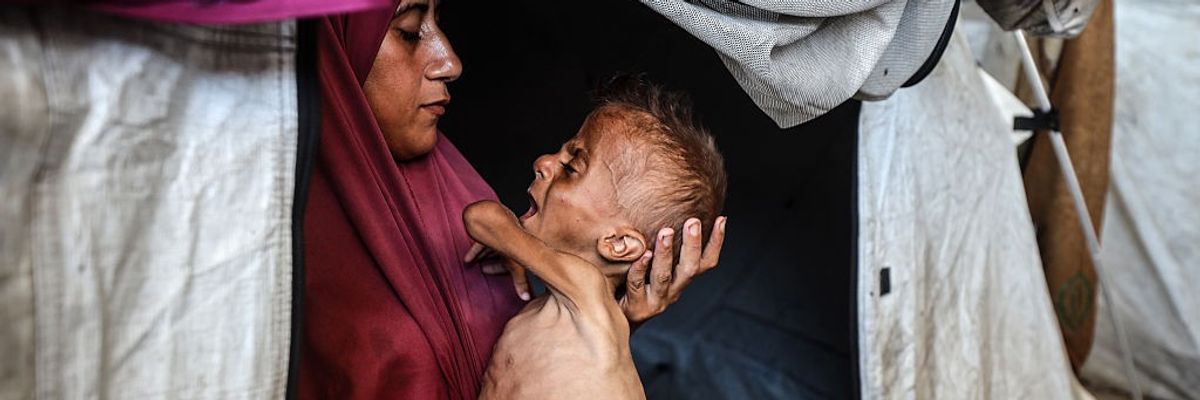
Hidaya, a 31-year-old Palestinian mother, sits with her starving 18-month-old son Mohammed al-Mutawaq inside their tent at the al-Shati refugee camp in Gaza City, Palestine, on July 25, 2025.
(Photo: Majdi Fathi/NurPhoto via Getty Images)
Brett Wilkins
Jul 25, 2025
COMMON DREAMS
As more and more Palestinians, mostly children, starve to death due to Israel's 657-day obliteration and siege of Gaza, reliably pro-Israel U.S. corporate media outlets in recent days have centered the starvation crisis—which began in October 2023—while critics have decried passive language and anti-Palestinian tropes used in some reporting.
The Washington Post published at least two articles on the subject in as many days, including an Associated Press story by Wafaa Shurafa, Sarah El Deeb, and Lee Keath titled "Dozens of Kids and Adults in Gaza Have Starved to Death in July as Hunger Surges" and an internal piece by Louisa Loveluck, Heba Farouk Mahfouz, Siham Shamalakh, Miriam Berger, and Abbie Cheeseman with the headline "Mass Starvation Stalks Gaza as Deaths Rise From Hunger." The authors of the latter article noted that "Israel has severely limited the amount of food entering Gaza, where society is on the brink of collapse."
The New York Times on Friday published a morning newsletter article by Lauren Jackson titled "The Starvation Spreading in Gaza," which stressed that "hunger in Gaza is not new" amid an Israeli blockade that has choked the strip "for nearly two decades." Jackson's piece followed a Thursday front-page story by Rawan Sheikh Ahmad, Isabel Kershner, and Abu Bakr Bashir, with images by Palestinian photographer Saher Alghorra, headlined "Gazans Are Dying of Starvation."
Palestinian peace activist Ihab Hassan, who heads the Agora Initiative's Human Rights for Gaza project, said on the social media site X, "Starvation in Gaza made it to the front page of The New York Times—a horror so vast, it could no longer be ignored."
Carnegie Middle East Center senior editor Michael Young wrote on X, "Don't underestimate that a mainstream media outlet in the U.S. is finally stating the obvious, that Gazans are dying of starvation."
"But it's not as if they're just dying, for no reason; they are being denied adequate amounts of food by Israel, therefore are being killed," Young added. "Nonetheless, that the NYT presents the story in so blunt a way, under a heartbreaking photograph, must qualify as a turning point of sorts given how reluctant U.S. media outlets are to say anything bad about Israel."
Assal Rad, a fellow at the Arab Center Washington D.C. and frequent media critic, offered a more accurate headline for the Times story—"ISRAEL IS STARVING PALESTINIANS TO DEATH.
"If a publication ran an editors' note to 'clarify' that some portion of Nazi death camp victims had preexisting conditions, it would rightfully be accused of Holocaust denialism," said one observer.
Muhammad Zakariya Ayyoub al-Matouq, an 18-month-old child in Gaza City, Gaza, faces life-threatening malnutrition as the humanitarian situation worsens due to ongoing Israeli attacks and blockade, on July 21, 2025.
(Photo: Ahmed Jihad Ibrahim Al-arini/Anadolu via Getty Images)
Julia Conley
Jul 30, 2025
COMMON DREAMS
As the U.S. corporate media stepped up its coverage last week of the impact Israel's near-total blockade on Gaza is having on Palestinians, at least 154 of whom have now starved to death, Israeli officials zeroed in on just one of the children featured in a New York Times report.
After suggesting that his case showed reports of starvation in Gaza are overblown, they evidently managed to convince the newspaper to issue a clarification.
The Times mentioned Atef Abu Khater, a 17-year-old whose father said he was "not responding to the treatment" he was getting for severe malnutrition, and four-month-old Yahia al-Najjar, who died on July 22 after his mother, who was subsisting on one serving or lentils or rice per day, was unable to nurse him.
But the Israeli media and the Coordinator of Government Activities in the Territories (COGAT), which facilitates humanitarian aid in Gaza, focused on the story of 18-month-old Mohammed Zakaria al-Mutawaq, whose mother told the Times, "I look at him and I can't help but cry."
I24 News reported Wednesday that after the story was printed, COGAT "publicized records showing the child suffered from severe preexisting medical conditions."
Al-Mutawaq was born with cerebral palsy, The Jerusalem Post reported Tuesday, adding that the Israeli government had uncovered another photo of the child's family in which his older brother looked "distressed but relatively healthy."
"Their mother also does not appear to be suffering from any symptoms of starvation," the outlet mused.
Children are most at risk for being severely impacted by hunger and starvation, and often die at twice the rate of adults, according to the International Rescue Committee.
As images of Al-Mutawaq's mother holding his skeletal body were published by other outlets, the U.S.-based pro-Israel media watchdog HonestReporting also took notice.
The photos, said the website, were being used "as visual proof of a humanitarian catastrophe. More than that, as proof that Israel is deliberately starving the people of Gaza."
Israeli officials themselves have said they are deliberately starving the people of Gaza, with Finance Minister Bezalel Smotrich saying in May that Israel would let only the "tiniest amount" of aid into the enclave so the world would "continue providing us with international protection." International human rights groups and experts have assessed that Israel is carrying out a policy of deliberate starvation.
Nonetheless, HonestReporting demanded that "every outlet that promoted this false narrative must update their coverage to reflect the full truth: Mohammad has a medical condition."
Late on Tuesday, the Times appeared to respond to the outcry.
In addition to publishing an addendum to its initial reporting, the newspaper's communications department issued an official statement.
It emphasized that children in Gaza are malnourished and starving, and noted that it had learned of Al-Mutawaq's health condition.
"We... have updated our story to add context about his preexisting health condition," said a spokesperson. "This additional detail gives readers a greater understanding of his situation."
In at least one case, the communications department directly responded to a pro-Israel journalist who had said photos of Al-Mutawaq did not show "the face of famine."
The Times did not suggest Al-Mutawaq's health condition negated or lessened the impact of the malnutrition he is also suffering from.
But a number of observers were aghast at the paper's apparent decision to appease the Israeli government and pro-Israel groups and media outlets that had suggested reporting on Al-Mutawaq's case was "misleading" and "playing into the hands of Hamas' propaganda war."
"If a publication ran an editors' note to 'clarify' that some portion of Nazi death camp victims had preexisting conditions, it would rightfully be accused of Holocaust denialism," said writer Natalie Shure. "This is one of the most depraved things The New York Times has ever published."
Some emphasized that the news of Al-Mutawaq's health condition hardly vindicates Israel, especially considering that the Israel Defense Forces have decimated Gaza's healthcare system since they began bombarding the enclave nearly 21 months ago.
"This actually makes it even more grotesque," said Nathan Robinson of Current Affairs. "Of course the first people to die have preexisting health problems. Starvation is a eugenic policy which first kills off the weakest and sickest. Israel acts like proving 'preexisting health problems' is a defense. It's an indictment."
Some pro-Israel entities appeared to view the Times' addendum and statement as something of a victory, with the right-wing news outlet The Daily Caller writing that the newspaper was "forced to backtrack on reporting of Gazan child after getting key element wrong."
The Times' move didn't stop others from criticizing the newspaper. The Instagram account Jewish Lives Matter said the spokesperson's statement didn't reverse the "journalistic malpractice" the paper had committed. Former Israeli Prime Minister Naftali Bennett said the Times was guilty of "blood libel"—a reference to medieval antisemitic allegations that Jewish people used the blood of Christian children in rituals.
As for the Israeli government, hours after the Times issued its statement, the Ministry of Foreign Affairs moved on to criticizing media outlets for printing photos of another emaciated child: Osama al-Raqab, who has cystic fibrosis in addition to suffering from malnutrition brought on by Israel's blockade.
'A Horror So Vast, It Could No Longer Be Ignored': US Media Finally Centering Starving Gazans
However, one critic lamented that corporate media "continues to act like starvation is the unfortunate byproduct of 'war.'"
However, one critic lamented that corporate media "continues to act like starvation is the unfortunate byproduct of 'war.'"
Hidaya, a 31-year-old Palestinian mother, sits with her starving 18-month-old son Mohammed al-Mutawaq inside their tent at the al-Shati refugee camp in Gaza City, Palestine, on July 25, 2025.
(Photo: Majdi Fathi/NurPhoto via Getty Images)
Brett Wilkins
Jul 25, 2025
COMMON DREAMS
As more and more Palestinians, mostly children, starve to death due to Israel's 657-day obliteration and siege of Gaza, reliably pro-Israel U.S. corporate media outlets in recent days have centered the starvation crisis—which began in October 2023—while critics have decried passive language and anti-Palestinian tropes used in some reporting.
The Washington Post published at least two articles on the subject in as many days, including an Associated Press story by Wafaa Shurafa, Sarah El Deeb, and Lee Keath titled "Dozens of Kids and Adults in Gaza Have Starved to Death in July as Hunger Surges" and an internal piece by Louisa Loveluck, Heba Farouk Mahfouz, Siham Shamalakh, Miriam Berger, and Abbie Cheeseman with the headline "Mass Starvation Stalks Gaza as Deaths Rise From Hunger." The authors of the latter article noted that "Israel has severely limited the amount of food entering Gaza, where society is on the brink of collapse."
The New York Times on Friday published a morning newsletter article by Lauren Jackson titled "The Starvation Spreading in Gaza," which stressed that "hunger in Gaza is not new" amid an Israeli blockade that has choked the strip "for nearly two decades." Jackson's piece followed a Thursday front-page story by Rawan Sheikh Ahmad, Isabel Kershner, and Abu Bakr Bashir, with images by Palestinian photographer Saher Alghorra, headlined "Gazans Are Dying of Starvation."
Palestinian peace activist Ihab Hassan, who heads the Agora Initiative's Human Rights for Gaza project, said on the social media site X, "Starvation in Gaza made it to the front page of The New York Times—a horror so vast, it could no longer be ignored."
Carnegie Middle East Center senior editor Michael Young wrote on X, "Don't underestimate that a mainstream media outlet in the U.S. is finally stating the obvious, that Gazans are dying of starvation."
"But it's not as if they're just dying, for no reason; they are being denied adequate amounts of food by Israel, therefore are being killed," Young added. "Nonetheless, that the NYT presents the story in so blunt a way, under a heartbreaking photograph, must qualify as a turning point of sorts given how reluctant U.S. media outlets are to say anything bad about Israel."
Assal Rad, a fellow at the Arab Center Washington D.C. and frequent media critic, offered a more accurate headline for the Times story—"ISRAEL IS STARVING PALESTINIANS TO DEATH.
Fairness & Accuracy in Reporting's Counterspin blog took aim at the Post's "Mass Starvation Stalks Gaza" headline, noting that "it's actual human beings stalking Gaza, who could right now choose to act differently."
Still, there have recently been remarkable discussions about Gaza in U.S. corporate media outlets that would have been all but unimaginable during past Israeli attacks on Palestine.
CNN's "NewsNight" with Abby Phillip on Thursday aired a panel discussion titled, "Why Is the U.S. Silent About the Starvation in Gaza?" The segment featured journalist Peter Beinart, who highighted the International Criminal Court's issuance of arrest warrants for Israeli Prime Minister Benjamin Netanyahu for alleged crimes against humanity and war crimes including forced starvation, U.S. support for Israel's ethnic cleansing of Gaza, and the Israeli government's ban on foreign journalists entering the strip.
"To say the United States is silent, it's much worse than that," Beinart said. "We are profoundly complicit and deeply responsible. It is our weapons that enforce this starvation. It is our diplomatic efforts that prevent international justice from being done."
"The blood is on our hands!" he stressed.
The CNN segment also featured a video clip of United Nations World Food Program Director Cindy McCain, whose warnings of a looming starvation emergency in Gaza began in October 2023.
Asked by Phillip if the images of starving Gazans making headlines around the world marked "an inflection point," Beinart replied, "Why did it take this long?"
Meanwhile, Israel's oldest newspaper, Haaretz, ran an editorial Thursday titled "Israel Is Starving Gaza."
"Gaza is starving, and Israel is responsible," the Haaretz editors wrote. "According to the Gaza Health Ministry, 111 people have died from malnutrition since the war began, most of them children. Alarmingly, 43 of those deaths occurred just in the past week."
"The famine that has been created is another facet of Israel's cruel inhumanity towards the people of Gaza," the editors added. "It constitutes a war crime and a crime against humanity and is a clear violation of the orders issued a year and a half ago by the International Court of Justice in The Hague."
Still, there have recently been remarkable discussions about Gaza in U.S. corporate media outlets that would have been all but unimaginable during past Israeli attacks on Palestine.
CNN's "NewsNight" with Abby Phillip on Thursday aired a panel discussion titled, "Why Is the U.S. Silent About the Starvation in Gaza?" The segment featured journalist Peter Beinart, who highighted the International Criminal Court's issuance of arrest warrants for Israeli Prime Minister Benjamin Netanyahu for alleged crimes against humanity and war crimes including forced starvation, U.S. support for Israel's ethnic cleansing of Gaza, and the Israeli government's ban on foreign journalists entering the strip.
"To say the United States is silent, it's much worse than that," Beinart said. "We are profoundly complicit and deeply responsible. It is our weapons that enforce this starvation. It is our diplomatic efforts that prevent international justice from being done."
"The blood is on our hands!" he stressed.
The CNN segment also featured a video clip of United Nations World Food Program Director Cindy McCain, whose warnings of a looming starvation emergency in Gaza began in October 2023.
Asked by Phillip if the images of starving Gazans making headlines around the world marked "an inflection point," Beinart replied, "Why did it take this long?"
Meanwhile, Israel's oldest newspaper, Haaretz, ran an editorial Thursday titled "Israel Is Starving Gaza."
"Gaza is starving, and Israel is responsible," the Haaretz editors wrote. "According to the Gaza Health Ministry, 111 people have died from malnutrition since the war began, most of them children. Alarmingly, 43 of those deaths occurred just in the past week."
"The famine that has been created is another facet of Israel's cruel inhumanity towards the people of Gaza," the editors added. "It constitutes a war crime and a crime against humanity and is a clear violation of the orders issued a year and a half ago by the International Court of Justice in The Hague."

No comments:
Post a Comment