Palestinian Solidarity Is Achieving Critical Mass
No other country, no other conflict, no other cause has permeated public spaces as profoundly as that of Palestine.
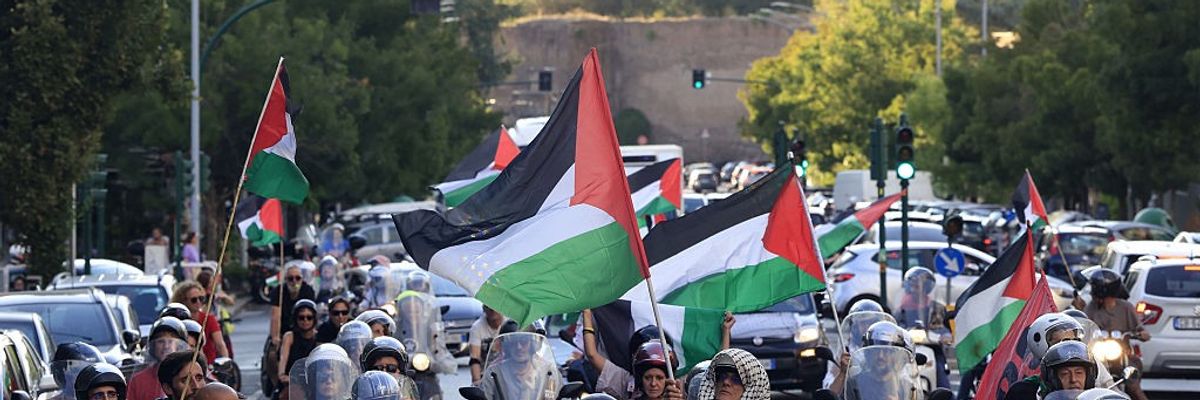
Demonstrators protest in support of Palestine in Rome, Italy, on July 30, 2025.
No other country, no other conflict, no other cause has permeated public spaces as profoundly as that of Palestine.
Demonstrators protest in support of Palestine in Rome, Italy, on July 30, 2025.
(Photo: Riccardo De Luca/Anadolu via Getty Images)
Ramzy Baroud
Aug 03, 2025
Ramzy Baroud
Aug 03, 2025
Common Dreams
I rarely visit Rome without stopping at the Campo de' Fiori to pay homage to Giordano Bruno, an Italian philosopher who, in 1600, was brutally burned at the stake by the Roman Inquisition. His crime was daring to challenge entrenched dogmas and to think freely about God and the infinite nature of the universe.
As I stood beneath his imposing statue, a strange ruckus suddenly erupted, growing louder as a sizable group of protesters drew closer. Dozens of people of all ages banged on pots and pans with fervent urgency.
Following the initial shock and subsequent confusion, it became clear that the protest was an urgent attempt to awaken people to the horrific famine unfolding in Gaza. In no time, more people spontaneously joined in, some clapping, having arrived unprepared with their own tools for protest. Waiters from the square's osterie instinctively began to bang their hands on anything that could generate sound, adding to the growing clamor.
The square stood momentarily still, pulsating with the collective noise before the protesters marched on to another square, their numbers visibly swelling with each step.
Palestinians, Arabs, and all supporters of justice worldwide must urgently seize this critical opportunity to decisively defeat the Israeli Hasbara for good.
In the bustling streets of Rome, Palestinian flags were conspicuously the only foreign flags to occupy public spaces. They hung from light poles, were glued onto street signs, or flew proudly atop balconies.
No other country, no other conflict, no other cause has permeated public spaces as profoundly as that of Palestine. Though this phenomenon is not entirely new, the ongoing Israeli war and genocide in Gaza has undeniably amplified this solidarity, pushing it fiercely beyond the traditional confines of class, ideology, and political lines.
Yet, no other space in Italy can truly be compared to Naples. Palestinian symbols are everywhere, permeating the city's fabric as if Palestine is the paramount political concern for the entire region's populace.
What was particularly fascinating about the solidarity with Palestinians in this vibrant city was not merely the sheer volume of graffiti, posters, and flags, but the very specific references made to Palestinian martyrs, prisoners, and movements.
Pictures of Walid Daqqa, Shireen Abu Akleh and Khader Adnan, alongside precise demands tailored to what would have been considered, outside of Palestine, largely unfamiliar specifics to a global audience, were prominently displayed.
How did Naples become so intricately attuned to the Palestinian discourse to this extent? This vital question resonates far beyond Italy, applying to numerous cities across the world. Notably, this major shift in the deeper understanding of the Palestinian struggle and the widespread embrace of the Palestinian people is unfolding despite the pervasive and unrelenting media bias in favor of Israel and the persistent intimidation by Western governments of pro-Palestinian activists.
In politics, critical mass is achieved when an idea, initially championed by a minority group, decisively transforms into a mainstream issue. This crucial shift allows it to overcome tokenism and begin to exert real and tangible influence in the public sphere.
In many societies around the world, the Palestinian cause has already attained that critical mass. In others, where government crackdowns still stifle the debate at its very roots, organic growth nevertheless continues, thus promising an inevitable and fundamental change as well.
And this is precisely the haunting fear of numerous Israelis, especially within their political and intellectual classes. Writing in the Israeli newspaper Haaretz on July 25, former Prime Minister Ehud Barak sounded the alarm once more. "The Zionist vision is collapsing," he wrote, adding that Israel is "stuck in a 'war of deception' in Gaza."
Though Israel's pervasive Hasbara machine is relentlessly striving to stave off the surging flood of sympathy with Palestine and the rising tide of rage against Israeli alleged war crimes, for now its focus remains intently fixed on complicating the extermination of Gaza, even at the high price of global condemnation and outrage.
When the war is finally over, however, Israel will undoubtedly exert its utmost efforts, employing numerous creative new ways to once more demonize the Palestinians and elevate itself—its so-called democracy and the "right to defend itself."
Due to the growing international credibility of the Palestinian voice, Israel is already resorting to using Palestinians who indirectly defend Israel by faulting Gaza and attempting to play the role of the victim for "both sides." This insidious tactic is poised to grow exponentially in the future, as it aims directly at creating profound confusion and turning Palestinians against each other.
Palestinians, Arabs, and all supporters of justice worldwide must urgently seize this critical opportunity to decisively defeat the Israeli Hasbara for good. They must not allow Israel's lies and deceit to once more define the discourse on Palestine on the global stage.
This war must be fiercely fought everywhere, and not a single space must be conceded—neither a parliament, a university, a sports event, or a street corner.
Giordano Bruno endured a most horrific and painful death, yet he never abandoned his profound beliefs. In the Palestine solidarity movement, we too must not waver from the struggle for Palestinian freedom and the accountability of war criminals, regardless of the time, energy, or resources required.
Now that Palestine has finally become the uncontested global cause, total unity is paramount to ensure the march toward freedom continues, so that the Gaza genocide becomes the final, agonizing chapter of the Palestinian tragedy.
I rarely visit Rome without stopping at the Campo de' Fiori to pay homage to Giordano Bruno, an Italian philosopher who, in 1600, was brutally burned at the stake by the Roman Inquisition. His crime was daring to challenge entrenched dogmas and to think freely about God and the infinite nature of the universe.
As I stood beneath his imposing statue, a strange ruckus suddenly erupted, growing louder as a sizable group of protesters drew closer. Dozens of people of all ages banged on pots and pans with fervent urgency.
Following the initial shock and subsequent confusion, it became clear that the protest was an urgent attempt to awaken people to the horrific famine unfolding in Gaza. In no time, more people spontaneously joined in, some clapping, having arrived unprepared with their own tools for protest. Waiters from the square's osterie instinctively began to bang their hands on anything that could generate sound, adding to the growing clamor.
The square stood momentarily still, pulsating with the collective noise before the protesters marched on to another square, their numbers visibly swelling with each step.
Palestinians, Arabs, and all supporters of justice worldwide must urgently seize this critical opportunity to decisively defeat the Israeli Hasbara for good.
In the bustling streets of Rome, Palestinian flags were conspicuously the only foreign flags to occupy public spaces. They hung from light poles, were glued onto street signs, or flew proudly atop balconies.
No other country, no other conflict, no other cause has permeated public spaces as profoundly as that of Palestine. Though this phenomenon is not entirely new, the ongoing Israeli war and genocide in Gaza has undeniably amplified this solidarity, pushing it fiercely beyond the traditional confines of class, ideology, and political lines.
Yet, no other space in Italy can truly be compared to Naples. Palestinian symbols are everywhere, permeating the city's fabric as if Palestine is the paramount political concern for the entire region's populace.
What was particularly fascinating about the solidarity with Palestinians in this vibrant city was not merely the sheer volume of graffiti, posters, and flags, but the very specific references made to Palestinian martyrs, prisoners, and movements.
Pictures of Walid Daqqa, Shireen Abu Akleh and Khader Adnan, alongside precise demands tailored to what would have been considered, outside of Palestine, largely unfamiliar specifics to a global audience, were prominently displayed.
How did Naples become so intricately attuned to the Palestinian discourse to this extent? This vital question resonates far beyond Italy, applying to numerous cities across the world. Notably, this major shift in the deeper understanding of the Palestinian struggle and the widespread embrace of the Palestinian people is unfolding despite the pervasive and unrelenting media bias in favor of Israel and the persistent intimidation by Western governments of pro-Palestinian activists.
In politics, critical mass is achieved when an idea, initially championed by a minority group, decisively transforms into a mainstream issue. This crucial shift allows it to overcome tokenism and begin to exert real and tangible influence in the public sphere.
In many societies around the world, the Palestinian cause has already attained that critical mass. In others, where government crackdowns still stifle the debate at its very roots, organic growth nevertheless continues, thus promising an inevitable and fundamental change as well.
And this is precisely the haunting fear of numerous Israelis, especially within their political and intellectual classes. Writing in the Israeli newspaper Haaretz on July 25, former Prime Minister Ehud Barak sounded the alarm once more. "The Zionist vision is collapsing," he wrote, adding that Israel is "stuck in a 'war of deception' in Gaza."
Though Israel's pervasive Hasbara machine is relentlessly striving to stave off the surging flood of sympathy with Palestine and the rising tide of rage against Israeli alleged war crimes, for now its focus remains intently fixed on complicating the extermination of Gaza, even at the high price of global condemnation and outrage.
When the war is finally over, however, Israel will undoubtedly exert its utmost efforts, employing numerous creative new ways to once more demonize the Palestinians and elevate itself—its so-called democracy and the "right to defend itself."
Due to the growing international credibility of the Palestinian voice, Israel is already resorting to using Palestinians who indirectly defend Israel by faulting Gaza and attempting to play the role of the victim for "both sides." This insidious tactic is poised to grow exponentially in the future, as it aims directly at creating profound confusion and turning Palestinians against each other.
Palestinians, Arabs, and all supporters of justice worldwide must urgently seize this critical opportunity to decisively defeat the Israeli Hasbara for good. They must not allow Israel's lies and deceit to once more define the discourse on Palestine on the global stage.
This war must be fiercely fought everywhere, and not a single space must be conceded—neither a parliament, a university, a sports event, or a street corner.
Giordano Bruno endured a most horrific and painful death, yet he never abandoned his profound beliefs. In the Palestine solidarity movement, we too must not waver from the struggle for Palestinian freedom and the accountability of war criminals, regardless of the time, energy, or resources required.
Now that Palestine has finally become the uncontested global cause, total unity is paramount to ensure the march toward freedom continues, so that the Gaza genocide becomes the final, agonizing chapter of the Palestinian tragedy.
"One has to be blind not to see that Israel has completely lost the majority of the world—including in the West."
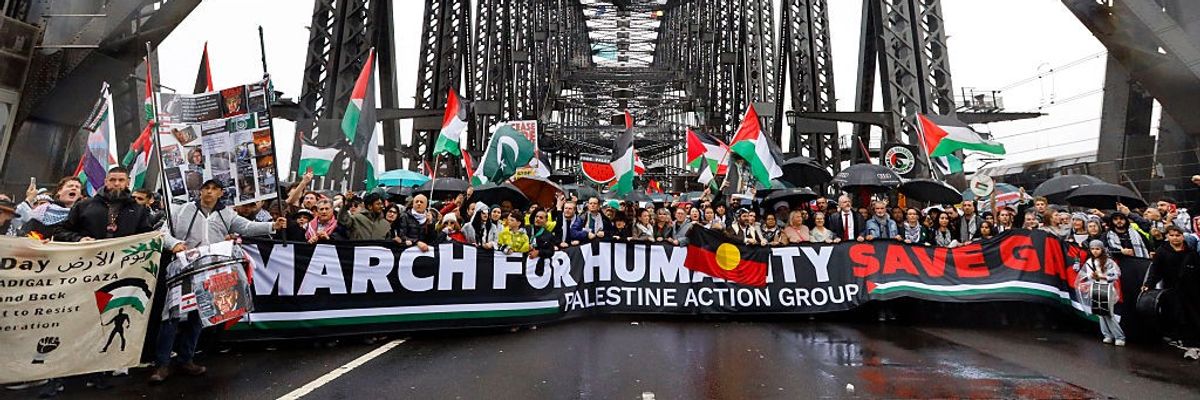
Protesters march across the Sydney Harbour Bridge during the rally. Thousands of protesters took part in the "March for Humanity Save Gaza," crossing the Sydney Harbour Bridge to call for an end to Israel's military assault on Gaza and demand immediate humanitarian aid access. The march was part of a broader movement across Australia condemning the bombardment, displacement, and civilian deaths in the besieged territory.
(Photo by Ye Myo Khant/SOPA Images/LightRocket via Getty Images)
Common Dreams Staff
Aug 03, 2025
Organizers estimated that 300,000 people marched across the Sydney Harbour Bridge in Australia's most populous city on Sunday in demonstration against the ongoing genocide being carried out by Israel and its international backers in Gaza.
Footage being shared widely online showed throngs of people unbowed by the rain crossing the iconic bridge in a flood of umbrellas and ponchos, many carrying signs that said, "Feed Gaza!"; "Let Aid In"; and "Stop Genocide!"
Solidarity actions for the people of Gaza—organized under the banner of "March for Humanity - Save Gaza"—were also held in Melbourne and other cities, but the crowds were largest in Sydney.
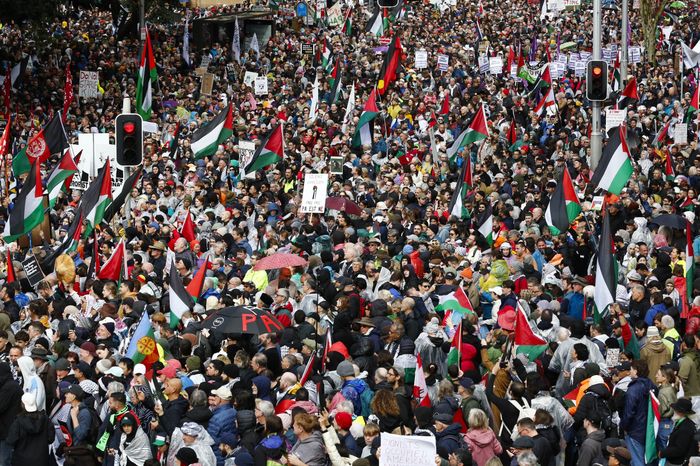
Protesters march ahead toward the Sydney Harbour Bridge during the rally. Hundreds of thousands of protesters took part in the "March for Humanity Save Gaza," crossing the Sydney Harbour Bridge to call for an end to Israel's military assault on Gaza and demand immediate humanitarian aid access. (Photo by Ye Myo Khant/SOPA Images/LightRocket via Getty Images)
"It's even bigger than my wildest dreams," Josh Lees, one of the the key organizers of the protest, told Guardian Australia while walking near the head of the march. "It's a mass march for humanity to stop a genocide, our politicians have to now listen to the will of the people and sanction Israel."
Observers said the scale of the demonstration shows that international support for Israel's attack on Gaza, even among countries that have long been allies, is fracturing in the face of the undeniable evidence that atrocities are taking place against the Palestinian people on a daily basis and in a coordinated manner.
"One has to be blind not to see that Israel has completely lost the majority of the world—including in the West," said Trita Parsi, executive vice president at the U.S.-based Quincy Institute, pointing to footage of the protest. "No level of intimidation, surveillance, or threats can force the majority of humanity to support and defend apartheid and genocide."
As the crowd approached a police line near the bridge, reported The Age newspaper, rally organizer Mohammad Sharab called on protesters to "prove to the world that this is not a movement that will clash with police" and asked people to stay back from the police or sit down peacefully in protest.
"They are holding their guns, their weapons, against people who are protesting peacefully," he said of the officers. "Shame on Victoria Police, shame."
Sharab said the protests were about peace and humanity and he criticized the media personalities and Australian politicians for characterizing as "extremists" those calling for a cease-fire and an end to the policy of starvation in Gaza.
"We stand for justice," said Sharab. "We are not ashamed of it. For those who call us extremist and antisemitic for standing against genocide, these extreme comments make you the extremist. That's my message to [Premier] Jacinta Allan."
"It's even bigger than my wildest dreams," Josh Lees, one of the the key organizers of the protest, told Guardian Australia while walking near the head of the march. "It's a mass march for humanity to stop a genocide, our politicians have to now listen to the will of the people and sanction Israel."
Observers said the scale of the demonstration shows that international support for Israel's attack on Gaza, even among countries that have long been allies, is fracturing in the face of the undeniable evidence that atrocities are taking place against the Palestinian people on a daily basis and in a coordinated manner.
"One has to be blind not to see that Israel has completely lost the majority of the world—including in the West," said Trita Parsi, executive vice president at the U.S.-based Quincy Institute, pointing to footage of the protest. "No level of intimidation, surveillance, or threats can force the majority of humanity to support and defend apartheid and genocide."
As the crowd approached a police line near the bridge, reported The Age newspaper, rally organizer Mohammad Sharab called on protesters to "prove to the world that this is not a movement that will clash with police" and asked people to stay back from the police or sit down peacefully in protest.
"They are holding their guns, their weapons, against people who are protesting peacefully," he said of the officers. "Shame on Victoria Police, shame."
Sharab said the protests were about peace and humanity and he criticized the media personalities and Australian politicians for characterizing as "extremists" those calling for a cease-fire and an end to the policy of starvation in Gaza.
"We stand for justice," said Sharab. "We are not ashamed of it. For those who call us extremist and antisemitic for standing against genocide, these extreme comments make you the extremist. That's my message to [Premier] Jacinta Allan."

No comments:
Post a Comment