Over 80 percent of Americans are already concerned about the price of groceries and many are struggling to stay afloat.
By Jake Johnson ,
August 1, 2025

A container ship is seen at the Port of Los Angeles, in Los Angeles, California, on July 31, 2025.ROBYN BECK / AFP via Getty Images
U.S. President Donald Trump on Thursday used emergency authority to impose high tariff rates on imports from dozens of American trading partners, including Canada — a move that economists criticized as a senseless approach to global trade that will further increase costs for consumers who are already struggling to get by.
Trump outlined the new tariff rates in executive orders signed just ahead of his arbitrary August 1 deadline for U.S. trading partners to negotiate a deal with the White House, whose erratic, aggressive, and legally dubious approach has alarmed world leaders.
Under the president’s new orders, Canadian goods that are not covered by the U.S.-Mexico-Canada Agreement (USMCA) will face 35% import duties, while steel and aluminum imports will face a 50% tariff rate.
Trump claimed Canada “has failed to cooperate in curbing the ongoing flood of fentanyl and other illicit drugs.” But Canadian Prime Minister Mark Carney hit back in a statement early Friday, noting that Canada “accounts for only 1% of U.S. fentanyl imports and has been working intensively to further reduce these volumes.”
“While we will continue to negotiate with the United States on our trading relationship, the Canadian government is laser-focused on what we can control: building Canada strong,” Carney added. “Canadians will be our own best customer, creating more well-paying careers at home, as we strengthen and diversify our trading partnerships throughout the world.”
Related Story
U.S. President Donald Trump on Thursday used emergency authority to impose high tariff rates on imports from dozens of American trading partners, including Canada — a move that economists criticized as a senseless approach to global trade that will further increase costs for consumers who are already struggling to get by.
Trump outlined the new tariff rates in executive orders signed just ahead of his arbitrary August 1 deadline for U.S. trading partners to negotiate a deal with the White House, whose erratic, aggressive, and legally dubious approach has alarmed world leaders.
Under the president’s new orders, Canadian goods that are not covered by the U.S.-Mexico-Canada Agreement (USMCA) will face 35% import duties, while steel and aluminum imports will face a 50% tariff rate.
Trump claimed Canada “has failed to cooperate in curbing the ongoing flood of fentanyl and other illicit drugs.” But Canadian Prime Minister Mark Carney hit back in a statement early Friday, noting that Canada “accounts for only 1% of U.S. fentanyl imports and has been working intensively to further reduce these volumes.”
“While we will continue to negotiate with the United States on our trading relationship, the Canadian government is laser-focused on what we can control: building Canada strong,” Carney added. “Canadians will be our own best customer, creating more well-paying careers at home, as we strengthen and diversify our trading partnerships throughout the world.”
Related Story

Experts See Echoes of the 1930s Amid Trump’s Tariff Tantrums
If a US-European tariff war really does kick off in earnest, the consequences could be hugely damaging. By Sasha Abramsky , Truthout July 24, 2025
Economist Brad Setser said that while the impact of the higher tariff on Canadian imports could be muted because of the exemption of USMCA-covered products such as oil, the 35% rate is still “insane” and “dumb.”
“Same with the high tariff on Switzerland. Crazy,” Setser wrote, pointing to the 39% rate for Switzerland imports. “This isn’t just protectionism, it is bad protectionism — and will have all sorts of unintended consequences.”
The new tariff rates for Canadian goods will take effect Friday while the higher rates for other nations such as Brazil (50%), India (25%), and Vietnam (20%) won’t kick in until next week “to give Customs and Border Protection officials time to prepare,” The Washington Post reported. Customs and Border Protection collects tariffs, which are effectively taxes paid by importers — who often pass those costs onto consumers in the form of higher prices.
“Trump’s definition of ‘winning’ is hitting the American people with ever-higher taxes,” Dean Baker, senior economist at the Center for Economic and Policy Research, wrote late Thursday.
Recent U.S. economic data indicates that Trump’s tariffs are already putting upward pressure on prices — and companies are using the president’s trade chaos as an excuse to drive up prices further and pad their bottom lines.
The Tax Foundation noted earlier this week that “a variety of food imports” will be impacted by Trump’s tariffs, likely leading to “higher food prices for consumers.” More than 80% of Americans are already concerned about the price of groceries and many are struggling to stay afloat, according to survey data released Thursday by The Century Foundation.
Baker warned Thursday that even nations that have agreed to trade frameworks with the U.S. are not out of the woods.
“Deals are meaningless to Trump. He’ll break them in a second any time he feels like it,” Baker wrote. “I trust everyone negotiating with Trump understands that fact.”
Most Americans say Trump responsible for rising prices and high cost of living: report
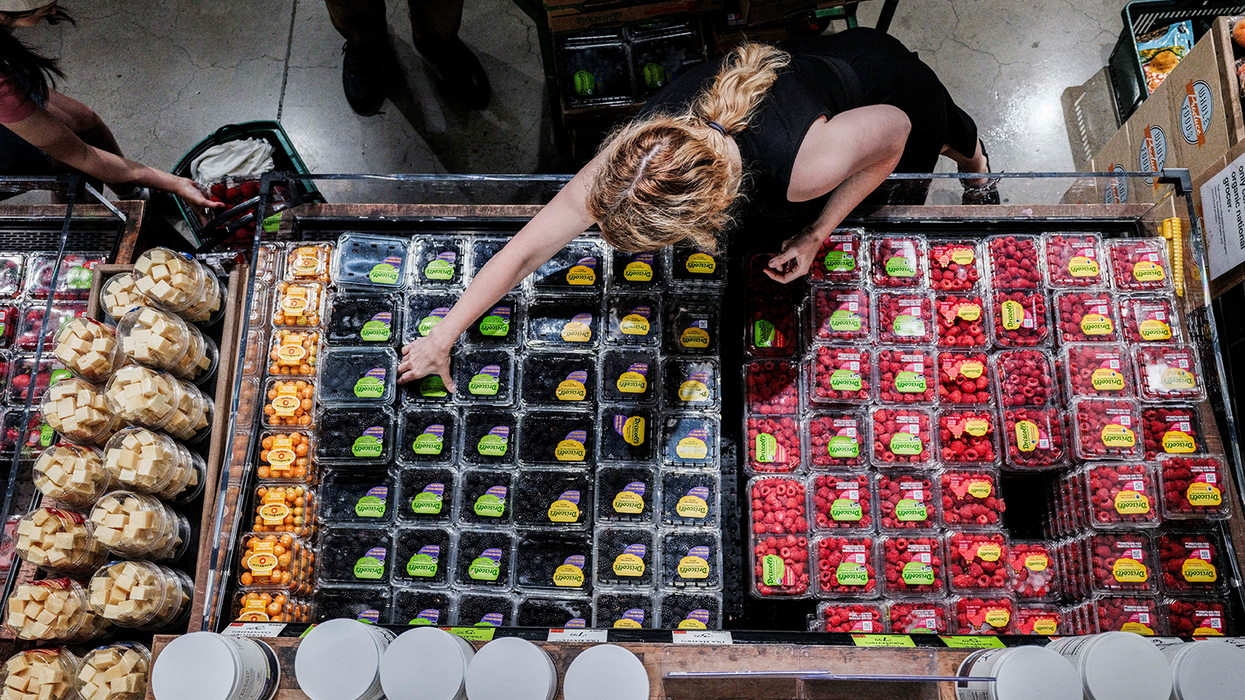
FILE PHOTO: People shop for groceries at a store in New York City, U.S., July 15, 2025. REUTERS/Jeenah Moon/File Photo
Analysis Shows Big Corporations Are Using Trump Trade Chaos as 'Cover' to Jack Up Prices
"While Trump's tariffs continue to cause economic upheaval, corporations are exploiting the chaos and working families are left to foot the bill," said one analyst.
Brad Reed
Jul 29, 2025
COMMON DREAMS
The effects of U.S. President Donald Trump's tariffs are winding their way through the American economy, and a new piece of analysis claims that corporate America is using them as "cover" to further jack up prices.
Progressive advocacy group Groundwork Collaborative issued a new report on Tuesday that uses corporate executives' own words to show how many firms are taking advantage of the tariff situation by using it as an all-purpose justification for price increases. The report found many of these executives' admissions through quarterly earnings calls in which they discussed plans to increase costs even if their inputs were not being significantly affected by the tariffs.
Among others, the report cited a statement made earlier this year by Aaron Jagdfeld, the CEO of power generation products manufacturer Generac Power Systems, who said on an earnings call that "even if we have metals that weren't impacted directly by tariffs, the indirect effect of tariffs is that it gives steel producers and the mills and other fabricators... great cover for increased pricing in some cases."
Another executive quoted in the report was Matthew Stevenson, the CEO of auto parts manufacturer Holley, who said that "in the marketplace we have seen price increases well in excess of what we put out into the market" and added that "we've seen increases as high as 30% or more on some categories from some competitors."
Thomas Robertson, the CFO of footwear company Rocky Brands, flat-out said during an earnings call that his company planned to raise prices even as Trump had backed off his most strident trade-war threats with China.
"We certainly welcome a reduction in the Chinese tariffs, but we'll be announcing a price increase here regardless of any changes of the Chinese tariffs over the next week or two to go into effect in June," he said.
While the report names and shames corporations for price increases, Groundwork Collaborative executive director Lindsay Owens did not absolve Trump of responsibility for the situation.
"President Trump's turbulent trade policy has created a perfect storm of market chaos, giving corporations a golden opportunity to jack up prices, pad profit margins, and fleece Americans simply because they can," said Owens. "While Trump's tariffs continue to cause economic upheaval, corporations are exploiting the chaos and working families are left to foot the bill."
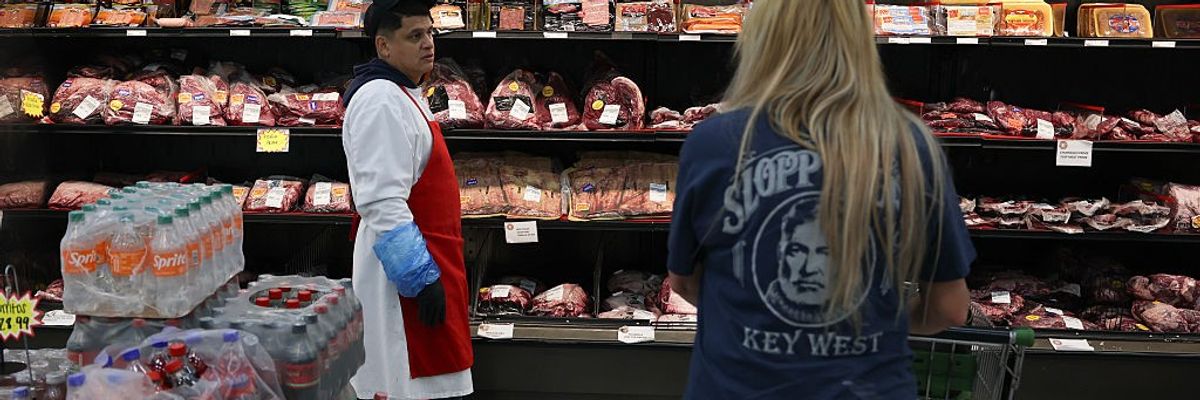
Marlo Ramirez helps Lisa Lungaro shop in the meat aisle in a grocery store on July 22, 2025 in Miami, Florida.
(Photo: Joe Raedle/Getty Images)
Amid intensifying tariffs, just 30% of Americans say they can afford the cost of living, according to a poll from Data for Progress.

U.S. President Donald Trump walks with Federal Reserve Chair Jerome Powell (R) and US Sen. Tim Scott (L), Republican of South Carolina, as he visits the Federal Reserve in Washington, D.C., on July 24, 2025.
(Photo: Andrew Caballero-Reynolds/AFP/Getty Images)
FILE PHOTO: People shop for groceries at a store in New York City, U.S., July 15, 2025. REUTERS/Jeenah Moon/File Photo
THE NEW CIVIL RIGHTS MOVEMENT
August 01, 2025 |
With inflation and unemployment rising, a majority of Americans say President Donald Trump is to blame for increased prices and the high cost of living, as many turn to credit cards and other high-interest vehicles to pay for their purchases, a new poll finds. Some are skipping meals just to make ends meet, some spend time daily worrying about how they are going to pay their bills, and many are forced to turn to friends and family for financial support.
“American families are struggling financially, and 6 in 10 place blame on Donald Trump for driving up their cost of living,” reported progressive think tank The Century Foundation, with data from a Morning Consult poll that it sponsored. “More than half believe that billionaires, corporations, and congressional Republicans have made their lives harder,” while the “majority of voters feel the Trump administration’s actions are making their problems and anxieties worse—not better.”
Overall, a staggering four out of five Americans (83%) are concerned about the cost of groceries, including 46% who say they are “very concerned.”
Almost half (47%) worry about being able to pay their rent or mortgage, almost one in four say it would be difficult to pay for an unexpected home or medical emergency—and many would have trouble paying even a $500 expense.
“This financial insecurity is widespread across demographic and income groups—although it is more pronounced among groups such as younger Americans, Americans of color, women, and lower-income Americans,” the report stated.
For many Americans, anxiety about money is a daily experience, and a large majority worry that things are going to get worse.
“A shocking 1 in 4 Americans (24 percent) say they spend at least three hours on a typical day worrying about their finances and ability to afford basic necessities. More than 4 in 10 spend at least one hour per day,” according to the report. “While low- and middle-income Americans express the strongest financial concerns, one-third of those with incomes above $100,000 also spend at least an hour concerned about their finances on a typical day.”
President Donald Trump’s tariffs are a major concern for many Americans as well.
49% believe Trump’s tariffs will make the cost of goods made overseas more expensive, and nearly seven in ten say they believe Trump’s tariffs will increase prices.
The Century Foundation published video detailing its findings.
Watch the video below or at this link.
With inflation and unemployment rising, a majority of Americans say President Donald Trump is to blame for increased prices and the high cost of living, as many turn to credit cards and other high-interest vehicles to pay for their purchases, a new poll finds. Some are skipping meals just to make ends meet, some spend time daily worrying about how they are going to pay their bills, and many are forced to turn to friends and family for financial support.
“American families are struggling financially, and 6 in 10 place blame on Donald Trump for driving up their cost of living,” reported progressive think tank The Century Foundation, with data from a Morning Consult poll that it sponsored. “More than half believe that billionaires, corporations, and congressional Republicans have made their lives harder,” while the “majority of voters feel the Trump administration’s actions are making their problems and anxieties worse—not better.”
Overall, a staggering four out of five Americans (83%) are concerned about the cost of groceries, including 46% who say they are “very concerned.”
Almost half (47%) worry about being able to pay their rent or mortgage, almost one in four say it would be difficult to pay for an unexpected home or medical emergency—and many would have trouble paying even a $500 expense.
“This financial insecurity is widespread across demographic and income groups—although it is more pronounced among groups such as younger Americans, Americans of color, women, and lower-income Americans,” the report stated.
For many Americans, anxiety about money is a daily experience, and a large majority worry that things are going to get worse.
“A shocking 1 in 4 Americans (24 percent) say they spend at least three hours on a typical day worrying about their finances and ability to afford basic necessities. More than 4 in 10 spend at least one hour per day,” according to the report. “While low- and middle-income Americans express the strongest financial concerns, one-third of those with incomes above $100,000 also spend at least an hour concerned about their finances on a typical day.”
President Donald Trump’s tariffs are a major concern for many Americans as well.
49% believe Trump’s tariffs will make the cost of goods made overseas more expensive, and nearly seven in ten say they believe Trump’s tariffs will increase prices.
The Century Foundation published video detailing its findings.
Watch the video below or at this link.

"While Trump's tariffs continue to cause economic upheaval, corporations are exploiting the chaos and working families are left to foot the bill," said one analyst.
Brad Reed
Jul 29, 2025
COMMON DREAMS
The effects of U.S. President Donald Trump's tariffs are winding their way through the American economy, and a new piece of analysis claims that corporate America is using them as "cover" to further jack up prices.
Progressive advocacy group Groundwork Collaborative issued a new report on Tuesday that uses corporate executives' own words to show how many firms are taking advantage of the tariff situation by using it as an all-purpose justification for price increases. The report found many of these executives' admissions through quarterly earnings calls in which they discussed plans to increase costs even if their inputs were not being significantly affected by the tariffs.
Among others, the report cited a statement made earlier this year by Aaron Jagdfeld, the CEO of power generation products manufacturer Generac Power Systems, who said on an earnings call that "even if we have metals that weren't impacted directly by tariffs, the indirect effect of tariffs is that it gives steel producers and the mills and other fabricators... great cover for increased pricing in some cases."
Another executive quoted in the report was Matthew Stevenson, the CEO of auto parts manufacturer Holley, who said that "in the marketplace we have seen price increases well in excess of what we put out into the market" and added that "we've seen increases as high as 30% or more on some categories from some competitors."
Thomas Robertson, the CFO of footwear company Rocky Brands, flat-out said during an earnings call that his company planned to raise prices even as Trump had backed off his most strident trade-war threats with China.
"We certainly welcome a reduction in the Chinese tariffs, but we'll be announcing a price increase here regardless of any changes of the Chinese tariffs over the next week or two to go into effect in June," he said.
While the report names and shames corporations for price increases, Groundwork Collaborative executive director Lindsay Owens did not absolve Trump of responsibility for the situation.
"President Trump's turbulent trade policy has created a perfect storm of market chaos, giving corporations a golden opportunity to jack up prices, pad profit margins, and fleece Americans simply because they can," said Owens. "While Trump's tariffs continue to cause economic upheaval, corporations are exploiting the chaos and working families are left to foot the bill."
Marlo Ramirez helps Lisa Lungaro shop in the meat aisle in a grocery store on July 22, 2025 in Miami, Florida.
(Photo: Joe Raedle/Getty Images)
The Groundwork Collaborative report was released on the same day that consumer goods giant Procter & Gamble announced that it would be raising prices on roughly one-quarter of its products due to Trump's tariffs. As reported by CNBC, the company said during its quarterly earnings call that it expects "mid-single-digit price increases" on a wide range of products over the next quarter to help offset what it projects to be a $1 billion hit from the tariffs levied against major trading partners such as Canada and China.
A report by the Tax Foundation on Monday estimated that the Trump tariffs would affect 75% of all food imported from other countries, which would add even more burden to American consumers. What's particularly troubling about the food tariffs, the Tax Foundation explained, is that they will fall on products such as bananas and coffee that are simply not capable of being grown on a mass scale in the United States.
"In 2024, the U.S. imported about $221 billion in food products, 74% of which ($163 billion) faced the Trump tariffs," wrote the Tax Foundation. "While these imports currently face tariff rates ranging from 10% to 30%, they will exceed 30% for some countries if the reciprocal tariffs go into effect on August 1. The top five exporters of food products to the U.S., in order, are Mexico, Canada, the E.U., Brazil, and China, accounting for 62% of total U.S. food imports."
A report by the Tax Foundation on Monday estimated that the Trump tariffs would affect 75% of all food imported from other countries, which would add even more burden to American consumers. What's particularly troubling about the food tariffs, the Tax Foundation explained, is that they will fall on products such as bananas and coffee that are simply not capable of being grown on a mass scale in the United States.
"In 2024, the U.S. imported about $221 billion in food products, 74% of which ($163 billion) faced the Trump tariffs," wrote the Tax Foundation. "While these imports currently face tariff rates ranging from 10% to 30%, they will exceed 30% for some countries if the reciprocal tariffs go into effect on August 1. The top five exporters of food products to the U.S., in order, are Mexico, Canada, the E.U., Brazil, and China, accounting for 62% of total U.S. food imports."
As White House Touts 'Economic Boom,' Americans Say They're Barely Scraping By
Amid intensifying tariffs, just 30% of Americans say they can afford the cost of living, according to a poll from Data for Progress.
U.S. President Donald Trump walks with Federal Reserve Chair Jerome Powell (R) and US Sen. Tim Scott (L), Republican of South Carolina, as he visits the Federal Reserve in Washington, D.C., on July 24, 2025.
(Photo: Andrew Caballero-Reynolds/AFP/Getty Images)
Stephen Prager
Jul 25, 2025
COMMON DREAMS
The White House says the U.S. is in the midst of an "economic boom" under President Donald Trump. But voters aren't feeling it in their wallets.
Polling released by Gallup Thursday found the president's approval rating at just 37%, the lowest point of his second term so far, with an all-time low approval rating of 29% among independents.
This precipitous decline has been helped along by sagging approval on the economy, which has historically been the issue where he gets the most support. After a high of 42% in February, approval for his handling of the economy is likewise down to just 37%.
An uptick in inflation seen over the past month has exacerbated the cost of living crisis Trump promised to abate on the campaign trail.
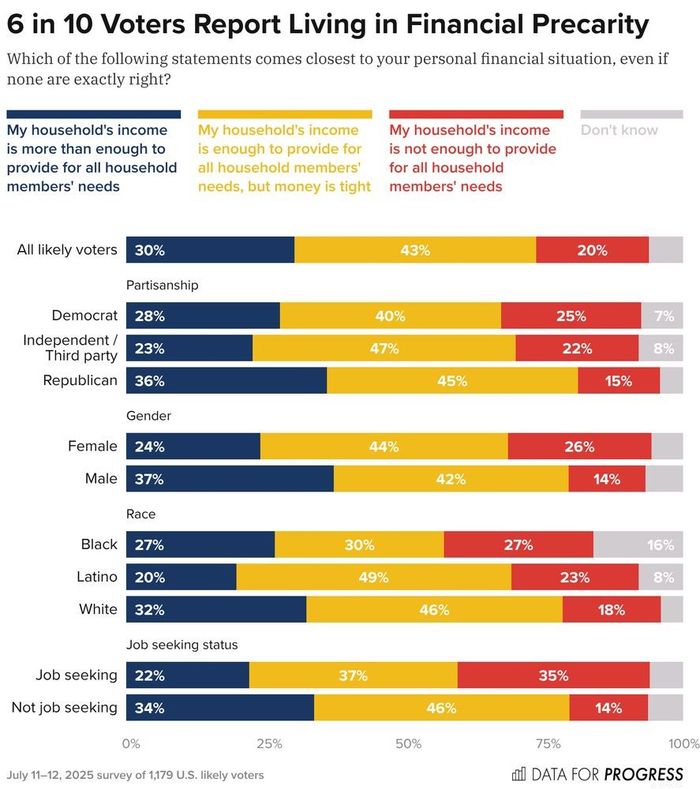
A poll released Friday by Data for Progress found that, "Only 30% of likely voters report having enough income to be able to comfortably provide for their household's needs, while a plurality of voters (43%) say they have enough income but money is tight, and 20% say they do not make enough to provide for all household members' needs."
Jul 25, 2025
COMMON DREAMS
The White House says the U.S. is in the midst of an "economic boom" under President Donald Trump. But voters aren't feeling it in their wallets.
Polling released by Gallup Thursday found the president's approval rating at just 37%, the lowest point of his second term so far, with an all-time low approval rating of 29% among independents.
This precipitous decline has been helped along by sagging approval on the economy, which has historically been the issue where he gets the most support. After a high of 42% in February, approval for his handling of the economy is likewise down to just 37%.
An uptick in inflation seen over the past month has exacerbated the cost of living crisis Trump promised to abate on the campaign trail.
A poll released Friday by Data for Progress found that, "Only 30% of likely voters report having enough income to be able to comfortably provide for their household's needs, while a plurality of voters (43%) say they have enough income but money is tight, and 20% say they do not make enough to provide for all household members' needs."
(Graphic: Data for Progress)
"As his approval tanks, President Trump has finally lost voters on the one issue where they've historically trusted him: the economy," said Lindsay Owens, the executive director of the Groundwork Collaborative. "Not only has Trump shirked his promise to lower prices, he's made the situation substantially worse as his tax and tariff policies have landed a double blow to household budgets."
According to data from Indeed, cited by Forbes, 43% of Americans have seen their wages lagging behind the cost of living over the past year. The jobs feeling the worst crunch are those "at the low-to-middle end of the pay spectrum."
Trump has imposed the highest tariffs on imported goods since the Great Depression. After months of relative quiet, they began to make their impact felt this past month, with consumer prices up 2.7% from the previous year, compared with just 2.4% in May.
While rising rent costs were the top driver of inflation in June, prices for clothing, toys, and consumer appliances all rose, as did food and energy.
The president was elected on promises to tackle the cost of living. But now 70% say that he is not focused enough on lowering prices, according to polling released Sunday by CBS News. Meanwhile, 61% say Trump is focusing too much on his tariff policy, which remains broadly unpopular.
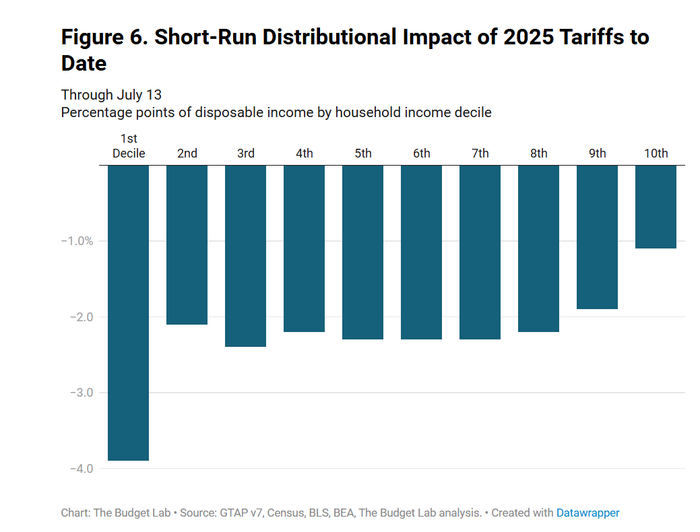
Yale's Budget Lab estimates that it would cost the average household $2,770 worth of disposable income per year if tariffs stayed at their current rate indefinitely, with the worst impact—especially in the short term—on the poorest Americans.
"As his approval tanks, President Trump has finally lost voters on the one issue where they've historically trusted him: the economy," said Lindsay Owens, the executive director of the Groundwork Collaborative. "Not only has Trump shirked his promise to lower prices, he's made the situation substantially worse as his tax and tariff policies have landed a double blow to household budgets."
According to data from Indeed, cited by Forbes, 43% of Americans have seen their wages lagging behind the cost of living over the past year. The jobs feeling the worst crunch are those "at the low-to-middle end of the pay spectrum."
Trump has imposed the highest tariffs on imported goods since the Great Depression. After months of relative quiet, they began to make their impact felt this past month, with consumer prices up 2.7% from the previous year, compared with just 2.4% in May.
While rising rent costs were the top driver of inflation in June, prices for clothing, toys, and consumer appliances all rose, as did food and energy.
The president was elected on promises to tackle the cost of living. But now 70% say that he is not focused enough on lowering prices, according to polling released Sunday by CBS News. Meanwhile, 61% say Trump is focusing too much on his tariff policy, which remains broadly unpopular.
Yale's Budget Lab estimates that it would cost the average household $2,770 worth of disposable income per year if tariffs stayed at their current rate indefinitely, with the worst impact—especially in the short term—on the poorest Americans.
(Graphic: Yale Budget Lab)
But they are set to grow more intense beginning on August 1, when Trump has said he'll roll out new levies on imports from some of America's top trading partners, including Canada, the European Union, Mexico, Brazil, and South Korea.
According to economists who spoke with Vox, the worst effects are likely yet to come. Preston Caldwell, chief U.S. economist for Morningstar, said inflation would likely peak in 2026 rather than 2025.
"Companies have started paying tariffs on their imported goods, but as far as the goods that are being sold in stores right now, those are primarily being drawn from the inventory of goods that were brought in before the tariffs," Caldwell said. "So most companies are still not really having to recognize the loss of tariffs yet to a great degree."
"The more that it becomes clear that tariffs are here for at least the foreseeable future," he continued, "the more that they are going to have to eventually adjust to this new reality, which will entail increasing their prices."
Owens said that will likely translate to even fiercer backlash against Trump.
"Working families," she said, "know exactly who to blame as they pay higher prices on everything from groceries and electricity bills to school supplies and appliances."
But they are set to grow more intense beginning on August 1, when Trump has said he'll roll out new levies on imports from some of America's top trading partners, including Canada, the European Union, Mexico, Brazil, and South Korea.
According to economists who spoke with Vox, the worst effects are likely yet to come. Preston Caldwell, chief U.S. economist for Morningstar, said inflation would likely peak in 2026 rather than 2025.
"Companies have started paying tariffs on their imported goods, but as far as the goods that are being sold in stores right now, those are primarily being drawn from the inventory of goods that were brought in before the tariffs," Caldwell said. "So most companies are still not really having to recognize the loss of tariffs yet to a great degree."
"The more that it becomes clear that tariffs are here for at least the foreseeable future," he continued, "the more that they are going to have to eventually adjust to this new reality, which will entail increasing their prices."
Owens said that will likely translate to even fiercer backlash against Trump.
"Working families," she said, "know exactly who to blame as they pay higher prices on everything from groceries and electricity bills to school supplies and appliances."

No comments:
Post a Comment