Analysis
A spate of recent incidents involving Russian-linked ships has put the spotlight on the sea as an increasingly important element in Moscow's hybrid warfare strategy targeting Europe.
Issued on: 03/10/2025 -
FRANCE24
By: Sébastian SEIBT
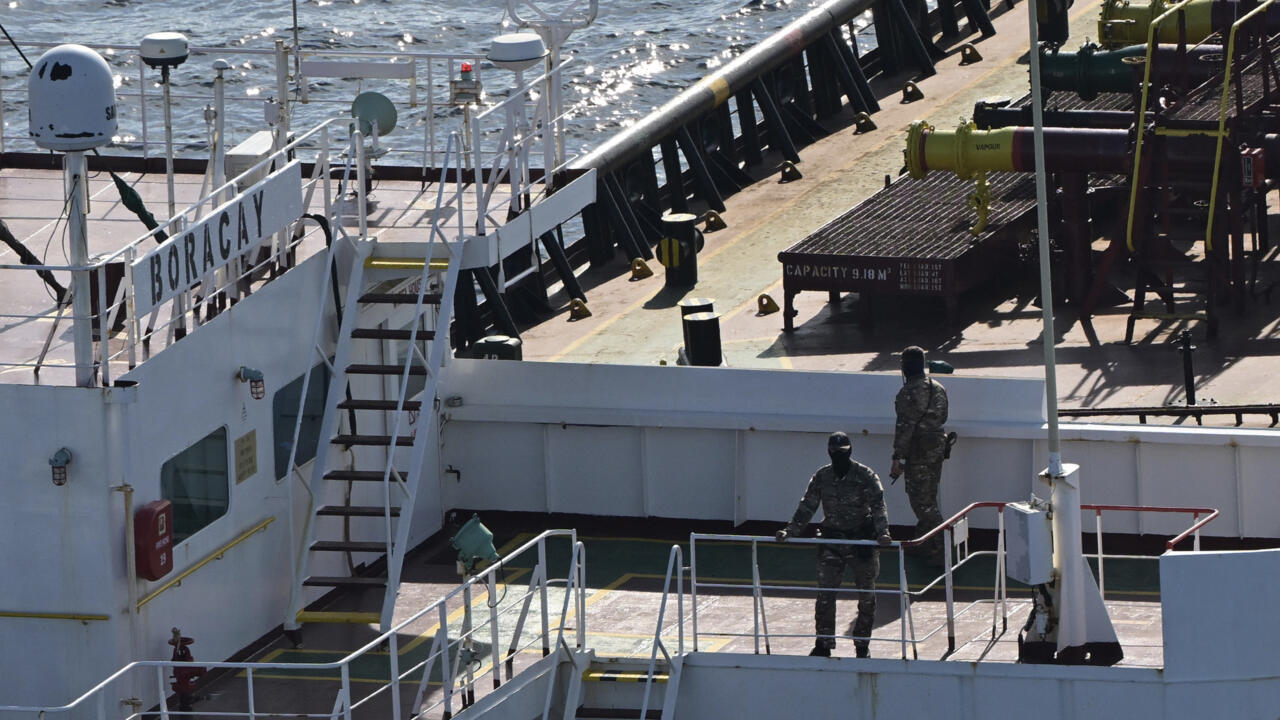
French soldiers on board a tanker linked to Russia's shadow fleet off the western French city of Saint-Nazaire on October 1, 2025. © Damien Meyer, AFP
There are increasing signs that a hybrid warfare escalation off the coasts of Europe is coming.
A ship thought to be part of Russia's "shadow fleet”, the Boracay, was boarded by the French navy off Saint-Nazaire on France’s Atlantic coast on Saturday, amid suspicions that the oil tanker could have been used as a launch pad for drone incursions into Danish and Norwegian airspace.
Watch moreFrench navy boards Russia 'shadow fleet' ship, detains two
The vessel resumed its journey and was heading towards the Suez Canal Friday with its captain back on board, according to data from maritime websites and a source close to the case.
The Boracay, flying the Beninese flag and also known as Pushpa, is not the only ship that has aroused European suspicions.
Two other cargo ships spotted sailing in the vicinity of Copenhagen airport last week are also on the list of vessels suspected of serving as platforms for Russian hybrid warfare operations, including the drone overflights of Danish airports.
The presence of a Russian submarine off the coast of Gibraltar last weekend added to European nervousness about this Russian “threat”.
Since the 2022 Russian full-scale invasion of Ukraine, Moscow has often been suspected of sabotaging undersea internet cables, whether in the Baltic Sea or off the UK coast.
Read moreDenmark drone incursions: All signs point to Russia?
Moscow seems to have decided ships are now an integral part of its hybrid capabilities, “and we're only at the beginning of this, I think." said Mark Lacy, a specialist in new warfare trends and international politics at Lancaster University in the UK.
Multi-purpose tool
A ship can be a multi-purpose tool in the conduct of hybrid warfare.
It can pursue “practical objectives” like “mapping undersea infrastructure” which could be targeted by future sabotage operations, notes Basil Germond, a specialist in maritime security issues at Lancaster University.
“About 97 percent of our internet communication transits via undersea cables, which are increasingly targeted by hostile actors,” Germond noted.
Ships, even civilian vessels such as cargo ships or oil tankers, can be equipped with military sensors and crewed by “military personnel disguised as civilians” but capable of conducting intelligence operations, says Erik Stijnman, a security expert at the Netherlands Institute of International Relations Clingendael.
There are increasing signs that a hybrid warfare escalation off the coasts of Europe is coming.
A ship thought to be part of Russia's "shadow fleet”, the Boracay, was boarded by the French navy off Saint-Nazaire on France’s Atlantic coast on Saturday, amid suspicions that the oil tanker could have been used as a launch pad for drone incursions into Danish and Norwegian airspace.
Watch moreFrench navy boards Russia 'shadow fleet' ship, detains two
The vessel resumed its journey and was heading towards the Suez Canal Friday with its captain back on board, according to data from maritime websites and a source close to the case.
The Boracay, flying the Beninese flag and also known as Pushpa, is not the only ship that has aroused European suspicions.
Two other cargo ships spotted sailing in the vicinity of Copenhagen airport last week are also on the list of vessels suspected of serving as platforms for Russian hybrid warfare operations, including the drone overflights of Danish airports.
The presence of a Russian submarine off the coast of Gibraltar last weekend added to European nervousness about this Russian “threat”.
Since the 2022 Russian full-scale invasion of Ukraine, Moscow has often been suspected of sabotaging undersea internet cables, whether in the Baltic Sea or off the UK coast.
Read moreDenmark drone incursions: All signs point to Russia?
Moscow seems to have decided ships are now an integral part of its hybrid capabilities, “and we're only at the beginning of this, I think." said Mark Lacy, a specialist in new warfare trends and international politics at Lancaster University in the UK.
Multi-purpose tool
A ship can be a multi-purpose tool in the conduct of hybrid warfare.
It can pursue “practical objectives” like “mapping undersea infrastructure” which could be targeted by future sabotage operations, notes Basil Germond, a specialist in maritime security issues at Lancaster University.
“About 97 percent of our internet communication transits via undersea cables, which are increasingly targeted by hostile actors,” Germond noted.
Ships, even civilian vessels such as cargo ships or oil tankers, can be equipped with military sensors and crewed by “military personnel disguised as civilians” but capable of conducting intelligence operations, says Erik Stijnman, a security expert at the Netherlands Institute of International Relations Clingendael.
"Ready for the age of drones? Europeans scramble for solutions to hybrid threats • FRANCE 24"

© FRANCE 24
44:49
44:49
“Depending on the capabilities your ships have, they can listen in on military communications,” gather information on “weapons supply lines” or on a country's defence readiness, says Christian Kaunert, an international security expert at the University of South Wales.
A belligerent act carried out at sea is also a highly political statement of intent. “It shows a country's willingness to operate at the boundary between peace and war – in the maritime ‘grey zone’,” said Germond.
“These incursions are part of Russia’s overall strategy to disrupt the ‘normal’ state of affairs in the UK and Western societies, to create uncertainties, spread fears” and “test the resolve and boundaries” of NATO countries, Germond adds.
From economic sanctions-busting to military 'hard power' projection
The recent campaign of drone incursions into the airspace of several countries has highlighted European weak points, notes Kaunert.
In Germany, drone incursions led to confusion about which authority was responsible for managing the threat and who had the right to shoot them down. “If you don't even have a policy on who can shoot down the drones, you are very obviously the weak point,” said Kaunert.
The maritime environment is particularly prone to hybrid warfare because “jurisdictions overlap and because it is difficult to control and monitor vast expanses of water”, explained Germond.
There's a big “attribution problem” – pinpointing who is responsible for malign acts at sea. A ship may belong to a company based in one country, fly the flag of another, and officially transport only commercial goods. Under these conditions, it is “really difficult” to attribute an action “to a specific state actor”, says Stijnman, who has written about the Russian hybrid threat.
In the arsenal of hybrid warfare tools — influence operations, cyberattacks, sabotage — ships “are an important and growing part of the grey zone tactics", said Lacy. The vast increase in global trade since the end of the Cold War makes the seas “a particularly attractive environment for those who want to cause major disruption”.
Moscow is also repurposing its “shadow fleet”, using ageing ships of uncertain ownership to export Russian oil and circumvent Western sanctions. While the ships initially had an economic rationale, the focus now seems to be on “hard power, on the military aspects” by using the fleet to put pressure on Europe, says Kaunert. "It is all linked to the idea of undermining the confidence of European allies who support Ukraine" he noted.
Read moreEU agrees 'unprecedented' round of sanctions targeting Russia's oil exports
The increasingly important role played by drones in the Ukrainian conflict has also given Moscow ideas. The Russians have significantly increased their production of drones and can afford to use some of them in hybrid warfare operations — and ships make very good launch pads, analysts say.
A difficult threat to counter
Countering this floating threat is no easy task. The tanker Boracay was boarded last week by the French navy even though the ship remained just outside France's exclusive economic zone. After an initial detention, the tanker’s Chinese captain was released on Thursday and the ship resumed its journey.
But the boarding of the tanker “sets a precedent,” noted Stijnman. The operation may seem legitimate in the context of combating Russian hybrid threats, but what if other countries, perhaps less scrupulous about legalities, use this example as a pretext to seize ships beyond their territorial waters?
For many analysts, the priority is to strengthen intelligence gathering in the maritime domain so that responsibility for hostile acts can be determined as quickly as possible. Otherwise, a ship used for a sabotage operation can just sail away, leaving behind only vague suspicions in its wake.
This article was adapted from the original in French by David Howley.

No comments:
Post a Comment