Ukraine Claims Strike on Oil Terminal in Crimea
By Tsvetana Paraskova - Oct 06, 2025, 8:30 AM CDT![]()
Ukraine has hit an oil terminal in Crimea, which has been occupied by Russia since 2014, the Ukrainian Army said on Monday.
The Ukrainians also struck an explosives manufacturing plant in Dzerzhinsk, in the Nizhny Novgorod region in Russia.
The Ukrainian army hit the Marine Oil Terminal in Feodosia, Crimea. A massive fire at the terminal erupted as a result of the successful hit, the army said on its Telegram channel.
The Marine Oil Terminal is a trans-shipment complex for oil and oil products from railway tank cars to vessels and vice versa, and provides fuel to Russia’s army, the Ukrainian army said.
Ukraine has intensified attacks on Russian energy infrastructure in recent weeks. Major refineries are out of service due to drone strikes while the Ust-Luga complex and export port on the Russian Baltic Sea, is still recovering from a major strike at the end of August.
Russia’s government plans to boost fuel imports from Belarus and import gasoline from China, Singapore, and South Korea to address falling domestic output and gasoline shortages in several regions after a wave of drone attacks crippled the Russian refining capacity.
Russia’s gasoline and diesel supply has been crippled in recent weeks by intensified attacks on refineries with Ukrainian drones, which at one point curtailed 40% of Russia’s refining capacity.
Russia has not commented on the extent of the damage done by Ukrainian drones, but various reports have said that at least 10 refineries have been targeted with drones by Ukraine, and some of them have sustained damages and had to temporarily halt crude intake.
The Ukrainian attacks could also force Russian oil producers to reduce output. State pipeline firm Transneft, which handles more than 80% of all the crude oil pumped in Russia, has warned producers that it may have to accept lower volumes on its system, industry sources close to Russian oil producers told Reuters in the middle of September.
By Tsvetana Paraskova for Oilprice.com
Ukraine has hit an oil terminal in Crimea, which has been occupied by Russia since 2014, the Ukrainian Army said on Monday.
The Ukrainians also struck an explosives manufacturing plant in Dzerzhinsk, in the Nizhny Novgorod region in Russia.
The Ukrainian army hit the Marine Oil Terminal in Feodosia, Crimea. A massive fire at the terminal erupted as a result of the successful hit, the army said on its Telegram channel.
The Marine Oil Terminal is a trans-shipment complex for oil and oil products from railway tank cars to vessels and vice versa, and provides fuel to Russia’s army, the Ukrainian army said.
Ukraine has intensified attacks on Russian energy infrastructure in recent weeks. Major refineries are out of service due to drone strikes while the Ust-Luga complex and export port on the Russian Baltic Sea, is still recovering from a major strike at the end of August.
Russia’s government plans to boost fuel imports from Belarus and import gasoline from China, Singapore, and South Korea to address falling domestic output and gasoline shortages in several regions after a wave of drone attacks crippled the Russian refining capacity.
Russia’s gasoline and diesel supply has been crippled in recent weeks by intensified attacks on refineries with Ukrainian drones, which at one point curtailed 40% of Russia’s refining capacity.
Russia has not commented on the extent of the damage done by Ukrainian drones, but various reports have said that at least 10 refineries have been targeted with drones by Ukraine, and some of them have sustained damages and had to temporarily halt crude intake.
The Ukrainian attacks could also force Russian oil producers to reduce output. State pipeline firm Transneft, which handles more than 80% of all the crude oil pumped in Russia, has warned producers that it may have to accept lower volumes on its system, industry sources close to Russian oil producers told Reuters in the middle of September.
By Tsvetana Paraskova for Oilprice.com
Ukraine Claims Long-Range Strike on Russian Warship North of Moscow
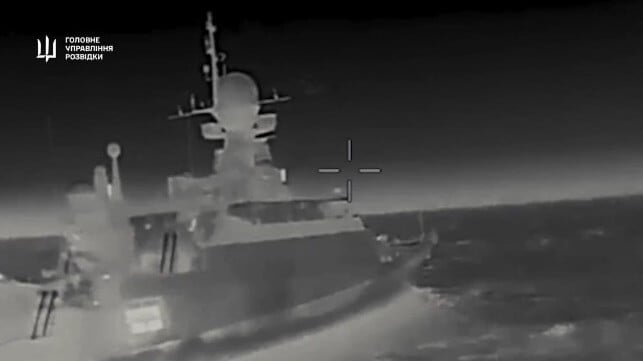
Ukraine's armed forces claim to have carried out a drone strike on a Russian Buyan-M missile ship on Lake Onega, over 600 miles north of the Ukrainian border.
Ukrainian special operations group SSO reported that its drone forces hit the Grad, a 2022-built Buyan-M, striking the vessel on the starboard side near an engineering space. The vessel was en route from the Baltic to the Caspian, according to the SSO; it was one of several targets hit during the evening's attacks, along with the Kirish oil refinery near St. Petersburg.
Lake Onega lies well inland: 230 miles to the northeast of Leningrad, 150 miles south of the White Sea, 400 miles north of Moscow and 150 miles from the Finnish border. It forms is part of the Volga-Baltic Canal system, which connects St. Petersburg with Cherepovets. From there, the Volga River connects through all the way to the Caspian Sea, or (via the Volga-Don Canal) with the Sea of Azov. The Buyan-M class was designed with the dimensions of Russia's inland canal system in mind, and is small enough to fit through the Volga waterways and locks.
Buyan-M corvettes are designed for coastal work. They are armed with a 60-round-per-minute 100mm gun and eight vertical launch cells for 500-mile range Kalibr cruise missiles, capable of hitting either land or naval targets. The Buyan-M class is also equipped with short-range Pantsir and Komar anti-aircraft systems designed to intercept incoming drones and anti-ship missiles, crews for which may not have been either sober or particularly alert at the 04:31 pre-dawn time of attack. RNS Grad is one of the latest versions built of its class, having joined the Baltic Fleet in December 2022.
The transfer of Grad from the Baltic Fleet to the Caspian Flotilla may indicate that the Caspian has been given a higher threat priority, given the Ukrainian attack on the cargo vessel Port Olya-4 which was hit when docked in the northern Caspian on August 14 this year. Vessels in the Port Olya series have been used to ship Iranian missiles, ammunition and drones loaded in Amirabadport in Iran, for use in the war in Ukraine. Or if a replacement vessel, it may reflect the fact that damage was inflicted on a Buyan Class corvette when the Caspian Flotilla was attacked in the port of Kaspiysk on November 6 last year, during which the Project 11661 Gepard Class frigates RFS Tatarstan (691) and RFS Dagestan (693) are known to have been hit.
One of Grad's sister ships, Vyshniy Volochyok, recently illustrated the continual threat of Ukraine's drone operations, even far behind the front lines. During a Ukrainian drone attack in the Sea of Azov on August 8, the Volochyok maneuvered in response to the presence of nearby drones and subsequently collided with a 4,500 dwt product tanker. A social media leak account claims to have obtained the official report on the collision, including imagery of structural damage to the corvette.

No comments:
Post a Comment