Mainstream Media Miss the Global Significance of Counterrevolution in Sudan
This is a war against civilians and against a truly pro-democracy revolution, says Professor Khalid Mustafa Medani.
By Daniel Falcone ,
Interview |
Sudanese Activists Are Fighting US and UAE Complicity in Sudan’s Genocide
The US acknowledged Sudan’s genocide in January but continues to send arms to the UAE, one of the war’s main drivers. By Shireen Akram-Boshar , Truthout February 25, 2025
Additionally, widespread diseases like cholera and other treatable diseases are devastating the country. Sexual violence and sexual assault as a weapon of war are included in a wide range of human rights violations that impact civilians. They are primary targets on the part of the protagonists, the Sudanese Armed Forces (SAF) and the Rapid Support Forces (RSF).
How do informal economic networks currently shape the power dynamics between the SAF and the RSF and how do they both perpetuate the conflict in Sudan? How did we get to this place? What role have informal economic ties and linkages and resources played starting in 1989?
Recently, in a short piece about the authoritarian legacies that led to this war, I mention authoritarian legacies built on the basis of informal economic networks. This autocratic playbook was utilized in 1989 when an Islamist-backed military under the leadership of Omar al-Bashir took over with concrete policy replicated in other authoritarian settings.
It was called empowerment (temkin, in Arabic) and publicly announced. It had four pillars that are important to emphasize. Two of those were essential to our understanding of informal economic networks but the two others were political and very familiar to people who study autocracy. The first pillar purged the bureaucracy of those not loyal to the Islamist movement. So over 600,000 were summarily dismissed from their jobs in the bureaucracy and military and replaced with loyalists that were part and parcel of the wider Islamist movement.
Here is where informal economic networks become very important. What we see here is the monopolization of informal financial networks. This is the first phase of the economy. At that point the regime and formal economy was in shambles, not just in terms of debt to international organizations like the IMF and World Bank, but in terms of corruption. This led to the downgrading of the formal economy, factories, and agriculture. In the context of the erosion of the formal economy, informal finance played a large role, as military governments can monopolize remittances and informal financial networks. It financed a loyalty, or clientelist, networks that made the government survive in the context of authoritarian rule for three decades.
Informal financial networks amounted to billions of dollars hoarded and monopolized investments in Islamic banking institutions at the same time weak military institutions in Africa and elsewhere (Middle East, Syria and Iraq) saw a rise in militias and paramilitary forces.
In the early 2000s, the insurgency took over the global headlines. It was essentially put down through a counterinsurgency that was backed by the central government. The [government in Khartoum] established a military that formed an informal network of militias. They financed and organized, as one scholar put it very effectively, a financed counterinsurgency campaign on the cheap. Basically, paramilitary militias were created to put down the insurgency. This was very important for putting down dissent. When you have a national standing army short on legitimacy, unable to protect citizens and borders you saw a proliferation of the militias. Here, these informal networks of militias were crucial in putting down dissent and uprisings.
I want to highlight these pillars involving the legacy authoritarianism that led to this war: the informal financial networks that monopolized order to finance loyalty of a select group of Islamist loyalists; the purging of the bureaucracy in order to replace people with loyalists; and, lastly, the expansion of informal paramilitary militias in order to put down counterinsurgency and dissent of a continuous cycle of popular protest.
What do the resistance committees represent today in the civil war? Have they progressed into providing a political alternative?
The resistance committees are notable for their pro-democracy and revolutionary potential. The reason they became so important in late 2018 was that they were organized informally. The reason for that was once again related to authoritarian legacies and authoritarian rule that all authoritarian governments coopt. Labor unions and civil society resisted corporatist authoritarianism. Younger people in Sudan came up with something ingenious. That was to form informal unions and informal professional associations unmonitored by the state. They were clandestine just like the terrorist organizations.
The positive aspect of social capital in informal networks can also be very important in mobilizing people for democracy. This we’ve seen throughout the North African and Arab region following revolutions in Tunisia and Egypt. Here, the resistance committee coordinates with informal professional associations through mass mobilization. It brought down the Islamist fundamentalist military regime in April of 2019 and then transformed in the context of the war. This is a war against civilians and against a truly pro-democracy revolution that encompassed millions of Sudanese for over two years across ethnic groups and different classes and regions in Sudan.
This is the primary reason the two protagonists conspired to wage a coup in October 2021 against this revolution and took over the state by military means. The resistance committees played an important role in the revolution, but they also opposed an existential threat to both protagonists. Their goal was to provide social services that were not available in the context of an expansive war economy. There are extrajudicial killings of young people working in emergency response rooms. Militias use food as a weapon as others have done in other contexts but also to make sure that they suppress this kind of resistance committee and their potential for revolutionary change. There are international calls to cut off aid to the informal economic networks and the gold smuggling that finances these wars as well as the informal weapons supplies fueling the war. There is no future without these resistance committees.
How are the United Nations, African Union, and Western governments approaching Sudan historically or in comparison to other geopolitical conflicts?
It’s important to begin by framing Sudan as far from peripheral. There is, in some places, very little coverage of Sudan, but that’s not the case in the Middle East or Europe. Sudan borders seven different countries, most importantly Libya. The United Arab Emirates, Israel, U.S., Saudi Arabia, Yemen, China, and Turkey, are all vying for a strategic and economic foothold in the Red Sea. Sudan is the fifth largest exporter of gold in Africa. It is smuggled to the Dubai markets in the United Arab Emirates and then processed to fuel global markets.
In effect, countries in the Red Sea interact based on a shifting of interests. The UAE, Saudi Arabia, Israel, and the U.S. all organize against Iran. Turkey and Iran back rival factions and China remains more neutral, although it expands its presence without direct confrontation.
The U.S. outsources its Middle East and Red Sea policy to regional allies, with Israel playing a key role, and especially in coordination with the UAE. Again, Sudan is too often misread as peripheral, when it’s part of a large geo-political web. This is why the Trump administration wanted to normalize Sudanese relations with Israel. The international community, especially the UN, is largely constrained as a result by the interests of Security Council members’ veto power.
Despite pledges from Europe and others, financial aid to Sudan has been minimal, and there’s a deep reluctance to deploy peacekeepers due to past failures like Somalia. This hesitation has contributed to the lack of recognition of the crisis in Sudan as genocide. While talks like those in Jeddah and Bahrain showed potential, they failed largely due to resistance from Islamist elements within Sudan’s military leadership.
Could you comment on the media culture regarding Sudan? How would you examine how data is utilized (propaganda or misused) and where can we find solid coverage?
I worked for NBC News and have experience with international outlets like CNN, PBS, BBC, Al Jazeera, etc. The war in Sudan is distorted in Western media. It is commonly represented as either inexplicable or inherently African, thus reinforcing racist narratives that dehumanize those affected and normalize endless conflict on the continent. This kind of “under the radar” framing would be unthinkable in coverage of wars in Ukraine or Gaza, where the geopolitical causes and human suffering are very seriously examined. We should never compare conflicts in terms of importance; instead, we need to emphasize the interconnectedness of these conflicts and the collective role of regional/global powers.
Talking with Sudanese, Sudanese American, and Sudanese Canadian diaspora populations is vital. Sudanese women activists working on critical issues like sexual violence offer authentic, informed voices from within these communities and polls show that people are more interested in alternative voices and perspectives.
This article is licensed under Creative Commons (CC BY-NC-ND 4.0), and you are free to share and republish under the terms of the license.

Daniel Falcone
Daniel Falcone is a historian specializing in the revolutions of 1848 and the political refugees who sought asylum in New York City. His academic work focuses on Giuseppe Garibaldi’s influence on New York’s local history and the politics of memory in the nineteenth and twentieth centuries. Aside from his research, he is a teacher and journalist whose work has appeared in The Journal of Contemporary Iraq & the Arab World, The Nation, Jacobin and CounterPunch. His writing and interviews intersect history with modern-day geopolitical issues.
This is a war against civilians and against a truly pro-democracy revolution, says Professor Khalid Mustafa Medani.
By Daniel Falcone ,
October 17, 2025
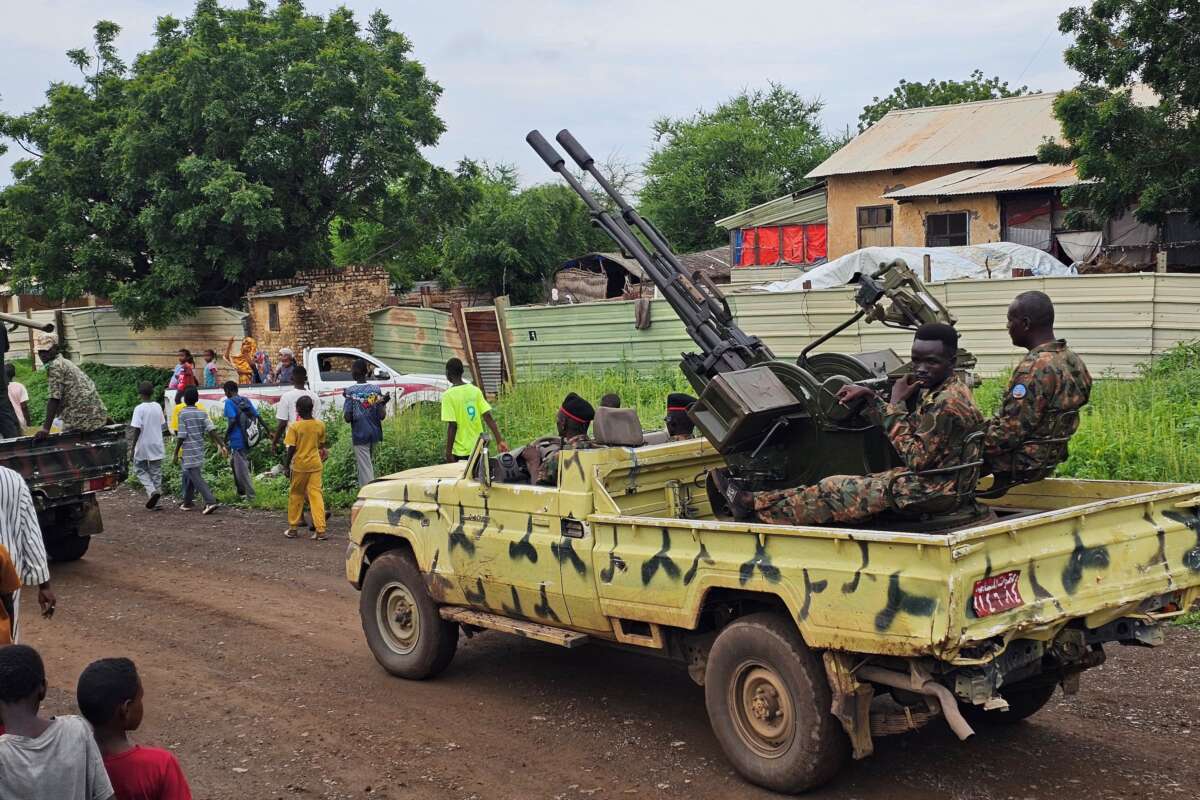
Children walk past a Sudanese army parade in the streets of Gedaref, in eastern Sudan, on August 14, 2025, marking the 71st anniversary of the formation of the Sudanese army. Since it began in April 2023, the Sudanese war between the regular army and its paramilitary rival, the Rapid Support Forces, has killed tens of thousands of people and driven millions from their homes.
AFP via Getty Images
The Rapid Support Forces, a paramilitary group, has tightened its siege of the Sudanese city of El Fasher amid their civil war with the Sudanese Armed Forces. About 260,000 people are estimated to be trapped in the city in a siege that has lasted for over 550 days, leaving the city without access to food, water, internet, and health care. The city’s plight reflects the dire situation for tens of millions of Sudanese people throughout the country who are facing mass starvation, displacement and atrocities due to the warring counterrevolution forces, who began fighting in April 2023, further thwarting a pro-democracy movement.
In this exclusive interview for Truthout, Khalid Mustafa Medani discusses the Sudanese civil war, authoritarian rule, and its political economy. He talks about how international actors factor into the conflict while challenging the idea that Sudan is geopolitically peripheral. Further, he analyzes Sudan’s popular resistance and contextualizes them as examples of humanitarian and democratic transformation.
Medani is an associate professor of Political Science and Islamic Studies at McGill University. His research focuses on African politics, political Islam, and informal economies, with an emphasis on Sudan. He is the author of Black Markets and Militants: Informal Networks in the Middle East and Africa and has advised organizations like the United Nations Development Programme and International Crisis Group. A former NBC News producer in Cairo and Khartoum, Medani is a frequent media commentator on conflict and revolution.
Daniel Falcone: Can you start by explaining the current situation in Sudan?
Khalid Mustafa Medani: It’s important to begin with the devastation of the war regarding Sudan. Since April 15, 2023, it has been disastrous on a humanitarian level with 13 million people internally displaced, hundreds of thousands killed, and targeted ethnic killings. It’s further important to highlight the complete destruction of the infrastructure, with hundreds of schools and 80 percent of hospitals in targeted areas forced to shut down.
Related Story
The Rapid Support Forces, a paramilitary group, has tightened its siege of the Sudanese city of El Fasher amid their civil war with the Sudanese Armed Forces. About 260,000 people are estimated to be trapped in the city in a siege that has lasted for over 550 days, leaving the city without access to food, water, internet, and health care. The city’s plight reflects the dire situation for tens of millions of Sudanese people throughout the country who are facing mass starvation, displacement and atrocities due to the warring counterrevolution forces, who began fighting in April 2023, further thwarting a pro-democracy movement.
In this exclusive interview for Truthout, Khalid Mustafa Medani discusses the Sudanese civil war, authoritarian rule, and its political economy. He talks about how international actors factor into the conflict while challenging the idea that Sudan is geopolitically peripheral. Further, he analyzes Sudan’s popular resistance and contextualizes them as examples of humanitarian and democratic transformation.
Medani is an associate professor of Political Science and Islamic Studies at McGill University. His research focuses on African politics, political Islam, and informal economies, with an emphasis on Sudan. He is the author of Black Markets and Militants: Informal Networks in the Middle East and Africa and has advised organizations like the United Nations Development Programme and International Crisis Group. A former NBC News producer in Cairo and Khartoum, Medani is a frequent media commentator on conflict and revolution.
Daniel Falcone: Can you start by explaining the current situation in Sudan?
Khalid Mustafa Medani: It’s important to begin with the devastation of the war regarding Sudan. Since April 15, 2023, it has been disastrous on a humanitarian level with 13 million people internally displaced, hundreds of thousands killed, and targeted ethnic killings. It’s further important to highlight the complete destruction of the infrastructure, with hundreds of schools and 80 percent of hospitals in targeted areas forced to shut down.
Related Story
Interview |
Sudanese Activists Are Fighting US and UAE Complicity in Sudan’s Genocide
The US acknowledged Sudan’s genocide in January but continues to send arms to the UAE, one of the war’s main drivers. By Shireen Akram-Boshar , Truthout February 25, 2025
Additionally, widespread diseases like cholera and other treatable diseases are devastating the country. Sexual violence and sexual assault as a weapon of war are included in a wide range of human rights violations that impact civilians. They are primary targets on the part of the protagonists, the Sudanese Armed Forces (SAF) and the Rapid Support Forces (RSF).
How do informal economic networks currently shape the power dynamics between the SAF and the RSF and how do they both perpetuate the conflict in Sudan? How did we get to this place? What role have informal economic ties and linkages and resources played starting in 1989?
Recently, in a short piece about the authoritarian legacies that led to this war, I mention authoritarian legacies built on the basis of informal economic networks. This autocratic playbook was utilized in 1989 when an Islamist-backed military under the leadership of Omar al-Bashir took over with concrete policy replicated in other authoritarian settings.
It was called empowerment (temkin, in Arabic) and publicly announced. It had four pillars that are important to emphasize. Two of those were essential to our understanding of informal economic networks but the two others were political and very familiar to people who study autocracy. The first pillar purged the bureaucracy of those not loyal to the Islamist movement. So over 600,000 were summarily dismissed from their jobs in the bureaucracy and military and replaced with loyalists that were part and parcel of the wider Islamist movement.
Here is where informal economic networks become very important. What we see here is the monopolization of informal financial networks. This is the first phase of the economy. At that point the regime and formal economy was in shambles, not just in terms of debt to international organizations like the IMF and World Bank, but in terms of corruption. This led to the downgrading of the formal economy, factories, and agriculture. In the context of the erosion of the formal economy, informal finance played a large role, as military governments can monopolize remittances and informal financial networks. It financed a loyalty, or clientelist, networks that made the government survive in the context of authoritarian rule for three decades.
Informal financial networks amounted to billions of dollars hoarded and monopolized investments in Islamic banking institutions at the same time weak military institutions in Africa and elsewhere (Middle East, Syria and Iraq) saw a rise in militias and paramilitary forces.
In the early 2000s, the insurgency took over the global headlines. It was essentially put down through a counterinsurgency that was backed by the central government. The [government in Khartoum] established a military that formed an informal network of militias. They financed and organized, as one scholar put it very effectively, a financed counterinsurgency campaign on the cheap. Basically, paramilitary militias were created to put down the insurgency. This was very important for putting down dissent. When you have a national standing army short on legitimacy, unable to protect citizens and borders you saw a proliferation of the militias. Here, these informal networks of militias were crucial in putting down dissent and uprisings.
I want to highlight these pillars involving the legacy authoritarianism that led to this war: the informal financial networks that monopolized order to finance loyalty of a select group of Islamist loyalists; the purging of the bureaucracy in order to replace people with loyalists; and, lastly, the expansion of informal paramilitary militias in order to put down counterinsurgency and dissent of a continuous cycle of popular protest.
What do the resistance committees represent today in the civil war? Have they progressed into providing a political alternative?
The resistance committees are notable for their pro-democracy and revolutionary potential. The reason they became so important in late 2018 was that they were organized informally. The reason for that was once again related to authoritarian legacies and authoritarian rule that all authoritarian governments coopt. Labor unions and civil society resisted corporatist authoritarianism. Younger people in Sudan came up with something ingenious. That was to form informal unions and informal professional associations unmonitored by the state. They were clandestine just like the terrorist organizations.
The positive aspect of social capital in informal networks can also be very important in mobilizing people for democracy. This we’ve seen throughout the North African and Arab region following revolutions in Tunisia and Egypt. Here, the resistance committee coordinates with informal professional associations through mass mobilization. It brought down the Islamist fundamentalist military regime in April of 2019 and then transformed in the context of the war. This is a war against civilians and against a truly pro-democracy revolution that encompassed millions of Sudanese for over two years across ethnic groups and different classes and regions in Sudan.
This is the primary reason the two protagonists conspired to wage a coup in October 2021 against this revolution and took over the state by military means. The resistance committees played an important role in the revolution, but they also opposed an existential threat to both protagonists. Their goal was to provide social services that were not available in the context of an expansive war economy. There are extrajudicial killings of young people working in emergency response rooms. Militias use food as a weapon as others have done in other contexts but also to make sure that they suppress this kind of resistance committee and their potential for revolutionary change. There are international calls to cut off aid to the informal economic networks and the gold smuggling that finances these wars as well as the informal weapons supplies fueling the war. There is no future without these resistance committees.
How are the United Nations, African Union, and Western governments approaching Sudan historically or in comparison to other geopolitical conflicts?
It’s important to begin by framing Sudan as far from peripheral. There is, in some places, very little coverage of Sudan, but that’s not the case in the Middle East or Europe. Sudan borders seven different countries, most importantly Libya. The United Arab Emirates, Israel, U.S., Saudi Arabia, Yemen, China, and Turkey, are all vying for a strategic and economic foothold in the Red Sea. Sudan is the fifth largest exporter of gold in Africa. It is smuggled to the Dubai markets in the United Arab Emirates and then processed to fuel global markets.
In effect, countries in the Red Sea interact based on a shifting of interests. The UAE, Saudi Arabia, Israel, and the U.S. all organize against Iran. Turkey and Iran back rival factions and China remains more neutral, although it expands its presence without direct confrontation.
The U.S. outsources its Middle East and Red Sea policy to regional allies, with Israel playing a key role, and especially in coordination with the UAE. Again, Sudan is too often misread as peripheral, when it’s part of a large geo-political web. This is why the Trump administration wanted to normalize Sudanese relations with Israel. The international community, especially the UN, is largely constrained as a result by the interests of Security Council members’ veto power.
Despite pledges from Europe and others, financial aid to Sudan has been minimal, and there’s a deep reluctance to deploy peacekeepers due to past failures like Somalia. This hesitation has contributed to the lack of recognition of the crisis in Sudan as genocide. While talks like those in Jeddah and Bahrain showed potential, they failed largely due to resistance from Islamist elements within Sudan’s military leadership.
Could you comment on the media culture regarding Sudan? How would you examine how data is utilized (propaganda or misused) and where can we find solid coverage?
I worked for NBC News and have experience with international outlets like CNN, PBS, BBC, Al Jazeera, etc. The war in Sudan is distorted in Western media. It is commonly represented as either inexplicable or inherently African, thus reinforcing racist narratives that dehumanize those affected and normalize endless conflict on the continent. This kind of “under the radar” framing would be unthinkable in coverage of wars in Ukraine or Gaza, where the geopolitical causes and human suffering are very seriously examined. We should never compare conflicts in terms of importance; instead, we need to emphasize the interconnectedness of these conflicts and the collective role of regional/global powers.
Talking with Sudanese, Sudanese American, and Sudanese Canadian diaspora populations is vital. Sudanese women activists working on critical issues like sexual violence offer authentic, informed voices from within these communities and polls show that people are more interested in alternative voices and perspectives.
This article is licensed under Creative Commons (CC BY-NC-ND 4.0), and you are free to share and republish under the terms of the license.
Daniel Falcone
Daniel Falcone is a historian specializing in the revolutions of 1848 and the political refugees who sought asylum in New York City. His academic work focuses on Giuseppe Garibaldi’s influence on New York’s local history and the politics of memory in the nineteenth and twentieth centuries. Aside from his research, he is a teacher and journalist whose work has appeared in The Journal of Contemporary Iraq & the Arab World, The Nation, Jacobin and CounterPunch. His writing and interviews intersect history with modern-day geopolitical issues.
Drones Take On Growing Role In Northern Sudan’s Conflict As Technology Advances

October 19, 2025
By Africa Defense Forum
The Sudanese Armed Forces (SAF) have deployed a sophisticated new weapon in their fight against the paramilitary Rapid Support Forces (RSF): the locally-produced Safrouq drone, which is packed with anti-jamming technology and has a range of 600 kilometers.
The Safrouq is a response to the RSF’s employing Belarus’ Groza-S electronic warfare system to identify and jam or trick the SAF’s incoming drones.
The Safrouq represents the latest technological advancement as both sides of the conflict shift their tactics to airborne weapons and away from ground forces, which have largely reached a stalemate.
The Safrouq can be used for reconnaissance, but it was designed to be a one-way attack (OWA) vehicle, also known as a kamikaze. It is also an upgrade from modified off-the-shelf drones both sides have used for kamikaze attacks in recent months.
The Safrouq debuted in July at the International Defence Industry Fair (IDEF) in Istanbul. Turkey continues to back the SAF and Sudan’s de facto leader, Gen. Abdel Fattah al-Burhan, politically and militarily through the sale of Bayraktar TB2 and Akinci drones.
The Turkish drones proved a key component in the SAF’s ability to drive the RSF out of Khartoum this year. The RSF claims to have shot down several of the Turkish drones, including an Akinci drone taken down over West Kordofan in September.
The RSF’s success against the drones “expose the fragility of unmanned superiority in a war where foreign-supplied defenses are levelling the aerial playing field,” according to Military Africa.
The RSF has increased its own drone use from its base in Nyala, South Darfur, using Chinese-made FH-95 kamikaze drones. Many of the RSF’s drones are designed to fly long distances into SAF-held territory and loiter above potential targets waiting to strike.
The RSF used long-distance drones launched from Darfur to attack Port Sudan, targeting an airstrip where the SAF’s Bayraktar drones were based. The SAF now stores the drones underground.
In recent weeks, the RSF used its loitering drones to attack a power station in Omdurman, an oil refinery in Khartoum and a weapons factory in Yarmouk. In early October, RSF drones struck a hospital and residential neighborhoods in el-Obeid, the capital of North Kordofan.
In July, Sudanese troops shot down an RSF kamikaze drone over the cities of al-Dabbah and Merowe in Northern State, a region that has remained largely untouched by the conflict.
The RSF has been able to threaten Northern State since taking control of the Owaynat Triangle, a key trade route, that borders Libya and Egypt in northwestern Sudan. In response, the SAF has boosted defenses around military sites in the region, adding jamming equipment and antiaircraft weapons to counter a potential drone attack.
The RSF also uses drones to assassinate prominent figures. Al-Burhan survived an attempt during a military graduation in Red Sea State in 2024.
Analysts note that the shift toward drone-based aerial campaigns increases pressure on soldiers and militia members tasked with defending key locations. However, those attacks don’t necessarily translate into territorial gains by either side.
“From a strategic calculus perspective, losses suffered by one party do not necessarily lead to gains for the other,” analyst Albadawi Rahmtall wrote recently in Military Africa.
“Air superiority unlinked to the ability to exploit ground conditions and alter military geography diminishes the value of airstrikes and reduces their military and political significance,” Rahmtall added.

Africa Defense Forum
The Africa Defense Forum (ADF) magazine is a security affairs journal that focuses on all issues affecting peace, stability, and good governance in Africa. ADF is published by the U.S. Africa Command.
October 19, 2025
By Africa Defense Forum
The Sudanese Armed Forces (SAF) have deployed a sophisticated new weapon in their fight against the paramilitary Rapid Support Forces (RSF): the locally-produced Safrouq drone, which is packed with anti-jamming technology and has a range of 600 kilometers.
The Safrouq is a response to the RSF’s employing Belarus’ Groza-S electronic warfare system to identify and jam or trick the SAF’s incoming drones.
The Safrouq represents the latest technological advancement as both sides of the conflict shift their tactics to airborne weapons and away from ground forces, which have largely reached a stalemate.
The Safrouq can be used for reconnaissance, but it was designed to be a one-way attack (OWA) vehicle, also known as a kamikaze. It is also an upgrade from modified off-the-shelf drones both sides have used for kamikaze attacks in recent months.
The Safrouq debuted in July at the International Defence Industry Fair (IDEF) in Istanbul. Turkey continues to back the SAF and Sudan’s de facto leader, Gen. Abdel Fattah al-Burhan, politically and militarily through the sale of Bayraktar TB2 and Akinci drones.
The Turkish drones proved a key component in the SAF’s ability to drive the RSF out of Khartoum this year. The RSF claims to have shot down several of the Turkish drones, including an Akinci drone taken down over West Kordofan in September.
The RSF’s success against the drones “expose the fragility of unmanned superiority in a war where foreign-supplied defenses are levelling the aerial playing field,” according to Military Africa.
The RSF has increased its own drone use from its base in Nyala, South Darfur, using Chinese-made FH-95 kamikaze drones. Many of the RSF’s drones are designed to fly long distances into SAF-held territory and loiter above potential targets waiting to strike.
The RSF used long-distance drones launched from Darfur to attack Port Sudan, targeting an airstrip where the SAF’s Bayraktar drones were based. The SAF now stores the drones underground.
In recent weeks, the RSF used its loitering drones to attack a power station in Omdurman, an oil refinery in Khartoum and a weapons factory in Yarmouk. In early October, RSF drones struck a hospital and residential neighborhoods in el-Obeid, the capital of North Kordofan.
In July, Sudanese troops shot down an RSF kamikaze drone over the cities of al-Dabbah and Merowe in Northern State, a region that has remained largely untouched by the conflict.
The RSF has been able to threaten Northern State since taking control of the Owaynat Triangle, a key trade route, that borders Libya and Egypt in northwestern Sudan. In response, the SAF has boosted defenses around military sites in the region, adding jamming equipment and antiaircraft weapons to counter a potential drone attack.
The RSF also uses drones to assassinate prominent figures. Al-Burhan survived an attempt during a military graduation in Red Sea State in 2024.
Analysts note that the shift toward drone-based aerial campaigns increases pressure on soldiers and militia members tasked with defending key locations. However, those attacks don’t necessarily translate into territorial gains by either side.
“From a strategic calculus perspective, losses suffered by one party do not necessarily lead to gains for the other,” analyst Albadawi Rahmtall wrote recently in Military Africa.
“Air superiority unlinked to the ability to exploit ground conditions and alter military geography diminishes the value of airstrikes and reduces their military and political significance,” Rahmtall added.
Africa Defense Forum
The Africa Defense Forum (ADF) magazine is a security affairs journal that focuses on all issues affecting peace, stability, and good governance in Africa. ADF is published by the U.S. Africa Command.
GET RID OF LEADERS TO END WAR
Friday 17 October 2025, by Paul Martial
Through their corruption and ethnicist politics, the country’s elites are plunging South Sudan into a new abyss of violence. Since its separation from Sudan in July 2011, the country has only experienced civil wars, of varying intensity. For the past eight months, Riek Machar, the vice-president, has been appearing in court on several charges such as crimes against humanity, rebellion and treason.
A permanent war
He is accused of inciting the “white” Army, a militia reputed to be close to his organization, the Sudan People’s Liberation Movement-in Opposition (SPLM-IO), to attack the barracks of Nasir, a city in Upper Nile State, causing the death of more than 250 soldiers. Reprisal operations launched by South Sudanese President Salva Kiir have targeted civilians and caused tens of thousands of people to flee. The 2018 peace accords, which were supposed to end the civil war, were never really implemented. Clashes continued on both sides.
The trial against Riek Machar and several leaders of the SPLM-IO is considered a breach of this peace agreement, especially since it has been accompanied by violent aerial bombardments against the cantonment centres of the organisation’s troops, which were to be integrated. These fighters have dispersed across the country and now have no choice but to resume guerrilla warfare. This situation is worrying, because an alliance has been created between the SPLM-IO and another militia, Thomas Cirilo’s National Salvation Front (NSF), which risks tipping the country back into a full-blown civil war.
Ethnicism and corruption
For Salva Kiir, the goal is to get rid of the opposition. He managed to poach some leaders of the SPLM-IO to maintain the façade of a government of national unity. His concern is to ensure his succession and hand over power to Benjamin Bol Mel, a businessman crony from Kiir’s family clan, who has already been appointed vice-president. Such a policy only traps the country in a conflictual situation.
Since its creation, the elites at the head of the young state have not ceased to exploit ethnic divisions by using the community to which they belong: Riek Machar for the Nuer, Thomas Cirilo for the Bari and Salva Kiir for the Dinka. At the same time, the economic situation is disastrous. South Sudan’s oil exports are blocked because of the war in Sudan and above all the country’s funds are embezzled on a large scale.
This is according to a report by the UN Commission on Human Rights, which departs from its diplomatic language to denounce a “shameless predation”. The report declares the above-mentioned Mel to be guilty of embezzling two billion dollars intended for road infrastructure. Another example: the Ministry of Health received only 19% of its budget, or $29 million, while the budget for presidential affairs exceeded its allocation by 584%, or $557 million.
The only solution for peace is for the people, all communities combined, to get rid of these warmongers.
2 October 2025
Translated by International Viewpoint from l’Anticapitaliste.
Attached documentsget-rid-of-leaders-to-stop-war-in-south-sudan_a9219.pdf (PDF - 905 KiB)
Extraction PDF [->article9219]
South Sudan
When African dictatorships reach out to Trump
Palestine, Sudan, and the Global North’s Indifference
Peace under threat in South Sudan
Paul Martial is a correspondent for International Viewpoint. He is editor of Afriques en Lutte and a member of the Fourth International in France.
International Viewpoint is published under the responsibility of the Bureau of the Fourth International. Signed articles do not necessarily reflect editorial policy. Articles can be reprinted with acknowledgement, and a live link if possible.
Friday 17 October 2025, by Paul Martial
Through their corruption and ethnicist politics, the country’s elites are plunging South Sudan into a new abyss of violence. Since its separation from Sudan in July 2011, the country has only experienced civil wars, of varying intensity. For the past eight months, Riek Machar, the vice-president, has been appearing in court on several charges such as crimes against humanity, rebellion and treason.
A permanent war
He is accused of inciting the “white” Army, a militia reputed to be close to his organization, the Sudan People’s Liberation Movement-in Opposition (SPLM-IO), to attack the barracks of Nasir, a city in Upper Nile State, causing the death of more than 250 soldiers. Reprisal operations launched by South Sudanese President Salva Kiir have targeted civilians and caused tens of thousands of people to flee. The 2018 peace accords, which were supposed to end the civil war, were never really implemented. Clashes continued on both sides.
The trial against Riek Machar and several leaders of the SPLM-IO is considered a breach of this peace agreement, especially since it has been accompanied by violent aerial bombardments against the cantonment centres of the organisation’s troops, which were to be integrated. These fighters have dispersed across the country and now have no choice but to resume guerrilla warfare. This situation is worrying, because an alliance has been created between the SPLM-IO and another militia, Thomas Cirilo’s National Salvation Front (NSF), which risks tipping the country back into a full-blown civil war.
Ethnicism and corruption
For Salva Kiir, the goal is to get rid of the opposition. He managed to poach some leaders of the SPLM-IO to maintain the façade of a government of national unity. His concern is to ensure his succession and hand over power to Benjamin Bol Mel, a businessman crony from Kiir’s family clan, who has already been appointed vice-president. Such a policy only traps the country in a conflictual situation.
Since its creation, the elites at the head of the young state have not ceased to exploit ethnic divisions by using the community to which they belong: Riek Machar for the Nuer, Thomas Cirilo for the Bari and Salva Kiir for the Dinka. At the same time, the economic situation is disastrous. South Sudan’s oil exports are blocked because of the war in Sudan and above all the country’s funds are embezzled on a large scale.
This is according to a report by the UN Commission on Human Rights, which departs from its diplomatic language to denounce a “shameless predation”. The report declares the above-mentioned Mel to be guilty of embezzling two billion dollars intended for road infrastructure. Another example: the Ministry of Health received only 19% of its budget, or $29 million, while the budget for presidential affairs exceeded its allocation by 584%, or $557 million.
The only solution for peace is for the people, all communities combined, to get rid of these warmongers.
2 October 2025
Translated by International Viewpoint from l’Anticapitaliste.
Attached documentsget-rid-of-leaders-to-stop-war-in-south-sudan_a9219.pdf (PDF - 905 KiB)
Extraction PDF [->article9219]
South Sudan
When African dictatorships reach out to Trump
Palestine, Sudan, and the Global North’s Indifference
Peace under threat in South Sudan
Paul Martial is a correspondent for International Viewpoint. He is editor of Afriques en Lutte and a member of the Fourth International in France.
International Viewpoint is published under the responsibility of the Bureau of the Fourth International. Signed articles do not necessarily reflect editorial policy. Articles can be reprinted with acknowledgement, and a live link if possible.

No comments:
Post a Comment