Sarah K. Burris
October 30, 2025
RAW STORY
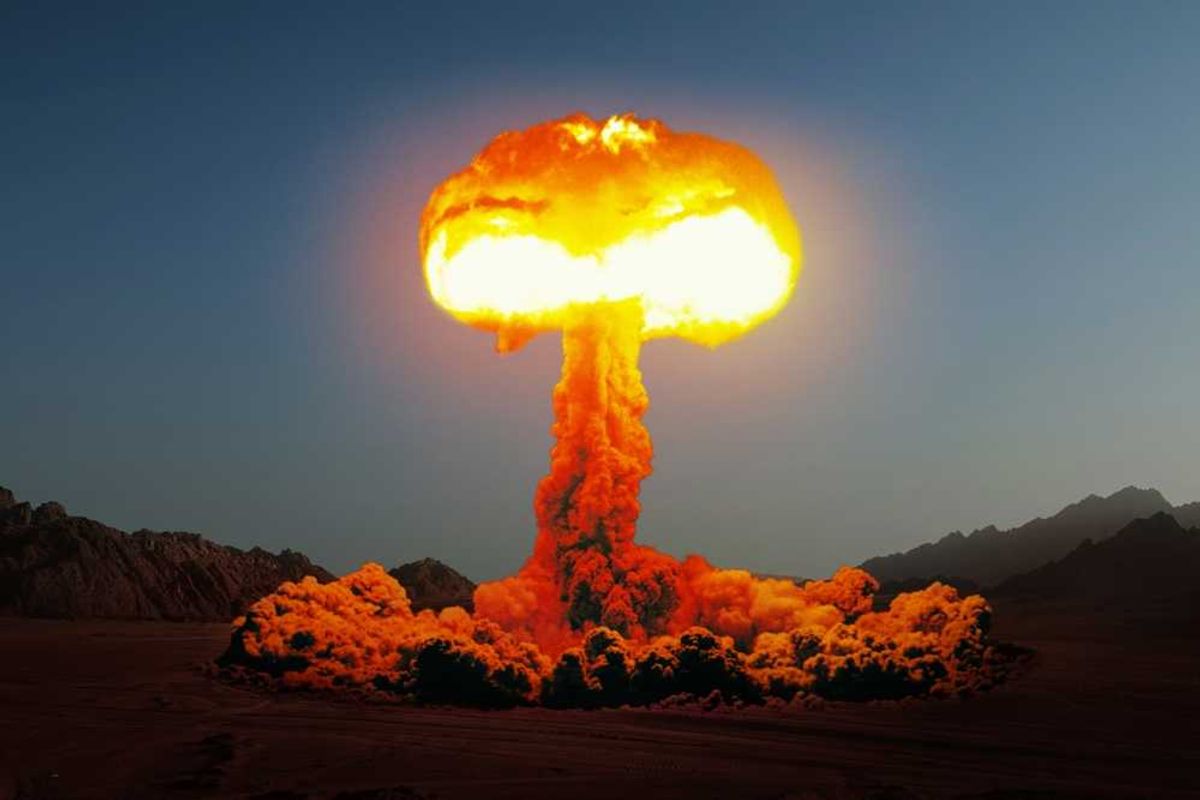
Explosion of a nuclear bomb with a mushroom in the desert.
(Photo credit: Alones / Shutterstock)
President Donald Trump announced that the U.S. will resume testing its nuclear weapons, stating that the move is necessary because America's adversaries have done so.
While the U.S. has the top military equipment in the world, spending several times more than other countries, Trump wants the U.S. to start blowing things up again. The problem, however, is that the government shutdown means the people who deal specifically with nuclear issues are furloughed.
Speaking to MSNBC on Thursday, Ian Bremmer, founder and president of the Eurasia Group, said that the tit-for-tat between Trump and Putin can't start right away.
"Well, they can't start nuclear testing now because the officials that would be in charge of that have mostly been furloughed," said Bremmer. "So, you have to get the government started. I guess that's an irony."
He noted that it appears to be a direct response from Trump to Russian President Vladimir Putin's threats to begin nuclear testing. Trump withdrew the United States from the Intermediate-Range Nuclear Forces (INF) Treaty with Russia in August 2019.
Bremmer noted that it was revealed that Russia had a successful test of a nuclear-powered cruise missile, "which had the ability to hit the United States easily. And a torpedo, but that was not a nuclear test. It appears the president was confused about that and responded by saying, 'Yeah, we're gonna start doing nuclear testing.'"
The U.S. joined the Nuclear Test Ban Treaty in 1996, and Bremmer thinks if the U.S. began testing again, then the Russians and Chinese would quickly follow.
President Donald Trump announced that the U.S. will resume testing its nuclear weapons, stating that the move is necessary because America's adversaries have done so.
While the U.S. has the top military equipment in the world, spending several times more than other countries, Trump wants the U.S. to start blowing things up again. The problem, however, is that the government shutdown means the people who deal specifically with nuclear issues are furloughed.
Speaking to MSNBC on Thursday, Ian Bremmer, founder and president of the Eurasia Group, said that the tit-for-tat between Trump and Putin can't start right away.
"Well, they can't start nuclear testing now because the officials that would be in charge of that have mostly been furloughed," said Bremmer. "So, you have to get the government started. I guess that's an irony."
He noted that it appears to be a direct response from Trump to Russian President Vladimir Putin's threats to begin nuclear testing. Trump withdrew the United States from the Intermediate-Range Nuclear Forces (INF) Treaty with Russia in August 2019.
Bremmer noted that it was revealed that Russia had a successful test of a nuclear-powered cruise missile, "which had the ability to hit the United States easily. And a torpedo, but that was not a nuclear test. It appears the president was confused about that and responded by saying, 'Yeah, we're gonna start doing nuclear testing.'"
The U.S. joined the Nuclear Test Ban Treaty in 1996, and Bremmer thinks if the U.S. began testing again, then the Russians and Chinese would quickly follow.
Trump’s order on nuclear testing: what we know
By AFP
October 30, 2025

The United States already periodically tests nuclear weapons delivery systems, such as during the February 2020 launch of a Minuteman III missile
By AFP
October 30, 2025
The United States already periodically tests nuclear weapons delivery systems, such as during the February 2020 launch of a Minuteman III missile
- Copyright US AIR FORCE/AFP
Clayton WEAR
President Donald Trump has ignited a firestorm of controversy and confusion with his announcement that the United States will begin nuclear weapons testing.
It’s unclear whether he was referring to testing weapons systems — which the United States already does — or actually conducting nuclear explosions, which only US arch-foe North Korea has carried out in the 21st century.
Below, AFP examines what Trump has said, the state of current US testing, and what it would take to resume explosive tests.
– What Trump said –
Trump said in a social media post that he had instructed the Defense Department “to start testing our Nuclear Weapons on an equal basis” with Russia and China.
However, neither of those countries are confirmed to have carried out recent explosive testing, and it is the Department of Energy that is responsible for the US nuclear stockpile.
The president subsequently told journalists on Air Force One that “they seem to all be doing nuclear testing,” and that “we halted it many years ago but with others doing testing I think it is appropriate we do also.”
He offered no details on the nature of the testing he had ordered.
– Current US testing –
The United States conducted the world’s first nuclear test in July 1945 and used two nuclear weapons against Japan near the end of WWII.
It has carried out more than 1,000 explosive nuclear tests in total — most recently in 1992 with a 20-kiloton underground detonation at the Nevada Nuclear Security Site.
That year, Congress passed a temporary moratorium on underground nuclear tests unless a foreign state conducted one, which has since occurred. Washington had already agreed not to conduct tests in the atmosphere, outer space and underwater as part of the Limited Test Ban Treaty, which it has been a party to since 1963.
The United States has also been a signatory since 1996 to the Comprehensive Nuclear-Test-Ban Treaty, which bans all atomic test explosions, but the Senate has yet to ratify it.
In the absence of explosive testing, the United States ensures its arsenal’s reliability through the so-called Stockpile Stewardship Program, which includes “a wide range of scientific activities, from modeling and simulation to subcritical nuclear experiments,” according to the US National Nuclear Security Administration.
“This program allows us to assess and certify the stockpile with extraordinary confidence,” it says.
Washington also periodically tests its nuclear delivery systems such as intercontinental ballistic missiles.
The US military launched an unarmed Minuteman III missile earlier this year, with the Space Force saying at the time that the United States had carried out more than 300 similar tests overall.
– Resuming explosive testing –
The president has the authority to authorize explosive tests, and Washington’s forces have “the capability to resume testing within 24-36 months of a presidential decision to do so,” the US Congressional Research Service says.
It notes that a 2012 study found that “the response time for resuming underground explosive testing is driven more by compliance with environmental, health, and safety regulations than by the technical testing requirements or the need to restore equipment and facilities.”
Doreen Horschig, a fellow with the Project on Nuclear Issues at the Center for Strategic and International Studies, said the US National Nuclear Security Administration would be able to “get the test site ready within six to 10 months for a very basic underground test.”
“The timeframe is much longer if you want to test new warheads and new capabilities,” Horschig said.
But she also noted that there is likely to be political opposition to a resumption of testing “from both sides of the political camps” in the United States, while “our allies (also) do not see a need for (a) return to testing.”
President Donald Trump has ignited a firestorm of controversy and confusion with his announcement that the United States will begin nuclear weapons testing.
It’s unclear whether he was referring to testing weapons systems — which the United States already does — or actually conducting nuclear explosions, which only US arch-foe North Korea has carried out in the 21st century.
Below, AFP examines what Trump has said, the state of current US testing, and what it would take to resume explosive tests.
– What Trump said –
Trump said in a social media post that he had instructed the Defense Department “to start testing our Nuclear Weapons on an equal basis” with Russia and China.
However, neither of those countries are confirmed to have carried out recent explosive testing, and it is the Department of Energy that is responsible for the US nuclear stockpile.
The president subsequently told journalists on Air Force One that “they seem to all be doing nuclear testing,” and that “we halted it many years ago but with others doing testing I think it is appropriate we do also.”
He offered no details on the nature of the testing he had ordered.
– Current US testing –
The United States conducted the world’s first nuclear test in July 1945 and used two nuclear weapons against Japan near the end of WWII.
It has carried out more than 1,000 explosive nuclear tests in total — most recently in 1992 with a 20-kiloton underground detonation at the Nevada Nuclear Security Site.
That year, Congress passed a temporary moratorium on underground nuclear tests unless a foreign state conducted one, which has since occurred. Washington had already agreed not to conduct tests in the atmosphere, outer space and underwater as part of the Limited Test Ban Treaty, which it has been a party to since 1963.
The United States has also been a signatory since 1996 to the Comprehensive Nuclear-Test-Ban Treaty, which bans all atomic test explosions, but the Senate has yet to ratify it.
In the absence of explosive testing, the United States ensures its arsenal’s reliability through the so-called Stockpile Stewardship Program, which includes “a wide range of scientific activities, from modeling and simulation to subcritical nuclear experiments,” according to the US National Nuclear Security Administration.
“This program allows us to assess and certify the stockpile with extraordinary confidence,” it says.
Washington also periodically tests its nuclear delivery systems such as intercontinental ballistic missiles.
The US military launched an unarmed Minuteman III missile earlier this year, with the Space Force saying at the time that the United States had carried out more than 300 similar tests overall.
– Resuming explosive testing –
The president has the authority to authorize explosive tests, and Washington’s forces have “the capability to resume testing within 24-36 months of a presidential decision to do so,” the US Congressional Research Service says.
It notes that a 2012 study found that “the response time for resuming underground explosive testing is driven more by compliance with environmental, health, and safety regulations than by the technical testing requirements or the need to restore equipment and facilities.”
Doreen Horschig, a fellow with the Project on Nuclear Issues at the Center for Strategic and International Studies, said the US National Nuclear Security Administration would be able to “get the test site ready within six to 10 months for a very basic underground test.”
“The timeframe is much longer if you want to test new warheads and new capabilities,” Horschig said.
But she also noted that there is likely to be political opposition to a resumption of testing “from both sides of the political camps” in the United States, while “our allies (also) do not see a need for (a) return to testing.”
Trump call for nuclear tests sows confusion
By AFP
October 30, 2025

Visitors watch a video of a nuclear bomb test at the All-Russia Exhibition Centre (VDNH) in Moscow in December, 2023 - Copyright AFP/File Eduardo Leal
Fabien ZAMORA
President Donald Trump Thursday sowed confusion among experts with his call for the start of nuclear weapons testing, with some pundits interpreting the announcement as US preparations for a shock resumption of explosive testing after more than 30 years.
The US president baffled foreign government and nuclear weapons experts alike when he said he had ordered the Pentagon to start nuclear weapons testing “on an equal basis” to China and Russia.
Speaking to reporters aboard Air Force One, the US president also said that it had been “many years” since the United States had conducted nuclear tests and it was “appropriate” to start again because others are testing.
The last time Russia officially tested a nuclear weapon was in 1990, and the United States last tested a nuclear bomb in 1992.
North Korea is the only country to have conducted nuclear weapons tests this century.
Heloise Fayet, a researcher at the French Institute of International Relations, said it was not immediately clear what Trump meant — or whether the United States might be preparing to tear up the global rulebook and resume nuclear weapons testing after a 33-year hiatus.
“Either he is talking about testing missiles, but the United States already does that,” she said.
“Or he is talking about subcritical tests, but I don’t think he has mastered that level of technology,” she added, referring to low-yield tests authorised by the Comprehensive Nuclear Test Ban Treaty.
“Or he is talking about real tests, but no one does that except North Korea.”
Trump’s announcement came after President Vladimir Putin said that Russia had in recent days tested nuclear-powered, nuclear-capable weapons — the Burevestnik cruise missile and the Poseidon underwater drone.
On Thursday, the Kremlin sought to cool tensions, saying those tests did not constitute a test of an atomic weapon.
– ‘Extremely complicated’ –
William Alberque, a former head of NATO’s nuclear non-proliferation centre, pointed to Trump’s lack of clarity.
“Initially, I thought Trump was reacting to Russia’s announcements about new systems like the nuclear-powered cruise missile Burevestnik and the Poseidon torpedo. So my first interpretation was that Trump was referring to system testing, not warhead testing,” he told AFP.
But like all nuclear powers, the United States already tests its weapons.
In September, the United States carried out tests of its nuclear-capable Trident missiles.
There is also a possibility that Trump might have meant the so-called subcritical nuclear tests, said Fayet.
“We are almost certain that Russia and China are conducting subcritical tests that release a certain amount of energy but remain within the limits,” said Fayet.
But “in the United States, they are conducting more restrictive subcritical tests, with no energy release, no heat and no critical reaction”.
Trump could demand to catch up, she said.
“But it’s an extremely complicated subject, and I don’t know if he is at that level of subtlety,” she added.
– ‘Chain reaction’ –
Alberque said that after closely examining Trump’s statements, he was inclined to think that “he’s talking about warhead testing.”
Many Trump supporters have long lobbied for a resumption of nuclear testing, despite the existence of computer-based simulations as well as serious negative international consequences.
“America must prepare to test nuclear weapons,” the influential conservative think tank Heritage Foundation said in a report in January, referring to a “deteriorating security environment”.
Some experts said Trump’s latest pronouncements were a gift to the governments of Russia and China.
In 2023, Putin ordered the Russian defence ministry and the nuclear agency Rosatom to “ensure readiness for testing Russian nuclear weapons”.
“We know for certain that some figures in Washington are already considering the possibility of conducting live tests of their nuclear weapons,” Putin said during his address to the Federal Assembly in February, 2023.
“But if the US conducts tests, then we will too.”
Daryl Kimball, executive director of the Washington-based Arms Control Association, said on X that Trump’s policy was “incoherent: calling for denuclearisation talks one day; threatening nuclear tests the next”.
The resumption of such tests “could trigger a chain reaction of nuclear testing by US adversaries, and blow apart the nuclear Nonproliferation Treaty,” Kimball said.
By AFP
October 30, 2025
Visitors watch a video of a nuclear bomb test at the All-Russia Exhibition Centre (VDNH) in Moscow in December, 2023 - Copyright AFP/File Eduardo Leal
Fabien ZAMORA
President Donald Trump Thursday sowed confusion among experts with his call for the start of nuclear weapons testing, with some pundits interpreting the announcement as US preparations for a shock resumption of explosive testing after more than 30 years.
The US president baffled foreign government and nuclear weapons experts alike when he said he had ordered the Pentagon to start nuclear weapons testing “on an equal basis” to China and Russia.
Speaking to reporters aboard Air Force One, the US president also said that it had been “many years” since the United States had conducted nuclear tests and it was “appropriate” to start again because others are testing.
The last time Russia officially tested a nuclear weapon was in 1990, and the United States last tested a nuclear bomb in 1992.
North Korea is the only country to have conducted nuclear weapons tests this century.
Heloise Fayet, a researcher at the French Institute of International Relations, said it was not immediately clear what Trump meant — or whether the United States might be preparing to tear up the global rulebook and resume nuclear weapons testing after a 33-year hiatus.
“Either he is talking about testing missiles, but the United States already does that,” she said.
“Or he is talking about subcritical tests, but I don’t think he has mastered that level of technology,” she added, referring to low-yield tests authorised by the Comprehensive Nuclear Test Ban Treaty.
“Or he is talking about real tests, but no one does that except North Korea.”
Trump’s announcement came after President Vladimir Putin said that Russia had in recent days tested nuclear-powered, nuclear-capable weapons — the Burevestnik cruise missile and the Poseidon underwater drone.
On Thursday, the Kremlin sought to cool tensions, saying those tests did not constitute a test of an atomic weapon.
– ‘Extremely complicated’ –
William Alberque, a former head of NATO’s nuclear non-proliferation centre, pointed to Trump’s lack of clarity.
“Initially, I thought Trump was reacting to Russia’s announcements about new systems like the nuclear-powered cruise missile Burevestnik and the Poseidon torpedo. So my first interpretation was that Trump was referring to system testing, not warhead testing,” he told AFP.
But like all nuclear powers, the United States already tests its weapons.
In September, the United States carried out tests of its nuclear-capable Trident missiles.
There is also a possibility that Trump might have meant the so-called subcritical nuclear tests, said Fayet.
“We are almost certain that Russia and China are conducting subcritical tests that release a certain amount of energy but remain within the limits,” said Fayet.
But “in the United States, they are conducting more restrictive subcritical tests, with no energy release, no heat and no critical reaction”.
Trump could demand to catch up, she said.
“But it’s an extremely complicated subject, and I don’t know if he is at that level of subtlety,” she added.
– ‘Chain reaction’ –
Alberque said that after closely examining Trump’s statements, he was inclined to think that “he’s talking about warhead testing.”
Many Trump supporters have long lobbied for a resumption of nuclear testing, despite the existence of computer-based simulations as well as serious negative international consequences.
“America must prepare to test nuclear weapons,” the influential conservative think tank Heritage Foundation said in a report in January, referring to a “deteriorating security environment”.
Some experts said Trump’s latest pronouncements were a gift to the governments of Russia and China.
In 2023, Putin ordered the Russian defence ministry and the nuclear agency Rosatom to “ensure readiness for testing Russian nuclear weapons”.
“We know for certain that some figures in Washington are already considering the possibility of conducting live tests of their nuclear weapons,” Putin said during his address to the Federal Assembly in February, 2023.
“But if the US conducts tests, then we will too.”
Daryl Kimball, executive director of the Washington-based Arms Control Association, said on X that Trump’s policy was “incoherent: calling for denuclearisation talks one day; threatening nuclear tests the next”.
The resumption of such tests “could trigger a chain reaction of nuclear testing by US adversaries, and blow apart the nuclear Nonproliferation Treaty,” Kimball said.


No comments:
Post a Comment