In a world of strongmen, a voice for peace and a beacon of hope shines through.
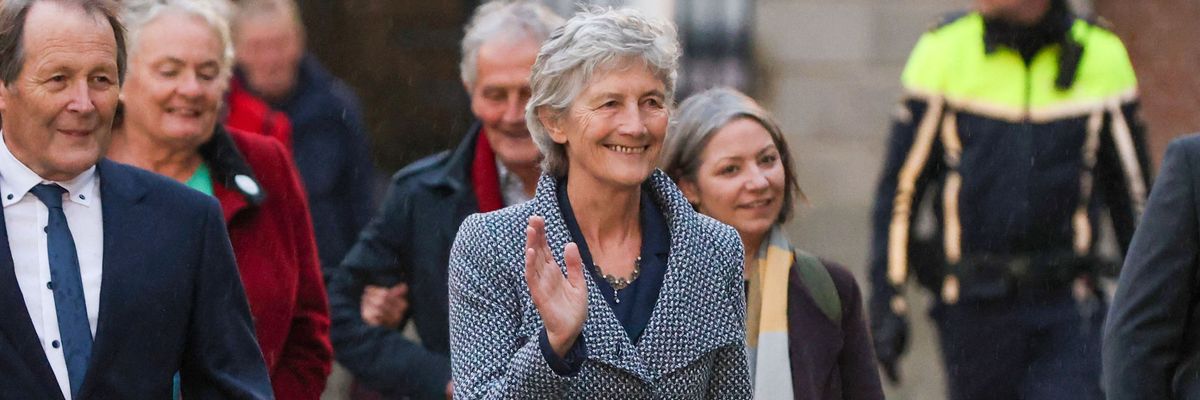
Catherine Connolly (C) smiles as she arrives at Dublin Castle, after being declared the winner in the presidential election to become the next president of Ireland in Dublin on October 25, 2025.
(Photo by Paul Faith /AFP via Getty Images)
Rachael Mellor
Nov 01, 2025
On November 11 2025, independent Member of Parliament Catherine Connolly will become the new president of Ireland after winning an overwhelming victory over the fiercely unpopular Heather Humphreys.
In her acceptance speech, President Connolly vowed to remain rooted in service, stay humble, and actively practice neutrality. She is anti-war, anti-imperialist, pro-reunification, an advocate for disability rights, and fluent in Irish. She has also been openly critical of the European Union’s inaction on Gaza, and is distrustful of France and the United Kingdom due to their massive armament programs.
In her words, Connolly strives to be “a moral compass in a world increasingly driven by profit and spectacle. A voice for those too often silenced.”
As a former barrister, from a humble background, Connolly has spent her years volunteering with the elderly and taking night classes to train in law. She formally entered politics in 1999 with the mission of tackling Ireland’s dire housing shortage crisis.
After serving 17 years as a councillor in Galway for the Labour Party, she left, citing a lack of support, and began her journey as an independent. In 2020, she became the first woman elected to chair debates as deputy speaker in the Dáil Éireann.
Rather than pandering to corporate interests, the wealthy elite, or a personal ego trip bent on abusing power (naming no names), Connolly offers a hopeful vision for a more compassionate and responsible approach to politics.
Connolly’s victory marked an important moment for independent candidates around the world. As the world slides to the right, her humble message of peace, inclusivity, and democracy is a powerful reminder that there is light. We must continue to draw attention to and support those who stand up against the establishment.
Connolly has shown that it is possible for well-deserving underdogs such as Zohran Mamdani, Jeremy Corbyn, Zack Polanski, and Bernie Sanders to bring common-good policies into the mainstream.
2025 Irish Presidential Election—Game-Changing for this Divided Nation
In a demonstration of her ability to unify opposing voices, Connolly’s landslide win came after she secured the support of opposition parties Sinn Féin, the Social Democrats, People Before Profit, and even her former party, Labour.
As an independent, Connolly pledged, in her opening speech, to be a ‘“president for all.” Her victory was secured after gaining the largest number of first-preference votes ever—the equivalent of 63%.
When we look at the bigger picture, however, it tells the story of a divided, disillusioned, and apathetic Ireland tired of the two-party system. Voter turnout was just 45.8%, and a huge 213,738 votes were either invalid or spoiled. This accounted for almost 13% of the overall vote, notably, more than 10 times the number in the last presidential election.
In the run-up to the election, violent riots broke out in the capital for two consecutive days. They took place in front of a hotel housing asylum seekers in an anti-immigration sentiment being witnessed across large parts of Europe. This is just one example of the ongoing immigration tensions in Ireland.
Irish citizens are frustrated with the government after years of austerity measures, the ongoing housing crisis, poor public services such as healthcare, and the fact that key candidates, such as Maria Steen, were not on the ballot.
Connolly’s Policies—A Progressive Ireland Led by a Moral Compass
With Connolly’s left-wing, progressive, and anti-war stance at the reins, the world eagerly awaits to see if Ireland can be the guiding light that so many nations need right now. In the face of fascist, authoritarian leaders such as Donald Trump, Viktor Orbán, Xi Jinping, Vladimir Putin, Benjamin Netanyahu, and Nicolás Maduro, we desperately need a new playbook.
Some of Connolly’s stances include:Strong advocacy for Irish reunification through a peaceful and democratic process;
The legalization of same-sex marriage. She stands for equality for all individuals, regardless of their sexual orientation;
Providing access to safe and legal abortion services. She advocates for reproductive rights and a woman’s right to choose;
A compassionate and humane approach to immigration;
A universal healthcare system that is accessible to everyone;
Addressing the housing issue and getting people experiencing homelessness off the streets;
The promotion and preservation of the Irish language by encouraging its integration into education and public life;
Comprehensive and urgent climate action to reduce carbon emissions, promote renewable alternatives, and support conservation efforts;
Implementing a wealth tax to address economic inequalities and fund public services;
Enhancing democratic processes to ensure transparency, accountability, and increased public participation;
Promoting peace through diplomatic means and maintaining neutrality. She is critical of NATO and other military alliances; and
Vocal advocacy for peace in Gaza, ending the blockade, and promoting humanitarian efforts to end the suffering of the Palestinian people. She supports a more ethical approach to international arms sales and highlights the complicity of those weapons which are used to commit war crimes, genocide, and create long-lasting human suffering.
With her pledge to be accountable to the citizens of Ireland, her policies are people-and-planet focused. Her commitment to justice, equality, and transparency is a refreshing change from the status quo. Rather than pandering to corporate interests, the wealthy elite, or a personal ego trip bent on abusing power (naming no names), Connolly offers a hopeful vision for a more compassionate and responsible approach to politics.
Let’s hope that her recent win bolsters the campaigns of other progressive candidates and serves as a reminder that positive change is possible. This is a huge win for the left; let’s keep the momentum going.
In the words of Catherine Connolly: “Use your voice in every way you can, because a republic and a democracy need constructive questioning, and together we can shape a new republic that values everybody.”
Rachael Mellor
Rachael is a key writer for the nonprofit platform Better World Info, which focuses on global issues such as peace, human rights, environment, and social justice. Her articles are also published in The Transnational and Peace News. Follow her work at www.betterworld.info and @BetterWorldInfo.
Full Bio >
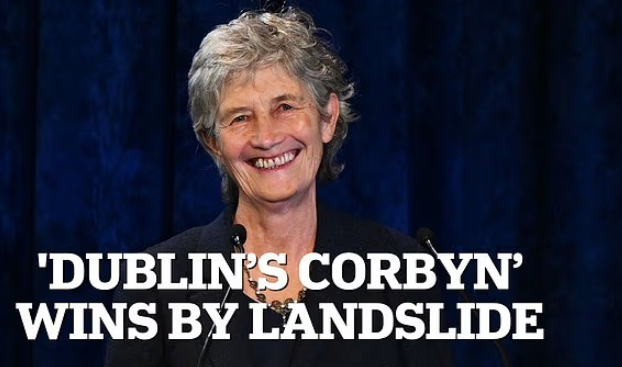
While the right may intend it as a slur, many would see the label ‘Dublin’s Corbyn’ as praise, a recognition of Catherine Connolly’s courage, compassion, and conviction.
Ireland has chosen a new president.
Catherine Connolly, the independent, pro-labour, pro-environment, pro-Palestine, pro-choice, pro-LGBT, left-wing politician from Galway, has been elected President of Ireland in a historic landslide.
A former barrister and lifelong campaigner for peace and social justice, Connolly won 63 percent of first preferences, trouncing former cabinet minister Heather Humphreys in the race to succeed Michael Higgins as head of state.
A self-described socialist and pacifist, Connolly has long championed equality, environmental justice, and national reunification. In her acceptance speech, delivered, fittingly, in Irish rather than English, she declared:
“I will be a voice for peace, a voice that builds on our policy of neutrality, a voice that articulates the existential threat posed by climate change, and a voice that recognises the tremendous work being done the length and breadth of the country.”
Connolly is an independent member of the Dail who managed to unite the majority of left-wing parties, including Sinn Fein, the Social Democrats and Labour, behind her candidacy.
Politicians from across the left hailed her victory as a watershed moment. Coventry South MP Zarah Sultana called it “a historic landslide for peace, justice, equality and socialism,” while Jeremy Corbyn congratulated Ireland’s “new President” whose victory, he wrote, was “a triumph for humanity and hope.”
Naturally, it didn’t take long for the vultures of the right-wing press to circle. Within hours, British tabloids were splashing headlines dripping with scorn and suspicion.
‘Dublin’s Corbyn’ Catherine Connolly pledges to unite Ireland: Far-left radical who called Hamas ‘part of the fabric of the Palestinian people’ claims landslide win in presidential elections,’ splashed the Daily Mail.
The paper’s coverage framed Connolly’s democratic victory as a geopolitical threat, claiming it would “send a shiver through Western foreign ministries – in particular those of Washington and Britain – after a series of hard-Left and pro-unification remarks.”
As is almost customary, the Mail couldn’t resist a derogatory reference to asylum seekers and “migrant hotels,” claiming Connolly’s election adds to the “turbulent politics of the Irish Republic,” … “sparked by the alleged sexual assault of a ten-year-old girl outside a migrant hotel.”
GB News followed suit, stating: “‘Ugly undercurrent!’ Unionists lash out at Irish Presidential election after hard-left independent seals victory.”
The Telegraph, meanwhile, described the election as “mired in controversy,” in that Fianna Fáil candidate Jim Gavin had withdrawn late in the race over an unresolved €3,300 rent dispute, leaving his name on the ballot, implying somewhat that Connolly’s victory was somehow less legitimate because the centre-right vote was split.
While the right may intend it as a slur, many would see the label ‘Dublin’s Corbyn’ as praise, a recognition of Catherine Connolly’s courage, compassion, and conviction.
Want Right-Wing Watch in a different format? Subscribe on Substack.
Triumph for united left in Irish presidential election

By Carol Coulter
The election of Catherine Connolly as the tenth president of Ireland with two-thirds of the valid votes cast has delivered a body-blow to the government and the two parties which make it up. It has provided a shot in the arm for the left, giving rise to hope of ongoing cooperation across a fractured left and the possibility of a left government after the next election, due in four years’ time.
None of this is a foregone conclusion. Presidential elections in Ireland rarely predict the outcome of general elections, as the president has no executive powers and largely plays a ceremonial role. Connolly’s victory is due not only to an exceptionally well-organised and well-received campaign, but to a disastrous series of mistakes by the governing parties. Her 63.5 per cent of the vote was a resounding endorsement, though based on a turnout of just 46 per cent. A worrying 13 per cent of voters spoiled their votes, indicating disillusionment on the part of a significant proportion of the electorate with the political system and the choice available in this election.
The role of the president is quite limited under the Constitution, involving formal appointment of the government and judiciary, signing legislation and representing the state abroad, but it has been stretched by successive presidents in recent decades. Mary Robinson visited Belfast and met Gerry Adams in 1993, a visit credited with giving an impetus to the peace process. Her successor, Mary McAleese, a Catholic from Northern Ireland, hosted the first ever visit to the Republic by a British monarch, Queen Elizabeth.
Michael D Higgins adroitly steered a “decade of commemorations” from 2013 to 2022 with a series of events marking the Dublin Lockout of 1913, the 1916 Rising, the subsequent War of Independence and then civil war, as well as the First World War in which tens of thousands of Irishmen died. He has also expressed trenchant views on Palestine, on the EU, on the negative impact of economic liberalism and on domestic issues like the housing crisis, which have not always coincided with those of the government and have raised questions as to whether he remained within the confines of the Constitution. Nonetheless, Higgins has been immensely popular, especially among young people, and his views undoubtedly chime with many of theirs.
The presidency, therefore, has come to be an important symbol of identity, expressing the values Irish people seek to show to the world. What presidential candidates are expected to offer is a vision as to how that identity is expressed.
Catherine Connolly is a former member of the Labour Party, serving in the Dail since 2011 as a left independent. There she has been an outspoken critic of the government on housing, domestic violence and poverty as well as being one of the first to denounce the genocide in Gaza and its enablers in the US, the UK and the EU. She is a fluent Irish speaker at a time when the Irish language has become popular among young people (she was endorsed by the Belfast Irish-language rap group Kneecap) and links Irish sympathy for the plight of Palestinians to our experience of colonialism.
She announced her candidacy for the presidency in July, and obtained the support of a small left-wing party, People before Profit, the Social Democrats (a split from the Labour Party) and a handful of left independents, meeting the constitutional requirement that a candidate be nominated by at least 20 members of the Dail or Senate (an alternative route to candidacy is nomination by four county councils). The Labour Party soon joined them and sought to rally wider left support for her candidacy. The Green Party followed suit. Following several weeks of internal discussion, Sinn Fein finally said in September that it would not field a candidate, but would support Connolly.
Of interest is the fact that this meant that a female candidate, Connolly, had the support of three female party leaders, Sinn Fein’s Mary Lou McDonald, Holly Cairns of the Social Democrats and Ivana Bacik of the Labour Party and their appearance together on platforms conveyed its own message.
One of the governing parties, Fine Gael, nominated its MEP and EU commissioner, Mairead McGuinness. However, weeks later she announced she was withdrawing for health reasons, and was replaced by a former minister, Heather Humphreys. The other governing party, Fianna Fail, did not nominate one of its own politicians but a former prominent football manager, Jim Gavin, seeking to broaden the appeal of a party that has been in decline since the financial crash.
This strategy, already internally divisive, spectacularly imploded when he was found to have deprived a tenant of a rent refund due to him almost 17 years earlier, and Gavin announced his withdrawal from the race. However, it came too late to remove his name from the ballot paper, where it remained. The Fianna Fail leadership then urged its supporters to vote for Humphreys, essentially the government candidate.
Meanwhile, a raft of prospective candidates sought nominations from politicians and county councils. A representative of a right-wing Catholic think-tank, Maria Steen, came closest, with 18 members of the Dail and Senate nominating her, but fell short of the necessary 20. Her supporters called for a spoiled vote, saying their constituency (a third of the electorate opposed recent changes to the Constitution on gay marriage and abortion) had no-one to vote for.
This left Connolly facing Humphries. It quickly emerged that this was an unequal contest. Humphreys, a Presbyterian from a border county, relied on this as evidence of her ability to connect with Northern Protestants in the context of a future united Ireland, but otherwise had nothing to say about her vision for the presidency. Connolly spoke of her support for the marginalised, her opposition to the genocide in Gaza and its enablers and her defence of Irish neutrality, which she saw as being undermined by growing militarisation in Europe. Her fluency in Irish also proved an asset to a generation confident in their Irish identity.
The Connolly campaign ran an extensive and effective campaign on social media, where she engaged with multiple podcasters and posted videos demonstrating a spontaneity and authenticity patently lacking in her opponent. In the set-piece media debates she was articulate and fluent while Humphreys often hesitated or uttered banalities like, “I am a mother and a grandmother”.
The Fine Gael campaign resorted to a number of increasingly desperate attacks on Connolly, seeking to portray her as an extreme left-wing candidate who would damage our international alliances. None of this stemmed her inexorable rise in the opinion polls, where at the outset of the campaign, when Gavin was still a candidate, all three were roughly level, to the final poll, when she led Humphreys by 18 per cent. Among 18-35-year-olds her support was 82 per cent. This gap was dwarfed by the eventual result, when her share of the valid poll was 35 percentage points ahead of that of Humphreys, the highest first preference vote of a presidential candidate ever.
But where the difference was most striking was in the ground campaign. 15,000 volunteers signed up to work for Connolly. Given that the population of Ireland is about five million, this would equate to over 200,000 in the UK. They ranged in age from students to veterans of left-wing campaigns of the late 1960s and 1970s. Some were members of the parties supporting her, many were not. As they canvassed houses throughout the country, the support for Connolly was palpable.
The question is what does the left do now. One of the things the campaign has done is formulate what the left in Ireland actually consists of. Sinn Fein, while it has long embraced generally social-democratic policies, has been unable to implement them while sharing power with the DUP in Northern Ireland, due to this and Westminster’s budgetary stranglehold. In elections in the south it never ruled out the prospect of a coalition with Fianna Fail. The Labour Party has a long history of successive coalitions with Fine Gael, for which it always paid dearly in subsequent elections. The Social Democrats were also equivocal in the wake of the last election.
The stance adopted by these parties in this campaign should rule such prospects out in the future. Meanwhile, People Before Profit, an assortment of former Trotskyists, has tended to treat the other left parties with contempt for even contemplating government, but this stance may be tempered by the experience of what unity can achieve.
There are four years to the next general election, unless this highly unpopular government falls. Proportional representation, where second and third preferences can play a crucial role in electing deputies to the Dail, allows the parties of the left to agree to transfer to each other, thus maximising the impact of a left vote. A pact to do this is likely.
But, if the momentum is to be maintained, more will have to be done. Already there is discussion around mounting joint campaigns on issues like housing, where a crisis in affordable housing has driven tens of thousands of young people abroad, leaving jobs unfilled in education and the health service, and some smaller towns emptied out of a generation.
And what do the spoiled votes signify? First, it is clear this was not a unified protest vote. Some voters scrawled the name of Maria Steen or another failed candidate on the ballot paper, others just crossed out the whole paper. A substantial number referenced immigration, including an alleged sexual assault on a young girl by a failed asylum seeker in the days before the election. This sparked three days of rioting outside a centre for refugees and asylum-seekers, mobilising 2,000 people at its height.
There is clearly a section of the population alienated from the political system for a variety of reasons. A housing crisis has been the major issue for over a decade, and successive governments, dominated by the same parties, have signally failed to do anything about it. An influx of refugees and asylum-seekers (Ireland took in over 100,000 Ukrainians) has exacerbated the problem, as well as creating pressure on schools and health services. A cost-of-living crisis, propelled by food price increases, has left many struggling. While up to now no right-wing party has gained a foothold in the Dail, unless these problems are solved it will only be a matter of time. A united left alternative could not be more urgent.
Carol Coulter is former Legal Affairs Editor of the Irish Times and currently runs the Child Law Project. She canvassed for Catherine Connolly.
Image: Catherine Connolly. Source: This image has been extracted from another file
: Therese Beirne and Catherine Connolly, March 2024.jpg. Author: Houses of the Oireachtas, licensed under the Creative Commons Attribution 2.0 Generic license.


No comments:
Post a Comment