It’s possible that I shall make an ass of myself. But in that case one can always get out of it with a little dialectic. I have, of course, so worded my proposition as to be right either way (K.Marx, Letter to F.Engels on the Indian Mutiny)
Wednesday, December 24, 2025
Study uncovers disrupted brain balance in alcohol dependence
Experiments show how dependence on alcohol rewires the brain's "go" and "stop drinking" signaling systems, with implications for preventing relapse.
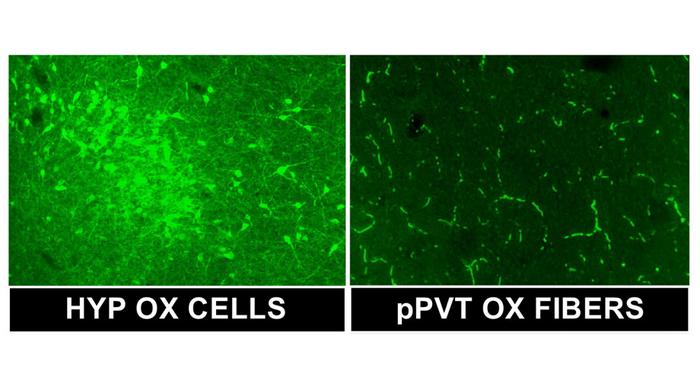
Orexin, one of the two signals the researchers studied, originates in neurons (green) in the brain’s hypothalamus (left) that connect with a part of the thalamus called the pPVT (right).
LA JOLLA, CA—A new study by Scripps Research reveals that alcohol dependence disrupts two signaling pathways in a stress-related part of the brain—and offers insights on developing drugs to treat this condition.
The research, conducted in animal models and published in Frontiers in Pharmacology on November 26, 2025, helps explain why people with alcohol use disorder (AUD) struggle to stay sober, especially under stress.
"We think that alcohol dependence changes these systems, and that's why individuals are prone to seek out alcohol even if they've gone without it for some time,” says senior author Rémi Martin-Fardon, an associate professor in the Department of Translational Medicine.
AUD, a condition in which someone cannot control their drinking despite the harm it causes, affects nearly 28 million Americans. FDA-approved medications like naltrexone, which reduces cravings, exist but have significant drawbacks, including nausea, and they do not work for everyone.
This recent study points to potential new treatments by uncovering molecular changes in two signaling systems—orexin and dynorphin—and the unexpected effects of blocking them. Inhibiting either signal individually reduced relapse-like behavior but, interestingly, blocking both cancelled this protective effect.
Once someone loses control of their drinking, regaining it can be a lifelong struggle. Research has demonstrated that stress increases the likelihood someone will become dependent on alcohol and will relapse after they try to stop. But the relationship goes two ways, because drinking itself activates the body’s stress response systems.
Among the systems affected is orexin-dynorphin signaling. These two neuropeptides are released by the same neurons, which originate in the brain’s hypothalamus, the region that coordinates the release of chemical signals. In normal brains, they have opposing effects: Orexin, discovered by scientists at Scripps Research and another team in 1998, acts as a "go" signal and promotes drug-seeking behavior. Meanwhile, dynorphin serves as the "stop" signal. In AUD, excessive drinking appears to alter dynorphin signaling so it produces the many diverse and unpleasant feelings that accompany withdrawal and motivate continued drinking.
Martin-Fardon's group has previously studied this relationship in cocaine addiction. This time, in experiments led by postdoctoral researcher Francisco Flores-Ramirez with research assistant Glenn Pascasio, they turned to alcohol.
The team zeroed in on a small region within the brain’s thalamus called the posterior paraventricular nucleus of the thalamus, or pPVT, a stress-processing hub that receives orexin and dynorphin signals. Martin-Fardon’s earlier work indicated that the pPVT is key to stress-triggered relapse-like behavior.
In this study, they found telling changes in gene expression. In alcohol-dependent rats, the hypothalamus appeared to be ramping up production of both the orexin "go" and dynorphin "stop" signals. But the pPVT's ability to receive them was skewed. Its neurons expressed fewer receptors for orexin, but more for dynorphin.
"What that tells us is that just being dependent on alcohol changes the orexin and dynorphin system, and that these changes persist well into abstinence," Flores-Ramirez says.
To reach these conclusions, the team simulated AUD in male rats, which pressed a lever to receive alcohol. After cutting off the alcohol supply, the researchers examined gene expression in both the pPVT and hypothalamus. Some animals had received inhibitors to block orexin or dynorphin signaling in their pPVTs, producing complex and somewhat counterintuitive results. As expected, shutting down the orexin "go" signal reduced stressed rats' attempts to drink alcohol. But blocking dynorphin's "stop" signal also appeared to significantly decrease the relapse-like behavior. When they inhibited both signals together, however, the rats pressed the lever as if they had not received any inhibitor at all.
Because the study focused on a single brain region and relied solely on male animals, the researchers say it's difficult to explain these effects or tie them directly to the changes in gene expression. Still, they sound a note of caution for drug development.
"If you want to combine treatments, you have to be very careful," Martin-Fardon says, though he notes that this strategy may be effective with different inhibitors—perhaps taking advantage of existing drugs or compounds with similar chemistry.
His team is now collaborating with Scripps Research colleagues Edward Roberts and Hugh Rosen, who are developing selective, shorter-acting dynorphin signaling inhibitors intended to provide quick relief. Martin-Fardon is also interested in combining one of these compounds with suvorexant, an insomnia drug that blocks orexin signaling, or a similar drug.
This study was supported by funding from the National Institute on Alcohol Abuse and Alcoholism (grant no. AA028549 and AA006420 to RM-F).
Journal
Frontiers in Pharmacology
Article Title
Functional interaction between orexin/dynorphin transmission in the posterior paraventricular nucleus of the thalamus following alcohol dependence: mediation of alcohol-seeking behavior
Brain injuries linked with potential risk of suicide, new study finds
The first of its kind study analysed data from over 1.8 million
Adults who experience a head injury face a substantially higher risk of attempting suicide compared to those without such injuries, according to the findings from a new UK-based study.
Published in Neurology®, the medical journal of the American Academy of Neurology, the study was led by University of Birmingham researchers. The paper is the first of its kind to examine suicide risk across all types of head injuries in a general population, moving beyond the traditional focus on traumatic brain injuries (TBIs) in military, athletic or hospital settings.
The population-based matched cohort study used nationally represented electronic primary healthcare records from more than 1.8 million adults, linked with Hospital Episode Statistics and Office for National Statistics data.
Researchers found that people with head injuries were 21% more likely to attempt suicide than those without, after analysing data across a 20-year period.
Key Findings:
Researchers found that people with head injuries were 21% more likely to attempt suicide than those without, even after adjusting for age, sex, deprivation, and mental health history.
The incidence rate was 2.4 per 1,000 person-years in individuals with head injuries, compared to 1.6 per 1,000 person-years in the control group. This translates to an absolute increase in risk of 0.7% (1.3% vs 0.6%), yet the adjusted hazard ratio reported was 21%, and
Elevated risk was observed across all subgroups, including individuals with no prior mental health conditions, highlighting that head injuries alone are linked to increased psychological vulnerability.
Professor Nicola Adderley, Professor of Epidemiology and Real-World Evidence at the University of Birmingham and a lead author of the study, said: “Our findings show that the impact of head injuries are not limited to just physical symptoms or repercussions. They can have profound psychological consequences. Suicide risk assessments should be considered for anyone with a recent head injury, regardless of their mental health history, to improve and safeguard patient outcomes.”
In the UK alone, nearly 6,000 deaths each year are attributed to suicide whilst the number of attempts is significantly higher. The study’s findings showed that the risk of suicide attempt was highest in the first 12 months following a head injury, suggesting a critical window for intervention.
While the risk declined over time, it remained elevated compared to those without head injuries. Researchers also found that social deprivation and a history of mental health conditions further amplified the risk.
While suicide attempts were more common among those with head injuries, the study did not find a significant increase in deaths by suicide after accounting for competing risks such as other causes of death; suggesting that head injuries may lead to more frequent non-fatal attempts.
Researchers are calling for the following changes in healthcare settings:
Routine suicide risk screening in primary and secondary care settings for patients with head injuries.
Enhanced mental health support, particularly during the first 12 months post-injury; with public awareness campaigns to help families and caregivers recognise warning signs.
The development and testing of suicide risk assessment and prevention strategies for people with head injuries should be investigated, especially within the first 12 months post-head injury and irrespective of mental health history.
Professor G. Neil Thomas, Professor of Epidemiology and Research Methods and a lead author of the study, said: “These findings have implications for both clinical practice and health policy; highlighting the urgent need for targeted mental health and wellbeing support.
“The development and testing of robust suicide risk assessment and prevention strategies for people with head injuries should be further investigated; especially within the first 12 months post-head injury and irrespective of mental health history.”
The research utilised data from the Clinical Practice Research Datalink (CPRD), linked with hospital and mortality records, covering a 20-year period (2000–2020). Ethical approval was granted by the Health Research Authority and CPRD Independent Scientific Advisory Committee.
Journal
Neurology
Article Title
The risk of suicide attempts after head injury: a matched UK population-based cohort study
Article Publication Date
22-Dec-2025
Exploring why some people may tend to persistently make bad choices
Some people rely on surrounding images and sounds to make decisions more than others. These individuals have a harder time updating their beliefs about these cues when they change to signal risky outcomes, which may lead to poor decision making over time.
When people learn that surrounding visuals and sounds may signify specific choice outcomes, these cues can become guides for decision making. For people with compulsive disorders, addictions, or anxiety, the associations between cues and choice outcomes can eventually promote poor decisions as they come to favor or avoid cues in a more biased manner. Giuseppe di Pellegrino, from the University of Bologna, led a study to explore associative learning and maladaptive decision making in people.
As reported in their JNeurosci paper, the researchers discovered that some people rely on surrounding cues to make decisions more than others. Furthermore, these individuals may have a harder time updating their beliefs and unlearning these associations when the cues change to signify riskier outcomes. This leads to more disadvantageous decision making that persists over time.
According to the researchers, this work suggests that some people have stronger cue sensitivity and less of an ability to update their beliefs about cues than others. The researchers aim to continue exploring associative learning in patient populations and probing whether harmful decision patterns—which characterize addictions, compulsive disorders, and anxiety—are more likely in those with heightened sensitivity to visuals and sounds that guide their choices.
JNeurosci was launched in 1981 as a means to communicate the findings of the highest quality neuroscience research to the growing field. Today, the journal remains committed to publishing cutting-edge neuroscience that will have an immediate and lasting scientific impact, while responding to authors' changing publishing needs, representing breadth of the field and diversity in authorship.
About The Society for Neuroscience
The Society for Neuroscience is the world's largest organization of scientists and physicians devoted to understanding the brain and nervous system. The nonprofit organization, founded in 1969, now has nearly 35,000 members in more than 95 countries.

No comments:
Post a Comment