Coal demand hits fresh high as US output rises — IEA
Cecilia Jamasmie | December 17, 2025 |
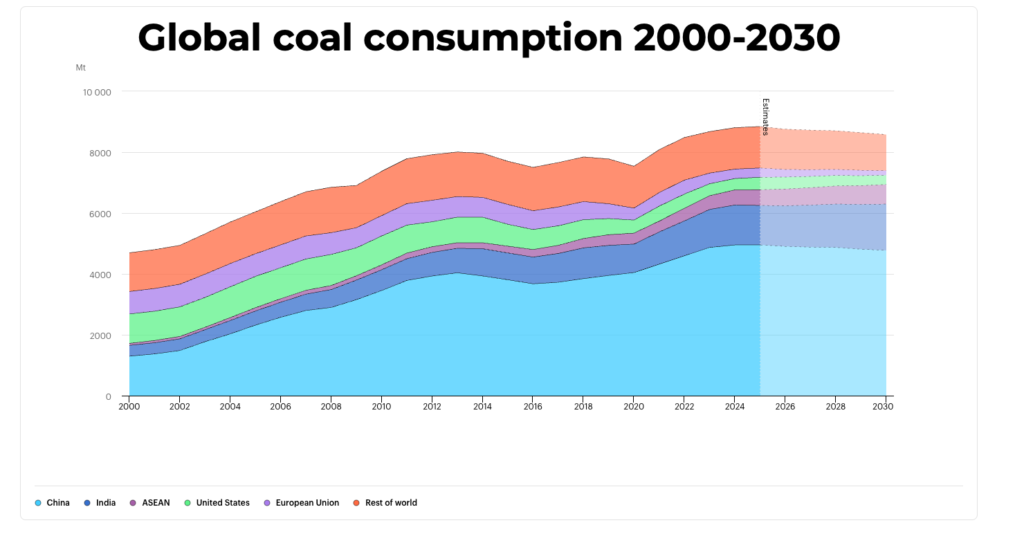
Global coal demand is set to reach a new record high in 2025, driven by higher output in the United States, before flattening and slowly declining by the end of the decade, according to the latest International Energy Agency (IEA) report.

The IEA projects global coal demand will rise 0.5% from 2024 to a record 8.85 billion tonnes this year, even as renewables, nuclear power and plentiful natural gas steadily erode coal’s grip on power generation.
The forecast underlines how hard it remains to quit fossil fuels, despite rapid growth in clean energy.
In the US, coal use is set to jump 8% in 2025, snapping a 15-year stretch of roughly 6% annual declines. Higher natural gas prices, slower retirements of coal-fired plants and federal policy support have lifted output, while weak wind conditions in Europe also blunted efforts there to move away from coal.
“Looking ahead, we observe that global coal demand plateaus and will start a very slow and gradual decline through the end of the decade,” IEA’s director of energy markets and security Keisuke Sadamori said.
Crying wolf on peak coal
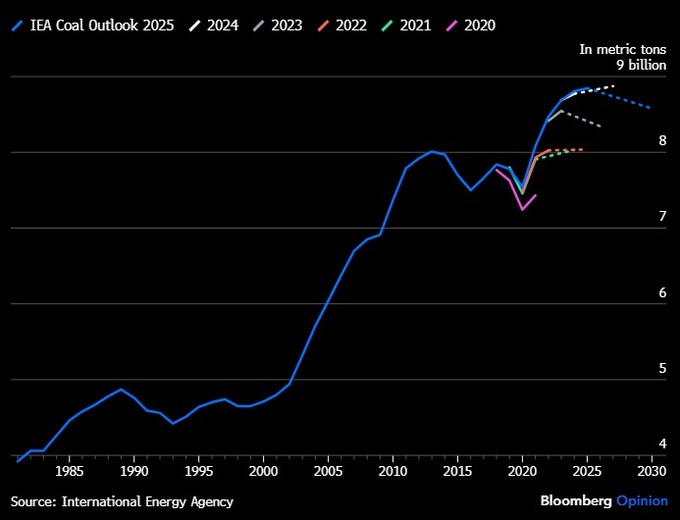
Calling the peak for coal has repeatedly humbled analysts, including the IEA itself. In 2023, the agency said demand had likely peaked, only to see consumption hit a new record in 2024 and rise again this year, largely because of surging electricity demand in China, India and other fast-growing economies. The latest outlook warns that the five-year forecast remains subject to “significant uncertainties” that could materially change the picture.
The report comes on the heels of the Paris Agreement’s 10-year- anniversary. The pact committed countries to keep global warming well below 2°C above pre-industrial levels, while striving to limit it to 1.5°C.
The United Nations’ 2025 Emissions Gap Report, released in November, says the world is currently on track for about 2.3°C warming by 2100, even if countries fully deliver on their stated climate commitments.
Recent global analyses show average warming over the past three years has already exceeded 1.5°C, with parts of the Arctic, Central and Eastern Europe, and North America running 3–7°C hotter than pre-industrial times. Whether this overshoot proves brief or lasting will shape social and economic stability for decades.
China and India Keep Global Coal Demand Rising
- Bloomberg: Global coal demand rose to an all-time high in 2025, up 0.5% y-on-y to 8,845 million tons.
- China consumes more coal than the rest of the world combined and fully determines global trends.
- India is the main source of net demand growth through 2030, driven by electricity demand, cement, steel, and coal-based industrial processes.
Bloomberg Opinion columnist and chief energy correspondent Javier Blas posted a chart on X from the International Energy Agency's new global coal report showing that coal demand jumped to an all-time high this year, despite years of efforts by the green-industrial complex to end its very existence.
"Global coal demand rose to an all-time high in 2025, up 0.5% y-on-y to 8,845 million tons (also, @IEA revised up 2024)," Blas wrote on X, adding, "Now, IEA says 2025 will mark a peak, with consumption dropping over the next 5 years. Time will tell, but previous peak forecasts were off."
Years of climate alarmists' demonization of coal have seemingly failed. In fact, coal remains structurally embedded in power systems and heavy industry, especially in Asia, even as renewables expand.
IEA's global coal demand forecast:
2025 global coal demand: 8.85 billion tonnes, a new record.
2030 outlook: roughly 3% below 2025 levels, still above pre-2023 norms.
Coal’s role shifts from baseload power to flexibility, backup, and reliability as wind and solar penetration rises.
Industrial coal use declines slowly; substitution is difficult outside power generation.
By country and/or region:
China:
Consumes more coal than the rest of the world combined and fully determines global trends.
Demand is broadly flat through 2025, then declines only marginally by 2030. Rapid renewable buildout reduces coal’s share of generation, but coal remains essential for grid stability.
Coal-to-chemicals and gasification offset declines in cement and steel, creating upside risk to demand forecasts.
India and Southeast Asia
India is the main source of net demand growth through 2030, driven by electricity demand, cement, steel, and coal-based industrial processes.
Southeast Asia shows the fastest growth rate, led by new coal power and metals processing.
Together, these regions offset most declines in advanced economies.
Europe
Structural decline continues, but short-term coal burn remains volatile due to gas prices, wind variability, and security-of-supply concerns.
Coal exits are politically uneven, with delays and carve-outs across several countries.
United States
Near-term coal demand rebounds in 2025 due to higher gas prices, weather effects, and explicit federal policy support.
Long-term trend remains downward, but decline slows materially versus prior expectations.
Coal plants increasingly retained for reliability amid rising power demand and data-center load.
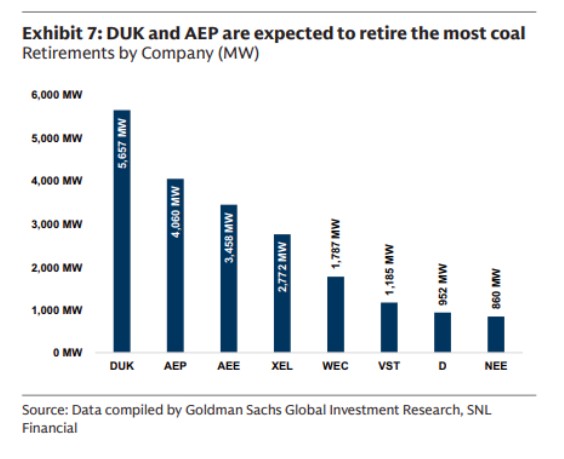
Focusing on the U.S. and separate from the IEA report, Goldman analysts, led by Carly Davenport, wrote in a note to clients earlier this month that U.S. coal retirements would slow.
In this note, we update our US and ERCOT power supply/demand models. We lower our US coal retirement forecast, now expecting ~40 GW of coal capacity retirement through 2030 (vs. 66 GW prior), as we expect assets to remain online to meet growing power demand until new build baseload solutions are more readily available.
What may infuriate climate alarmists is that coal is not disappearing this decade and will continue to serve as a bridge in a world of surging power demand from AI data centers and other electrification trends until sufficient nuclear power generation comes online, which is a 2030s story.
By Zerohedge.com

No comments:
Post a Comment