From Digitalization to Automation: 2026 Will Redefine Maritime Operations
This year has marked a major leap forward in maritime digitalization, driven by rapid advances in AI and a surge in tools supporting compliance and operational efficiency. But the wider shift happening across global industries goes far beyond adopting new software. In accounting, property management, transportation, legal, IT services and wealth management, we are now seeing a new kind of consolidation: AI-native, large-scale service companies. Venture and private equity funds are acquiring dozens of fragmented service providers, placing them onto unified AI operating systems, and operating them at dramatically higher levels of productivity, consistency and margin than traditional players. These AI-native platforms are already overtaking incumbents in cost, speed and reliability.
Maritime is not exempt from what is reshaping the rest of the service economy. Our sector shares the same characteristics as those undergoing consolidation today: highly fragmented structures, people-intensive operations, heavy compliance workloads, and wide variability in process execution. Traditional consolidation is already well underway, but the next competitive pressure will come from operators who embrace data standardization and AI automation far earlier and more decisively than the rest of the market. The message is becoming increasingly clear: companies must become streamlined, interoperable and AI-assisted—or risk being absorbed into more efficient, AI-native platforms as the industry evolves.
The IMO’s decision to delay its Net Zero Framework has also shifted attention back toward core operational fundamentals. While sustainability remains essential, there is renewed focus on the basics: safe operations, high-quality training, and digital tools that genuinely empower and protect seafarers. The next five years will be defined by AI-driven productivity gains and interoperability between ship and shore, reducing time spent on routine administration and enabling humans to focus on decisions that impact safety, availability and cost. Crucially, AI is not here to replace crewmembers. It is here to support them, remove administrative friction, and strengthen confidence in judgment.
Over the past year, growing proof points have shifted the adoption curve. With improved connectivity, new standards, and rising expectations through frameworks like SIRE 2.0 and RightShip, companies are gaining confidence because digital tools now demonstrate clear, measurable ROI. When technology fits real operational workflows, maritime adopts quickly—something we have seen repeatedly whenever solutions genuinely save time, reduce risk or pay for themselves. The task for 2026 is ensuring that late adopters can onboard without disruption, through turnkey rollouts, offline-capable systems and full visibility for crews and shore teams alike.
Regulation will continue to raise minimum standards, but it rarely drives transformation alone. True progress depends on leadership: sharing best practices, highlighting peers’ successes, and demonstrating with evidence what effective digitalization looks like in day-to-day operations. As we move into 2026, the shift will no longer be about digitizing paperwork but about automating work. AI will shoulder administrative weight onboard and ashore, enabling continuous readiness, risk- and cost-based maintenance planning, and far greater visibility into human factors such as corrosion patterns, behavioral trends and recurring operational gaps. This is where the industry will see the most meaningful gains: fewer surprises, stronger planning horizons, and more time allocated to real operational work.
Connectivity improvements and mounting compliance pressures have already pushed many leaders from document-based to data-driven operations. Data is increasingly being used to target maintenance, forecast risks, and evaluate readiness with far greater precision. Yet major challenges remain—fragmented systems, duplicate workflows, inconsistent onboard adoption, and significant administrative burden for technical teams. These gaps create real risk, as well as an opportunity: the companies that solve them first will set the operational benchmark for the decade.
The path forward lies in standardizing how data is collected, interpreted and shared—from observations and defect reports to photographic evidence and structured analytics. The goal is not simply to collect more information, but to ensure that data leads to better decisions and better outcomes. As other industries have shown, the organizations that embrace automation and AI-supported operations will widen the efficiency gap quickly, creating competitive pressure that slower adopters will struggle to match.
Maritime now stands at the same inflection point as many other service sectors. The coming years will reward companies that build interoperable, AI-assisted operating models and penalize those that cling to manual, inconsistent processes. The industry has a choice: evolve into streamlined, data-driven platforms—or risk being consolidated into those who already have. But the essence of progress remains unchanged. We win only when crews and technical managers win—when workflows become clearer, surprises become fewer, and people have more time for real operational work. This is the next wave of maritime innovation, and 2026 will bring it firmly into view.
Fabian Fussek is co-founder and CEO of Kaiko Systems.
The opinions expressed herein are the author's and not necessarily those of The Maritime Executive.
Fincantieri Outlines Plan to Consolidate and Strengthen Shipbuilding Ops
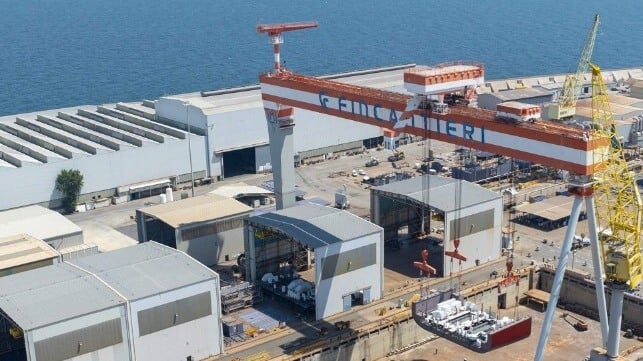
Italian shipbuilding group Fincantieri outlined its next long-term strategic plan, calling for growing its operations in the defense and underwater segments as well as specialized vessels. By 2030, the group projects it will grow revenues by 40 percent and improve margins and profitability, contributing to a 90 percent increase in EBITDA. The company projects a net profit of €500 million ($587 million) in 2030.
Fincantieri points to its strong foundation in shipbuilding with a recognized leadership in cruise ship construction and specialized offshore vessels through its VARD division. It has been strengthening its defense operations and, in May 2025, launched its new underwater segment after completing the acquisition of Leonardo’s Underwater Armaments & Systems (UAS) business, specializing in the construction of submarine defense systems and, in particular, torpedoes, countermeasures, and sonars.
As of September 30, 2025, Fincantieri reported that its backlog stood at €41.0 billion ($48 billion), up 32 percent compared to the end of 2024. It said that the backlog represents 100 ships in the portfolio with deliveries expected until 2036.
The company’s new strategic plan calls for growing revenues from the projected €9 billion in 2025 to approximately €11 billion in 2028 and €12.5 billion in 2030. Fueling this is a projected €50 billion in new orders, with defense playing a significant part in the growth of the business. They are calling for increased margins, enhanced efficiency, and an evolution in the business mix.
“The 2026-2030 Business Plan represents, firstly, an industrial manifesto borne from a strategic vision of the future, at a time when our industry is in the middle of a positive macro-trend, both in the commercial and defense sectors,” said Pierroberto Folgiero, Chief Executive Officer and Managing Director of Fincantieri. “With this plan, we enter a new phase of growth: we strengthen production capacity, increase competitiveness, and maintain focus on our core business and operational efficiency.”
Cruise continues to be a significant part of the business with Fincantieri reporting it won 11 new orders in the first nine months of this year, and has a total of 36 cruise ships on order. It believes the projected 4.5 percent average annual growth rate in cruise passengers between 2024 and 2032 will continue to drive the business segment.
Fincantieri, however, looks to defense shipbuilding to be a major driver of the business. It plans to ramp up production capacity, including doubling the production capacity in its Italian defense shipyard. The current geopolitical environment, it says, offers significant growth opportunities in defense shipbuilding. It reports that global government spending is expected to reach $2.93 trillion by 2030, up 18 percent compared to the $2.47 trillion in orders in 2025.
The group says it has identified commercial opportunities in the three years between 2026 and 2028 for over €56 billion, of which it puts a medium-high probability on €23 billion. They expect the first of the orders to come in 2026.
The new Underwater segment they project will double between 2026 and 2030. It is expected to reach €43 billion, up from the current €22 billion.
Shaping Class for the Future

This has been a significant year for ClassNK and for Hayato Suga, who stepped up to the role of President & CEO in March. Drawing on 40 years of ClassNK experience, the new CEO suggests shipping needs additional support from classification societies at a time when "boundaries between industries are becoming increasingly blurred due to environmental challenges and digital transformation."
"It is our responsibility to work with customers to provide certification and related services in a timely manner that meet diverse and fast-evolving needs," he says.
The responsibility applies to a class society whose register includes over 9,500 ships in 2025, served by 130 exclusive surveyor offices in 58 countries. Suga says he aims to make ClassNK more internationally competitive, expand its service portfolio and energize initiative-taking across the organization. A new Tech Expertise Centre in Piraeus, tasked with providing technical support beyond survey-related matters, offers a strong example.
“We are also focusing on expanding services relating to decarbonization, digitalization, and fuel certification in response to higher expectations,” says Suga. “The continuous emergence of new technologies demands that classification societies engage in thinking about and shaping what is coming next,” says Suga.
In one 2025 response, ClassNK added ClassNK Fleet Cost Simulation to its alternative fuel services to evaluate the regulatory costs of measures such as FuelEU Maritime and the EU ETS.
Low emission life cycle
Looking at the bigger emissions picture, this year ClassNK also became Asia’s first provider of Sustainable Aviation Fuel certification, in support of International Civil Aviation Organization 2027 reporting requirements. The ClassNK Sustainable Certification Scheme is authorized by ICAO to verify third parties conform when certifying CORSIA (Carbon offset reduction scheme for international civil aviation) eligible fuels.
This capability is highly relevant for shipping, given that it builds ClassNK’s experience in the type of fuel certification scheme that is expected to evolve out of IMO’s life cycle assessment (LCA) approach to greenhouse gas emissions in the future.
“We are committed to helping shipping overcome its uncertainties on energy transition by providing accurate information, reliable technical assessments and certification,” comments Suga.
Industry in transition
The society is no less energetic where more immediate needs are concerned, says Suga. ClassNK Transition Support Services are increasingly proactive on energy efficiency, alternative fuels, GHG emissions management and smart ship technologies.
In one example, ClassNK added Japan's first hydrogen-fuelled tugboat to its register in October – in the shape of TEN-OH, built by Tsuneishi Shipbuilding Co., Ltd. ClassNK reviewed the Nippon Foundation Zero Emission Ships Project vessel for safety.
Ship retrofitting is a further key area for attention. "The main challenge here lies in modifying legacy systems while ensuring technical integrity and safety, and that is an area where our expertise is well suited," says Suga.
But ClassNK has also taken a leading position in ensuring that ships continue to live up to environmental requirements at the end of life. ClassNK proactively engaged supporting implementation of the Hong Kong Convention long before it came into force in June this year – and even prior to its adoption in 2009.
To date, ClassNK has certified over 70 recycling yards and issued approval for Inventory of Hazardous Materials (IHM) for more than 5,000 vessels. Furthermore, its PrimeShip-GREEN/SRM ship recycling management software tool has become the de facto industry standard for the IHM.
The opinions expressed herein are the author's and not necessarily those of The Maritime Executive.

No comments:
Post a Comment