In Jesus’ own words, Christianity is a faith where the first shall be last and the last shall be first. It is meant not for the rich, the satisfied, and the powerful. Rather it is first intended for the poor, the hungry, the downtrodden, and the rejected.
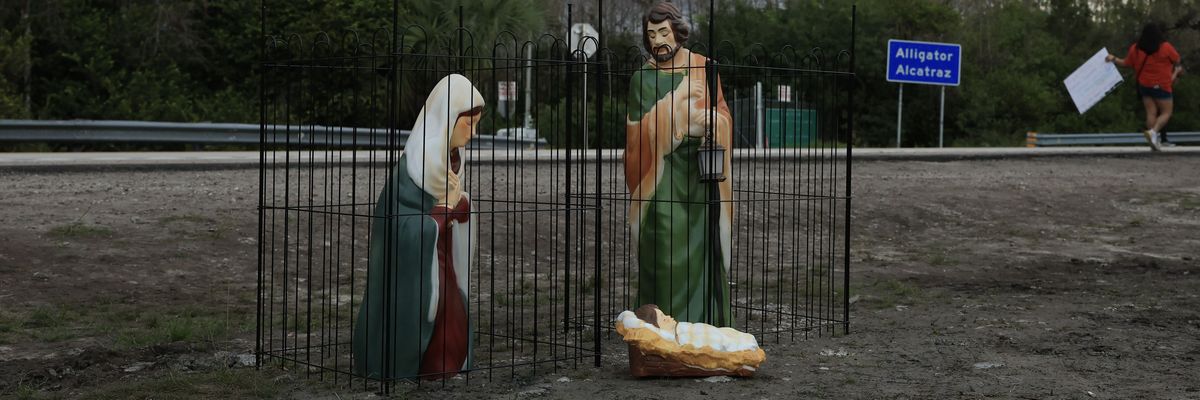
A Nativity scene depicting the birth of Jesus Christ, featuring Mary and Joseph in cages as they are held in custody, sits near the entrance to “Alligator Alcatraz” on December 21, 2025, in Ochopee, Florida. The depiction, activists said, represents a family separated from their baby as they demand that the detention camp be shut down, that the people being detained be freed, and that ICE sweeps end.
(Photo by Joe Raedle/Getty Images)
James Zogby
Dec 25, 2025
Dec 25, 2025
Common Dreams
Catholic churches have traditionally erected Nativity scenes outside at Christmas time. To represent the birth of Jesus, the scenes include the baby, his mother and father, Mary and Joseph, together with the shepherds, their animals, and the “wise men from the East” who came to witness the birth.
Despite the fact that the story is rich in meaning and symbolism, these Nativity scenes have been stripped of their deeper meaning and have become quite two-dimensional and shallow. Like the anodyne carols that have come to define the season, the portrait of the birth that emerges is “peaceful,” “calm,” and “bright.” There is no hint of the oppressive Roman occupation that forced this couple to travel across the country to register in a new census mandated by the empire. Nor is there a recognition of the many ironies underlying the story: that this Jewish baby, who is to be a savior, is born in a cave surrounded by animals, or that the first to come to pay homage are lowly sheep herders and non-Jewish travelers from afar.
In fact, it is these various ironies and others like them that truly define the biblical Christian narrative. It is, in reality, an upside-down faith. In Jesus’ own words, it is a faith where the first shall be last and the last shall be first. It is meant not for the rich, the satisfied, and the powerful. Rather it is first intended for the poor, the hungry, the downtrodden, and the rejected. And it is for those who recognize this and who therefore commit themselves to serving “the least of these.”
With this in mind, it is fascinating to see how in recent years some Christians have taken to reclaiming the challenge inherent in their faith.
Just two years ago a Palestinian clergyman in Bethlehem replaced the stable in the Nativity scene with rubble in order to portray what was unfolding in Gaza. His setting of “Jesus in the rubble” eloquently told the story of the Palestinian people: vulnerable, stripped of their humanity, and subjected to indignities. As if to more deeply develop this identification, last year, Pope Francis was shown in quiet prayer before a manger scene in which the baby Jesus was wrapped in a Palestinian keffiyeh.
In somewhat the same vein, this year, a Catholic community in Massachusetts, given the threats faced by migrants and refugees in the United States, found their own deeper meaning in the Christmas story. In the Nativity scene they erected outside their church, there is no Jesus, Mary, or Joseph. Instead, there is a sign noting that because of concern that ICE (the immigration enforcement police) would be conducting one of their raids, the family had gone into hiding and was seeking sanctuary inside the church.
There are reports of other similar efforts by churches to capture the challenge of the Christmas narrative—with references to ICE, the detention of immigrants, and the mistreatment of immigrant children figuring prominently in many of these portrayals.
In the case of the Massachusetts church, Catholic leaders in the state rebuked the church in question accusing them of playing politics. The Nativity scene, they said, was to provide opportunities for quiet prayerful reflection, not divisive politics. What these church leaders miss, of course, is that if they strip the birth story (and, one might add, the rest of the biblical narrative and for that matter the rest of the New Testament and the many radical injunctions Jesus gives to his followers) of its essential content, then it is they who are playing divisive politics. By not grounding the Nativity in its real-world context, there is the danger that the “contemplative prayer” the leaders are advocating can become shallow and contentless.
After all, the writers of the biblical stories had a point to convey. They weren’t just painting a pretty picture to some day appear in pastel tones on a holiday card. There are reasons why the child was born in a cave and first welcomed not by the high priests but by the lowest and foreigners. Why, in the face of repression, his parents had to take him and flee into Egypt. And why, as he grew, he made every effort to challenge the stale and corrupt religious hierarchy of his day, providing his followers with a challenging message of service to the rejected, the vulnerable, and those in need.
Every year around this time, our mailboxes are filled with mostly brightly decorated holiday greeting cards. About a decade ago, I was shocked to open one from a friend in Lebanon. It featured the anguished and dirtied face of a young boy in a tattered t-shirt staring out from behind a wire fence. Inside it read “Holiday Greetings.” At first, I was confused. “Why this card, with this incongruous message? And why now?”
After reflection, I realized that the plight of this young Syrian refugee, forced to flee his homeland, and now trapped in a camp living in squalor, hungry and dirty, is the perfect image to convey the meaning and challenge of the Christmas story. That story wasn’t written to give comfort to the rich, powerful, and clean. It was to give hope to the destitute and the powerless. And to challenge the rest of us to recognize that.

Petition Signers Want Elon Musk to Be ‘The Richest Man in Town’ This Christmas
Our work is licensed under Creative Commons (CC BY-NC-ND 3.0). Feel free to republish and share widely.
James Zogby
Dr. James J. Zogby is the author of Arab Voices (2010) and the founder and president of the Arab American Institute (AAI), a Washington, D.C.-based organization which serves as the political and policy research arm of the Arab American community. Since 1985, Dr. Zogby and AAI have led Arab American efforts to secure political empowerment in the U.S. Through voter registration, education and mobilization, AAI has moved Arab Americans into the political mainstream. Dr. Zogby has also been personally active in U.S. politics for many years; in 1984 and 1988 he served as Deputy Campaign manager and Senior Advisor to the Jesse Jackson Presidential campaign. In 1988, he led the first ever debate on Palestinian statehood at that year's Democratic convention in Atlanta, GA. In 2000, 2008, and 2016 he served as an advisor to the Gore, Obama, and Sanders presidential campaigns.
Full Bio >
Catholic churches have traditionally erected Nativity scenes outside at Christmas time. To represent the birth of Jesus, the scenes include the baby, his mother and father, Mary and Joseph, together with the shepherds, their animals, and the “wise men from the East” who came to witness the birth.
Despite the fact that the story is rich in meaning and symbolism, these Nativity scenes have been stripped of their deeper meaning and have become quite two-dimensional and shallow. Like the anodyne carols that have come to define the season, the portrait of the birth that emerges is “peaceful,” “calm,” and “bright.” There is no hint of the oppressive Roman occupation that forced this couple to travel across the country to register in a new census mandated by the empire. Nor is there a recognition of the many ironies underlying the story: that this Jewish baby, who is to be a savior, is born in a cave surrounded by animals, or that the first to come to pay homage are lowly sheep herders and non-Jewish travelers from afar.
In fact, it is these various ironies and others like them that truly define the biblical Christian narrative. It is, in reality, an upside-down faith. In Jesus’ own words, it is a faith where the first shall be last and the last shall be first. It is meant not for the rich, the satisfied, and the powerful. Rather it is first intended for the poor, the hungry, the downtrodden, and the rejected. And it is for those who recognize this and who therefore commit themselves to serving “the least of these.”
With this in mind, it is fascinating to see how in recent years some Christians have taken to reclaiming the challenge inherent in their faith.
Just two years ago a Palestinian clergyman in Bethlehem replaced the stable in the Nativity scene with rubble in order to portray what was unfolding in Gaza. His setting of “Jesus in the rubble” eloquently told the story of the Palestinian people: vulnerable, stripped of their humanity, and subjected to indignities. As if to more deeply develop this identification, last year, Pope Francis was shown in quiet prayer before a manger scene in which the baby Jesus was wrapped in a Palestinian keffiyeh.
In somewhat the same vein, this year, a Catholic community in Massachusetts, given the threats faced by migrants and refugees in the United States, found their own deeper meaning in the Christmas story. In the Nativity scene they erected outside their church, there is no Jesus, Mary, or Joseph. Instead, there is a sign noting that because of concern that ICE (the immigration enforcement police) would be conducting one of their raids, the family had gone into hiding and was seeking sanctuary inside the church.
There are reports of other similar efforts by churches to capture the challenge of the Christmas narrative—with references to ICE, the detention of immigrants, and the mistreatment of immigrant children figuring prominently in many of these portrayals.
In the case of the Massachusetts church, Catholic leaders in the state rebuked the church in question accusing them of playing politics. The Nativity scene, they said, was to provide opportunities for quiet prayerful reflection, not divisive politics. What these church leaders miss, of course, is that if they strip the birth story (and, one might add, the rest of the biblical narrative and for that matter the rest of the New Testament and the many radical injunctions Jesus gives to his followers) of its essential content, then it is they who are playing divisive politics. By not grounding the Nativity in its real-world context, there is the danger that the “contemplative prayer” the leaders are advocating can become shallow and contentless.
After all, the writers of the biblical stories had a point to convey. They weren’t just painting a pretty picture to some day appear in pastel tones on a holiday card. There are reasons why the child was born in a cave and first welcomed not by the high priests but by the lowest and foreigners. Why, in the face of repression, his parents had to take him and flee into Egypt. And why, as he grew, he made every effort to challenge the stale and corrupt religious hierarchy of his day, providing his followers with a challenging message of service to the rejected, the vulnerable, and those in need.
Every year around this time, our mailboxes are filled with mostly brightly decorated holiday greeting cards. About a decade ago, I was shocked to open one from a friend in Lebanon. It featured the anguished and dirtied face of a young boy in a tattered t-shirt staring out from behind a wire fence. Inside it read “Holiday Greetings.” At first, I was confused. “Why this card, with this incongruous message? And why now?”
After reflection, I realized that the plight of this young Syrian refugee, forced to flee his homeland, and now trapped in a camp living in squalor, hungry and dirty, is the perfect image to convey the meaning and challenge of the Christmas story. That story wasn’t written to give comfort to the rich, powerful, and clean. It was to give hope to the destitute and the powerless. And to challenge the rest of us to recognize that.
Petition Signers Want Elon Musk to Be ‘The Richest Man in Town’ This Christmas
Our work is licensed under Creative Commons (CC BY-NC-ND 3.0). Feel free to republish and share widely.
James Zogby
Dr. James J. Zogby is the author of Arab Voices (2010) and the founder and president of the Arab American Institute (AAI), a Washington, D.C.-based organization which serves as the political and policy research arm of the Arab American community. Since 1985, Dr. Zogby and AAI have led Arab American efforts to secure political empowerment in the U.S. Through voter registration, education and mobilization, AAI has moved Arab Americans into the political mainstream. Dr. Zogby has also been personally active in U.S. politics for many years; in 1984 and 1988 he served as Deputy Campaign manager and Senior Advisor to the Jesse Jackson Presidential campaign. In 1988, he led the first ever debate on Palestinian statehood at that year's Democratic convention in Atlanta, GA. In 2000, 2008, and 2016 he served as an advisor to the Gore, Obama, and Sanders presidential campaigns.
Full Bio >
What Holiday Magic Teaches Us About Resisting Authoritarianism
This holiday season, let us embrace the art of ambiguity as a form of resistance.
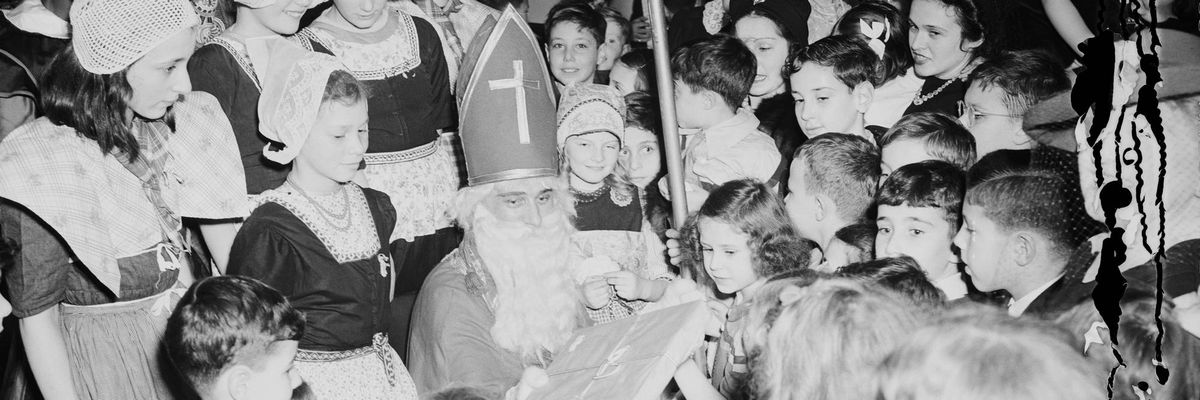
Dutch refugees celebrating St. Nicholas Day in New York City in 1941.
(Photo: Getty Images)
Emese Ilyés
Dec 25, 2025
This holiday season, let us embrace the art of ambiguity as a form of resistance.
Dutch refugees celebrating St. Nicholas Day in New York City in 1941.
(Photo: Getty Images)
Emese Ilyés
Dec 25, 2025
Common Dreams
As Donald Trump declares in his recent address that he has achieved “more than anyone could have imagined” with “zero illegal aliens” allowed into the country and “100 percent of all jobs” going to American-born citizens, I’m thinking about what my Hungarian mother, my édi, taught me about surviving authoritarianism: the radical necessity of making room for what we cannot fully explain or control.
I’m an academic. I derive great comfort from empirical evidence and investigating every question with a critical, researcher’s eye. I teach my students to do the same. I want them to confidently read the world with care and curiosity. This is more important than ever. As a group of students in my research methods class discovered this semester, 54% of adults in the U.S. read below a sixth-grade level. Authoritarians depend on this. They depend on a population that cannot parse complexity, that craves simple answers to complicated questions, that mistakes certainty for strength. In this recent ostensibly economic address, Trump declared he has “settled eight wars in 10 months” and brought “for the first time in 3,000 years peace to the Middle East.” No nuance. No acknowledgment of ongoing negotiations or fragile ceasefires. Just absolute, unquestionable victory. This is the language of someone who cannot tolerate ambiguity, everything must be either ‘worst ever’ or ‘best ever,’ with no room for the messy reality in between.
I teach at CUNY, the largest urban university in the United States, which makes me one of the luckiest people alive. My students are remarkable worldbuilders, often the first in their families to earn degrees. Much like I experienced as an immigrant navigating college, they have no one opening doors for them, no family footsteps to guide their decision-making. They are celebrations of all their ancestors, all their family members and their legacies. When we get to be together, it is sacred.
While I’m deeply invested in helping refine their critical thinking brilliance and their literacy of complex information, these are essential democratic tools after all, I also focus on something autocrats fear even more: our tolerance for ambiguity. This isn’t new wisdom. Simone de Beauvoir argued seventy years ago that embracing uncertainty is an ethical necessity, that rigid certainty is a form of bad faith. But knowing this intellectually isn’t enough. We must practice it, build the muscle of sitting with what we cannot control. We aren’t necessarily born with a tolerance for ambiguity, no, we have to develop it.
This is what ordinary people do when they refuse authoritarian thinking: they risk themselves for something beyond certainty, for the magic of collective care, for keeping possibility alive in impossible circumstances.
Authoritarianism offers the seductive comfort of certainty. It promises that complex problems have simple solutions, that there are clear enemies and obvious heroes, that strength means never wavering or admitting uncertainty. It means launching missiles at boats in international waters and, when survivors cling to debris, firing again and then claiming moral clarity where there is only extrajudicial killing. But meaningful civic engagement requires the opposite. Meaningful civic engagement requires the capacity to sit with complex questions, to accept unknowns, to trust processes we cannot fully control.
In my research methods course, I ask students to create “visual citations” to introduce themselves. For this assignment they are invited to use any medium their imaginations can conjure. When these are due, we create a gallery around the classroom and marvel at our luck to build community with each person. Students have brought in playlists, five items of clothing representing their life journeys, stunning collages, paintings, sculptures. One created an entire puzzle of her family’s migration story. As we complete our visual analysis, we ask: What gifts does our community bring? That is where we root ourselves, in the joys uncovered through a deceptively ambiguous and uncertain process.
But to reach this revelation, we first have to get past the discomfort of the unfamiliar. Students sometimes want to resist. Who can blame them? Why can’t I just give them an exam to cram for, definitions to memorize? But then, most of the time, the classroom comes to trust me. I always explain my pedagogical reasons. And these risks pay off tremendously. We come to see each other as complex, dynamic, wonderful human beings. We come to see ourselves as capable of things we could not have imagined.
I developed a high tolerance for ambiguity early, as a child in Ceaușescu’s Romania. My father escaped before I could hold onto memories of him. My childhood was my single mother and my two siblings. But Christmas—wow, my mom made Christmas magical!
In our region, it’s not Santa who comes on Christmas. On St. Nicholas Day early in the month, he leaves goodies (and handwritten notes giving tips about how we can behave in the coming year—Santa is such a critic) in our boots. On Christmas, angels arrive and bring surprises and the Christmas tree. We lived on the fifth floor of a communist tenement, and somehow my mom arranged for angels to arrive once while we were home. We had no other explanation. The angels must have flown in through the balcony door and left the same way. We knew that the angels were, in fact, real. Peering through the crack at the bottom of the door, we could see black boots moving in the living room.
Meaningful civic engagement requires the capacity to sit with complex questions, to accept unknowns, to trust processes we cannot fully control.
Decades later, on a rare visit to my village, I learned that our neighbor had been in cahoots with my mom that year and literally risked his life climbing over from his balcony to ours, to make sure we would not give up on the magic of Christmas. Angels do wear black boots, but some climb instead of fly.
This is what ordinary people do when they refuse authoritarian thinking: they risk themselves for something beyond certainty, for the magic of collective care, for keeping possibility alive in impossible circumstances.
We live in a complex world. How lucky we are to share it with people who hold different perspectives, different experiences, different skills from us. To fully appreciate the gift of diversity, we have to tolerate ambiguity.
As the Trump administration moves to consolidate power through the false comfort of absolute certainty—declaring “our border is secure, inflation has stopped, wages are up, prices are down,” a world with no room for the millions of Americans whose lived reality tells a different story—we must practice the opposite. We must hold space for what we cannot fully explain: for the neighbor who climbs across balconies in the dark, for the angels who somehow bring trees to the fifth floor, for the students whose brilliance catches us by surprise, for neighbors organizing to protect community members from ICE raids, for the ways collective care outsmarts surveillance states.
This holiday season, let us embrace the art of ambiguity as a resistance to authoritarianism. Let us choose the discomfort of complexity over the seductive ease of autocratic certainty. Let us trust in processes we cannot fully control—like democratic deliberation, like community care, like the slow work of building understanding across difference.
That’s how my mom taught me to survive authoritarianism with my soul intact. We did not match the rigid certainty of Ceaușescu’s policies. Instead we kept alive our capacity for wonder, for trust in what we cannot see, for believing that angels wear black boots and fly through balcony doors.
Our work is licensed under Creative Commons (CC BY-NC-ND 3.0). Feel free to republish and share widely.
Emese Ilyés
Emese Ilyés is a critical social psychologist and participatory action researcher whose work examines community resistance and collective survival in the face of authoritarianism. Her research focuses on grassroots movements and mutual aid networks.
Full Bio >
As Donald Trump declares in his recent address that he has achieved “more than anyone could have imagined” with “zero illegal aliens” allowed into the country and “100 percent of all jobs” going to American-born citizens, I’m thinking about what my Hungarian mother, my édi, taught me about surviving authoritarianism: the radical necessity of making room for what we cannot fully explain or control.
I’m an academic. I derive great comfort from empirical evidence and investigating every question with a critical, researcher’s eye. I teach my students to do the same. I want them to confidently read the world with care and curiosity. This is more important than ever. As a group of students in my research methods class discovered this semester, 54% of adults in the U.S. read below a sixth-grade level. Authoritarians depend on this. They depend on a population that cannot parse complexity, that craves simple answers to complicated questions, that mistakes certainty for strength. In this recent ostensibly economic address, Trump declared he has “settled eight wars in 10 months” and brought “for the first time in 3,000 years peace to the Middle East.” No nuance. No acknowledgment of ongoing negotiations or fragile ceasefires. Just absolute, unquestionable victory. This is the language of someone who cannot tolerate ambiguity, everything must be either ‘worst ever’ or ‘best ever,’ with no room for the messy reality in between.
I teach at CUNY, the largest urban university in the United States, which makes me one of the luckiest people alive. My students are remarkable worldbuilders, often the first in their families to earn degrees. Much like I experienced as an immigrant navigating college, they have no one opening doors for them, no family footsteps to guide their decision-making. They are celebrations of all their ancestors, all their family members and their legacies. When we get to be together, it is sacred.
While I’m deeply invested in helping refine their critical thinking brilliance and their literacy of complex information, these are essential democratic tools after all, I also focus on something autocrats fear even more: our tolerance for ambiguity. This isn’t new wisdom. Simone de Beauvoir argued seventy years ago that embracing uncertainty is an ethical necessity, that rigid certainty is a form of bad faith. But knowing this intellectually isn’t enough. We must practice it, build the muscle of sitting with what we cannot control. We aren’t necessarily born with a tolerance for ambiguity, no, we have to develop it.
This is what ordinary people do when they refuse authoritarian thinking: they risk themselves for something beyond certainty, for the magic of collective care, for keeping possibility alive in impossible circumstances.
Authoritarianism offers the seductive comfort of certainty. It promises that complex problems have simple solutions, that there are clear enemies and obvious heroes, that strength means never wavering or admitting uncertainty. It means launching missiles at boats in international waters and, when survivors cling to debris, firing again and then claiming moral clarity where there is only extrajudicial killing. But meaningful civic engagement requires the opposite. Meaningful civic engagement requires the capacity to sit with complex questions, to accept unknowns, to trust processes we cannot fully control.
In my research methods course, I ask students to create “visual citations” to introduce themselves. For this assignment they are invited to use any medium their imaginations can conjure. When these are due, we create a gallery around the classroom and marvel at our luck to build community with each person. Students have brought in playlists, five items of clothing representing their life journeys, stunning collages, paintings, sculptures. One created an entire puzzle of her family’s migration story. As we complete our visual analysis, we ask: What gifts does our community bring? That is where we root ourselves, in the joys uncovered through a deceptively ambiguous and uncertain process.
But to reach this revelation, we first have to get past the discomfort of the unfamiliar. Students sometimes want to resist. Who can blame them? Why can’t I just give them an exam to cram for, definitions to memorize? But then, most of the time, the classroom comes to trust me. I always explain my pedagogical reasons. And these risks pay off tremendously. We come to see each other as complex, dynamic, wonderful human beings. We come to see ourselves as capable of things we could not have imagined.
I developed a high tolerance for ambiguity early, as a child in Ceaușescu’s Romania. My father escaped before I could hold onto memories of him. My childhood was my single mother and my two siblings. But Christmas—wow, my mom made Christmas magical!
In our region, it’s not Santa who comes on Christmas. On St. Nicholas Day early in the month, he leaves goodies (and handwritten notes giving tips about how we can behave in the coming year—Santa is such a critic) in our boots. On Christmas, angels arrive and bring surprises and the Christmas tree. We lived on the fifth floor of a communist tenement, and somehow my mom arranged for angels to arrive once while we were home. We had no other explanation. The angels must have flown in through the balcony door and left the same way. We knew that the angels were, in fact, real. Peering through the crack at the bottom of the door, we could see black boots moving in the living room.
Meaningful civic engagement requires the capacity to sit with complex questions, to accept unknowns, to trust processes we cannot fully control.
Decades later, on a rare visit to my village, I learned that our neighbor had been in cahoots with my mom that year and literally risked his life climbing over from his balcony to ours, to make sure we would not give up on the magic of Christmas. Angels do wear black boots, but some climb instead of fly.
This is what ordinary people do when they refuse authoritarian thinking: they risk themselves for something beyond certainty, for the magic of collective care, for keeping possibility alive in impossible circumstances.
We live in a complex world. How lucky we are to share it with people who hold different perspectives, different experiences, different skills from us. To fully appreciate the gift of diversity, we have to tolerate ambiguity.
As the Trump administration moves to consolidate power through the false comfort of absolute certainty—declaring “our border is secure, inflation has stopped, wages are up, prices are down,” a world with no room for the millions of Americans whose lived reality tells a different story—we must practice the opposite. We must hold space for what we cannot fully explain: for the neighbor who climbs across balconies in the dark, for the angels who somehow bring trees to the fifth floor, for the students whose brilliance catches us by surprise, for neighbors organizing to protect community members from ICE raids, for the ways collective care outsmarts surveillance states.
This holiday season, let us embrace the art of ambiguity as a resistance to authoritarianism. Let us choose the discomfort of complexity over the seductive ease of autocratic certainty. Let us trust in processes we cannot fully control—like democratic deliberation, like community care, like the slow work of building understanding across difference.
That’s how my mom taught me to survive authoritarianism with my soul intact. We did not match the rigid certainty of Ceaușescu’s policies. Instead we kept alive our capacity for wonder, for trust in what we cannot see, for believing that angels wear black boots and fly through balcony doors.
Our work is licensed under Creative Commons (CC BY-NC-ND 3.0). Feel free to republish and share widely.
Emese Ilyés
Emese Ilyés is a critical social psychologist and participatory action researcher whose work examines community resistance and collective survival in the face of authoritarianism. Her research focuses on grassroots movements and mutual aid networks.
Full Bio >

No comments:
Post a Comment