“This year’s celebrations carry a message of hope and resilience for our people and a message to the world that the Palestinian people love peace and life.”
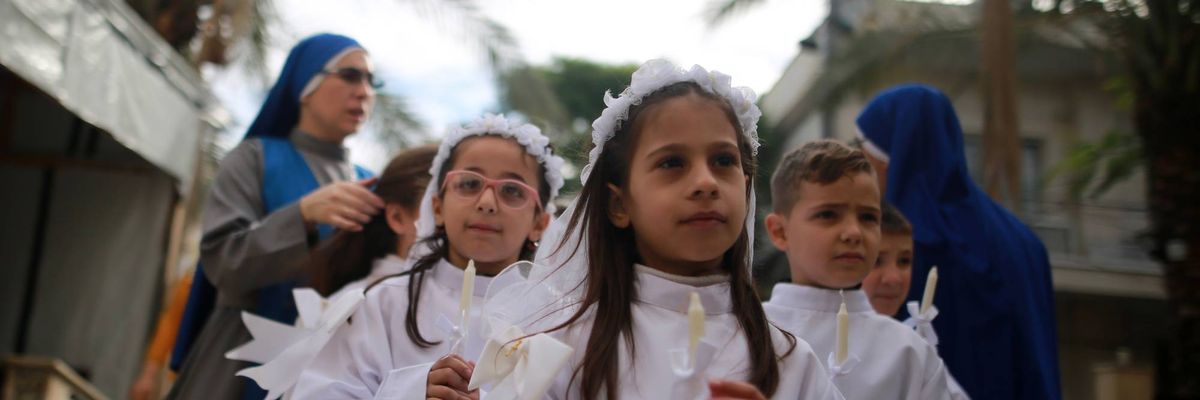
Children participate in a Christmas Mass at the Holy Family Parish in Gaza City, Gaza on December 21, 2025.
(Photo by Majdi Fathi/NurPhoto via Getty Images)
Julia Conley
Dec 24, 2025
COMMON DREAMS
With Gaza’s Christian population decimated by Israeli attacks and forced displacement over the past two years, those who remain are taking part in muted Christmas celebrations this week as the West Bank city of Bethlehem displays its tree and holds festivities for the first time since Israel began attacking both Palestinian territories in October 2023.
Middle East Eye reported that while Cardinal Pierbattista Pizzaballa, the Latin patriarch of Jerusalem, led a Christmas Mass at Holy Family Church in Gaza City on Sunday and baptized the newest young member of the exclave’s Christian community, churches in Gaza have been forced this year to keep their celebrations indoors as the Israel Defense Forces (IDF) have continued its attacks despite a “ceasefire” that Israel and Hamas agreed to in October.
Dec 24, 2025
COMMON DREAMS
With Gaza’s Christian population decimated by Israeli attacks and forced displacement over the past two years, those who remain are taking part in muted Christmas celebrations this week as the West Bank city of Bethlehem displays its tree and holds festivities for the first time since Israel began attacking both Palestinian territories in October 2023.
Middle East Eye reported that while Cardinal Pierbattista Pizzaballa, the Latin patriarch of Jerusalem, led a Christmas Mass at Holy Family Church in Gaza City on Sunday and baptized the newest young member of the exclave’s Christian community, churches in Gaza have been forced this year to keep their celebrations indoors as the Israel Defense Forces (IDF) have continued its attacks despite a “ceasefire” that Israel and Hamas agreed to in October.
“Churches have suspended all celebrations outside their walls because of the conditions Gaza is going through,” Youssef Tarazi, a 31-year-old Palestinian Christian, told MEE. “We are marking the birth of Jesus Christ through prayer inside the church only, but our joy remains incomplete.”
“This year, we cannot celebrate while we are still grieving for those killed, including during attacks on churches,” Tarazi said. “Nothing feels the same anymore. Many members of our community will not be with us this Christmas.”
The IDF, Israeli officials, and leaders in the US and other countries that have backed Israel’s assault on Gaza have insisted the military has targeted Hamas and its infrastructure, but Christian churches are among the places—along with schools, refugee camps, hospitals, and other civilian buildings—that have been attacked since 2023.
Our people-powered journalism cannot survive without you
Your support allows Common Dreams to continue covering the stories and amplifying the voices that the corporate media never will. Make a tax-deductible year-end gift to ensure we can sustain the reporting needed to meet the challenges of 2026.
At least 16 people were killed just days into the war when the IDF struck the Church of Saint Porphyrius, one of the oldest churches in the world. In July, Israel attacked the only Catholic church in Gaza, killing two women and injuring several other people.
Palestinian officials say at least 44 Christians are among more than 71,000 Palestinians who have been killed since Israel began its assault in retaliation for a Hamas-led attack. Some have been killed in airstrikes and sniper attacks while others are among those who have died of illnesses and malnutrition as Israel has enforced a blockade that continues to limit food and medical supplies that are allowed into Gaza.
United Nations experts, international and Israeli human rights groups, and Holocaust experts are among those who have called Israel’s assault a genocide, and the International Criminal Court issued a warrant last year for the arrest of Israeli officials including Prime Minister Benjamin Netanyahu for war crimes and crimes against humanity in Gaza.
George Anton, the director of operations for the Latin patriarchate in Gaza, estimated that the number of Christians killed so far is at least 53, with many dying “because we could not reach hospitals or provide medicine, especially elderly people with chronic illnesses.”
In the past, Muslims in Gaza have joined Christian neighbors for the annual lighting of Gaza City’s Christmas tree and other festivities, and churches have displayed elaborate lights and decorations in their courtyards for the Christmas season.
“We decorated our homes,” Anton told MEE. “Now, many homes are gone. We decorated the streets. Even the streets are gone... There is nothing to celebrate.”
“We cannot celebrate while Christians and Muslims alike are mourning devastating losses caused by the war,” he added. “For us, the war has not ended.”
Hilda Ayad, a volunteer who helped decorate Holy Family Church earlier this month, told Al Jazeera that “we don’t have the opportunity to do all the things here in the church, but something better than last year because last year, we didn’t celebrate.”
About 1,000 Christians, who were mainly Greek Orthodox or Catholic, lived in Gaza before Israel’s latest escalation in the exclave began in 2023.
Greek Orthodox Church member Elias al-Jilda and Archbishop Atallah Hanna, head of the church’s Sebastia diocese in Jerusalem, told the Washington Post that the population has been reduced by almost half. More than 400 Christians have fled Gaza in the last two years. Those who remain have often sheltered in churches, including the ones that have sustained attacks.
Al-Jilda told the Post that this year’s celebrations “will not be full of joy, but it is an attempt to renew life.”
In Bethlehem in the West Bank, officials have sought to send a message to the world this Christmas that “peace is the only path in the land of Palestine,” Mayor Hanna Hanania told Anadolu Agency.
“This year’s celebrations carry a message of hope and resilience for our people and a message to the world that the Palestinian people love peace and life,” he said.
At Al Jazeera, Palestinian pastor Rev. Dr. Munther Isaac wrote that “celebrating this season does not mean the war, the genocide, or the structures of apartheid have ended.”
“People are still being killed. We are still besieged,” he wrote. “Instead, our celebration is an act of resilience—a declaration that we are still here, that Bethlehem remains the capital of Christmas, and that the story this town tells must continue.”
“This Christmas, our invitation to the global church—and to Western Christians in particular—is to remember where the story began. To remember that Bethlehem is not a myth but a place where people still live,” Isaac continued. “If the Christian world is to honor the meaning of Christmas, it must turn its gaze to Bethlehem—not the imagined one, but the real one, a town whose people today still cry out for justice, dignity, and peace.”
Festive lights, security tight for Christmas in Damascus
By AFP
December 24, 2025

Syria's Christian community is believed to have shrunk from one million in 2011, when the war began, to around 300,000 today, with many seeking refuge abroad
By AFP
December 24, 2025
Syria's Christian community is believed to have shrunk from one million in 2011, when the war began, to around 300,000 today, with many seeking refuge abroad
- Copyright TURKISH DEFENCE MINISTRY/AFP HANDOUT
Maher al-Mounes
Christmas lights illuminate Damascus’s Old City while government forces patrol its shadows as security fears haunt Syria’s Christian community.
They recall the shooting and suicide attack in June at the Saint Elias church in the Syrian capital that killed 25 people and wounded dozens more.
“People are going home early, and are afraid,” said Tala Shamoun, 26, a university student who was visiting a Christmas market with family and friends.
Damascus has seen crime including robberies and kidnappings, she said, but the attack on the church “was the biggest tragedy”, she told AFP.
Syria’s authorities blamed the Islamic State jihadist group, while a little-known Sunni Muslim extremist group claimed responsibility.
The Islamists that ousted ruler Bashar al-Assad last year have reaffirmed their commitment to coexistence among all of Syria’s religious groups, vowing to involve everyone in the transition.
But earlier this year, the country’s Alawite heartland saw sectarian massacres, while Druze-majority areas in the south were hit by major clashes.
– ‘Security plan’ –
Interior ministry forces searched some pedestrians or stopped people on motorbikes in the Old City.
At one of the district’s main entrances, an armed member of the government security forces was holding a walkie-talkie and a map of where his personnel were deployed.
“We’ve put a security plan in place that includes several districts and areas in the capital, in order to ensure the safety of all citizens,” he said on condition of anonymity.
“It is the state’s duty to protect all its people, Christian and Muslim, and today we are doing our duty to protect the churches and secure people’s celebrations,” he added.
Ousted ruler Assad, himself an Alawite, had long presented himself as a protector of minorities, who were the target of attacks during Syria’s war, some of which were claimed by jihadists.
Syria’s Christian community is believed to have shrunk from one million in 2011, when the war began, to around 300,000 today, with many seeking refuge abroad.
In the Old City, home to a small but vibrant Christian community and several important churches, red baubles hang from some trees, shopkeepers have put up Christmas decorations and street vendors peddle warm chestnuts.
So-called neighbourhood committees are also providing additional security, with dozens of local Christians protecting churches in coordination with government forces.
– ‘Syria deserves joy’ –
Fuad Farhat, 55, from the area’s Bab Touma district, was supervising the deployment of several unarmed, black-clad Christian men with walkie-talkies in front of the churches.
Many people fear that Christmas crowds could heighten security risks, but with the additional measures “they feel safer and are more comfortable going out”, he said.
“We have been taking steps to protect those celebrating in the Christian neighbourhoods” to avoid any problems, in coordination with the security forces, he said.
University student Loris Aasaf, 20, was soaking up the Christmas atmosphere with her friends.
“Syria deserves joy and for us to be happy, and to hope for a new future,” she said.
“All sects used to celebrate with us, and we hope to see this in the coming years, in order to rebuild Syria,” she added.
Near the Saint Elias church which saw June’s deadly attack, government security forces cordoned off entry and exit areas with metal barriers, while heavily armed personnel were searching anyone entering.
Church-goers lit up a tree decorated with stars bearing the image of those killed in June.
“Christmas this year is exceptional because of the pain and sorrow we went through,” said housewife Abeer Hanna, 44.
“The security measures are necessary because we are still afraid,” she said.
Nearby, Hanaa Masoud lit a candle for her husband Boutros Bashara and other relatives who were among those killed in the attack.
“If we go to church and get blown up, where can we find safety?” she said, choking back tears.
Maher al-Mounes
Christmas lights illuminate Damascus’s Old City while government forces patrol its shadows as security fears haunt Syria’s Christian community.
They recall the shooting and suicide attack in June at the Saint Elias church in the Syrian capital that killed 25 people and wounded dozens more.
“People are going home early, and are afraid,” said Tala Shamoun, 26, a university student who was visiting a Christmas market with family and friends.
Damascus has seen crime including robberies and kidnappings, she said, but the attack on the church “was the biggest tragedy”, she told AFP.
Syria’s authorities blamed the Islamic State jihadist group, while a little-known Sunni Muslim extremist group claimed responsibility.
The Islamists that ousted ruler Bashar al-Assad last year have reaffirmed their commitment to coexistence among all of Syria’s religious groups, vowing to involve everyone in the transition.
But earlier this year, the country’s Alawite heartland saw sectarian massacres, while Druze-majority areas in the south were hit by major clashes.
– ‘Security plan’ –
Interior ministry forces searched some pedestrians or stopped people on motorbikes in the Old City.
At one of the district’s main entrances, an armed member of the government security forces was holding a walkie-talkie and a map of where his personnel were deployed.
“We’ve put a security plan in place that includes several districts and areas in the capital, in order to ensure the safety of all citizens,” he said on condition of anonymity.
“It is the state’s duty to protect all its people, Christian and Muslim, and today we are doing our duty to protect the churches and secure people’s celebrations,” he added.
Ousted ruler Assad, himself an Alawite, had long presented himself as a protector of minorities, who were the target of attacks during Syria’s war, some of which were claimed by jihadists.
Syria’s Christian community is believed to have shrunk from one million in 2011, when the war began, to around 300,000 today, with many seeking refuge abroad.
In the Old City, home to a small but vibrant Christian community and several important churches, red baubles hang from some trees, shopkeepers have put up Christmas decorations and street vendors peddle warm chestnuts.
So-called neighbourhood committees are also providing additional security, with dozens of local Christians protecting churches in coordination with government forces.
– ‘Syria deserves joy’ –
Fuad Farhat, 55, from the area’s Bab Touma district, was supervising the deployment of several unarmed, black-clad Christian men with walkie-talkies in front of the churches.
Many people fear that Christmas crowds could heighten security risks, but with the additional measures “they feel safer and are more comfortable going out”, he said.
“We have been taking steps to protect those celebrating in the Christian neighbourhoods” to avoid any problems, in coordination with the security forces, he said.
University student Loris Aasaf, 20, was soaking up the Christmas atmosphere with her friends.
“Syria deserves joy and for us to be happy, and to hope for a new future,” she said.
“All sects used to celebrate with us, and we hope to see this in the coming years, in order to rebuild Syria,” she added.
Near the Saint Elias church which saw June’s deadly attack, government security forces cordoned off entry and exit areas with metal barriers, while heavily armed personnel were searching anyone entering.
Church-goers lit up a tree decorated with stars bearing the image of those killed in June.
“Christmas this year is exceptional because of the pain and sorrow we went through,” said housewife Abeer Hanna, 44.
“The security measures are necessary because we are still afraid,” she said.
Nearby, Hanaa Masoud lit a candle for her husband Boutros Bashara and other relatives who were among those killed in the attack.
“If we go to church and get blown up, where can we find safety?” she said, choking back tears.

No comments:
Post a Comment