The Renewed Plan for US Global Hegemony
The Donald Trump administration revealed the US empire’s new plan for global dominance in the 2025 National Security Strategy. The goal is to impose hegemony in the Western Hemisphere, reviving the colonial Monroe Doctrine, to move supply chains out of Asia and bring manufacturing into Latin America via “nearshoring”, in order to economically decouple from China and prepare for conflict in Cold War Two. Ben Norton analyzes the important document.
Will Trump 'pull' Italy, Austria, Poland, Hungary from EU?
The US recently published its new National Security Strategy. A leaked draft appears to show the US wants to exert its influence over four European countries in particular to destabilize the European Union.

Trans-Atlantic relations have suffered since Donald Trump took office for a second time in January. The publication of the National Security Strategy on December 4, 2025 was seen by many European politicians as an open affront.
In the document, which each new administration submits to Congress, Europe is described as a continent in decline where there is a risk of "civilizational erasure" because of migration policies. There is mention of "censorship of free speech and suppression of political opposition."
However, a longer, unpublished draft of the document was circulated prior to the official, public strategy. It reportedly goes into more detail about the plans the US has in store for Europe. According to the Washington-based digital media platform Defense One, which claims to have seen the draft, it lists Italy, Austria, Poland and Hungary as countries that the US should "work more with … with the goal of pulling them away" from the European Union.The White House has denied the existence of any such draft.
But the question remains: Is the US trying to divide the European Union? And why are these four countries of particular interest?
Italy, Austria, Poland and Hungary
Hungary's name on the list is probably the least surprising, as Hungarian Prime Minister Viktor Orban and US President Trump remain close allies. Orban supported Trump during his 2016 presidential campaign — the only ruling EU leader to do so at the time.
Both stand to mutually benefit from the other's political stance. Orban is widely seen as a maverick and a destabilizing force for the EU — an institution that Trump appears to deeply distrust. And Trump has referred to Orban as his "great friend" and is even alleged to have offered Hungary a "financial shield" of $20 billion (€17 billion) — similar to the one he recently offered Argentina. Hungary's economy is in a weak state, and significant EU funds due to the country have been frozen over persistent concerns about democratic backsliding.
Trump told the media outlet Politico earlier this month that he had not promised Hungary a financial lifeline, but said Orban had asked for one.
The US president also appears enthusiastic about Italian Prime Minister Giorgia Meloni and her Brothers of Italy, a right-wing party with neofascist roots. But Daniel Hegedüs, regional director for Central Europe at the German Marshall Fund of the United States, believes the US government is under a "misapprehension" that Meloni would oppose the EU.
Though she shares certain ideological views with Orban, Meloni has not played an obstructionist role in the bloc. Indeed, she is very pragmatic, Hegedüs told DW, adding that few had understood as well as she had what a stable EU could do for their country.
While neither Poland nor Austria are currently led by right-wing populist governments, this was the case until recently, and right-wing and euroskeptic parties remain extremely influential in both countries. In the last elections, the far-right Freedom Party of Austria (FPÖ) was the strongest force. It is currently leading the polls. In Poland last summer, Karol Nawrocki, the candidate backed by the national conservative Law and Justice party (PiS), won the presidential election.
It is perhaps not surprising that the Trump administration might hope to soon be able to exert more influence in both countries.
German lawmaker: US lost values once shared with Europe 12:24
Why not the Czech Republic and Slovakia?
What is surprising, at least to some, is that two EU states do not appear on the list: the Czech Republic and Slovakia.
In the first, the parliamentary elections were won by the billionaire Andrej Babis and his populist ANO party in October. Babis formed a coalition government with the right-wing Motorists for Themselves party and the far-right Freedom and Direct Democracy party.
Meanwhile, Slovakia has been experiencing a shift to the right since Robert Fico came to power as prime minister in 2023. His nominally social democratic, but in fact nationalist and increasingly right-wing Smer-SD party was recently expelled from the EU-level Party of European Socialists.
Both Babis and Fico are outspoken EU skeptics, and both have the potential to cause chaos in EU decision-making and to undermine the bloc's authority on strategic issues, especially with regard to Russia and Ukraine — qualities that the current Trump administration is likely to appreciate.
Hegedüs believes the fact that the two states did not end up being mentioned in the final strategy document lies with the roots of their parties. For a long time, ANO could not be classified on the traditional left-right spectrum, while Smer-SD saw itself as left-wing.
"You can clearly see how ideological the US approach is," said Hegedüs. "Because Smer and ANO do not have a traditional right-populist background, they are not considered to be like-minded, even though they possibly pursue policies that are useful to the Trump administration."
US touts self-reliant Europe, but wants dependent EU: Expert 10:29
Trump supports ideological allies
Initial attempts by the US government to interfere in democratic processes in Europe at the beginning of the year, such as Vice President JD Vance's controversial speech at the Munich Security Conference, were initially dismissed by observers of trans-Atlantic relations. Many argued that the new administration in Washington still had to find its feet in its new role.
But ever since, the US government has interfered again and again — in the Romanian, Polish and German election campaigns, for instance. The pattern is always the same: support is given to those whom the Trump administration sees as an ally in ideological terms, and to those who can weaken Brussels.
Experts such as Hegedüs doubt that the US goal is to promote the departure of one of these four nations from the bloc, but rather to push a gradual disintegration of European integration through diplomatic, political and perhaps even financial support.
The first signs of this are already visible. For example, although the EU has agreed to gradually phase out its dependence on Russian energy and the bloc will ban imports of liquefied natural gas by the end of 2026 and pipeline gas by the fall of 2027, Hungary has announced it will refuse to comply.
In November, Prime Minister Orban secured a waiver from US sanctions on Russian oil and gas imports from Trump. He said that he did not accept the EU's decision and would take the case to the European Court of Justice. In a recent joint press conference with Turkish President Recep Tayyip Erdogan, Orban announced that Turkey would continue to guarantee the route so that gas could be transported from Russia to Hungary via the TurkStream pipeline.
Hegedüs predicts that in the coming years there will be more such cases, with member states failing to comply with joint decisions, thereby increasingly calling into question the very essence of European integration.
This article was originally written in German.
A Fascistic NSS Full of Hemispheric Menace
On Thursday, December 4, the White House released a new National Security Strategy, a document that lays out the Trump’s regime’s “America First” designs on the world order.
The Trump regime’s new United States National Security Strategy (hereafter the “T47NSS”) is a significantly fascist as well as classically imperialist document.
Channeling far-right racist “Great Replacement Theory” and the notion of creeping “white genocide,” the T47NSS claims that Europe is facing “civilizational erasure” because of loose immigration policies. It commits the US to “promoting European greatness” by aligning with “patriotic European parties” that want to keep their nations majority white.
This is a call for US to promote racist and xenophobic nationalist, blood and soil neofascist white-nationalist parties like German’s Alternative for Germany (AfD), Vox (Spain), Austria’s Freedom Party, the Netherlands’ Party for Freedom, the Swedish Democrats, the Danish People’s Party, the Brothers of Italy (Lega), France’s National Rally, and the like.
The T47NSS calls for the US to “deepen ties” with “the healthy nations of Eastern, Central, and Southern Europe,” by which the administration means nations where authoritarian, racist, nativist, and patriarchal parties hold power.
Not satisfied to promote just two of the three great pillars of neofascism – white supremacism and xenophobic nationalism – the document makes a full-throated cry to the third, militant patriarchy, by declaring that the Trump regime wants to create a new American “golden age” that “cannot be accomplished without growing numbers of strong traditional families.” That is not-so veiled code language for the rolling back of women’s, gay, and trans rights in the US – a curious thing to be advocating in a foreign policy document.
Along the way, the T47NSS channels the fascist cult of personality with laudatory references to Trump and his supposed superior vision, which is said to be bringing about a “course correction” steering the US away from what Trump calls (in a cover letter at the front of the document) “disasters and catastrophes” rooted in the “weakness” imposed by the “extremism” of “radical gender ideology” and “woke lunacy.”
Contrary to myth, fascism is imperialist, not “isolationist.” The T47NSS’s much ballyhooed call for a retreat from supposedly democratic US-America’s supposed democracy- and freedom-promotion in Russia, the Middle East, Asia, Africa, and Latin America is not at all an argument for US global retreat. It is instead an appeal for the US to drop egalitarian and missionary pretense while unabashedly pursuing nothing but raw profitable advantage in dealing with other nations.
The T47NSS takes a brazenly imperialist approach to Latin America. It calls for the US to “enforce the Monroe Doctrine to restore American preeminence in the Western Hemisphere,” “protect…our access to key geographies throughout the region,” restrict Latin American immigration, prevent non-US companies from winning business contracts in Latin America, and “enlist” pro-US/pro-business governments across the region in support of US regional dominance.
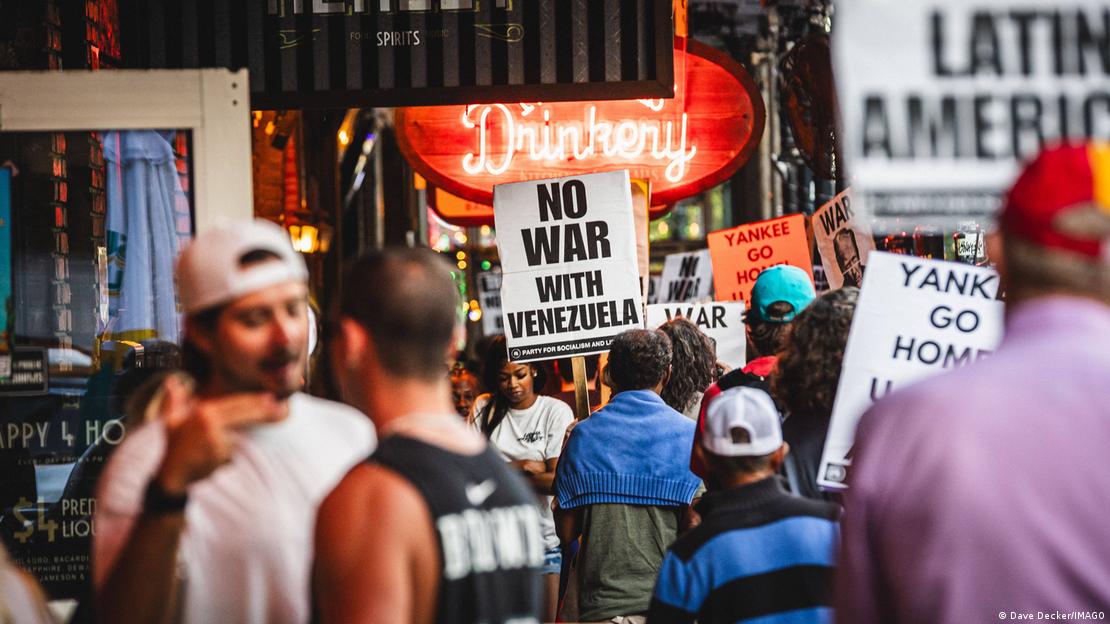
That makes for some darkly interesting reading as the US commits cold-blooded extrajudicial executions of Venezuelan and Colombian people in the Caribbean and prepares for a possibly imminent regime change war on Venezuela. The T47NSS’s call for the U.S. to shift its global military footprint more heavily onto the Western Hemisphere — away from more distant “theaters whose relative import to American national security has declined” — suggests that the Trump fascist regime’s ongoing war crimes and ominous military build-up in the Caribbean will continue and indeed intensify. The document is rightly seen as menacing by Latin Americans and most especially by the people of Venezuela and Colombia.
The T47NSS calls for the U.S. to sustain America s “military overmatch” of China to deter its chief competitor state in the Western Pacific. That contradicts not just the notion of the Trump regime as isolationist but also the notion that the regime is content to grant China unchallenged dominance in its own regional sphere of influence.
Regarding Trump’s cover letter, it is darkly amusing to see him say that “America is strong and respected again and because of that we are making peace all over the world” — this as the Trump regime is shown to have criminally executed more than 80 mariners and boat passengers in the Caribbean and Eastern Pacific over the last three months and as the Trump Pentagon assembles massive military assets for a likely criminal regime change war on Venezuela. So far the Trump regime’s aggression against Venezuela has graduated from the criminal serial killer boat strikes to declaring the air space over that country closed to flying fighter jets over the nation to seizing a Venezuelan oil tanker just off the nation’s coast, an act of brazen piracy capped by trump claiming the US will “keep the [interdicted ship’s] oil.”
Trump is also threatening to attack Colombia, saying this about that nation’s left president: “He’ll be next soon. I hope he’s listening, he’s going to be next.”It is likely that the US is more disrespected around the world than it has ever been under Trump47.


A longer, unpublished version of the Trump administration’s National Security Strategy identifies Poland as one of four countries the US should try to “pull away” from the European Union, according to leaked excerpts reported by the Defense One news website.
It also calls for Washington to support parties and movements that “seek sovereignty and preservation/restoration of traditional European ways of life”.
The news emerged as senior security aides to Poland’s right-wing President Karol Nawrocki, a close ally of Trump, arrived in Washington for talks with their US counterparts over the new American strategy.
The official, 33-page version of the National Security Strategy was published by the White House last week and drew attention in particular for its claim that Europe is facing “civilisational erasure”, making it “far from obvious whether certain European countries will…remain reliable allies”.
It accused the EU of “undermining political liberty and sovereignty” and said that “migration policies are transforming the continent and creating strife”.
On Tuesday, Defense One published extracts from what it said was a “fuller version” of the strategy that had been circulating before the White House published the unclassified version.
The document listed Poland, Austria, Italy and Hungary as countries that the US should “work more with…with the goal of pulling them away from the [European Union]”, according to Defense One.
“And we should support parties, movements, and intellectual and cultural figures who seek sovereignty and preservation/restoration of traditional European ways of life…while remaining pro-American,” added the document.
Those plans appear to align with US policy in the region, where Trump has enjoyed friendly relations with national-conservative leaders such as Hungarian Prime Minister Viktor Orbán and Polish President Karol Nawrocki.
Nawrocki last month called for major reform of the EU to restore greater national sovereignty and stop Brussels from “dictating” to member states and trying to “regulate the lives of citizens”. He regards Washington as Poland’s most important partner.
Opinion polls consistently show that a large majority of Poles favour their country’s continued membership of the EU, though some recent surveys suggest that so-called “Polexit” is supported by a growing minority.
On Tuesday, a delegation from Nawrocki’s National Security Bureau (BBN) arrived in Washington at the invitation of Trump’s National Security Council (NSC) for discussions relating to the new National Security Strategy.
The talks offered a chance to “ask about certain details that cannot possibly be discussed or described in the document”, said the deputy head of the BBN, Andrzej Kowalski, quoted by news website Onet.
“We are the first European delegation to have the opportunity to discuss the details and intentions behind this document,” added BBN advisory Nikodem Rachoń. “These were very good talks, demonstrating that the Americans are open to expanding security cooperation with Poland on a bilateral basis.”
Poland’s more liberal, pro-EU government, which regularly clashes with Nawrocki, has been less positive about Trump’s new National Security Strategy.
Shortly after it was published, Prime Minister Donald Tusk addressed his “American friends” on social media, telling them that “Europe is your closest ally, not your problem”.
“We have common enemies. At least that’s how it has been in the last 80 years. We need to stick to this, this is the only reasonable strategy of our common security. Unless something has changed,” he added.

Trump’s National Security Strategy Is Pax Americana With a MAGA Twist

Donald Trump’s new National Security Strategy, which formalizes the ideological shift that U.S. foreign policy has taken under Trump 2.0, has won praise in Moscow but stunned European allies.
Indeed, the strategy document, which was published on December 4, 2025, sent political shock waves through the whole of Europe as European leaders and political analysts grasped how Trump’s radical reconception of U.S. foreign policy is now being applied to Europe and its leaders — namely, by reshaping Europe’s political landscape through open support for far right European parties.
Brando Benifei, a member of the European Parliament for the Progressive Alliance of Socialists and Democrats and chair of the European Union’s (EU) Delegation for Relations with the U.S., responded by saying that the U.S., not the EU, is “going in a bad direction,” while French political analyst Sylvie Matelly described the section on Europe in the Trump’s strategy document as “three pages full of vitriol.”
Trump’s National Security Strategy holds a curious mirror to the U.S.’s younger imperialist self. It does so because it comes straight out of the trash can of fascist ideology and propaganda. It presents us with deconstructed fascism, imperialist aggression, and racist rage.
Trump’s National Security Strategy comes straight out of the trash can of fascist ideology and propaganda.
To start with, the National Security Strategy calls for the pursuit of aggressive policies throughout the Western Hemisphere. It invokes the Monroe Doctrine and adds a “Trump Corollary.” It is a call for a return to the classical age of imperialism, as the document states clearly that the strategic aim here is to “reassert and enforce the Monroe Doctrine to restore American preeminence in the Western Hemisphere.” The Trump administration identifies migration, drugs, and China as the perceived main threats to the hemisphere, and the readjustment and expansion of U.S. military presence in the region are considered to be of the utmost importance for addressing these challenges.
Trump’s strategy document goes on to assert that rolling back outside influence in the Western Hemisphere requires the pursuit of such goals as “Enlist and Expand,” which entails enlisting governments and even political parties and movements in the Trump administration’s war against mass migration (which Trump frames as an existential threat to the security of the United States) and drug trafficking while also expanding partnerships between the U.S. government and various actors, and discouraging countries from seeking collaboration with others.
It will come as no surprise that in tandem with its call for military imperialism, Trump’s strategy also promotes economic imperialism. The National Security Strategy specifies that there needs to be “a closer collaboration between the U.S. Government and the American private sector” and asserts that the primary goal of U.S. officials in countries in the Western Hemisphere should be to “help American companies compete and succeed.”
In tandem with its call for military imperialism, Trump’s strategy also promotes economic imperialism.
Trump’s plan also identifies Indo-Pacific as a region of vital interest to the United States as it is “the source of almost half the world’s GDP based on purchasing power parity.” Subsequently, his National Security Strategy asserts that this inevitably makes the Indo-Pacific a site of major economic and geopolitical conflicts. The document further contends, however, that the U.S. can successfully compete in the Indo-Pacific region, and already does so, on account of possessing “the world’s strongest economy and military.” But it finds it necessary to “rebalance America’s economic relationship with China” by bringing allies and adversaries into line with U.S. interests. In other words, it argues that countries in the Indo-Pacific region must be compelled, one way or another, to align themselves with the geopolitical and geoeconomic interests of the United States. After all, putting “America First” is the vision behind Trump’s plan, and the Indo-Pacific strategy revolves almost exclusively around China. There is no reference at all to the Philippines, while Japan, South Korea, and even India attract very little attention.
While the National Security Strategy downplays the Trump administration’s ideological differences with China, it does the exact opposite with regard to the U.S.’s European allies, skewering European leaders for their alleged unwillingness to protect their national identities and their “unrealistic expectations” for a solution to the war in Ukraine. After highlighting Europe’s economic decline, which is attributed to regulations, Trump’s strategy report attacks European governments as weak and ineffective, accusing leaders of pushing the European continent toward “civilizational erasure” due to mass migration.
Funnily enough given the Trump administration’s own blunt authoritarianism and open flirtation with fascism, his strategy document also accuses the European Union of “undermining political liberty” and engaging in “censorship of free speech and suppression of political opposition.” It’s a true statement, to be sure, but for the wrong reasons.
Across Europe, governments have been cracking down on protests and suppressing public resistance. But the problem is that the Trump administration actually wants to destroy liberal democracy, not expand it, and is keen to see far right parties in power across Europe implementing his immigration policies and promoting white supremacy.
President Trump has made no secret of his affinity for Hungary’s autocratic leader Viktor Orbán, who is hostile to immigration and LGBTQ rights, and who promotes an explicitly white and Christian vision for Hungary and Europe alike.
The alignment of Trump’s National Security Strategy with Europe’s far right is too obvious to miss. Indeed, as Gérard Araud, former French ambassador to the U.S., observed on X: “The stunning section devoted to Europe reads like a far-right pamphlet.”
But it gets worse. Trump’s strategy plan not only launches a direct attack on Europe and its institutions, which undoubtedly made Vladimir Putin do a dance, but also calls for direct interference in European political affairs. While labeling Europe weak and in decline, and criticizing European governments for their continued support for the war in Ukraine, the new security doctrine acknowledges that the continent remains strategically, economically, and culturally vital to the United States. As such, it asserts that the United States can “not afford to write Europe off” but “must help Europe correct its current trajectory.”
Naturally, given Europe’s traditional subservience to Washington, the reaction from most of the continent’s active political leaders has been to downplay the Trump administration’s new security doctrine.
A few European leaders, however, such as European Council President António Costa, reacted with dismay and warned against interference in Europe’s affairs. Nicolai von Ondarza, the head of the EU/Europe Research Division at the German Institute for International and Security Affairs, went even further by saying that the new U.S. security doctrine not only represents “a fundamental shift in transatlantic relations” but leaves “open US backing for regime change” in Europe.
Trump’s National Security Strategy is loaded with imperialist aims while envisioning the creation of an authoritarian, neofascist world.
With regard to the Middle East, however, not only is there not the slightest hint at regime change, but Trump’s National Security Strategy calls instead for respect of the traditions and the “historic forms of government” of the Gulf states. The document also claims that the days when the Middle East dominated U.S. foreign policy are over and implies that the Trump administration has either resolved all of the major conflicts in the region or lessened their intensity, including the situation in Gaza. As surreal as this may be in light of the fact that the Israeli occupation and brutal violence continue, Trump’s strategy document asserts, with regard to Gaza, that the ceasefire represents “progress toward a more permanent peace.”
Trump’s foreign policy has been described by some mainstream analysts as representing the end of “Pax Americana” — the world order the United States constructed after World War II and the era of relative peace that followed under U.S. economic and military dominance. But in reality, the message behind the new U.S. security doctrine is that the Trump administration intends to keep U.S. capitalism in the global driver’s seat and that it will rely not only on diplomacy but also on military might to attain that goal. Moreover, it will interfere in the political affairs of European countries to assert on European soil the Trumpist goal of “restoring Europe’s civilizational self-confidence and Western identity.”
Trump’s National Security Strategy is loaded with imperialist aims while envisioning the creation of an authoritarian, neofascist world. Let’s call it Pax Americana with a MAGA twist.


No comments:
Post a Comment