Thursday, March 13, 2025

Empathy in Authoritarianism’s Valley of Dry Bones

“I can't go on. I'll go on.”


The Good Samaritan, 1890 by Vincent van Gogh

Empathy is weakness, asserts a man, who views the world through ego-inflated grandiosity not the grandeur that is spread before him in the form of the living earth.

“The fundamental weakness of Western civilization is empathy.” — Elon Musk

When the dismal, life-defying ways of humankind (embodied by the aforementioned tech billionaire grifter) cause life to seem unbearable to my sight, I’m compelled to turn my grief-darkened vision inward; therein, I am, in moments of grace, greeted by a type of internal dawn. The first light of inner day touches my mind. The warmth of its touch stays with me as night winds howl, the ignorant gibber and rage, and foul men ascend to power.

“I can’t go on. I’ll go on.” ― Samuel Beckett, The Unnamable

There are moments, despair-pummeling hours during long, rest-deprived nights that I, pressed down by the crush of events, feel as though I simply can’t go on. Held in the thrall of grief, I cannot manage to write another word. Yet I continue to, word by word, sentence by sentence. Somehow I bear up. It remains a mystery as to how. I suspect, if I had to speculate as to the reason, the mystery in itself is exhilarating.

The rude rifting delivered by an insult comic, ridiculing vanity and human folly, is, most likely, less offensive to God (or even human sensibility) than religious fundamentalists praying for the end of the world or tech bros insisting they will deliver us to a “posthuman” paradise, wherein the serpent is empathy. .

The world does not need a savior to die — or become transhuman — for our sins. At every sunrise, inner or extant, rebirth is possible.

Before we can access our humanity, we must first genuflect before the grandeur of earthworm and galaxy. From my empathy-ridden perspective sin is committed by refusing to notice the terrible beauty of it all and allow the worst among us to do all the talking and claim the world as their entitlement. A voice resounds within me: defy the lie; resist soullessness. Because we are mortal human beings, defeat will come — but choose to be wounded by beauty.


Rubens, Saint Sebastian Tended By Two Angels, circa 1650

Only when I admit life is incomprehensible can I discern the cretinous lies passed off as truths by those who seek to gain power. Under the perpetual and pummeling uncertainty of a capitalist system, the contrived confidence of grifters will hold those who crave certainty in the thrall of tales promising false hope. Removal of dangerous outsiders is a time-tested go to of the ruthless. Thus the mark has been provided with provisional relief from anxiety, as, all the while, relieved of his money; and from the realm of political grifters, eventually, freedom of choice.

How does authoritarian rule come to be? First and foremost, because the mark has been swindled out of the ability to endure the incomprehensible — thus to endure the anxiety inherent to freedom. Hence, the calling of writers is to ask uncomfortable questions. Demagogues and grifters claim they have solutions. They have cures for all ills at hand, they lie. They will bring deliverance from troubles. Don’t question them; just fall in and be swept along in the parade of true believers.
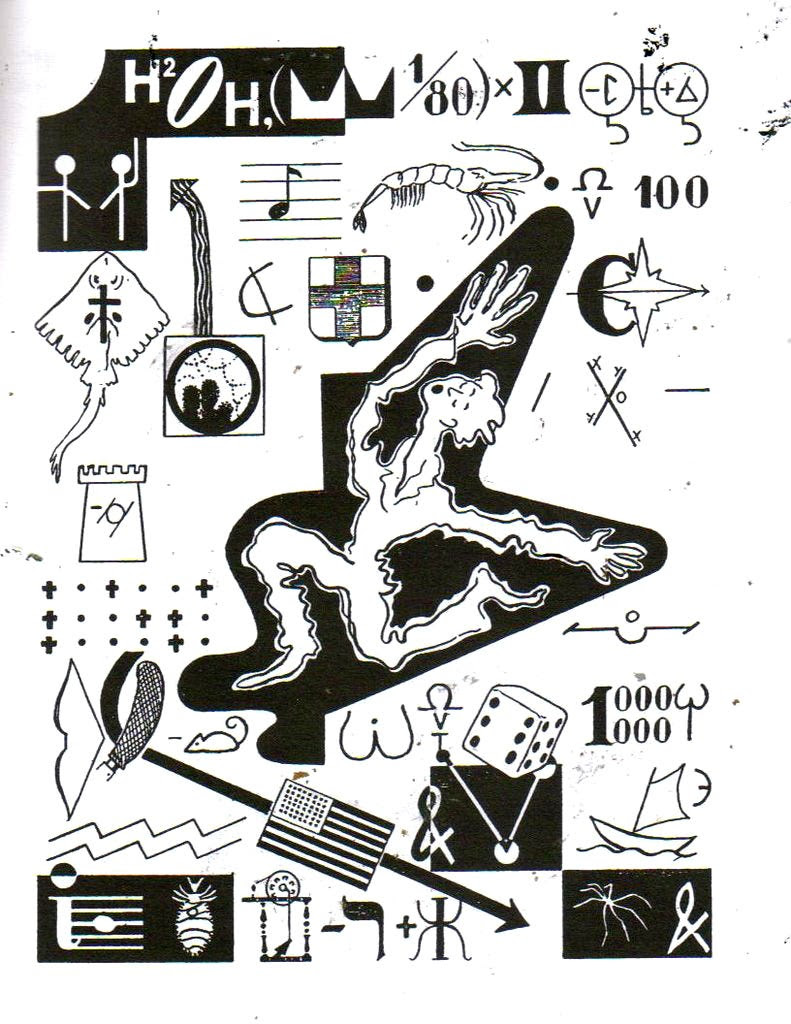
Gabriel Pomerand
Gabriel Pomerande, from Saint Ghetto of the Loans, 1950

Enveloped, as we are, within the present media simulacrum and building AI panopticon, a landscape of lies extends to the ends of the mind. Events, terrible in nature, unfold with the illusion of weightlessness as everything seems to be giving way and flying apart. A center made of nothing cannot hold.

Empathy is crucial as a centering principle. Set yourself in the direction of liberation by defending the dignity of the unfairly shunned. Freedom can be gained by resistance to falling into authoritarianisms’ manic, joyless parade of mass conformity; many join authoritarian movements to relieve the anxiety inherent to uncertainty and the elation – albeit illusionary – experienced by (shallow in nature) acceptance within the mass.

In a just world, those deserving of shunning are the power-seeking types of shitheels who attempt to gain authority by retailing in hatred and fear. Demagogues, inherently devoid of empathy, inflict division. In soul-making contrast, resisting their lies can serve to unite those possessed of viable hearts and dreaming souls..

Where words leave off, music begins. Poetry, the closest a verbal form can come to music insofar as revealing visions not perceptible to the temporal-locked mind. See if you recognize this Bronze Age classic:

I will search for my lost ones who strayed away, and I will bring them safely home again. I will bandage the injured and strengthen the weak. But I will destroy those who are fat and powerful. I will feed them, yes—feed them justice! — Ezekiel 34:16

First, the ineffable vision; then stranded in a valley of dry, rattling bones; then a rain from Heaven came, and the army known as flesh was restored. Then came a trickle of a stream rising from the heart of a hidden, desert temple…that makes fecund the arid land and restores life to a salt-poisoned sea.

Ezekiel is not promulgating prophecy about real estate — he was referring to the heart of humanity.

We will be lost in a valley of bones until repentance enters and brings to restoration the dry hearts of a worldview that permits genocide and ethnic cleansing and regards empathy as a weakness of character.


“The Vision of The Valley of The Dry Bones” by Gustave DorĂ©

Ezekiel’s vision unfolds as poetry. Hence it is true…in the lexicon of the heart.

A devotee of literalism would sneer at the assertion, “So, you’re saying, an acrid valley strewn with sun-bleached skeletal remains, upon hearing the voice of God, was restored then rose as an army of flesh? Have you over-indulged in edibles? How can you pretend that is even possible?”

No, the edibles remain untouched, and yes, from the numinous perspective of poetic vision, it is possible. A transformation of vision has come to be. Poems are reflections of the human psyche, our hub of Anima Mundi i.e., The Soul Of The World. Remember, a poet does not create a poem; the poem creates the poet. In this way, poetry begets the flesh of essential being.

Therefore from the perspective of the psyche it is not only possible but a vital aspect of human existence. Deliverance from dry despair can be remedied by a flowing stream of hope. The heart, revitalized, will soldier forth as the army of your living flesh.

Yet, a culture dominated by crackpot realists insist you are the sum total of your bank account, that your persona is defined by your car and place of dwelling. Is it not a mystery as to why people are depressed and desperate. Why, in a consumer culture, the citizenry become hapless marks of grifters retailing in sleight-of-hand corporatism and bait-and-switch politics. And empathy is scorned as an enemy of the state and a threat to the common good.

Antithetical to the storylines of the grift, from the poetic imagination, enigmatic visions glide into the minds as wheels within wheels of fire; the thoughts of the heart flow forth and restore to living abundance the Dead Sea within you.

Crazy talk, huh? From the vantage point of my internal Ezekiel, my ragged, defrocked, enslaved-by-empire seer within, the anguish of the times is being inflicted by capitalist con men — not by poets chanting of the anguish felt in the heart witnessing the hideous mess created by crackpot realism. To wit, transitioning from prose to verse, a dispatch from the landscape of visions and renewal:

A ravine in my heart;
nocturnal creatures slink and prowl.
Moonlight issues forth from my mouth;
reflected on cold city steel — I tremble.
The sky is the dark blood of the redeemers’ wounds;
the rain-renewed creek wails out the birth cries of newborns.
March winds buffet my thoughts — night spirit, what are you demanding?
With every year, sustained eye contact is made with the inscrutable gaze of my dead.

(Postscript: A poem, a comedy routine, a parcel of prose achieves to be a prayer of communion dispatched toward the greater world from inner terrains of loneliness. Yet, once sent, the missive has forgotten the name of its author. Living force that it is, it seeks connection and merges with the living force that is the reader. At that point, its creator might not recognize it in passing while amid the clamor within the agora of the imaginal. This kind of loneliness is inconsolable. It is lonely as the Moon; the Sun’s caress will never reach her dark side. Yet her borrowed luminosity bestows night here on earth with the ache inflicted by beauty.)

Living day by day, hour by hour, minute by minute can unfold in meaning, with purpose, even beauty. Convinced otherwise, one is diminished; one’s essences become fragmented to shards. Yes, the times are ugly — yet there exists a possibility of surrendering to the beauty that is bestowed, odd as it seems, by lamentation and/or the humor of knowing what has been lost to folly. Existence is laughing near you – not at you. Thus a crack opens in persona where ensoulment can enter and take up long term residence.

Enchantment beckons; blunder towards its scintillation and caress; insist reluctant types come along for the ride. Yes, all concerned can be brought to ruin — but, as is the case with a fine piece of clothing, what good is persona that is never worn outside of the house?

After your inevitable downfall make the soul your bed of recovery.

Moments of fulfillment and wisdom do not give themselves over into companionship with those who, by reflex, reject life out of fear of losing a type of vanity revealing itself as a forced innocence, evinced far too long into life. Moreover, the compulsive pursuit of happiness is the stuff of vacationing on one of those crass cruise ships sloshing between hyper-commodified port cities.

“You lose your grip, and then you slip into the masterpiece.” — A Thousand Kisses Deep, Leonard Cohen

There is a force within driving you to be used by life. Ignore it and you will bore yourself and others blind.

The woundings incurred by living life on life’s terms are a crucial aspect of it all.

The scars inflicted will heal into a braille by which you will tell your life’s tale.
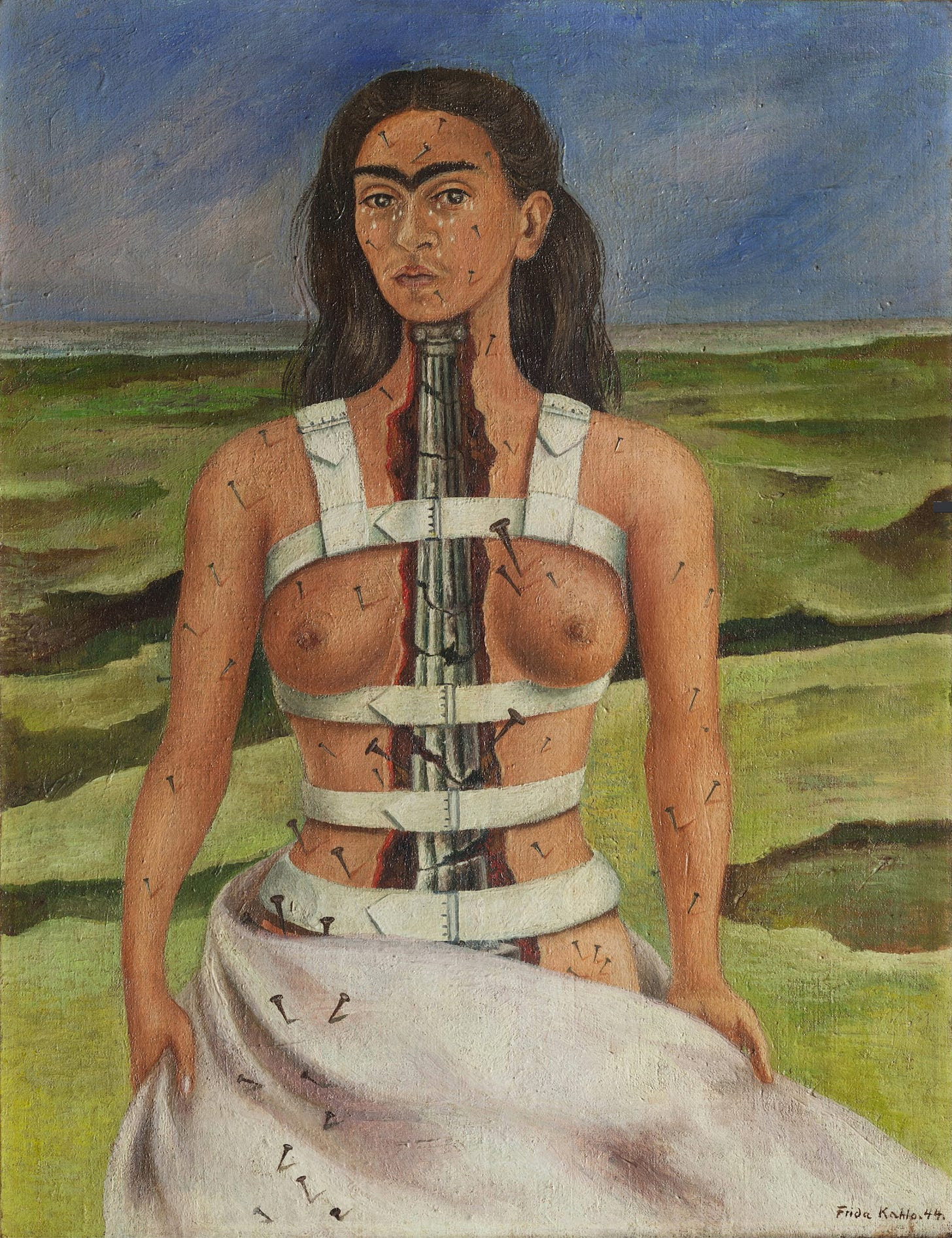
The Broken Column, zoomed in
Frida Kahlo, The broken column  

Phil Rockstroh is a poet, lyricist, and essayist. His poems, short fiction, poetry and essays have been published in numerous print publications and anthologies; his political essays have been widely posted on the progressive/left side of the internet. Visit and subscribe to Phil’s Substack newsletter at https://substack.com/@philrockstrohRead other articles by Phil.

What to Do When Faced with Tariffs? 

Diversify


The New York Times yesterday (11 March 2025) headlined: “Trump Intensifies Statehood Threats in Attack on Canada.” What particularly stood out was the sub headline: “The U.S. president on Tuesday reiterated his claims on Canada’s territory as he increased tariffs, threatening to bring the country’s economy to its knees.”

How are Canadians supposed to feel about being threatened? How are Canadians to feel about the indignity of being brought economically to their knees? It calls to mind the invocation of Mexican revolutionary Emilio Zapatista who stated: “It is better to die on your feet than to live on your knees!”

The article opens:

The fresh attacks President Donald Trump aimed at Canada on Tuesday extended beyond imposing more tariffs on America’s neighbor and NATO ally, and laid out in the clearest terms yet his vision for annexing Canada and making it part of the United States.

Trump is a selfish, narcissistic, vain person (e.g., here and here), and that plays well to a certain audience. It is obvious from his pandering to the public, his name calling of others (e.g., referring to Canada’s prime minister Justin Trudeau as a governor of the 51st state), his preening with bold sharpie-signed documents held up for cameras, his declarations affecting others without first speaking to the others.

It is about Trump’s vision for Canada. It’s an all stick and no carrot approach. That is what annexation is: “possession taken of a piece of land or a country, usually by force or without permission: The country’s annexation of its neighbor caused an outcry.”

Past and present Canadian governments (and the Canadians who elect so-called representatives to the parliament) are responsible for Canada’s exports being so reliant on the US market rather than diversifying its trade into other world markets.

It doesn’t have to stay that way. In fact, it is a rude wake-up call that Canada must not rely on the US to be a faithful and steadfast partner. Canada’s dignity and sovereignty1 demand a change in the status quo.

Unlike China, Canada is unprepared for round two of a Trump administration.

The US economy is forecast by many commentators to be heading for a recession, something that Trump does not deny. China, on the other hand, has set its 2025 GDP growth target at around 5%. It seems futile to tie one’s ship-of-state to another sinking ship.

Canada says it will fight fire with fire, that it will reciprocate the US tariffs. This is a lose-lose proposition. Canada needs to get off its knees and seek a win-win, respectful relationship — something that China always promotes. No need to completely disengage with the US, but apply to BRICS and the BRI and develop relations with the Global South. Pursue a path that is best for Canadians.

ENDNOTE:

  • 1
    Canada’s dignity and sovereignty will always be morally challenged given that it exists on the dispossession of its Indigenous peoples — a lamentable criminality that Canada shares with the US.
Kim Petersen is an independent writer. He can be emailed at: kimohp at gmail.com. Read other articles by Kim.

NIH Funding Cuts Will Hit Red States, Rural Areas and Underserved Communities the Hardest


 March 11, 2025
Facebook

Photograph Source: Duane Lempke – Duane Lempke Photography – CC0

The National Institutes of Health is the largest federal funder of medical research in the U.S. NIH funds drive research and innovation, leading to better understanding and treatment of diseases and improved health outcomes.

The NIH provided more than US$35 billion in grants to over 2,500 universities and other institutions in 2023 to support biomedical research. Thus, it came as a shock to these institutions when the NIH, based on a new Trump administration policyannounced on Feb. 7, 2025, that it intends to cut the funding used to support the grantee institutions by $5.5 billion annually.

On March 5, a U.S. district judge in Boston issued a nationwide injunction blocking the administration from implementing the proposed cuts to NIH funding, arguing that the planned cuts were unlawful. However, the White House will almost certainly appeal.

We are a husband-and-wife team of immunologists who have been funded by the NIH for several decades. We believe our research has led to a better understanding of inflammatory and autoimmune diseases. In addition, one of us (Prakash Nagarkatti) served as vice president for research at the University of South Carolina for over a decade, managing all NIH grants awarded to the university.

While we believe such cuts will be detrimental to the entire country, they will disproportionately hurt states that traditionally have received very low levels of NIH funding, the majority of which are red states that supported Trump’s election to a second term. This is because such states lack resources to develop advanced research infrastructure necessary to compete nationally for NIH funding.

Several Republican senators have vocally opposed the funding cuts, including Susan Collins of Maine, who said they “would be devastating, stopping vital biomedical research and leading to the loss of jobs.”

Support for cancer, Alzheimer’s research

NIH funding is crucial for advancing biomedical research, improving public health and fostering innovation. It has a broad impact on different facets of society.

The agency funds biomedical research leading to the development of vaccines or new drugs to prevent and treat infectious diseases and clinical disorders. The NIH played a crucial role in funding research on pandemics and global health crises caused by HIV/AIDS and COVID-19.

In addition, the NIH supports advanced research in focused areas such as cancer, through the establishment of designated centers that offer cancer prevention, diagnosis, clinical trials and advanced treatment. Each year, approximately 400,000 patients receive cancer diagnoses and treatment at such centers.

Similarly, the NIH supports research in other focused areas, such as Alzheimer’s disease, through the establishment of specialized research centers.

The NIH also supports Small Business Innovation Research and Small Business Technology Transfer opportunities. These programs stimulate technological innovation by funding small businesses to commercialize new research ideas.

Moreover, the agency provides funding to train the next generation of biomedical scientists, clinicians and public health professionals. Thus, the NIH awards create jobs at universities, biotechnology companies and related industries. Together, such NIH programs promote local and national economies.

In 2024, NIH funding generated an estimated US$92 billion in economic activity. Every $100 million in NIH funding generates 76 patents, which creates $598 million in further research and development, as reported by NIH.

Therefore, any cuts to the agency’s budget will have far-reaching and significant consequences on health outcomes and the economy.

How the NIH funding process works – and how the cuts will affect research.

Caps on indirect costs

When the NIH awards grants, it is divided into two separate categories: the direct costs, which include expenses that are necessary to pursue the proposed work and that are provided to the scientists, and the indirect costs. These cover expenses such as maintenance of lab space, utilities, grant management, federal regulatory compliance, security and other miscellaneous needs. These funds are provided directly to the institution.

Indirect costs are negotiated between the institution and the federal agency and expressed as a percentage of the direct costs. Because each institution has unique operational expenses, the indirect cost rates vary from 30% to 70%.

The new policy rolled out by the NIH capped the indirect costs for all institutions at a fixed rate of 15%. In 2023, NIH spent $35 billion to support research at various institutions, of which $9 billion was used to cover indirect costs. Thus, NIH estimates it could save $4 billion by capping indirect costs at 15%.

How red states get hurt the most

There is a significant geographic disparity in NIH funding that most people are unaware of. There are 27 states in the U.S. that receive 94% of NIH funding, while the other 23 states receive only 6%. Moreover, the NIH funding received by the 23 states has remained relatively unchanged for the past 20  years.

There are many reasons why the latter states are less competitive. These include: lack of large medical centers, hospitals and research-intensive universities; thin and more rural populations; less robust economies; and lack of cutting-edge research infrastructure driven by less investment by the states in research and development.

It is for these reasons that Congress in 1993 authorized the NIH to start a new program called the Institutional Development Award, or IDeA, to support the 23 states plus Puerto Rico that have traditionally received low levels of NIH funding. Such states are commonly called IDeA states and contain predominantly rural and medically underserved communities.

These awards, which constitute less than 1% of the total NIH budget, are expected to help these states grow their research infrastructure and make them more competitive nationally.

The IDeA states are: Alaska, Arkansas, Delaware, Hawaii, Idaho, Kansas, Kentucky, Louisiana, Maine, Mississippi, Montana, Nebraska, Nevada, New Hampshire, New Mexico, North Dakota, Oklahoma, Rhode Island, South Carolina, South Dakota, Vermont, West Virginia, and Wyoming, plus Puerto Rico. All the states but Delaware, Hawaii, Maine, New Hampshire, New Mexico, Rhode Island and Vermont voted for Trump in the 2024 election.

Indirect costs pay for cutting-edge technologies

Indirect costs, in addition to supporting the management of specific grants, are also helpful in promoting the institutions’ research infrastructure.

The indirect costs help purchase and upgrade state-of-the-art research equipment and technologies. They help institutions develop high-performance computing facilities that are critical for research missions and provide access to journals and books through the library facilities. These costs also renovate old labs and help create new cutting-edge facilities such as germ-free facilities for microbiome research.

Thus, the indirect costs are critical for IDeA states that have limited resources such as state support for pursuing research.

According to the Higher Education Research and Development Survey, in 2023, non-IDeA states like California invested $548 million and New York over $303 million in R&D. In contrast, IDeA states Kentucky and West Virginia invested $49 million and $15 million, respectively, in R&D.

Such data clearly demonstrates how challenging it would be for IDeA states to face cuts in NIH funding and advance research infrastructure.

In our view, it is critical that all states have access to NIH research funding to enable the states to solve the unique challenges they face, such as environmental issues and population health disparities.

For example, biomedical scientists and clinicians trained by NIH grants are addressing locally relevant issues such as coal workers’ pneumoconiosis, commonly known as black lung disease, which occurs when coal dust is inhaled. This is an occupational hazard linked to the coal industry in West Virginia and Kentucky.

Similarly, Hawaii, with its tropical climate, has mosquitoes that can carry dengue virus, so dengue infection can pose a unique health and economic problem for this state when compared with the others in the U.S.

Training the biomedical workforce and physicians in IDeA states also helps with retaining health providers in the state to further address these local challenges and prevents brain-drain to other non-IDeA states.

IDeA states heavily rely on NIH funds to pursue and advance their research capabilities and address local and general health challenges. For such states, already struggling to receive NIH funding, reducing indirect costs would further exacerbate their disadvantages, increasing the risk of falling behind in medical research, patient care and regional economic growth.The Conversation

This article is republished from The Conversation under a Creative Commons license. Read the original article.

Prakash Nagarkatti, Professor of Pathology, Microbiology and Immunology, University of South Carolina and Mitzi Nagarkatti, Professor of Pathology, Microbiology and Immunology, University of South Carolina