Sunday, April 20, 2025

Indigenous Group of Seven work brought together for exhibit in Banff


Wednesday, April 2nd, 2025 

Image

Image Caption

At left is Indigenous Group of Seven member Joseph Sánchez. At right is a work from member Daphne Odig (top) and one from Eddy Cobines

By Crystal St.Pierre
Local Journalism Initiative Reporter
Windspeaker.com

Joseph Sánchez is co-curating the upcoming exhibit The Ancestors Are Talking: Paintings by the Indigenous Seven at The Whyte museum located in Banff, Alta. from May 3 to Oct. 19. The exhibit features 77 works.

Sánchez is the last living member of the Indigenous Group of Seven. The group consisted also of Jackson Beardy, Eddy Cobiness, Alex Janvier, Norval Morrisseau, Daphne Odig and Carl Ray.

Co-curators are The Whyte's curator of Indigenous initiatives Dawn Saunders Dahl and Christina Cuthbertson, the director of curatorial initiatives.

Sánchez and the Indigenous Group of Seven established Professional Native Indian Artists Inc. (PNIAI) in the early 1970s. They set out to change the way Indigenous art was viewed by Canadians and the world. Their intention was to move Indigenous art from being categorized or viewed as handicraft into the perspective of contemporary modern art.

Members had their own individual artistic styles that reflected their various cultural backgrounds. Collectively, they were determined to work towards having Indigenous art showcased at exhibitions and fine art galleries.

Additionally, the group was passionate about clearing the path for future artists and, as part of their group philosophy, they decided to take a portion of all the money they raised through sales of their work to mentor upcoming Indigenous artists.

At the time of PNIAI’s incorporation, Sánchez was only 22 years old.

Now 77, with all of the other members passed away, Sánchez wanted to curate an exhibit that brought all seven artists’ work to display from the beginning of their inception and throughout their careers.

“It’s really exciting,” Sánchez said. “One that kind of will transcend some of the early negativity about the group, that it was simplistic or whatever. But that was 55 years ago… A lot of artists have benefited from the fact that this group existed and broke that feeling and that’s what I think people need to kind of understand when they look at this work, that it did break barriers so long ago.”

Though the group worked together behind the scenes, their work wasn’t often shown together.

“Three of them have had a one-person show at the National Gallery,” said Sanchez, adding they were considered masters. Now he wants to show that all of the members were masters in their own way.

The only gallery in Canada where all seven artists’ work has been displayed together was at the Museum of Aboriginal Peoples’ Art & Artifacts located in Lac La Biche, Alta. The museum houses nearly 2,000 Indigenous artworks and artifacts.

For the upcoming show at The Whyte, Sánchez was able to borrow items from each of the artists’ personal collections, as well as from private collectors.

“Some of the works had never been seen at all,” explained Sánchez. “They went directly from the artist to the collectors so it’s going to be a lot of that kind of stuff in there, work that you’ve never seen before.”

But highlighting work from the group is not the only intention of the exhibit. Sánchez is also looking forward to having the opportunity to show how each of the artists influenced each other.

“This show will definitely focus on how, if you look close enough, you’ll see the influence of the older artists to the younger artists,” he said.

A few of the artists passed away many years ago, while others lived up until recently.

Odjig, who passed in 2016 was 97 years old.

“Daphne kept painting all the way up to the end,” Sánchez said. “She was drawing on her last day of her life.”

This vast array of work throughout the years was the driving force behind the exhibit.

“I wanted people to see the work, the full spectrum of the work that was created,” Sánchez said. “Not just this Indian work from the 1970s because basically the group was founded to stop that designation, that we were Indian artists.”

“I want to share new insights into this work with the public,” Sanchez said.

Prior to Morrisseau’s passing, he said Sanchez was one of the only people still alive with a true understanding of each of the artists’ work.

“(He said) I’m one of the only people still alive that understands what these symbols and these works mean, so it’s important that we share that,” explained Sanchez. “It’s quite more of an open-eyed look at the work … and also the work had lots to do with healing. Not only healing of our people but healing of the whole nation.”

The entire philosophy of the group was “this idea that we should help each other, and we should also take our work to our own people … We need to share it with our young people to help their cultural awareness.”

To honour this aspect, Sanchez and The Whyte administration wanted to tie the exhibit to an opportunity for young artists to learn from Sánchez.

“I’ve invited all of the mural artists who have been working on various murals on the museum grounds… to come back and work with Joseph for four days to spend some time with Joseph on the show and then be inspired by those works (to create their own) and we would show that exhibit next year,” said Saunders Dahl. “So, we’ll give them about a year to create new works and then we will show them the following year. It’s about keeping that legacy going.”

Sánchez said he has been preparing for the exhibit since his inclusion into the group and is looking forward to finally being able to bring it to life.

“As it turns out, you know, like Norval said, I’d be the last one living and I would carry the work. I would be able to share the work with the wider audience and that’s just what I’m trying to do,” said Sánchez.

Local Journalism Initiative Reporters are supported by a financial contribution made by the Government of Canada.


A Two-Spirit Journey is the ‘book to change the narrative’ in 2025

Wednesday, April 9th, 2025 

Image

Image Caption

Ma-nee Chacaby (centre) with author Michael Redhead Champagne (left) and book defender Shayla Stonechild at the Canada Reads celebration event in Winnipeg. (photo provided)
By Shari Narine
Windspeaker.com Books Feature Writer
Local Journalism Initiative Reporter

CBC’s competition Canada Reads recently celebrated a memoir published almost a decade ago.

“I am grateful that they picked the book,” said Ma-Nee Chacaby, Ojibwe-Cree author of A Two-Spirit Journey. “I didn't ever think it was ever going to go anywhere. I just wanted other First Nations to start writing their stories. That was my main thing. Maybe if I write, they’ll follow.”

A Two-Spirit Journey was published in 2016 by the University of Manitoba Press. Chacaby, who is visually impaired, told her story to non-Indigenous close friend and professional writer Mary Louisa Plummer over Skype during the course of several months in 2013. Plummer typed it and then read the first draft to Chacaby, who rounded it out with additional material.

2 spirit
Ma-Nee Chacaby on the cover of A Two-Spirit Journey.

A Two-Spirit Journey is an unflinching hard-hitting honest story of Chacaby’s youth in a small remote northern town in Ontario, suffering through poverty, becoming an alcoholic, being sexually and physically abused. But it’s also a story of hope and resilience as Chacaby works through her burdens to raise her children, counsel youth and women, and accept herself as two-spirited.

“It was important for me to talk about my two-spirit life. There's a male person inside of me and a female person inside of me, and I feel there's two of me, and I am privileged to have that kind of life, to be able to have the two-spirit in me,” Chacaby told Windspeaker.com

“The younger generations right now always think about it as a sexual being. It's not about that. It's about being alive. It's about respecting your body as a male side and a female side, and it's about the love that you have inside of your own body, mind and soul. That's how I think of my two-spirit life.”

A Two-Spirit Journey was the only Indigenous-authored book in the competition, beating out four others in the 2025 Canada Reads that had as its goal “one book to change the narrative.”

From March 17 to March 20, podcaster and wellness advocate Shalya Stonechild, a Red River Métis and Nēhiyaw iskwēw from Muscowpetung First Nation, defended A Two-Spirit Journey facing off against other celebrities who championed other books: Watch Out for Her by author Samantha M. Bailey, Etta and Otto and Russell and James by Emma Hooper, Jennie’s Boy by Wayne Johnston, and Dandelion by Jamie Chai Yun Liew.

Chacaby had never heard of the annual Canada Reads before her book took the stage. But for those four days she sat with three or four friends in her home in Thunder Bay, Ont. watching the debates on her laptop. At the end it came down to her book and Dandelion.

“When Canada Reads was happening during that week, I was watching it and sometimes I was excited. I would jump up and down. I was cheering for everybody that wrote a book. Then when it was my turn, I would also jump up and run the other way and, ‘Oh my God, did they call my name?’ I was kind of shy and scared,” said Chacaby, laughing.

She admits she finds it easier to cheer for others than for herself. For herself, “I get excited inside. But I don’t show a lot of emotions outside. I was very, very happy the book won.”

In defending and talking about A Two-Spirit Journey, Stonechild said in the final debate that the book was “a powerful act of resilience, of truth telling and of healing… It’s a Canadian story that challenges, educates, and transforms its readers.”

During that debate, other judges commented that Chacaby’s work was “such an important document” more than it was simply a story

“Us writers as Indigenous people, we are inherently educational and political just through being alive here…It made me question…would I be seen as an academic text if I wrote my story?” asked Stonechild.

“I want to think of it as a story,” said Chacaby. It was the story she needed to write to refute her friends who called her lucky for never having attended residential school. “I looked at them and I felt really like, ‘How do you know what the hell I went through?’ I didn't say that to them. I just thought about it that way.”

As for the comments made by the judges, Chacaby says she soaked it in.

“There was not a time where I tried to correct somebody or just say, ‘Oh, I didn't say it that way.’ I just listened to them. I just took it in the way it's supposed to be. I don't make judgments…I just take it in stride, I guess,” she said.

Chacaby, who is now 74 and sober for 50 years, continues to persuade other Indigenous people to write their stories.

“One lady talked to me yesterday. So maybe it’s going to happen,” said Chacaby.

Said Stonechild of A Two-Spirit Journey, “Canada needs this book because it amplifies a voice that usually would not be heard, and it shines a light on important experiences that would not be seen.”

Local Journalism Initiative Reporters are supported by a financial contribution made by the Government of Canada.


Environment taking a back seat to Trump and new energy projects: Op-ed

environment

The sun rises over the Arctic landscape in Resolute Bay, Nunavut. Photo: Danielle Paradis/APTN.


It is truly unfortunate that the climate crisis is not top of mind for most voters but I also feel the emotions that have been triggered by [U.S. President] Donald Trump and the threat to Canadian sovereignty and to our economy.

I feel the fear for jobs, anger at Trump’s complete disregard for human rights and his dismantling of so many of the initiatives that have greatly benefited the environment.

And then there is the “Elbows Up” rally for a strong Canada. Such turmoil.

The impact of Trump’s actions on Canada are very real and there are election promises for fast tracking of new fossil fuel projects – all under the banner of finding new markets for Canadian resources and boosting the economy.

I think it’s very short sighted.  Our overheating planet does not care about  politics. Consent by Indigenous Nations should not be assumed. It is my position that Canada should not be building new fossil fuel projects!

It is my wish that these turbulent times be seen as an opportunity to transition away from fossil fuels and double down on advancing renewable energy projects.

The proposal for a coast to coast electricity transmission corridor is a great example of what should be the focus.  Electrification of everything, increasing battery capacity and power generation by renewables is what will get us to a more livable earth.

There has not been near enough talk about all of the jobs that can be created from big infrastructure projects like this.  I understand that people fear for their jobs and just want a good life for their families.

As a citizen of the Otipemisiwak Métis Government, I am on a journey to discover what it means to be Métis in this modern world. I have lived and worked in cities for most of my life. My connection to the land might be practiced in a different way than my ancestors.

I love the native flowers that I have planted in my own garden and celebrate the bees that these flowers attract. I physically feel the pain of the earth hurting as it overheats.

I want to be a good ancestor to future generations.

That is why I am actively working on a political campaign for the candidate in my riding that I feel supports the most climate friendly policies. I am building relationships with my candidate that I hope will be my MP because there will be a lot of work to do after the election.  I will be part of teams that lobby our MPs to champion policy that will make this world more livable.

And I am always having conversations with folks to get them to vote, to talk about climate and to take personal actions that will make a difference.

We need action on all levels.


Cathy Page is a proud Métis from Alberta who is retired and living in Calgary. She says her retirement offers her the chance to volunteer for causes she is passionate about including inspiring others to make the world a more livable place. One of her volunteer positions is with Citizens Climate Lobby Canada. 

Poll shows higher number of Indigenous voters favour NDP in election campaign


New polling data shows more Indigenous voters are sticking with the NDP in this federal election than the general population.

The data, compiled by Mainstreet Research, says if an election were held today among decided voters 17 per cent of Indigenous people would cast their ballots for the NDP compared to 6.3 per cent of the general population.

Much of this vote would come at the expense of the Liberals which polled at 41.3 per cent for the general population compared to 31.9 per cent amongst Indigenous voters.

The Conservatives polled at 37.9 per cent for the general population and 33.9 per cent with Indigenous voters.

Mainstreet CEO Quito Maggi said a popular First Nations NDP premier in Manitoba may explain some of the reason why more Indigenous voters are sticking with the NDP.

“I can’t help but think there’s a Wab Kinew factor, certainly among voters in Manitoba he’s very, very popular,” Maggi said. “But also, he’s been getting along very well the Liberals and Trudeau (Justin, former prime minister and Liberal leader) and since then with Carney (Mark, prime minister and Liberal leader).

“So, I think there’s some of those NDP premiers and strong NDP leaders in Western Canada that’s making a big difference. Especially in those rural communities where the First Nations are going to be a factor in those ridings.”

Mainstreet used a text message to invite eligible voters living in Canada to complete an online survey from Mar. 19 to Apr. 6 with a sample size of 8758 of which 250 identified as Indigenous.

The margin of error is plus or minus one per cent with a confidence level of 95 per cent.


Read More: Decision 2025 


An Indigenous communications expert says U.S. President Donald Trump’s decision this week to pause tariffs for some countries for 90 days is unlikely to change the current trajectory of the Canadian federal election campaign.

“Okay, so 90 days are we back on this roller coaster again,” Cam Holmstrom, founder and principal of Niipaawi Strategies, asked. “Is he (Trump) going to read one bad tweet and all of a sudden he’s threatening 100 per cent tariffs on something else, somewhere else? I think that’s the problem the Conservatives, the New Democrats – really all the opposition parties have here. Is that it is so unstable and so unpredictable.”

With Trump’s tariff and annexation threats dominating the campaign so far, the Liberals have used this to their advantage capitalizing on Prime Minister and Liberal Leader Mark Carney’s economic expertise to answer these threats.

On the flip side, both the Conservatives and NDP have tried to drag the campaign back to domestic issues such as affordability, lack of housing and voter fatigue after 10 years of Liberal rule.

The CEO of the Somerset West Community Health Centre in downtown Ottawa says the forced closure of its supervised consumption site will leave a number of people that struggle with addictions that much more vulnerable to the city’s illicit toxic drug supply.

“At the Somerset West Community Health Centre last year, we were able to reverse close to 500 overdoses,” Suzanne Obiorah said. “There is a drug supply that is unregulated, that is unknown, that is poisonous, that’s leading to tremendous challenges. From a health standpoint, from a behaviour standpoint. It’s causing brain injury and yet people are still in a cycle where they’re needing to use.”

Ontario’s Ford government has passed legislation that bans supervised consumption sites within 200 metres of schools or daycares.

A recent court injunction says the sites can remain open for now but Somerset West has still decided to close its facility because it depended on provincial funding to operate.

Instead the centre is focusing on its new Homeless and Addiction Recovery Treatment or Hart Hub which provides mental health, addiction and homelessness services.

Eldest syilx Okanagan member marks 95th birthday with rousing call for unity

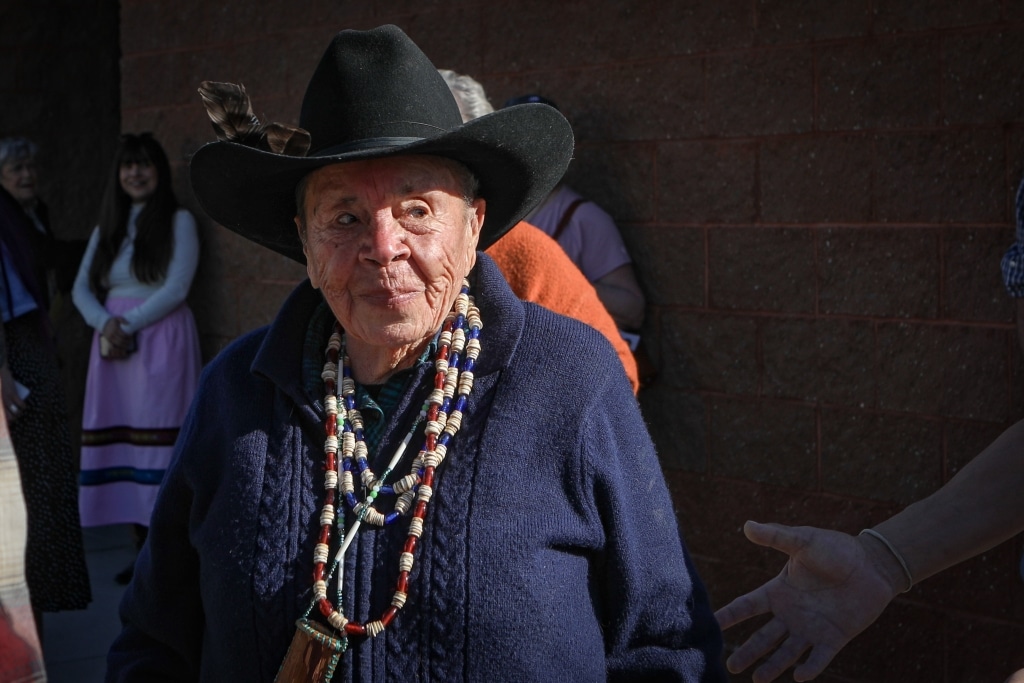
qʷʕayxnmitkʷ xʷəstalk̓iyaʔ (Jane Stelkia) of Osoyoos Indian Band was honoured with speeches, cake — and a celebratory horseback ride
qʷʕayxnmitkʷ xʷəstalk̓iyaʔ (Jane Stelkia) of the Osoyoos Indian Band, stands outside of Nk’mip Campground’s Clubhouse in sw̓iw̓s (Osoyoos) in syilx territory ahead of her 95th birthday party on April 11. Photo by Aaron Hemens

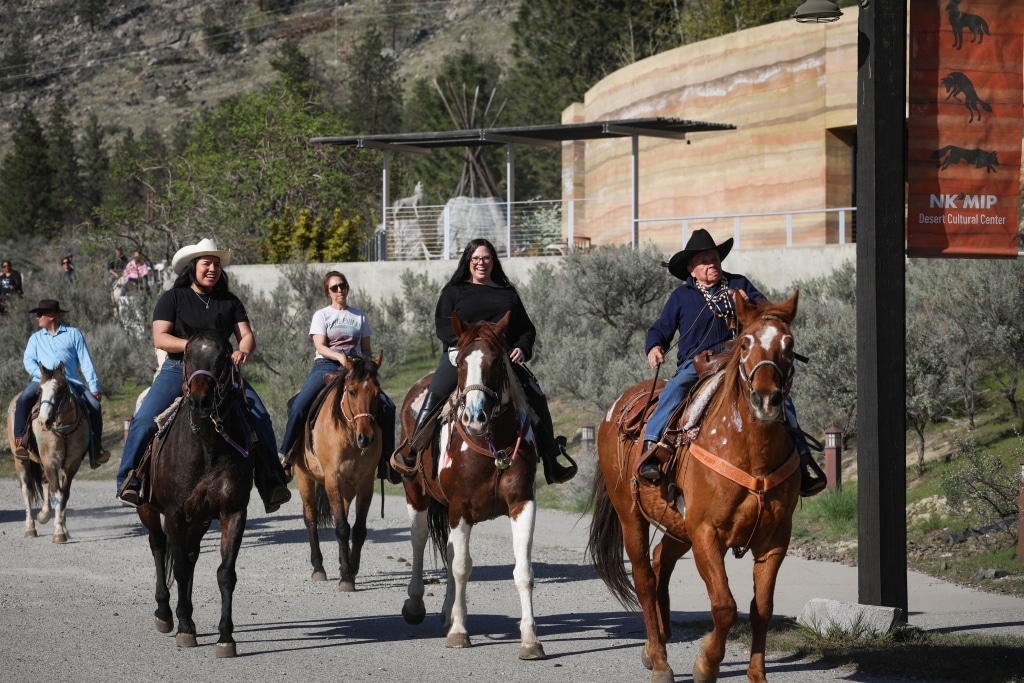
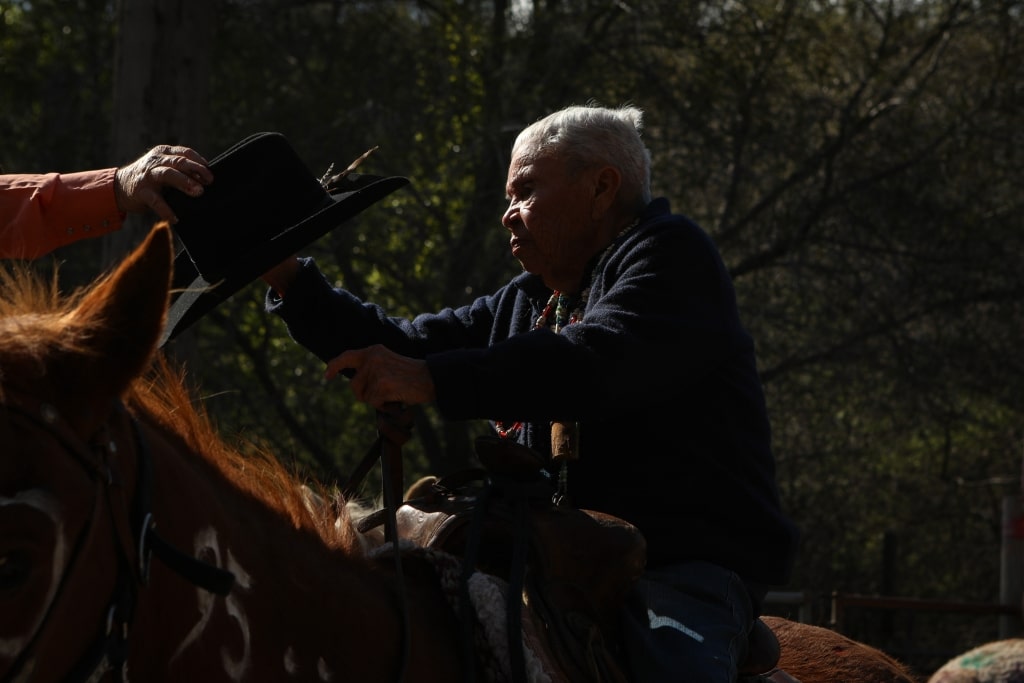
To celebrate her 95th birthday, qʷʕayxnmitkʷ xʷəstalk̓iyaʔ (Jane Stelkia) rode through her Osoyoos Indian Band community on horseback with her family.

The Elder is the oldest member of the syilx Okanagan Nation. She was honoured by leaders and community members with cake and speeches last week.

As roughly 100 people packed into the community clubhouse to celebrate on April 11 — “a real good turnout,” she said — Stelkia used her platform to share a speech of her own.

“I’m going to give a little talk — a talk from way back, so people can find out what it was like before,” she told IndigiNews.

“I thought to myself, ‘Well, if I have a good big one, I’m going to bring out my speech about the Indians.’”

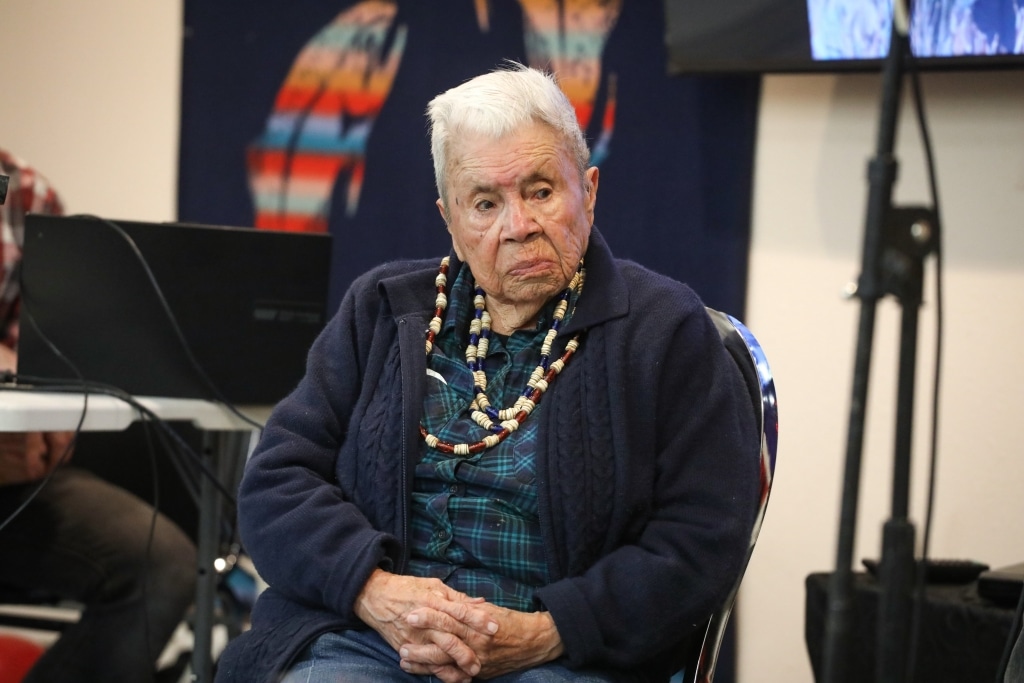
Stelkia asked a community member to read her speech on her behalf.

In it, she urged Indigenous people to assert a unified “Indian” identity, reclaiming the colonial label imposed by Christopher Columbus in 1492.

“For 532 years, we have been called Indians here, in what is now called Canada,” she said, in remarks delivered on her behalf. “Fight to put the Indian back.”

After dinner and birthday cake at the Nk’mip Campground’s Clubhouse in sw̓iw̓s (Osoyoos), Stelkia’s speech argued that Canada is attempting “to side-step the hell that the government put all us Indians through” by constantly changing the words used to describe sqilx’w (Indigenous) people — whether “Aboriginal,” “First Nations,” or “Indigenous.”

“They hope that in 50 or 100 years, no one will remember the Indians that went through hell. They want to erase that part of our history, because they couldn’t erase us,” said Stelkia.

“Since I was young, all I heard was that we were Indians. Until the past 20 years, I never heard the words First Nations or Aboriginals among us … Just another form of colonization.”

qʷʕayxnmitkʷ xʷəstalk̓iyaʔ (Jane Stelkia) listens as a community member reads her 95th birthday speech at Nk’mip Campground’s Clubhouse in sw̓iw̓s (Osoyoos) on April 11. Photo by Aaron Hemens


Nearly a century of historic changes

Stelkia, who is an nsyilxcən language speaker, has lived through monumental changes in her nearly a century of life.

When she was born in 1930, the country had just entered the Great Depression. King George V was “Canada’s” monarch, and William Lyon Mackenzie King its prime minister. At the time, Indigenous people were not yet allowed to vote in federal elections — unless they gave up any treaty rights and Indian status.

The notorious Duncan Campbell Scott still led the Department of Indian Affairs. In 1920 he made residential “school” attendance compulsory, saying his goal was “to get rid of the Indian problem” through total assimilation.

Just five decades before Stelkia’s birth, Canada’s 1876 Indian Act outlined that the term “Indian” means “any male person of Indian blood reputed to belong to a particular band,” or “any child of such person,” or “any woman who is or was lawfully married to such person.”

“We are Indians — we were called that from day one, so we gotta stick to that,” said Stelkia. “For 95 years, I’ve lived this and I know it.”

Reclaiming Indian identity also has legal implications. The controversial term was enshrined in 1982 in Section 35 of the Constitution Act, which declared that “Aboriginal peoples of Canada includes the Indian, Inuit and Métis peoples.”

She said governments have “always tried to get rid of the Indian” — and now she said they’re trying to get rid of the term “Indian” too.

“This is just a more indirect genocide of what was left,” she argued, “after the first genocide didn’t work.”

Over the decades, newer labels like “Aboriginal,” “First Nations,” or “Indigenous” have instead served to divide different nations once more unified in fighting for their rights, “and this is what the government wants,” she said.

She warned that if her people keep changing their collective names, decades in the future “nobody will know the history of wrong done to us.”

“The only way we can bring back our unity is if we are all Indians in the eyes of the government,” she said. “Divide and conquer is alive and well; now, the chiefs are having trouble having one voice.

“So have a voice by being Indians — because that’s what we are.”

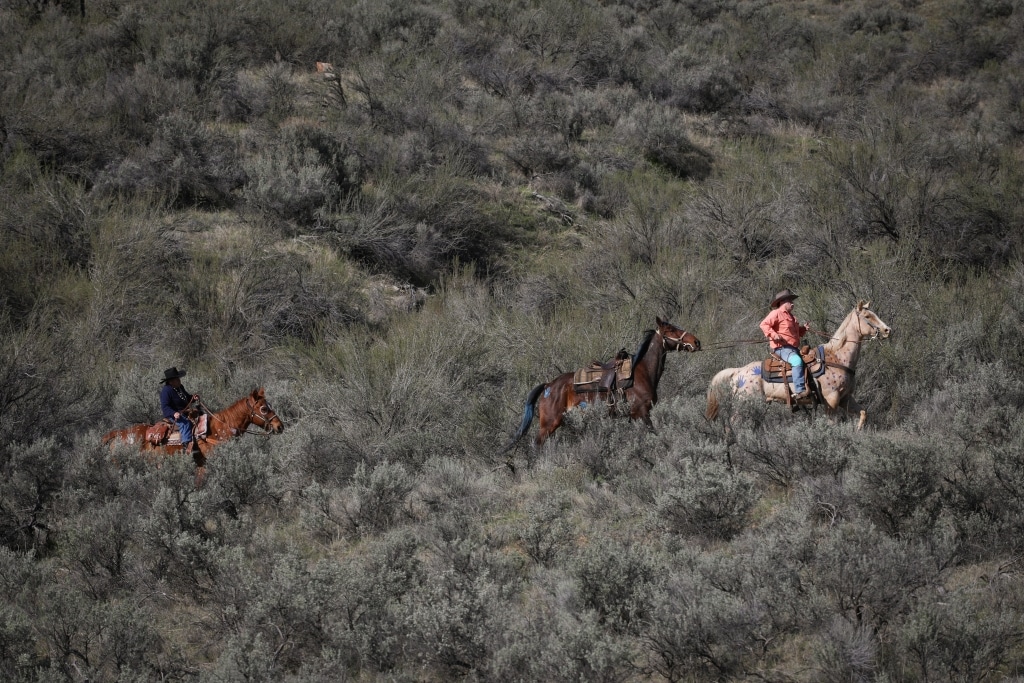
Jane Stelkia, left, and her son, Aaron, follow a trail outside of the Nk’Mip Desert Cultural Centre in sw̓iw̓s (Osoyoos) ahead of her 95th birthday party on April 11. Photo by Aaron Hemens


A horse-riding birthday tradition


Before Stelkia’s dinner and speech, Stelkia began her birthday with a personal tradition: a horseback ride through her community, alongside her family.

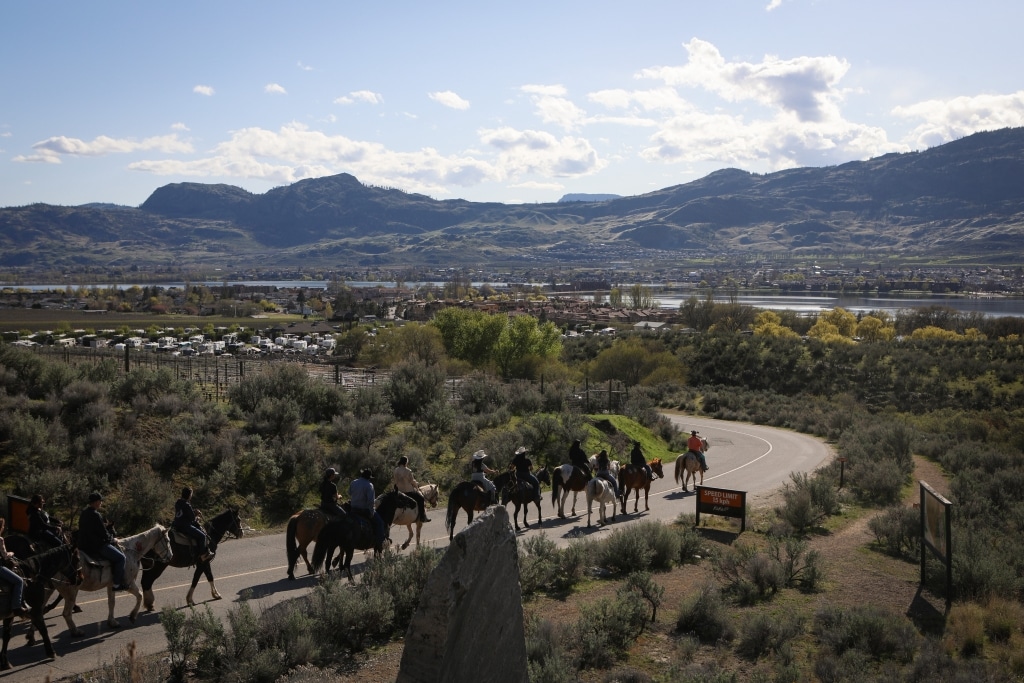
Nearly 40 Indigenous and non-Indigenous horseback riders joined her as she rode from the Indian Grove Riding Stables up along a ridge outside of the Nk’Mip Desert Cultural Centre.

She told her fellow riders “that’s where the ancestors are” — and reminded them her syilx Okanagan forebears depended on horses.

Those ancestors once lived in pithouses built into the earth along their route, she told the riders before setting off.


“They lived underground … for thousands and thousands of years,” she explained.

Horse riders make their way to the Nk’mip Campground’s Clubhouse in sw̓iw̓s (Osoyoos) for Jane Stelkia’s 95th birthday party on April 11. Photo by Aaron Hemens

The group made its way along the ridge and past the cultural centre, where they circled a fountain at the nearby Spirit Ridge Resort, drawing the attention of tourists, before winding their way down to Nk’mip Campgrounds and the camp’s clubhouse.

Stelkia said she’s been riding horses since she was a baby.

“I was almost born on a horse, I guess,” she told IndigiNews. “Indian people, back then, had their kids on the horses. Horses mean a lot to the Indian people, because we didn’t have anything to travel on.”

She remembers a time where horses were the only mode of transportation, when all you’d find on dusty roads were saddles, and simple four-wheeled wagons called buckboards.

Reaching 95, and being the eldest member of her nation, is a milestone, but “I didn’t even pay any attention to it,” she quipped about her age.

Jane Stelkia and riders make their way past the Nk’Mip Desert Cultural Centre in sw̓iw̓s (Osoyoos) ahead of her 95th birthday party on April 11. Photo by Aaron Hemens


Spirit, tenacity and grit


Attending Stelkia’s birthday party were four-of-seven chiefs from Okanagan Nation Alliance’s member communities, and each took to the microphone to share what the Elder meant to them.

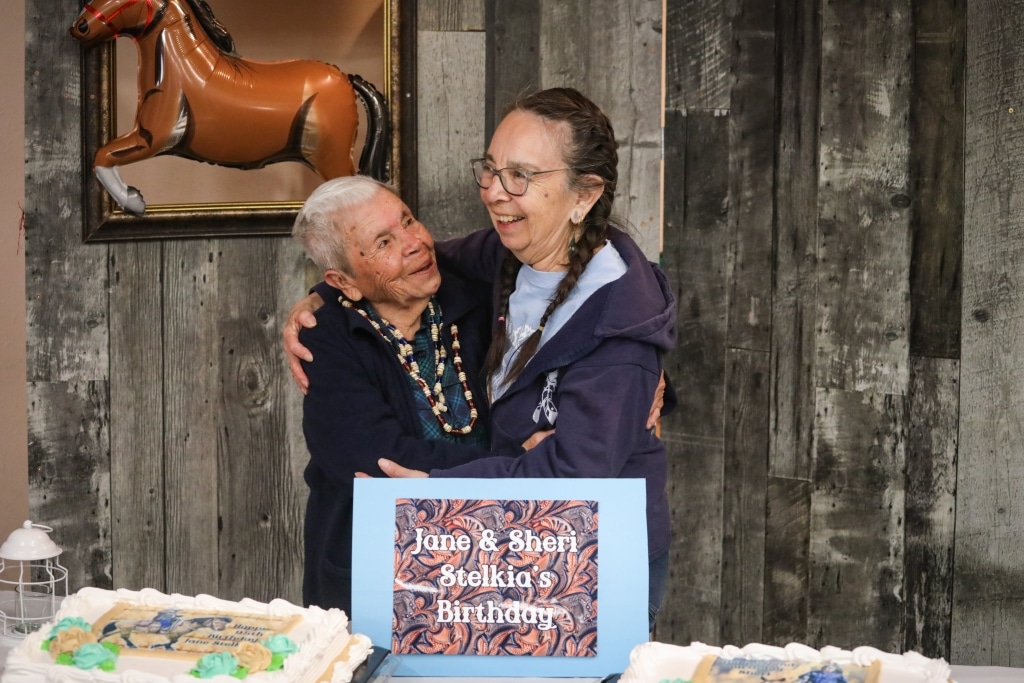
It was also Sheri Stelkia’s birthday, so two cakes were brought out to honour them.

Chief Robert Louie, of Westbank First Nation, said he’d known Jane since the early 1970s.

“Jane, you’ve got the same spirit, the same tenacity, the same grit, the same person that you were when I first met you,” he said. “You haven’t changed a bit.”

Jane and Sheri Stelkia celebrate their birthdays together at Nk’mip Campground’s Clubhouse in sw̓iw̓s (Osoyoos) on April 11. Photo by Aaron Hemens

Chief Keith Crow, of Lower Similkameen Indian Band, remarked about Stelkia still working with her hands at her age, for instance repairing fences.

“I see you’re doing everything at 95 years old,” he said. “I hope I can still be doing that at 95 — I hope I make it to 95 … You’re gonna go for 106.”

Penticton Indian Band’s Chief Greg Gabriel called her an inspiration throughout the nation and beyond.

“I’m just so happy to see you so young at 95,” he said. “Still riding, still working hard. You’re an amazing woman.”

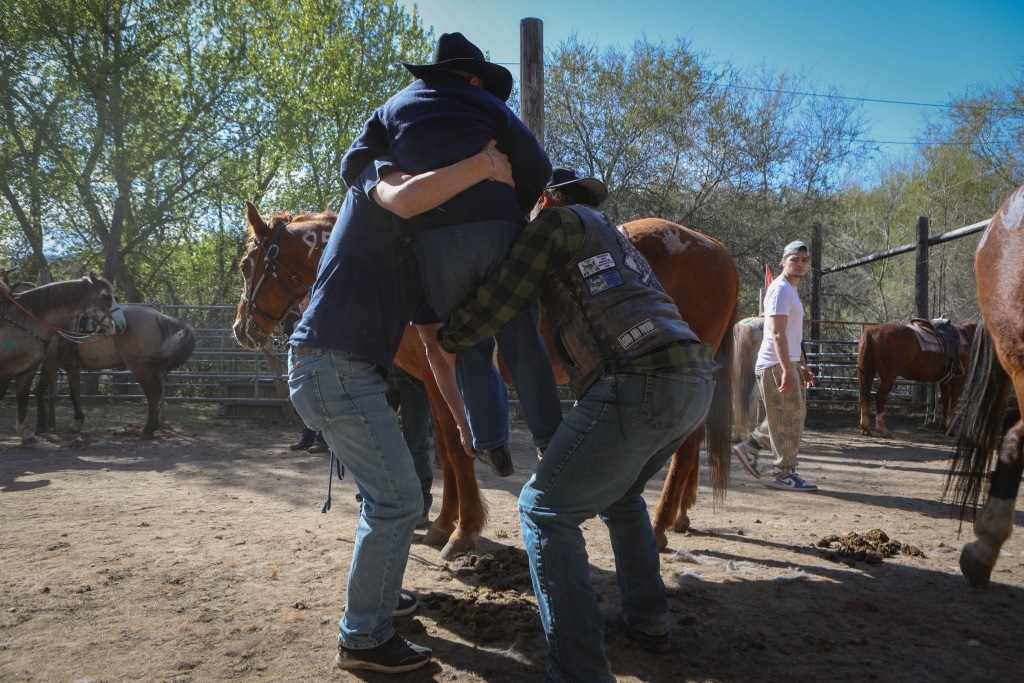
Jane Stelkia gets a lift onto her horse at the Indian Grove Riding Stables in sw̓iw̓s (Osoyoos) ahead of her 95th birthday party on April 11. Photo by Aaron Hemens

Chief Clarence Louie, of Osoyoos Indian Band, praised Stelkia’s hard-working lifestyle, and for keeping the syilx Okanagan horse culture alive.

He also thanked her and other language speakers in the room for their efforts in keeping nsyilxcən alive.

“None of us remember a time without you around,” Louie said. “You remember a time where most of our people didn’t speak much English.”

He reminded attendees in her childhood the world was a very different place for syilx Okanagan people.

“Our people didn’t have electricity; they had to get water from the creeks,” he recalled. “They had to build a fire and stay warm in the winter time.”

But even though times were tough when Stelkia grew up, he said, she still reminds people that there were also good times, too.

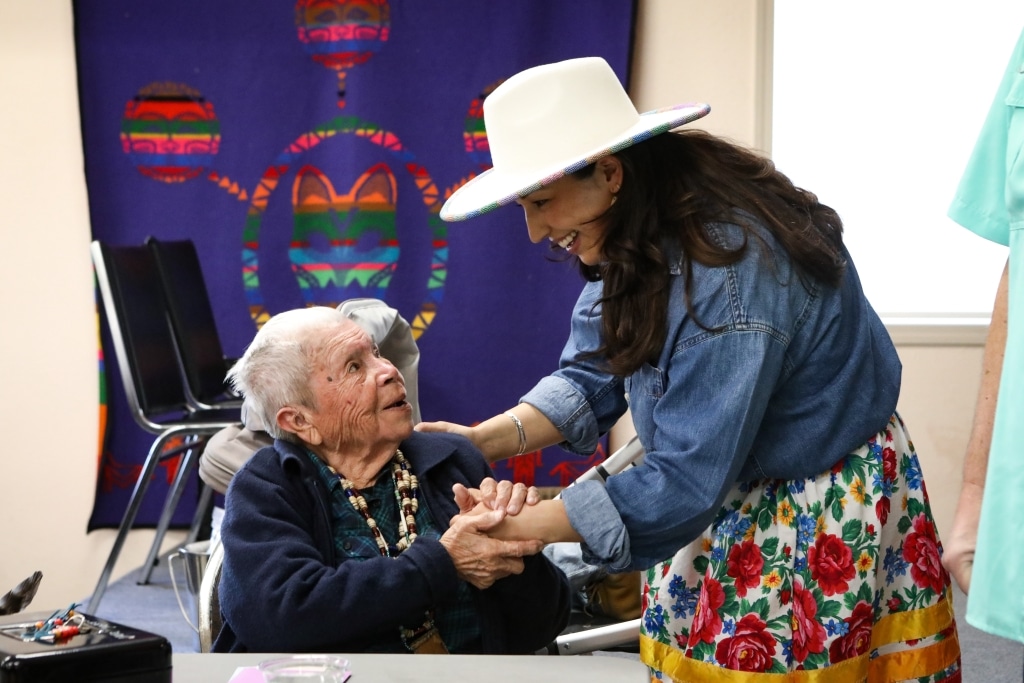
Jane Stelkia is greeted by snikłc̓aʔ tkʷmilxʷsniktcaʔ Jordan (Bower) Polychroniou at the Nk’mip Campground’s Clubhouse in sw̓iw̓s (Osoyoos) during her 95th birthday party on April 11. Photo by Aaron Hemens

“You remind us that we have to get back and not forget those times,” he told her with gratitude. “To remember those times, and to acknowledge where we come from, not just as a band but as a people and a nation.”

After the chiefs all spoke, attendees watched a video tribute of moments from Stelkia’s life on a big screen.

Between old pictures and footage, she narrated the eras of her lifetime, from her early years at the Inkameep Indian Day School, to her love of ranching, cattle and horses.

In her birthday tribute video, someone asked Stelkia how she deals with failures.

“I don’t know,” was her answer, saying failure simply wasn’t an option for her.

In the event’s closing words, she thanked her community for joining her celebration, telling everyone to stand strong.

“Be proud to be Indian,” she encouraged, “of our culture, your language and discipline.”

Jane Stelkia receives her hat from her son, Aaron, at the Indian Grove Riding Stables in sw̓iw̓s (Osoyoos) ahead of her 95th birthday party on April 11. Photo by Aaron Hemens


Author

AARON HEMENS, LOCAL JOURNALISM INITIATIVE REPORTER

Aaron Hemens is an award-winning photographer, journalist and visitor in unceded syilx Okanagan territory. He is Filipino on his mom’s side, and has both French and British roots on his dad’s. As a settler, he is committed to learning and unlearning in his role as Storyteller for the Okanagan region, and to accurately and respectfully tell stories of Indigenous Peoples throughout the area. Aaron’s work is supported in part with funding from the Local Journalism Initiative in partnership with The Discourse and APTN.


New docuseries Wildfire features episode on all Indigenous firefighting crew

Wednesday, April 16th, 2025 

Image

Image Caption

A still from the series Wildfire of the Salish Firefighter crew. Photo courtesy of Optic Nerve Films and CK9 Studios.


By Crystal St.Pierre
Local Journalism Initiative Reporter
Windspeaker.com

Knowledge Network is launching a five-part docuseries titled Wildfire on April 29.

Filmed in 2023 during one of the worst wildfire seasons in British Columbia’s history, the series captures the spirit and cutting-edge tactics of frontline B.C. Wildfire Service responders.

Wildfire was created by Optic Nerve Films’ Kevin Eastwood and CK9 Studios’ Simon Shave and Clayton Mitchell. Both Shave and Mitchell are former wildland firefighters.

Knowledge Network is British Columbia’s public education broadcaster. Available throughout the province on television and on streaming platforms across Canada, it features Knowledge Original documentaries commissioned from B.C.-based producers, curated dramas, fact series and documentaries from around the globe, as well as programming for pre-schoolers and parents.

Included in the Wildfire series is an episode highlighting the all-Indigenous Salish unit crew. The show explores how these firefighters navigate their commitment to the forest and their communities during devasting situations.

From initial attack crews to specialized air attack, parattack, and rapattack teams, Wildfire captures units across B.C. banding together in an effort to save the land and rebuild in the aftermath of some of the worst fires in the province’s history.

Viewers will be provided insight into fire behaviour, Indigenous fire keeper knowledge, and cultural practices that shape wildfire management.

Eastwood, executive producer and co-director, said after brainstorming with the other producers and directors about the documentary concept, his research indicated there had been attempts to create such a series in the past.

“The broadcasters I spoke to said it’s all about access,” said Eastwood. “You see, wildfire services just wouldn’t allow us, a (film) crew, to be on the frontline.”

Wildfire producers decided to take their concept to B.C. Wildfire Service, leaning into the team’s firefighting experience.

“(We) presented them with the idea and said ‘look, if it were these two (Mitchell and Shave), who are obviously very well trained and have trained a lot of people that work at these wildfires, a lot of the ground crews, would that be something different?’ And they said ‘yeah, with them this would be different’,” said Eastwood.

In 2022, the team filmed a few short pieces showing they knew how to handle safety protocols without becoming a distraction or disrupting the work of the actual firefighting crews. These short films satisfied B.C. Wildfire.

“So, we got the green light, and we certainly never anticipated that when we started filming it would be what became summer of 2023, which was that unprecedented summer with so much more acres and hectares burned than any other previous year in B.C. history,” said Eastwood.

While putting together the outline for the show, Eastwood and his crew were interested in showcasing the Salish crew members.

“I was very curious because I knew that, obviously, the people that have stewarded this land for millennia know a lot more about fire and the use of fire on the land than almost anybody else,” he said.

“I knew that there used to be a number of all-Indigenous wildfire crews, but there’s only one remaining that’s all 100 per cent Indigenous left, and that’s the Salish crew.”

Matt Nelson
Matt Nelson, Salish crew unit supervisor. Photo courtesy of Optic Nerve Films and CK9 Studios.

Eastwood connected with the Salish crew’s unit supervisor Matt Nelson, who was just beginning to fill the position from predecessor Ryan Pascal.

“It was just an interesting and powerful story in itself and both of them, they’re very different, but both Ryan and Matt are just such lovely people, such wonderful human beings and it was such a joy to spend time with both of them and to film them and to tell each of their stories.”

Wildfire was also given the opportunity to capture the importance of the all-Salish unit crew in their communities, showing what a source of inspiration they are to the people.

“They’re obviously doing a really important job and that was just a source of pride for the community,” said Eastwood. “When they know the Salish unit crew, those are the members of their community that are saving people’s lives and saving the land. Once upon a time the only people that were protecting the land from fire were the Indigenous peoples and so I think there’s a strong sense of tradition.”

At one time there were many Indigenous crews, but that number has dwindled due to recruitment happening online, which many community members don’t always have access too. Additionally, the boot camp training space is located in a different geographical area.

Nelson hopes that by showcasing the Salish crew in Wildfire it will prompt other Indigenous people to come forward and train.

“I grew up hunting and fishing and everything. It feels like we’re slowly losing that in communities. Some communities are doing way better than others, but I think just understanding that nature is part of healing and health and wildfire, definitely, will put you out onto the land, which is so important for people… to reconnect to the land,” Nelson said.

Beginning straight out of high school, Nelson applied and went through the wildland firefighter interview process.

He describes the mental training as self-paced as it is completed online. Once that is complete, individuals attend a seven-day bootcamp for the physical training portion.

“You’re there with 90 other students who are like-minded,” explained Nelson. “Then, if you do good in the bootcamp, you get hand-selected for crews.”

Crews vary as some have more Indigenous members than others. Nelson said, when surrounded by others from his community, he appreciates the cultural aspects brought through with Salish traditions.

“I think the biggest piece for me is, if we want to have a debrief or something… we will bring out a drum and sing and it’s just really nice because we will be doing months away from home, away from culture and then one of our guys will bring song to the debriefs,” said Nelson.

Nelson said he has always felt safe with the other crew members as well, because everyone has taken the same level of training and “we all look out for each other.”

Another episode of the Wildfire series focuses on the Rattlers crew, which is comprised mostly of firefighters from Lytton First Nation, which was one of the communities devasted by the wildfires of 2021.

“Although they’re not entirely an all-Indigenous crew, they’re mostly Indigenous,” said Eastwood. “We hear from some of the members of the Rattlers about being members and they talk about what it was like to be on a fire. They were on a different fire that day when their own town, their own village was burned down and so that provides some really powerful stories of just what was at stake.”

Eastwood hopes viewers gain the appreciation he did during filming of how the responders are not just working at a job, but instead how being a member of the B.C. Wildfire Service is a way of life, a choice and a calling to serve.

Wildfire airs Tuesdays from April 29 to May 27 on Knowledge Network, streaming free across Canada at www.knowledge.ca/wildfire and on the Knowledge Network app.

Local Journalism Initiative Reporters are supported by a financial contribution made by the Government of Canada.


‘Just respect the fire’: Returning cultural burns to a parched Okanagan landscape brings risk and reward


Long before colonialism, syilx people regularly started low-intensity controlled fires. Those bringing it back see how it’s saving homes and lives

Charles Kruger, a technician with Ntityix Resources LP, stands near a burning slash pile under his watch in the Glenrosa area in Westbank First Nation in syilx territory on March 20. Photo by Aaron Hemens

Growing up in the bush in the mountains around snpink’tn (Penticton) in syilx Okanagan territories, Charles Kruger’s family taught him how to start fires when he was no older than five.

“Being able to start a fire really young was crucial,” said Kruger, who is of syilx Okanagan and Sinixt ancestry.

“Because we live off the land — deer, moose, elk, grouse, stuff like that — being able to start a fire in the rain, in the snow, is super important. That’s a skill in itself.”

Kruger comes from a long line of hereditary fire chiefs, stretching back “many hundreds of years,” he said.

“My grandma would be the one to tell everybody when to burn. She was the fire-keeper, I guess you could say.”


Charles Kruger monitors burning slash piles in the Glenrosa area in Westbank First Nation in syilx Okanagan homelands on March 20. Photo by Aaron Hemens

For a millennia, long before settler colonialism, syilx Okanagan people would regularly conduct low-intensity controlled burns, carefully planned to maintain and replenish the health of the land and the tmixʷ (all living things).

Viewing fire as a medicine, this method of burning forests and grasslands — what are today known as prescribed, controlled, cultural or traditional burns — also limited the threat of devastating wildfires blazing out of control.

Kruger’s nation once had many villages across the region, and his ancestors would keep their communities safe with such practices.

“My grandma’s grandma’s grandma said that we had to burn around our villages,” Kruger recalled. “What that would do is it would protect the village” in the hottest months of summer.

“It makes a lot more vegetation and stuff,” he added. “That’s what we used to do for a long time to get the fresh green shoots that come up … a lot of animals live off of that.”

But with colonialism came the gradual suppression of fire from the landscape locally — settlers in syilx Okanagan territories favoured reactionary wildfire-suppression strategies.

Maintaining healthy forest ecosystems — which can require fire to thrive in the long-term — suddenly became secondary to logging and extracting resources.

The settler approach to fighting fires came at a cost — leading to an extreme buildup of dry fuels and vegetation cover in fire-prone areas that have resulted in unhealthy forests more likely to burn uncontrollably.

All those factors, combined with drier conditions brought on by climate change, have resulted in the devastating wildfires experienced in recent years — and seen a series of communities in “B.C.” and “Alberta” largely burned to the ground.

“When you look around the forests now, it didn’t look like that hundreds of years ago,” explained Jordan Coble, a Westbank First Nation councillor and president of Ntityix Resources, in an interview with IndigiNews in 2022.

“We’ve had lots of fires here in the Central Okanagan,” he said. “But none of those fires would’ve been so massive had we been able to carry out our traditional fire-burning practices.”

Coming from a family of hunters, Kruger said he’s noticed the impact a hotter, drier climate is having not just on the intensity of wildfires, but the decline in animal populations as well.

In some areas he frequents that once had water flowing through them, today much of the water has dried up because of lower snowpack. Without water, vegetation has dwindled — and so has the buck population.

“What that means,” he noted, “is that we’re getting a little drier and drier every year.”


Slash piles – which consist of accumulated forest debris, surface and ladder fuels — burn in a forestry area that had undergone wildfire mitigation work in 2024, in the Glenrosa area in Westbank First Nation in syilx Okanagan homelands on March 20. Photo by Aaron Hemens


‘We can’t prevent a fire from starting’


With climate change exacerbating dry conditions and causing more intense wildfires throughout “B.C.,” Kruger said it’s urgent to support the work of organizations like Ntityix Resources.

Owned by Westbank First Nation (WFN), Ntityix Resources has performed wildlife mitigation — including cultural burns — on more than 300 hectares of syilx homelands over the last 10 years.

Responsible for treating areas within the First Nation’s community forest, Ntityix’s wildfire mitigation projects have proven to be effective.

One key activity to maintain forest health is removing surface and ladder fuels — smaller trees and pruned lower-hanging branches — to keep fires close to the ground.

Slash piles – which consist of accumulated forest debris, surface and ladder fuels — burn in a forestry area that had undergone wildfire mitigation work in 2024, in the Glenrosa area in Westbank First Nation in syilx Okanagan homelands on March 20. Photo by Aaron Hemens

Earlier mitigation work in the Glenrosa area — including pruning tree branches and creating more space between adult trees — kept the flames of the 2021 Mt. Law wildfire from reaching the top of tree canopies, and then spreading into community neighbourhoods.

The mitigation work of keeping fire from climbing up the trees ultimately limited the wildfire’s growth, and helped firefighters maintain its intensity by keeping the flames on the ground.

Thanks to these efforts, only one home was lost in the area.

Similar groundwork helped save even more homes in the 2023 McDougall Creek wildfire, which burned through 8,000 hectares of WFN’s community forest.

And like the Mt. Law wildfire, Ntityix’s previous fire mitigation work in Rose Valley Regional Park enabled firefighters to effectively contain its spread, dropping flames in the forest canopy down to the ground.

Peter Kascak, a mentoring forester at Ntityix, explained that holding flames on the ground lets firefighters “work on the ground in front” of them — at once protecting people’s homes and keeping them safer while doing their jobs.

“We call it mitigation because we can’t prevent a fire from starting,” Kascak said. “A fire is going to start — it’s just going to happen. But what we can do is create a situation where it could be of less intensity.”
Peter Kascak, a mentoring forester at Ntityix, stands near a burning slash pile in the Glenrosa area in Westbank First Nation in syilx Okanagan homelands on March 20. Photo by Aaron Hemens


‘The greater the distance, the better’

Kruger joined Ntityix as a technician about four months ago, and he’s been contributing his knowledge of fire to the rest of the crew ever since.

On March 20, Kruger and a handful of other Ntityix technicians were burning slash piles in the WFN community forest, again in the Glenrosa area.

The piles consisted of accumulated forest debris, as well as surface and ladder fuels collected during Ntityix’s mitigation work in the spring of 2024.
Keenau Saunders, a technician with Ntityix Resources LP, ignites a slash pile with a drip torch in the Glenrosa area in Westbank First Nation in syilx Okanagan homelands on March 20. Photo by Aaron Hemens

This part of the WFN community forest within the Glenrosa area had been identified as a critical priority area, because it’s close to private property lines within a wildlife-urban interface.

Kascak said the technicians prefer to have a minimum 100-metre buffer space between properties and forest — and ideally double that.

“We’re creating some depth in there,” he said of the strategy. “The more you have mitigated, the better; the greater the distance, the better. The more chance, if fire is up in the canopy, of it dropping to the ground.”

By the time they finished their mitigation work in the area last year, it was too late to burn the piles of wood they made, he explained.

There’s a risk to the work. Burning the wood piles at the wrong time could spark a grass fire, especially if it’s timed too close to wildfire season.

“So you’re getting into a situation where you could start a forest fire if you start burning piles,” he said.

“So we have to leave them. The nice thing about that is that they dry out over the summer and they’re a little easier to burn.”

The March day’s moist conditions proved to be a favorable time to burn the piles, he said. Kruger agreed, adding that the timing was perfect.

”The snakes, the frogs — everything — are all underground,” he said. “It’s the perfect time to burn, this time of year.”

Kruger said he was helping to teach the others in the crew how to pile wood properly — in a stacked formation — preparing to burn it.

“The way I was taught … I always stacked them,” he said. “When I do it parallel like that, the embers will fall and they won’t hit the ground or go out. They’ll stay — you want them to stay.”


Slash piles – which consist of accumulated forest debris, surface and ladder fuels — burn in a forestry area that had undergone wildfire mitigation work in 2024, in the Glenrosa area in Westbank First Nation in syilx Okanagan homelands on March 20. Photo by Aaron Hemens

Once the dozen or so remaining slash piles had burned, the years-long effort to increase the fire guard between the Glenrosa community and the nearby forest was done.

“If a fire was to be out on the boundaries coming in this way towards the little village,” Kruger said, “well, the firefighters have a better chance of fighting it in these areas.”

He takes a lot of pride in the work he does at Ntityix. They’re ultimately working to protect people’s homes, he said — and lives.

But if fire is to be reintroduced to the ecosystem — and used as good medicine like it once was — he said that fire should be treated with more respect by everyone living in the Okanagan Valley.

“It could save your life in the cold months. It could also hurt you if you don’t know what you’re doing,” he remarked.

“Respect that fire. It can hurt you, it can scar you — just respect the fire, which we do, and utilize it.”

Author

AARON HEMENS, LOCAL JOURNALISM INITIATIVE REPORTER

Aaron Hemens is an award-winning photographer, journalist and visitor in unceded syilx Okanagan territory. He is Filipino on his mom’s side, and has both French and British roots on his dad’s. As a settler, he is committed to learning and unlearning in his role as Storyteller for the Okanagan region, and to accurately and respectfully tell stories of Indigenous Peoples throughout the area. Aaron’s work is supported in part with funding from the Local Journalism Initiative in partnership with The Discourse and APTN.