Tuesday, December 23, 2025

Ignoring International Obligations: Blocking UN Human Rights Delegates in Australia


Bureaucracy, in a formulation by the great German sociologist Max Weber, fanatically defends secrecy, and is bound to confect any explanation in doing so. When it comes to swatting away scrutiny by United Nations human rights delegates, local officials can be relied upon to obfuscate, blur and lie about a Member State’s observance of conventions and fundamental norms. In October 2022, and again in December 2025, UN bodies have been trying to piece together various troubling pieces of the Australian criminal justice system. In a country lacking a bill of rights, administrators and officials have often shown themselves indifferent to their obligations in international law.

In 2022, the United Nations Subcommittee on Prevention of Torture (SPT) was blocked from accessing Queensland and New South Wales prisons. Till that point, the Subcommittee had made over 80 visits to more than 60 countries. Only on one other occasion was a visit terminated. A press release from the Office of the UN High Commissioner from Human Rights (OCHR) noted that the SPT had “experienced difficulties in carrying out a full visit at other locations, and was not given all the relevant information and documentation it had requested.”

The head of the four-member delegation, Aisha Shujune Muhammad, said at the time that Australia had clearly breached its obligations under the Optional Protocol to the Convention Against Torture (OPCAT). The termination of the visit scheduled for October 16 to 27 was “deeply regrettable” but showed a profound ignorance on the part of prison and government officials about the SPT’s mandate. “The SPT is neither an oversight body, nor does it carry out investigations or inspections,” explained Muhammad. Its purpose was to furnish State Parties with confidential recommendations on how best to establish “effective safeguards against the risk of torture and ill-treatment in places of deprivation of liberty.”

The SPT Report on the matter went on to note “persistent negative media coverage” of its members, “including pernicious remarks from government officials in certain regions, amounting to what the Subcommittee would qualify as a smear campaign.” These “no doubt contributed in some cases to the hostility faced by the Subcommittee, as evidenced by the repetition of disparaging quotes from government officials by the administrators of some of the places of deprivation of liberty that it visited.”

Such coarse ignorance towards the functions of another UN body, this time the United Nations Working Group on Arbitrary Detention, was again in evidence when the Northern Territory blocked it from visiting watch houses, mental health facilities, and prisons for adults and children. The Working Group, during its visit from December 1 to 12, faced a souped up response from the NT Corrections Minister Gerard Maley that the visit could not be accommodated given concerns about “operational capacity, safety and workforce resourcing priorities”. This rationale did not seem to apply to a visit conducted that same week by a delegation from the United Arab Emirates, presumably less likely to ruffle feathers in visiting the Holtze Youth Detention Centre and Darwin Correctional Centre.

The gloomy November report by the territory’s Ombudsman, which was cognisant that “watch house cells were very crowded with no opportunity for prisoners to leave the cell”, suggested the authorities had much to hide. Adding to this the use of exposed toilets made such a “combination of conditions […] undignified and inhumane, particularly where prisoners were subjected to these conditions for extended periods of time.”

The same fate of bureaucratic apologetics befell the Working Group in attempting to visit youth detention centres in Western Australia. Both the Banksia Hill Youth Detention Centre and the youth wing of the high-security adult prison south of Perth called “Youth 18” were deemed off limits till the state’s Justice Department had deemed it “appropriate and safe to do so”. The WA Corrective Services Minister Paul Papalia confirmed that visits were being made by the delegates to certain detention facilities only “where safe and appropriate”.

The memory of the 2022 SPT visit must have lingered in its sting, given the Subcommittee’s findings that the Banksia Hill Detention Centre lacked running water, working showers, or televisions, with cells having mattresses on floors. Children were also left alone – effectively “de facto solitary confinement” – for up to 23 hours a day, with cell lighting externally controlled. One wonders how tardy the WA government has been in addressing the matter.

The Working Group statement was not as harsh as that of the SPT. But its bite was toothy. In its December 12 statement, the members noted that, while having enjoyed both unimpeded access to Commonwealth places of detention and freedom of inquiry inspecting detention facilities in the Australian Capital Territory and New South Wales, the same could not be said about Western Australia and the Northern Territory. Such a “complete lack of cooperation by authorities” had undermined “the Working Group’s ability to implement its mandate and deprives detainees of access to independent international protection.”

The delegates also identified the continued “gross over-representation of First Nations people in the prison population, the shocking detention of children as young as 10, and the punitive approach to migrants”. The “extremely young ages from which children may be detained in Australia” violated “fundamental human rights norms.” Punitive migration detention proved particularly persistent, with detainees facing “extremely lengthy periods”, sometimes exceeding 15 years. The detention of non-citizens and their transfer to Nauru pursuant to a Third Country Resettlement Arrangement further “dismayed” the Working Group.

Many Australian politicians, always happy to execrate foreign states for their human rights blemishes, make it their due not to comment on violations taking place closer to home. But the Australian Greens sensed something has gone off in the process, noting how little the Commonwealth has done regarding its human rights obligations in this field. Justice Spokesperson for the Greens, Senator David Shoebridge, underlines the stark point that the territory’s budget is funded to the tune of 80%, a figure that inevitably covers incarceration facilities. “If they’re funding it, they should demand to open it. If they won’t, they should cut off funding to these torture factories.”

Australia is regarded as a liberal democracy, with a smattering of human rights legislation its various governments observe with resignation, when convenient. Along with most states, its attitude to the UN and its various emissaries remains guarded. Every so often, a feral sort of sovereignty asserts itself, beating back those human right scrutineers who do much in trying to fracture the cruelties bureaucracy seeks to mask.

Binoy Kampmark was a Commonwealth Scholar at Selwyn College, Cambridge. He lectures at RMIT University, Melbourne. Email: bkampmark@gmail.comRead other articles by Binoy.
DECOLONIZATION

Hawai‘i Has a Rare Opportunity to Reclaim Land From the US Military

The US military is abusing Hawaiian land. Will residents be able to exert Indigenous sovereignty and get it back?


By Christine Ahn & Davis Price
December 22, 2025

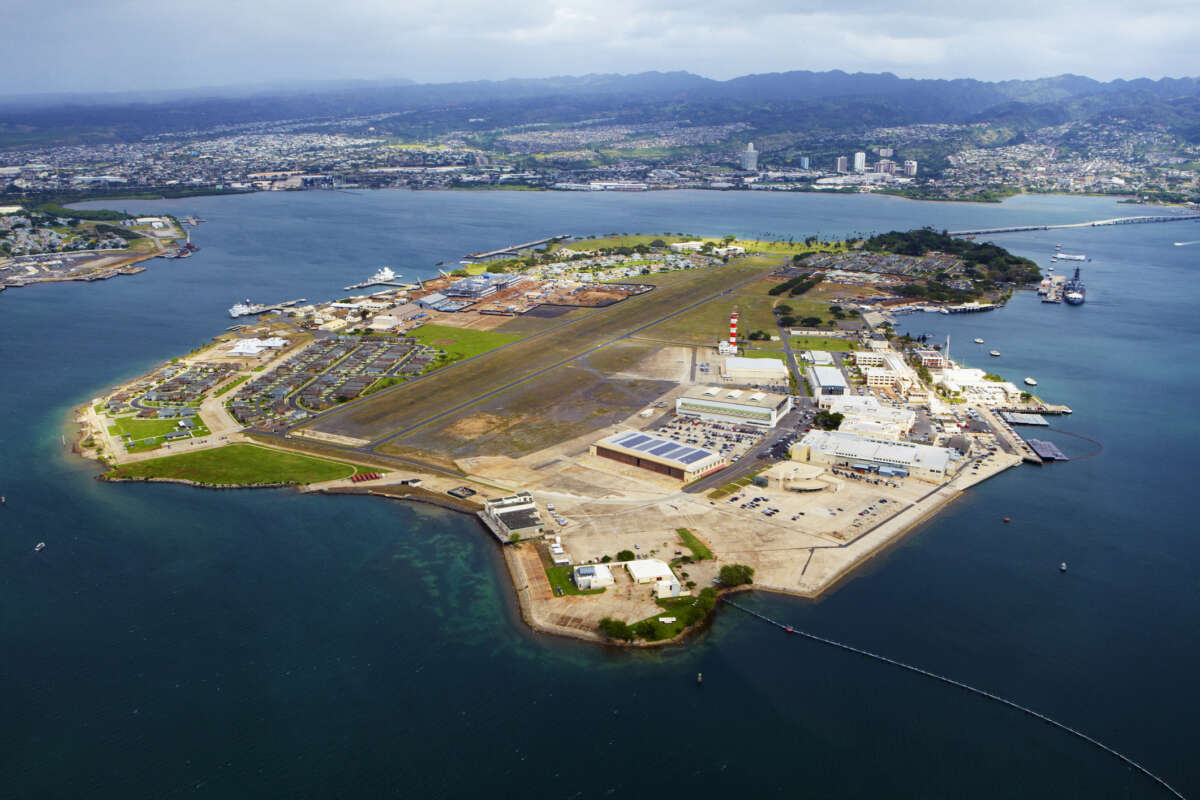
Aerial view of Pearl Harbor, a deep water U.S. naval base and headquarters of the U.S. Pacific fleet, taken circa 2012.

Since 1964, the U.S. military has leased roughly 47,000 acres of land from the State of Hawai‘i — for a token $1. The leases, which account for 18 percent of military lands in Hawai‘i, are set to expire in 2029, offering Hawai‘i a rare opportunity to reclaim land from the war machine. As the expiration date looms, Hawai‘i residents are at a crossroads: remain a staging ground for U.S. imperialism or pivot toward community well‑being, environmental sustainability, and economic self‑determination.

But that decision may arrive sooner than 2029: Allegedly faced with pressure from federal officials to fast-track lease renewals by the end of this year, Democratic Gov. Josh Green signed a statement of principles in September with Army Secretary Dan Driscoll expressing the intention to “explore the feasibility of land use that aligns national security and Army readiness needs with the State’s priorities for public benefit.” A month later, Green sent Driscoll a proposal for a $10 billion plan that included a “community benefits” package. He argued that this sum would be favorable should the Army pursue “condemnation,” the use of eminent domain to seize Hawai‘i’s land for “national security.”

Native Hawaiian groups swiftly condemned the move in a September 2 statement signed by 40 organizations. They opposed fast-tracking the leases and pointed out that Green and Driscoll sidestepped federal and state statutes that require a thorough review — a process the Army and Navy had already failed to complete earlier that year.

After mounting pressure from the Office of Hawaiian Affairs, state legislators, and numerous environmental and civic organizations, Green walked back the end-of-year deadline and extended the negotiation timeline into 2026. Still, the episode highlighted how easily the U.S. military can bypass democratic debate in the name of “national security,” and how vital it is for the public to have informed discussions about the military’s impact on Hawai‘i.

How Hawai‘i Became Occupied

The U.S. military controls roughly 254,000 acres across Hawai‘i, making it the most militarized state per capita in the country. On O‘ahu alone, the military occupies 86,000 acres, or 25 percent of the island. These lands were part of the “ceded” territories illegally seized from the Hawaiian Kingdom.


From Hawaii to Haiti, We Must Center Decolonization in Our Climate Action
Tourist “paradises” come at a steep price paid by native islanders and local ecosystems.
By Kwolanne Felix , Truthout August 27, 2023


Once a sovereign nation, Hawai‘i was the starting point for America’s century of imperialism and conquest in the Pacific. In the late-19th century, American missionaries and plantation owners, seeking to avoid U.S. tariffs on Hawaiian sugar, conspired with the U.S. Navy to orchestrate a coup to overthrow Queen Lili‘uokalani in 1893.

Although the coup was condemned by President Grover Cleveland as illegal, in 1898 President William McKinley signed the Newlands Resolution, illegally annexing Hawai‘i as a U.S. territory through a joint congressional resolution, bypassing the legally required two-thirds majority in the Senate to ratify a treaty between two nations.

After annexation, the provisional government reclassified Crown and government lands as “public” property and transferred them to the U.S. Interior Department. In 1908, the U.S. designated Pearl Harbor a naval base, making Hawai‘i a strategic location between the U.S. and Asia, and shifted U.S. “Manifest Destiny” from a continental to a global empire. When Hawai‘i was admitted as a state in 1959, about 1.8 million acres of former Crown and government lands — including those currently considered for lease renewal — were transferred to the state, with the condition that these lands be used for five specific public purposes, including the “betterment of the condition of native Hawaiians.”


U.S. Military Footprint


This year, the Hawai‘i State Legislature passed House Resolution 199 directing the Department of Land and Natural Resources to conduct a comprehensive economic analysis of military‑leased lands. The purpose was to assess lost economic opportunities in agriculture, housing, and education, as well as costs for cleanup of contaminants and unexploded ordnance. In the end, the legislature did not fund the study.

While we lack a comprehensive view, there are indications that the U.S. military’s impact on Hawai‘i’s economy and environment is significant, especially as it pertains to housing. According to a 2024 Pentagon report, 35 percent of the 42,333 servicemembers living on O‘ahu occupy off-base rental housing. This represents about 10 percent of the private rental properties on Oahu. Not only do military personnel displace local renters, but they also drive up rental prices because of Basic Housing Allowances, which help them outbid locals. While the amount varies by rank, the lowest enlisted pay grade living in Honolulu, an E-1 military personnel without dependents, receives $2,403 per month in addition to their salary. Meanwhile, high-ranking military personnel without dependents receive $4,287 monthly.

When you add this to their free or low-cost health care, food allowances, subsidized groceries at the commissaries, store discounts, and free education and training, it’s clear that military personnel enjoy a much more comfortable financial situation than many local residents. Even Rep. Ed Case, a Blue Dog conservative Democrat, acknowledged this dynamic: “One factor in driving unacceptably high home rental prices throughout our state and especially on O’ahu is military servicemember participation.”


Environmental Damage

While positioning itself as a protector of Hawaii’s security and well-being, the U.S. military strains and poses a major threat to the island’s natural resources. According to data from the Honolulu Board of Water Supply, the U.S. Marine Corp Base in Kāneʻohe is the single largest consumer of water in Hawai‘i, using 63.7 million gallons per month.

Aside from water usage, the U.S. military also jeopardizes Hawai‘i’s freshwater supply. In 2021, 20,000 gallons of jet fuel leaked from the Navy’s Red Hill Bulk Fuel Storage Facility into the Moanalua-Waimalu aquifer, affecting more than 93,000 people, mostly military personnel and their families.

The fuel storage facility was built in 1940, 100 feet above the aquifer, which serves as the main source of drinking water for over 400,000 Oahu residents. Groups such as Kaʻohewai, a coalition of Native Hawaiian organizations, the Sierra Club of Hawai‘i, and the grassroots group O’ahu Water Protectors mobilized to pressure the Navy to shut down and defuel Red Hill. The disaster response and efforts to shut down the facility have cost taxpayers over $2 billion, and the Board of Water Supply is suing the Navy for $1.2 billion in damages related to cleanup and protecting the island’s drinking water from further contamination. Because of the Red Hill crisis, the Board of Water Supply asked residents to reduce water use by 10 percent, and in 2025, they doubled that request to 20 percent.

“The Red Hill crisis exposed a central contradiction of the military’s presence in Hawai’i,” wrote Kyle Kajihiro, University of Hawai‘i at Manoa professor. “Contrary to the dominant national security discourse that the U.S. military protects Hawai‘i and the Pacific region, Red Hill epitomizes the military occupation of Hawai‘i that threatens people and the environment.”

Precedence for Resisting Lease Renewals

Even before a lease can be renewed, the state’s Bureau of Land and Natural Resources (BLNR) must approve the military’s environmental impact statement. In 2025, the BLNR rejected the U.S. Army’s Final Environmental Impact Statement and its lease renewal of 23,000 acres at Pōhakuloa Training Area on the Big Island.

Pōhakuloa is the U.S. military’s prized lease, covering about 132,000 acres, of which 20 percent is leased from the state. Under the lease, the military must remove or disable ammunition after training. However, in response to a lawsuit filed by two Native Hawaiian cultural practitioners, a judge ruled that the state did not enforce cleanup rules at Pōhakuloa. Inspectors discovered shells and discarded vehicles on the property, and found that the Army’s cleanup efforts and the state’s record-keeping were inadequate. The military’s failure to uphold its lease commitments led the Hawaiʻi County Council in August to unanimously approve a resolution calling on the military to halt all “desecration activities” and for the state to conduct comprehensive cleanup and restoration before considering any lease extensions or land swaps at Pōhakuloa.

According to Mahina Tuteur, a Native Hawaiian attorney with Pō`ai Ke Aloha `Aina, Hawai‘i ’s history with the U.S. military teaches two important lessons. First, once land is acquired — whether through lease, condemnation, transfer, or other means — it is rarely returned unless there is organized opposition. Second, the state of Hawaiʻi has often failed in its duty as a trustee for these lands.

Tuteur points to two long-term successful organizing initiatives where Kānaka `ōiwi, along with peace and environmental activists, mobilized communities and filed lawsuits to stop live-fire bombing by the U.S. military. For decades, the U.S. military used Kaho`olawe to practice live-fire bombing for the Korean and Vietnam wars, even simulating an atomic bomb blast. In 1976, as the movement for Hawaiian sovereignty grew, Kānaka `ōiwi occupied Kaho`olawe and demanded an end to the bombings and the return of the land. Fourteen years later, their efforts succeeded, and cleanup efforts began with $400 million allocated to remove unexploded ordnance, though it remains incomplete.

Another example is Mālama Mākua, a Native Hawaiian-led community group on O`ahu, which successfully stopped live-fire bombing and secured cultural access in Mākua Valley after fighting for decades to end the military’s use of their land. They are close to ending the military’s lease as a first step towards reclaiming all occupied land.

Tuteur argues that communities should demand that the State of Hawai‘i act as an active trustee, with clear obligations to beneficiaries — Native Hawaiians and the public — by requiring environmental and land assessments, ongoing cleanup efforts, and a process rooted in the state’s constitutional duty to protect these lands for future generations.


Redefining Security in Hawai‘i

Governor Green invoked “national security” to accelerate negotiations of lease renewals with the U.S. Army, writing that the usual public‑input process must be set aside because of the “urgency” expressed by Army Secretary Dan Driscoll.

When the State of Hawai‘i signed the original 1964 leases, it did so under the shadow of eminent‑domain threats. As Tuteur explains, “Condemnation has been weaponized as a colonial tool and negotiating tactic, often resulting in harm to Hawaiian families.” For Green and Driscoll to think that there can be “friendly condemnation” — the expeditious transfer of property via eminent domain — highlights just how far apart the sides are on this issue.

Why rush now, especially as U.S.-China relations enter a phase of “managed rivalry,” a term coined by David Meale, a former diplomat, that refers to the space for cooperation despite lingering tensions. A 2025 study by Harvard and MIT scholars published in International Security reached the same conclusion: “There is no evidence that China poses an existential threat to the countries on its borders or in its region that it does not already claim sovereignty over.” Analyzing thousands of articles, speeches, and policies, the authors concluded, “China does not seek regional hegemony or aim to compete with the United States for global supremacy. Instead, China views international relations as multilateral and cooperative.”

Instead of expanding militarization, the U.S. should partner with China on shared challenges — especially climate change, to which the U.S. military is a major contributor.


According to Neta Crawford, a professor at the University of St. Andrews, the Pentagon is the single largest institutional consumer of energy in the United States and the world’s biggest single source of fossil‑fuel‑related greenhouse‑gas emissions. Crawford and Lennard de Klerk found that for the 2024 Rim of the Pacific (RIMPAC) war drills, U.S. forces, which were given 20 million gallons of naval and jet fuel, produced about 300,000 tons of CO2-equivalent emissions, exceeding the annual emissions of the eight lowest-emitting countries in 2022.

Hawai‘i is especially vulnerable to the climate crisis. Chip Fletcher, dean of UH Mānoa’s School of Ocean and Earth Science and Technology, warns that rising carbon dioxide has already pushed Hawai‘i into a Pliocene‑like climate, where average temperatures exceed 84 degrees Fahrenheit and threaten photosynthesis, but if they climb to 104 degrees Fahrenheit, tropical crops could die permanently. Rising temperatures from climate change are causing intense droughts, triggering wildfires that destroyed Lahaina and warming oceans, leading to “coral bleaching” and acidification that is destroying marine ecosystems around the islands.

Rather than serve as a training ground for a prospective U.S.-China war, Hawai‘i can instead become the piko (center) of peace and resilience. Hawai‘i’s 2015 legislative commitment to 100-percent renewable energy illustrates the state’s capacity to lead on sustainability.

Professor Jonathan Kamakawiwoʻole Osorio, dean of the Hawaiʻinuiākea School of Hawaiian Knowledge, emphasizes that the U.S. occupation of Crown and Government lands deprives Hawaiʻi of wise land use. Kānaka ʻōiwi are reclaiming traditional, sustainable food practices like growing taro and building fishponds, advancing innovative solutions to our most urgent infrastructural and affordability issues. “These lands are from a public trust, and that means that the use of these lands, the deployment of these lands, has to fulfill a public interest,” Osorio said in an interview with Truthout. “There is no greater public interest than anticipating the changes that climate is going to force on our society.” Osorio advocates for expanding community governance over these trust lands so that natural resources are managed for the benefit of the people, not for military purposes.

Reclaiming Land for Hawai‘i’s Resilience

With public pressure mounting, Rep. Jill Tokuda (D- Hawai‘i), who sits on the House Armed Services Committee, helped remove language from the 2025-26 National Defense Authorization Act that would have temporarily authorized the military to condemn state land. “Under no circumstances should we entertain the idea of giving land away to the military,” Tokuda said in a press release. “If they attempt such an illegal action, they will lose in court and more importantly, they will lose the trust of the people of Hawai‘i.”

Now, the people of Hawai‘i must seize this crucial opening to advocate for using these state lands to meet more basic human needs that increase the islands’ resiliency and self-sufficiency, especially in the face of climate change.

Keoni Lee, co‑CEO of Hawai’i Investment Ready, argues that Hawai‘i’s pre‑colonial economy — rooted in the non‑monetary ahupuaʻa system where “success was measured by the health and productivity of people and ‘āina” — offers a template for a regenerative future. He warns that today’s extraction‑driven, GDP‑focused model generates inequality and environmental harm. Lee is part of a growing movement in Hawaiʻi that is elevating models like Kumano I Ke Ala, a community-based social enterprise that restores and cultivates traditional agricultural lands and trains youth in the values that supported a once fully sustainable traditional Hawaiian food system.

Native Hawaiian advocates are building momentum toward a shift in the governance of resources in Hawaiʻi, which has been dominated by extractive and abusive industries, such as the military, for too long. While large‑scale stewardship projects exist, they are often treated as side ventures, and lack long‑term capital investments, like roads or schools. Investing in regenerative economies, Lee argues, could create thousands of place‑based jobs in restoration, farming, and renewable energy. “We’d keep more money circulating locally instead of leaking out, building real security from the inside out,” Lee explains. “Hawai‘i’s resilience is national security.”

By engaging in informed public debate about the economic, environmental, and cultural costs of the military’s footprint — and exploring repurposing the military’s footprint for community-driven, sustainable uses — Hawai‘i can transform from a base preparing for war into a beacon of peace, resilience, and Indigenous innovation.


This article is licensed under Creative Commons (CC BY-NC-ND 4.0), and you are free to share and republish under the terms of the license.


Christine Ahn is an associate fellow at the Institute for Policy Studies and the founder and former executive director of Women Cross DMZ, a movement of women mobilizing for peace in Korea.


Davis Price is co-founder of ʻĀina Aloha Economic Futures and the Senior Domestic Policy Strategist at the NDN Collective.

America’s closest allies increasingly view Trump-era US as 'negative force' in the world


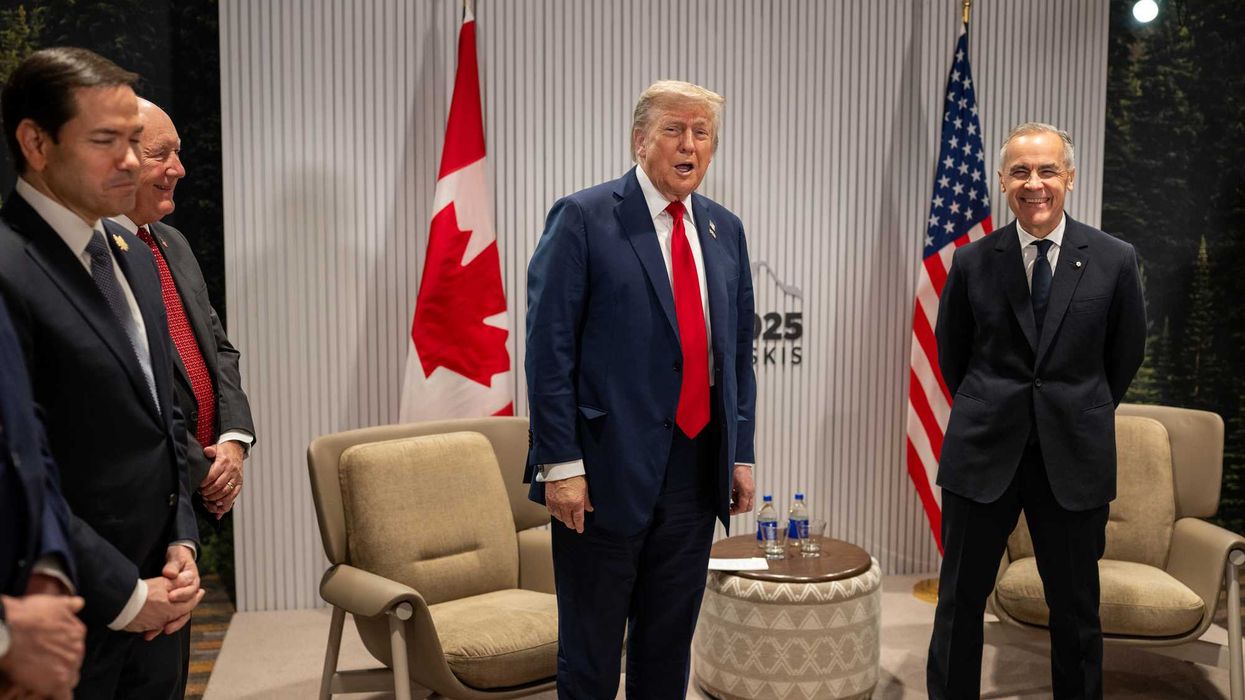
U.S. President Donald Trump with Canadian Prime Minister Mark Carney 
and U.S. Secretary of State Marco Rubio on June 16, 2025

December 23, 2025
ALTERNET


The term "Pax Americana" (which means "American Peace" in Latin) is used to describe the period of relative stability that the West enjoyed in the decades following World War 2. According to concept, the United States' alliances with Canada and European countries kept the "Pax Americana" strong for many years. But liberal economist Paul Krugman, a scathing critic of President Donald Trump's foreign policy, believes that the Pax Americana "basically ended on January 20, 2025" — the day Trump returned to the White House following the end of Joe Biden's presidency.

U.S. allies that helped keep the Pax American strong included Canada, France, Germany and the UK (which is four countries in one: England, Scotland, Wales and Northern Ireland). And according to a newly released survey conducted by Politico/Public First, those allies are really worried about the U.S. — especially Canada.

Politico's Erin Doherty, in an article published on December 23, reports, "Unreliable. Creating more problems than solving them. A negative force on the world stage. This is how large shares of America's closest allies view the U.S., according to new polling, as President Donald Trump pursues a sweeping foreign policy overhaul. Pluralities in Germany and France — and a majority of Canadians — say the U.S. is a negative force globally, according to new international Politico-Public First polling. Views are more mixed in the United Kingdom, but more than a third of respondents there share that dim assessment."

The percentage of people who now consider the U.S. a "negative force" in the world, according to Doherty, includes 56 percent of Canada, 40 percent of Germany and France, and 35 percent of the UK.


When Politico/Public First asked if the U.S. "creates problems" or "solves problems," those who said "creates problems" included 63 percent of Canada, 52 percent of Germany, 47 percent of France, and 46 percent of the UK.


Doherty notes, "In the U.K., Trump remains polarizing, but Prime Minister Keir Starmer has largely avoided public confrontation. His priorities now include finalizing a U.K.-U.S. trade deal and coordinating a European response to Trump's efforts to end the war in Ukraine — without angering the White House, the delicate balance many allied leaders are trying to strike. Canada, meanwhile, has seen the sharpest deterioration in relations, which have soured amid a punishing trade war and Trump’s intermittent rhetoric on annexation."

Read Erin Doherty's full article for Politico at this link.


'Right to self-determination': Greenland leader shoots down Trump’s latest power grab


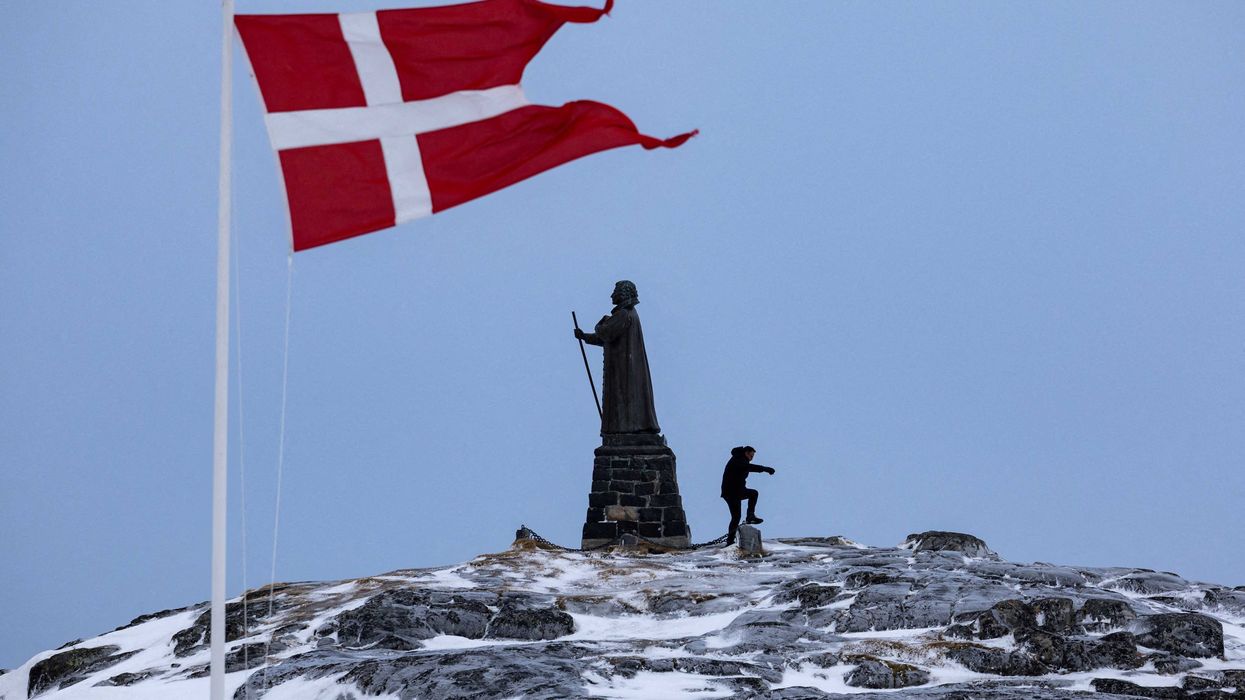
FILE PHOTO: A man walks as Danish flag flutters next to Hans Egede Statue ahead of a March 11 general election in Nuuk, Greenland, March 9, 2025
December 23, 2025 
ALTERNET

During Donald Trump's first presidency, he was often described as an "isolationist" whose paleoconservative "America First" views were a major departure from hawkish GOP presidents like George W. Bush, Ronald Reagan, Richard Nixon and George H.W. Bush. Yet Trump, at times, has taken an imperialistic turn during his second presidency — from calling for Canada to become "the 51st state" to pushing for regime change with Venezuela to wanting the United States to acquire Greenland.

Trump, in late December, reiterated his desire to take over Greenland — a Danish colony — and Greenland Premier Orla Joelsen reiterated that he has no desire for that to happen.

In a Tuesday, December 23 post on X, former Twitter, Joelsen posted, "This morning, I am both saddened and grateful. Saddened, because during a press conference last night, the President of the United States once again expressed a desire to take over Greenland. With such statements, our country is reduced to a question of security and power. That is not how we see ourselves, and it is not how Greenland can or should be spoken about."

The Greenland premier continued, "We are a people with a long history, a strong culture, and a vibrant democracy. We are a country with responsibility for our own territory and for our own future. Our territorial integrity and our right to self-determination are firmly anchored in international law and cannot simply be ignored. That is also why I am grateful."

Joelsen went on "thank heads of government" around the world for respecting Greenland's "democratic institutions."

"Once again: Greenland is our country," Joelsen tweeted. "Decisions are made here. And I will at all times fight for our freedom and our right to decide for ourselves and to shape our own future."

‘You Cannot Annex Other Countries’: Greenland, Denmark Furious at Trump Special Envoy Appointment

Louisiana Gov. Jeff Landry’s new title “changes nothing for us at home,” said the leader of Greenland. “We decide our future ourselves.”


Greenland’ s head of government, Jens-Frederik Nielsen, addresses the audience during a meeting at the Katuaq Cultural House with Denmark’s prime minister attending, in Nuuk, Greenland, on September 24, 2025.
(Photo by Mads Claus Rasmussen/Ritzau Scanpix/AFP/Getty Images)

Julia Conley
Dec 22, 2025
COMMON DREAMS

The leaders of Denmark and Greenland have rejected President Donald Trump’s plans to take control of the latter country “very clearly before,” said Danish Prime Minister Mette Frederiksen and Greenlandic Premier Jens-Frederik Nielsen on Monday, but they were forced to make their resolve even more explicit after the US leader appointed a new special envoy to the autonomous Arctic island territory.

“National borders and the sovereignty of states are rooted in international law,” said Frederiksen and Nielsen in a joint statement Monday. “You cannot annex other countries... Greenland belongs to the Greenlanders, and the US should not take over Greenland. We expect respect for our common territorial integrity.”

The two leaders spoke out after Trump announced his appointment of Republican Louisiana Gov. Jeff Landry as envoy to Greenland, with both men referencing plans to take control of the country of 57,000 people, which is part of the Danish kingdom.

“Jeff understands how essential Greenland is to our National Security, and will strongly advance our Country’s Interests for the Safety, Security, and Survival of our Allies, and indeed, the World,” said the president Sunday evening.

Landry replied that it is “an honor to serve you in this volunteer position to make Greenland a part of the US.”


While joining Frederiksen in forcefully rejecting any plans for an annexation of Greenland, Nielsen also dismissed Landry’s new role in another statement.

“It may sound big,” said Nielsen of the Trump administration’s latest overtures. “But it changes nothing for us at home... We decide our future ourselves.”

Trump has pushed for a takeover of Greenland since his first term in the White House, and he has ramped up efforts this year since returning to office. In August, Danish Foreign Minister Lars Løkke Rasmussen summoned Mark Stroh, the US chargé d’affaires in Denmark, after the country’s public broadcaster reported that the Trump administration had launched a covert “influence” campaign to sew discord between Denmark and Greenland.

Earlier this year, polling showed that 85% of Greenlanders opposed joining the US. Hundreds of people protested in Greenland’s capital, Nuuk, in March, ahead of US Vice President JD Vance’s visit to the country.

Greenlandic photographer Orla Joelsen said Monday that should Landry come to the country, “he will be welcomed by a massive demonstration—larger than the one we held back in March this year.”

The White House has said the US should take control of the mineral-rich island for “national security and even international security.” According to the US Geological Survey, the Arctic holds 13% of undiscovered oil resources and 30% of undiscovered gas. The climate emergency and melting Arctic ice has also expanded the use of the northern ocean for trade shipping routes, and controlling Greenland would give the US a greater claim in the region.

Trump has threatened to use military action to seize Greenland, saying in March that the White House would “go as far as we have to” to take ownership of the island.

On Monday, Rasmussen told the press he plans to summon the US ambassador to Denmark, Ken Howery, to the European country to demand “an explanation” of Landry’s appointment.

Rasmussen said Landry’s statement about Greenland was “completely unacceptable.”

“As long as we have a kingdom in Denmark that consists of Denmark, the Faroe Islands, and Greenland, we cannot accept that there are those who undermine our sovereignty,” he said.

European Commission chief Ursula von der Leyen and European Council President Antonio Costa expressed “full solidarity” with Denmark and Greenland on Monday, calling territorial sovereignty “fundamental principles of international law.”

“These principles are essential not only for the European Union,” they said, “but for nations around the world.”


Fuming Denmark summons US ambassador over Greenland envoy

By AFP
December 22, 2025


Trump has repeatedly said the US needs resource-rich Greenland for security reasons - Copyright AFP STRINGER

Denmark said Monday it would summon the US ambassador after President Donald Trump appointed a special envoy to Greenland who immediately vowed to make the Danish autonomous territory “a part of the US”.

Since returning to the White House in January, Trump has repeatedly said the US needs the resource-rich Arctic island for security reasons, and has refused to rule out using force to secure it.

On Sunday, Trump appointed Louisiana governor Jeff Landry as special envoy to Greenland.

Danish Foreign Minister Lars Lokke Rasmussen said Monday he was “deeply angered” by the move and warned Washington to respect Denmark’s sovereignty, with the EU later offering its “full solidarity”.

In a post on his social media platform Truth Social, Trump said Landry understood “how essential Greenland is to our national security, and will strongly advance our country’s interests for the safety, security, and survival of our allies, and indeed, the world”.

Landry responded directly to Trump in a post on X: “It’s an honour to serve you in this volunteer position to make Greenland a part of the US.”

The Danish foreign minister told television TV2 the appointment and statements were “totally unacceptable” and said his ministry would call in the US ambassador in the coming days “to get an explanation”.

“As long as we have a kingdom in Denmark that consists of Denmark, the Faroe Islands, and Greenland, we cannot accept that there are those who undermine our sovereignty,” he said.

Greenland’s Prime Minister Jens-Frederik Nielsen and Danish Prime Minister Mette Frederiksen said in a joint statement: “You cannot annex another country.

“We expect respect for our joint territorial integrity.”

In a Facebook post addressed to Greenlanders, Nielsen said the appointment of a special envoy had not changed anything for Greenlanders.

“We will determine our future ourselves. Greenland is our country,” he wrote, adding: “Greenland belongs to Greenlanders.”

European Commission chief Ursula von der Leyen and European Council President Antonio Costa stressed on social media that territorial integrity and sovereignty were “fundamental principles of international law”.

“These principles are essential not only for the European Union, but for nations around the world. We stand in full solidarity with Denmark and the people of Greenland,” they wrote on X.


– ‘Show respect’ –


Most of Greenland’s 57,000 people want to become independent from Denmark but do not wish to become part of the United States, according to a January opinion poll.

Leaders of both Denmark and Greenland have repeatedly insisted that the vast island is not for sale and that it will decide its own future.

Lokke Rasmussen said the appointment confirmed continued American interest in Greenland.

“However, we insist that everyone -– including the US –- must show respect for the territorial integrity of the Kingdom of Denmark,” he said in a statement emailed to AFP.

The US believes Greenland, located between North America and Europe, can give it an economic edge over its rivals in the Arctic region.

The island has untapped rare earth minerals and could be a vital player as the polar ice melts and new shipping routes emerge.

Greenland’s location also puts it on the shortest route for missiles between Russia and the United States.

The US has its Pituffik military base in Greenland and opened a consulate on the island in June 2020.

In August, Denmark summoned the US charge d’affaires after at least three US officials close to Trump were seen in Greenland’s capital Nuuk trying to find out how people felt about deepening US ties.

Trump’s determination to take over Greenland has stunned Denmark, a fellow member of NATO that has fought alongside America in its wars in Afghanistan and Iraq.

In January, Copenhagen announced a $2-billion plan to boost its military presence in the Arctic region.

Global affairs reporter reveals the real reason behind Trump’s Denmark annexation push

Carl Gibson
December 22, 2025
ALTERNET


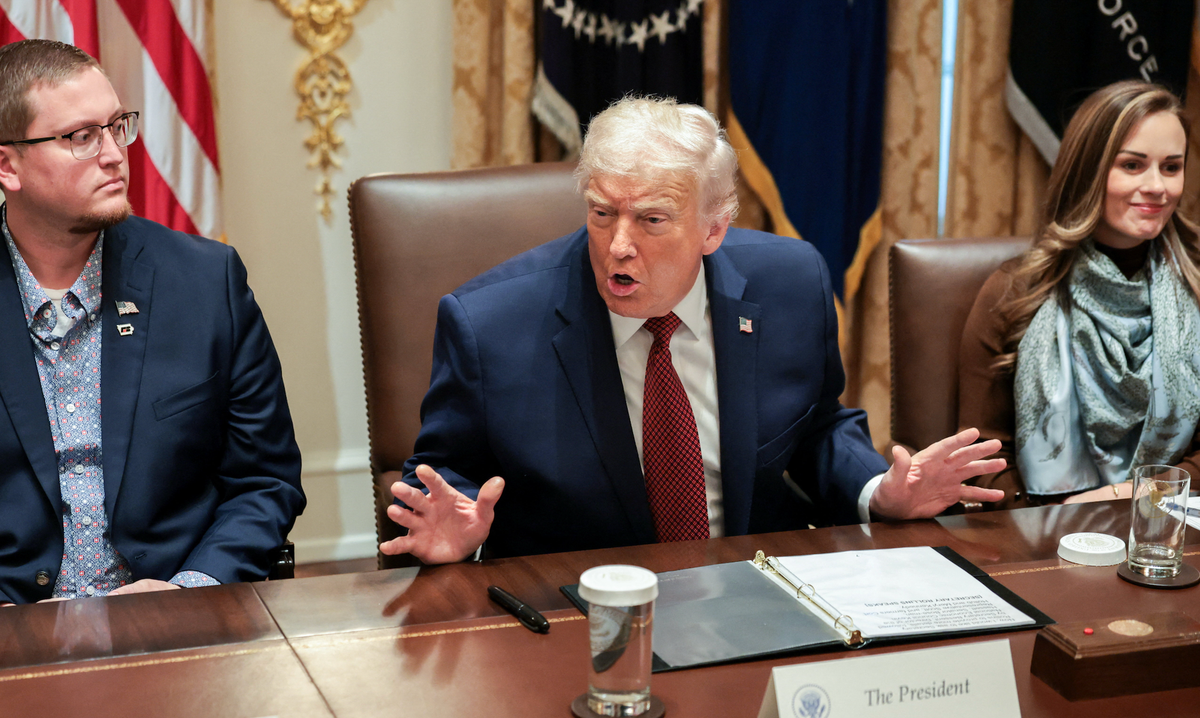
U.S. President Donald Trump gestures next to farmer Cordt Holub and Meryl Kennedy of the rice farming company 4 Sisters as they attend a roundtable discussion on the day Trump announced an aid package for farmers, at the White House in Washington, D.C., U.S., December 8, 2025. REUTERS/Jonathan Ernst

President Donald Trump's Sunday night decision to name Louisiana Gov. Jeff Landry (R) as his administration's new special envoy to Greenland is already making waves around the world.

Trump posted late Sunday to his Truth Social account that Landry "will strongly advance our Country’s Interests for the Safety, Security, and Survival of our Allies, and indeed, the World," and that the Louisiana governor "understands how essential Greenland is to our National Security." Landry appears to accept the role, though he posted on his official X account that his new "volunteer position to make Greenland a part of the U.S." would not intrude on his ongoing responsibilities in Baton Rouge.

Simon Marks, who is a contributor to the United Kingdom-based iPaper, quipped that Landry's role advancing U.S. efforts in Greenland's capital city of Nuuk "won’t be easy, since so far there is limited appetite for non-stop flights between the two cities." He also observed that Trump's announcement has caused a significant amount of consternation for Denmark, which has dominion over Greenland and controls its military and foreign policy (though Greenland has its own parliament).

"Land borders and the sovereignty of states are rooted in international law," Danish Prime Minister Mette Frederiksen and Greenland Parilament chairman Frederik Nielsen said in a joint statement. "You cannot annex other countries. Not even with an argument about international security. Greenland belongs to the Greenlanders … We expect respect for our territorial integrity."

Marks went on to note that Danish Foreign Minister Lars Løkke Rasmussen called Landry's appointment "unacceptable" and that he was "deeply angered" upon learning of Trump's announcement. Ken Howery, who is the U.S. Ambassador to Denmark (and a co-founder of PayPal) has reportedly been summoned to Copenhagen to discuss Landry's appointment.

Trump's announcement that he was putting Landry in charge of the United States' diplomatic efforts in Greenland comes as his administration continues to threaten Venezuelan leader Nicolas Maduro, which Trump recently admitted was about "getting land" and "oil rights." Marks wrote that "Trump is indicating that his expansionist tendencies are back in vogue, especially with regard to worldwide locations that are rich in natural resources."

The iPaper columnist hypothesized that if Venezuela is about oil, Trump's efforts in Greenland may be about mineral resources. He reminded readers that Greenland was rich in 25 of 34 minerals classified as "critical raw minerals" by the European Commission.

Click here to read Marks' full column in iPaper.

Security Is Indivisible — and History Matters


An Open Letter to Chancellor Friedrich Merz


Chancellor Merz,

You have spoken repeatedly of Germany’s responsibility for European security. That responsibility cannot be discharged through slogans, selective memory, or the steady normalization of war talk. Security guarantees are not one-way instruments. They go in both directions. This is not a Russian argument, nor an American one; it is a foundational principle of European security, explicitly embedded in the Helsinki Final Act, the OSCE framework, and decades of postwar diplomacy.

Germany has a duty to approach this moment with historical seriousness and honesty. On that score, recent rhetoric and policy choices fall dangerously short.

Since 1990, Russia’s core security concerns have been repeatedly dismissed, diluted, or directly violated — often with Germany’s active participation or acquiescence. This record cannot be erased if the war in Ukraine is to end, and it cannot be ignored if Europe is to avoid a permanent state of confrontation.

At the end of the Cold War, Germany gave Soviet and then Russian leaders repeated and explicit assurances that NATO would not expand eastward. These assurances were given in the context of German reunification. Germany benefited enormously from them. The rapid unification of your country — within NATO — would not have occurred without Soviet consent grounded in those commitments. To later pretend that these assurances never mattered, or that they were merely casual remarks, is not realism. It is historical revisionism.

In 1999, Germany participated in NATO’s bombing of Serbia, the first major war conducted by NATO without authorization from the UN Security Council. This was not a defensive action. It was a precedent-setting intervention that fundamentally altered the post–Cold War security order. For Russia, Serbia was not an abstraction. The message was unmistakable: NATO would use force beyond its territory, without UN approval, and without regard for Russian objections.

In 2002, the United States unilaterally withdrew from the Anti-Ballistic Missile Treaty, a cornerstone of strategic stability for three decades. Germany raised no serious objection. Yet the erosion of the arms-control architecture did not occur in a vacuum. Missile-defense systems deployed closer to Russia’s borders were rightly perceived by Russia as destabilizing. Dismissing those perceptions as paranoia was political propaganda, not sound diplomacy.

In 2008, Germany recognized Kosovo’s independence, despite explicit warnings that this would undermine the principle of territorial integrity and set a precedent that would reverberate elsewhere. Once again, Russia’s objections were brushed aside as bad faith rather than engaged as serious strategic concerns.

The steady push to expand NATO to Ukraine and Georgia — formally declared at the 2008 Bucharest Summit — crossed the brightest of red lines, despite vociferous, clear, consistent, and repeated objections raised by Moscow for years. When a major power identifies a core security interest and reiterates it for decades, ignoring it is not diplomacy. It is willful escalation.

Germany’s role in Ukraine since 2014 is especially troubling. Berlin, alongside Paris and Warsaw, brokered the February 21, 2014 agreement between President Yanukovych and the opposition — an agreement intended to halt violence and preserve constitutional order. Within hours, that agreement collapsed. A violent overthrow followed. A new government emerged through extra-constitutional means. Germany recognized and supported the new regime immediately. The agreement Germany had guaranteed was abandoned without consequence.

The Minsk II agreement of 2015 was supposed to be the corrective — a negotiated framework to end the war in eastern Ukraine. Germany again served as a guarantor. Yet for seven years Minsk II was not implemented by Ukraine. Kyiv openly rejected its political provisions. Germany did not enforce them. Former German and other European leaders have since acknowledged that Minsk was treated less as a peace plan than as a holding action. That admission alone should force a reckoning.

Against this background, calls for ever more weapons, ever harsher rhetoric, and ever greater “resolve” ring hollow. They ask Europe to forget the recent past in order to justify a future of permanent confrontation.

Enough with propaganda. Enough with the moral infantilization of the public. Europeans are fully capable of understanding that security dilemmas are real, that NATO actions have consequences, and that peace is not achieved by pretending that Russia’s security concerns do not exist.

European security is indivisible. That principle means that no country can strengthen its security at the expense of another’s without provoking instability. It also means that diplomacy is not appeasement, and that historical honesty is not betrayal.

Germany once understood this. Ostpolitik was not weakness; it was strategic maturity. It recognized that Europe’s stability depends on engagement, arms control, economic ties, and respect for the legitimate security interests of Russia.

Today, Germany needs that maturity again. Stop speaking as if war is inevitable or virtuous. Stop outsourcing strategic thinking to alliance talking points. Start engaging seriously in diplomacy — not as a public-relations exercise, but as a genuine effort to rebuild a European security architecture that includes, rather than excludes, Russia.

A renewed European security architecture must begin with clarity and restraint. First, it requires an unequivocal end to NATO’s eastward enlargement — to Ukraine, to Georgia, and to any other state along Russia’s borders.

NATO expansion was not an inevitable feature of the post–Cold War order; it was a political choice, taken in violation of solemn assurances given in 1990 and pursued despite repeated warnings that it would destabilize Europe.

Security in Ukraine will not come from the forward deployment of German, French, or other European troops, which would only entrench division and prolong war. It will come through neutrality, backed by credible international guarantees. The historical record is unambiguous: neither the Soviet Union nor the Russian Federation violated the sovereignty of neutral states in the postwar order — not Finland, Austria, Sweden, Switzerland, or others. Neutrality worked because it addressed legitimate security concerns on all sides. There is no serious reason to pretend it cannot work again.

Second, stability requires demilitarization and reciprocity. Russian forces should be kept well back from NATO borders, and NATO forces — including missile systems — must be kept well back from Russia’s borders. Security is indivisible, not one-sided. Border regions should be demilitarized through verifiable agreements, not saturated with ever more weapons.

Sanctions should be lifted as part of a negotiated settlement; they have failed to bring peace and have inflicted severe damage on Europe’s own economy.

Germany, in particular, should reject the reckless confiscation of Russian state assets — a brazen violation of international law that undermines trust in the global financial system. Reviving German industry through lawful, negotiated trade with Russia is not capitulation. It is economic realism. Europe should not destroy its own productive base in the name of moral posturing.

Finally, Europe must return to the institutional foundations of its own security. The OSCE — not NATO — should once again serve as the central forum for European security, confidence-building, and arms control. Strategic autonomy for Europe means precisely this: a European security order shaped by European interests, not permanent subordination to NATO expansionism.

France could rightly extend its nuclear deterrent as a European security umbrella, but only in a strictly defensive posture, without forward-deployed systems that threaten Russia.

Europe should press urgently for a return to the INF framework and for comprehensive strategic nuclear arms-control negotiations involving the United States and Russia — and, in time, China.

Most importantly, Chancellor Merz, learn history — and be honest about it. Without honesty, there can be no trust. Without trust, there can be no security. And without diplomacy, Europe risks repeating the catastrophes it claims to have learned from.

History will judge what Germany chooses to remember — and what it chooses to forget. This time, let Germany choose diplomacy and peace, and abide by its word.

Respectfully,

Jeffrey D. Sachs
University Professor
Columbia University

Jeffrey D. Sachs is a world-renowned economics professor, bestselling author, innovative educator, and global leader in sustainable development. Read other articles by Jeffrey, or visit Jeffrey's website.
Understanding the Dangerous Trump-MAGA National Security Strategy


Declaring an end to Pax Americana, the strategy reinforces white supremacy, authoritarianism, and kleptocracy at home and abroad.


Joseph Gerson
Dec 22, 2025
Common Dreams


After living on life support in the last half of the post-Cold War, Pax America is now a memory. It was relegated to the dustbin of history with the “Trump” National Security Strategy published earlier this month. President Donald Trump and his clique are not solely responsible for the reduced ambitions of the United States global empire. The world—including the United States—has changed. The strategy is the answer of a right-wing billionaire sector of the US elite to tectonic economic, military, and technological changes.

Eighty years ago, when the US emerged as the world’s dominant power nation, it possessed 50% of the world’s wealth, the most advanced “conventional” military forces, and was the only nation possessing genocidal nuclear weapons. After European nations and Japan rebuilt their economies in the aftermath of WWII, China brought 600 million people out of poverty, and the demise of colonialism, the US share of global GDP has fallen by half to 24%. These changes have had an immense impact on what can be spent to develop and deploy “advanced” and murderous militaries, the number of engineers and scientists a nation can produce, and even the exercise of soft power.

Other forces have also been at play. Witness the emergence of the Global South as a powerful force. South Africa had the temerity to challenge the Western assisted Israeli genocide in the International Court of Justice. The BRICS (Brazil, Russia, India, China, and others) are contesting US economic dominance. And the Emirates have emerged as a powerful economic and political force with leverage over Trump.

The strategy is also a mutant offspring of the information revolution and of an extreme right-wing Supreme Court that played a central role in birthing an immense concentration of wealth resulting in the rise of new and anti-democratic elites reminiscent of feudal era princes, lords, and masters.

The strategy is contradictory, ignorant, and white supremacist; written in highly accessible language designed to win support of the MAGA masses.

Thus, a powerful sector of the US billionaire elite has developed a revised, destructive, and nationally self-destructive strategy to reinforce their privilege and power for the still emerging multipolar world disorder.

The Trump strategy is painful to read. It reeks of white supremacist rhetoric and policy commitments. It begins with fawning and obsequious praise of our Great Helmsman, Trump. And it is rife with braggadocio that belies observable reality, for example the boasts of having obliterated Iraq’s nuclear program and ending eight wars including Gaza, Rwanda-Democratic Republic of Congo, and Thailand-Cambodia. But the strategy does crystallize what was implicit during Trump’s first term in office and what we have witnessed and suffered in the past very painful year.

There is also the truism that foreign policies are manifestations of domestic priorities. From reinforcing white supremacy to authoritarianism and kleptocracy, this is also the case for the Trump-MAGA strategy.

Analysts across the country and foreign leaders have been stunned by the strategy’s declaration of the end of Pax Americana, the confession that global hegemony is a “fundamentally undesirable and impossible goal.” Richard Haass, formerly the president of the liberal Council on Foreign Relations, declared that the strategy is “ the biggest redirection of US foreign policy since the end of WWII and the dawn of the Cold War…” Chinese officials describe it as “moving from unipolarity to multipolarity.” And Russians have not been shy about saying that it is consistent with their vision. European leaders are panicked.

How the World Sees the Strategy


Chinese leaders, since their pursuit of new great power relations in the Obama era, see the new US military and economic priorities as the logical consequence of US post-Cold War “hegemonic failures”: failed and disastrous imperial wars, its economic fragility, social and political fragmentation, and the worldwide perceptions that the US is no longer invincible.

Walden Bello, among the most inspired and inspiring Asian analysts and progressive political leaders, describes the strategy as a compromise document negotiated between three forces in Trump’s coalition: Maximalists who “still cling to the dream of American dominance,” Specifists led by Elbridge Colby at the Pentagon and his allies “who believe America must retreat from Europe and the Middle East to focus single-mindedly on China,” and Continentalists or “neo-Monroeists, led by Stephen Miller and Vice President JD Vance, ” who advocate “an almost hermit-like retrenchment, turning the US into a fortress continent.”

In Europe, where fear has abounded that the United States would abandon its continental protectorate, German Chancellor Friedrich Merz declared the end of Pax Americana. Carl Bildt, the former Swedish prime minister, warned that the strategy places the US to the right of the extreme right in Europe. And reflecting an increasingly shared belief, a researcher at the European Council on Foreign Relations declared that “the West as it used to be no longer exists.” And he is right.

The strategy has also sown panic among US neoconservatives and liberal imperialists. Speaking for many, Anne Applebaum remarked that it is “hard to think of another great power ever abdicating its influence so quickly and publicly.” And for some, the New York Times eight-page special opinion section which argues that the US military has been “overmatched” by China provides a path back to “normalcy.” It urges still greater military spending, focusing on creating greater AI and cyber warfare capabilities, and returning to the era when the Pentagon had 51, not 5, primary military contractors.


Extending the MAGA Counterrevolutionary Agenda

The strategy is contradictory, ignorant, and white supremacist; written in highly accessible language designed to win support of the MAGA masses.

The historian Heather Cox Richardson was clear that the National Security Strategy is explicit in its goal of creating a “white supremacist country,” rejecting immigration, and “'restoring Europe’s civilizational self-confidence and Western identity.” We hear echoes of Nazi and Charlottesville “great replacement” rhetoric as code words and dog whistles such as “restoration and reinvigoration of American spiritual and cultural health,” defending and preserving “civilization,” and “strong traditional families that raise healthy families” appear throughout the document.

While the strategy pledges the “predisposition to non-interventionism,” gunboat diplomacy continues apace with the largest US naval flotilla since the Cuban Missile Crisis assembled off the coast of Venezuela.

Its featured first goal is to establish “full control over our borders.” Why? Because “mass migration has strained domestic resources, increased violence and other crime, weakened social cohesion… undermined national security.” This despite actual crime statistics that immigrants are one-third less likely to be imprisoned than those born in the US, that construction and agricultural employers are hurting as tens of thousands of dedicated workers are deported, that fewer young workers mean weakened Social Security and support for our aging population. And our universities and industries that depend on attracting the best and brightest from around the world are deprived of essential human capital.

If that weren’t enough, the strategy pledges to “root out” diversity, equity, and inclusion in foreign, as well as domestic, policy—one other way that Trump and MAGA are sabotaging the nation’s foundations.

And on the subject of contradictions, while the strategy pledges the “predisposition to non-interventionism,” gunboat diplomacy continues apace with the largest US naval flotilla since the Cuban Missile Crisis assembled off the coast of Venezuela that is illegally sinking boats, murdering sailors in clear contravention of international law, and enforcing a blockade to impose regime change in Venezuela, and by extension Cuba.


Prioritizing Commerce and Profits


Soon after Donald Trump’s reelection a former senior US arms control diplomat was asked by his Russian interlocutor what Trump’s foreign policy priority would be. The answer: Trump’s first, second, and third priorities would be doing all that he can to enrich himself and his family. Not surprisingly we have been delivered the country’s most mercantile foreign policy agenda in more than a century. Access to other nations’ raw materials and markets are the priority, and, in another break with at least three generations of foreign policy rhetoric, the strategy is explicit that human rights concerns will not be a factor that interferes with US commercial interests and that the US won’t be imposing “democratic social change.” The New York Times: put it well when it carried a report saying, “The world as seen from the White House is a place where America can use its vast powers to make more money.”

What is its agenda? Seeking “balanced trade,” access to resources, protecting supply chains, and “reindustrialization.” Never mind that despite Trump’s devastating tariffs, which are increasing costs for Americans and alienating much of the world, offshored manufacturing is NOT returning to the US. Other commitments include maintaining the “dollar’s global reserve status,” pushing back against “Non-Hemispheric competitors’” economic inroads in “our hemisphere,” and the insistence on Latin American nations granting no-bid contracts to US companies. Taiwan’s value is boiled down to semiconductors and serving as a geopolitical cork, US forces are to maintain a “free and open Pacific” for trade purposes, and Saudi Arabia and the Emirates are seen as resources for investments. “Every US Government official that interacts with these countries should understand,” US diplomats and the world are told, “that part of their job is to help American companies compete and succeed.”


Geopolitics

After conceding that the US will not seek to control developments in every corner of the world, the strategy opts to maintain US primacy via balances of power and consolidating spheres of influence, not that China is to have a sphere. Consistent with its Biden and Obama predecessors, we are to be reassured by the Trumpian commitment to building the “world’s most powerful, lethal, and technologically advanced military,” ostensibly to “protect our interests” and to maintain the world’s “most advanced economy.” It allows no light to shine between the Trump agenda and the New York Times’ call for increased US military spending to modernize the US military industrial base, to maintain the world’s most deadly nuclear arsenal, and to divert hundreds of billions of dollars to military contractors to build Trump’s “Golden Dome” of missile defenses that will never work.

The strategy is consistent with the Jesse Helms-John Bolton insistence on sovereignty—personal and national. This should be read as white individualist sovereignty and rejection of international law, the United Nations, and foreign aid on which millions of human lives have depended. Moreover, the order in which the strategy addresses geopolitical regions is telling. First the Western Hemisphere, then Asia, then Europe, then the Middle East, and finally Africa


Europe

But let me begin with antecedents to the Trump-MAGA animus toward Europe. More than 200 years ago, as he retired from the presidency, George Washington warned the newly independent nation to avoid dangerous European entanglements. Prior to World Wars I and II, powerful isolationist movements opposed the US entering those wars. Decades later, in 2003, anger in response to French resistance to joining the US in its Iraq War for oil led to congressional dining rooms renaming French fries as “freedom fries!”

Since 1945, Western Europe has been a US protectorate. When NATO was founded in 1949, Lord Ismay, the alliance’s first secretary general, observed that its purpose was to keep Russia out, Germany down, and the US in. Now, after NATO’s expansion to Russia’s borders, European economic competition as well as collaborations with the US, Russian President Vladimir Putin’s invasion of Ukraine, and the reelection of a president more aligned with Russian authoritarianism that European liberal and social democracy, the strategy makes clear that the US will no longer guarantee Europe’s security. Europe must make its way between the hammer and anvil of Russian military power and China’s economic juggernaut. With the strategy’s mercantilist priorities, Europe is primarily valued for its trade and investment opportunities,

The strategy distances the US from NATO and brings it closer to Russia, which is seen as small potatoes compared with China. Moscow is a major nuclear power, but not an economic power. It makes clear that despite its ambitions Ukraine cannot join NATO—something that neither former President Joe Biden nor the most powerful NATO allies would tolerate. And as Trump insists that European NATO nations must take the lead in attending to their own defense, he simply offers to mediate between Europe and the Eastern powers, not to protect it. Worth noting, Walden Bello writes that this appears to include “Russian suzerainty in Eastern Europe.”

As economic security is traded for military capabilities, it further opens the way for fascist forces to gain power.

It is no secret that Trump, like Putin, has little patience for democracy, and this illuminates an underreported dimension of the strategy. Contagious thoughts travel. Thus, by their very existence, European democracies pose political and cultural threats to autocracies—American as well as Russian or Chinese. Ideologically, as well as economically and militarily, a growing number of European leaders now experience the US as a “security risk” for Europe. In a clarion call warning, a Danish intelligence report advises that “the United States uses economic power, including in the form of threats of high tariffs, to enforce its will and no longer excludes the use of military force, even against its allies.” In the tradition of international relations mirroring the rules of the game among Mafia families, the fate of Copenhagen’s mineral rich and geostrategically vital (think ice melt in the Northwest Passage) Greenland colony is at risk.

Perhaps worse is the strategy’s commitment to support “like minded” and racist “patriotic” parties—extreme right-wing and fascist—across Europe. In barely disguised code, the strategy warns that Europe faces “civilizational erasure” necessitating US to support “resistance.” There were intimations of this policy transformation in Vice President Vance’s February Munich Security Conference speech; his expressed support for the fascist right Alternative for Germany party; and the administration’s embrace of Prime Minister Viktor Orbán in Hungary, Prime Minister Giorgia Meloni in Italy, and Marine Le Pen in France.

In response to the fragility of US commitments to NATO, European elites have turned to create a more unified European military, either to reinforce NATO or potentially as an independent power. Since Vance’s Munich speech, compounded by fears that Russian ambitions may not be limited to eastern Ukraine, this process has been on steroids. Pressure is on to create an integrated European military-industrial complex. To increase the number of troops under arms, conscription and other forums of voluntary enlistment are being reintroduced. The numbers of tank forces and warplanes are being increased, and pressure is on to increase AI and cyber-security capabilities. Germany now seeks to become the continent’s major land power. And off-camera diplomacy quietly continues over whether the French or British nuclear weapons should replace the US nuclear umbrella as the source of extended deterrence.

As the newly created Stop ReArm coalition warns, this vastly increased military spending also threatens the viability of social democratic welfare commitments. As economic security is traded for military capabilities, it further opens the way for fascist forces to gain power.


Reinforcing US Indo-Pacific Military Dominance and Containment of China

That Danish intelligence report reminds us that with “the USA’s increasingly strong focus on the Pacific Ocean” the pivot to Asia and the Pacific begun by President Barack Obama remains at the center of US military and economic policy.

Media reports have concentrated on the strategy’s economic, not military, competition with China, in its section “Win the Economic Future, Prevent Military Confrontation.” There we read about the focus on industrial policies, intellectual property theft, protecting supply chains and access to minerals and rare earths, fentanyl, and propaganda and influence operation. Gone is Biden-era confrontational rhetoric.

Yes, China is no longer described as a peer competitor. The strategy advises that “the Indo-Pacific… will continue to be among the next century’s key economic and geopolitical battlegrounds…we must successfully compete there.” But, like the magician who diverts our attention when she shuttles a pea under shells, the media misses the continuity of US imperialism dating back to the “opening” of Japan, Admiral George Dewey’s gunships in Manila Bay, and US forces joining in repressing China’s nationalist Boxer Rebellion. Despite Trumpian allergies to alliances, the strategy reports that “President Trump is building alliances and strengthening partnerships in the Indo-Pacific that will be the bedrock of security and prosperity long into the future.”

Toward that end, the strategy stresses the US need to maintain dominance over the First Island Chain that extends from South Korea, through Japan, to Taiwan and the Philippines, extending westward to Australia. Instead of seeking regime change in Beijing, consistent with 80 years of building military alliances and creating hundreds of US military bases across the Asia-Pacific and Biden’s lattice-like network of Indo-Pacific alliances, Trump and company are explicit about containing China via balance of power dominance and Indo-Pacific alliances. Highlighted are the Biden era QUAD (US, Japan, South Korea, and India) and AUKUS (Australian, Britain, US) alliances. They are called to increase their burden sharing and move to burden shifting, the willingness to sacrifice their troops in US wars. And, to ensure their loyalty to Washington, the strategy calls for their collaborations into an “economic group” to ensure they don’t become “subordinate to any competing power.”

How serious is the competition? Two weeks after release of the strategy, US nuclear-capable bombers joined Japanese warplanes in a show of force. This came one day after Chinese and Russian bombers flew around western Japan to demonstrate Beijing’s rage at Japanese Prime Minister Sanae Takaichi’s warning that Japan would move to defend Taiwan if it were attacked.

Three other US military commitments to contain China are worth noting. To enforce US “deterrence” of China, the strategy promises to “build a military capable of denying aggression anywhere in the First Island Chain” and the US will not tolerate “any unilateral change to the status quo in the Taiwan Strait.” This, we are told, will require still greater US spending—including for defense industry bases. It insists that the US will not tolerate a “competitor” attempting to control the South China Sea, across which one-third of world trade travels. And after maintaining strategic ambiguity over US commitments to Taiwan, we are now told that war there must be avoided because it would have “major implications for the US economy;” because the autonomous island provides direct access to the Second Island Chain (Japan, Guam, and Micronesia), and its loss could split Northeast and Southeast Asia into two theaters; and because it is a “key” to controlling the South China Sea.

Thus, it came as no surprise that within days of the publication of the strategy, the Trump administration committed to selling Taiwan $11 billion of advanced military equipment to help transform it into an unappetizing military porcupine.

Some believe that the strategy’s less than hysterical language about China was designed to ensure that our would-be monarch receives the adulation he believes is his due when he travels to the Middle Kingdom in March. But profit and business deals come first. Shortly before the strategy was released and the TikTok deal was done, Trump signed off on Nvidia selling its second-most advanced chips, with AI and military capabilities, to China. How many of these chips, reported to give China a boost in the AI race, will ultimately land in China has yet to be determined. That uncertainty may provide Trump with one dimension of leverage in future negotiations with Beijing. But if Trump limits the numbers and uses each shipment as leverage, the effects will be far less dramatic.


The Global South (Trump’s “Shithole” Countries)

Beyond the tectonic signaling of the end of the 80-year transatlantic alliance, media outlines have shared the shock of the “Trump Corollary” to the Monroe Doctrine, a naked recommitment to US Western Hemispheric neocolonialism and hegemony. It’s about who gets the money, about oil, and about the white nationalist obsession with race.

As we see in recent reports, the US Central, European, and African Commands are to be downgraded and integrated into a new International Command, with the transfer of some forces to the Western Hemisphere, and, we can assume, to the Indo-Pacific. Thus, we now have an aircraft carrier fleet and thousands of troops redeployed from Europe to Venezuela, and in the words of the strategy, to “address urgent threats in our hemisphere.” On the subject of ideological and political alternatives, it is worth remembering that the Cuban economy is dependent on Venezuelan oil.

On other fronts, the strategy isn’t hesitant in describing Washington’s ambitions for Latin America. Where the US has “the most leverage,” we are instructed that it “must be sole-source contracts for our companies.” And, with Trump’s racist fantasies of an invasion of as many as 30 million immigrants—criminals, rapists, drug dealers, and more—and Immigration and Customs Enforcement shattering families and communities across the nation, the strategy tells us that “the Era of Mass Migration is Over.”

Proverbs tells us that “a people without a vision will perish.” It thus behooves us to provide alternate visions of what real security is and how to achieve it.

Terrorism originating in the Middle East is no longer a major security concern. Since Trump bowed to Saudi monarchs in the opening months of his first term, and his son-in-law took $2 billion as a going away present, Trump and his family have been wed to the Saudi and Persian Gulf emirs. We saw Qatar’s influence when it forced the White House to impose an Israeli-Hamas ceasefire in the wake of Israel’s assassination of Hamas’ lead negotiator in Doha.

While Trump claims that Venezuela has stolen our oil under its soil, neither Trump nor Defense Secretary Pete Hegseth have yet to claim that it is our oil under Middle East sands. Instead, Saudi Arabia and the Emirates are described as a source and destination of international investment, including nuclear energy, AI, and military technologies.

Consequently, not unlike China, the strategy rejects previous commitments to encourage social and political change in the Middle East. It “accept[s] the region, its leaders and its nations as they are.” It commits our country to “prevent an adversarial power from dominating the Middle East, its oil and gas supplies.” In order to do so, it pledges the “revitalization of our alliances in the Gulf, with other Arab partners, and with Israel.” Along these lines, it celebrates its collaborations with Israel but does not name Trump’s complicity in Gaza genocide or that its missile attacks on Iran’s nuclear infrastructure came in the midst of negotiations with Tehran.

When it comes to Africa, the strategy has little to say about what Trump once described as “shithole” countries. It will look to “select countries” to “ameliorate conflict” as it seeks to “foster mutually beneficial trade relations.” The goal is to “harness Africa’s abundant natural resources and latent economic potential.” So much for the end of colonial exploitation!


From Here


In a recent webinar about the “Security Strategy,” I was asked what then must we do? The challenge is as old as the commitment to building an empire in the Declaration of Independence, the genocidal conquest of a continent, the brutality of colonial conquests at the end of the 19th century, and President Dwight D. Eisenhower’s valedictory warning about the dangers of the military-industrial complex.

First and foremost is our responsibility to name and denounce the Trump-MAGA assault against constitutional democracy, against our security, and the well-being of rising generation, and people in other nations who are at the receiving and losing end of the strategy.

Proverbs tells us that “a people without a vision will perish.” It thus behooves us to provide alternate visions of what real security is and how to achieve it. My list begins with the non-utopian paradigm that served as the foundation for the end of the first Cold War. That was the concept of Common Security diplomacy that recognizes that security cannot be achieved against a rival, but only through difficult win-win diplomacy with competing nations. It has been observed that China has been able to take 600 million people out of poverty, and to create what is fast becoming the world’s most advanced infrastructure, in large measure because it has not wasted lives, wealth, and resources in wars for almost a half a century. Defending constitutional democracy and electing a US government committed to providing housing, health, food, and justice are essential places to begin. And there is no going back to those good old days that never really existed!


Our work is licensed under Creative Commons (CC BY-NC-ND 3.0). Feel free to republish and share widely.


Joseph Gerson
Dr. Joseph Gerson is the president of the Campaign for Peace, Disarmament, and Common Security; co-president of the International Peace Bureau; and author of Empire and the Bomb.
Full Bio >