“So if a geology student at the University of Oklahoma says in class the earth is 6,000 years young because that’s what they believe, a geology teacher can’t say squat?” asked one critic.
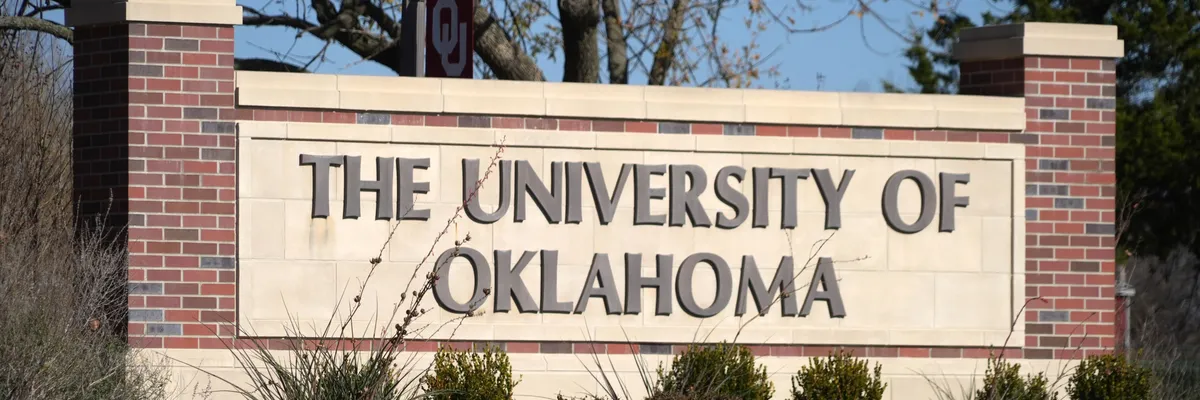
A sign on the campus of the University of Oklahoma is seen on December 1, 2024, in Norman, Oklahoma.
(Photo by Kirby Lee/Getty Images)
Julia Conley
Dec 23, 2025
COMMON DREAMS
A decision from the University of Oklahoma on Monday left some asking whether the research university can still be seen as having “academic standards” after an instructor was removed from teaching duties for giving a failing grade to a student who focused on her own religious beliefs about gender in a paper for a psychology course.
The university released a statement saying the graduate teaching assistant in the course, Mel Curth, had been “arbitrary” in the grading of a paper by student Samantha Fulnecky, who wrote an assigned essay about an article the class read about gender, peer relations, sterotyping, and mental health for the course.
Fulnecky’s paper cited the Bible and focused heavily on her beliefs that “God made male and female and made us differently from each other on purpose and for a purpose.”
“Women naturally want to do womanly things because God created us with those womanly desires in our hearts. The same goes for men,” she wrote in the essay, adding that “society pushing the lie that there are multiple genders and everyone should be whatever they want to be is demonic and severely harms American youth.”
Curth, who is transgender, gave Fulnecky a zero for the essay and emphasized in her response that she was “not deducting points because you have certain beliefs,” but because the paper “does not answer the questions for the assignment, contradicts itself, heavily uses personal ideology over empirical evidence in a scientific class, and is at times offensive.”
“Using your own personal beliefs to argue against the findings of not only this article, but the findings of countless articles across psychology, biology, sociology, etc. is not best practice,” Curth wrote.
Another instructor concurred with Curth on the grade, telling Fulnecky that “everyone has different ways in which they see the world, but in an academic course such as this you are being asked to support your ideas with empirical evidence and higher-level reasoning.”
On Monday, the university suggested Curth’s explanation for the grade was not satisfactory.
“What is there to say other than that the University of Oklahoma has no academic standards?” asked journalist Peter Sterne in response to the university’s statement.
One civil rights advocate, Brian Tashman, added that the school’s decision opens up numerous questions about how academic papers that focus on a student’s religious beliefs will be graded in the future.
“So if a geology student at the University of Oklahoma says in class the earth is 6,000 years young because that’s what they believe, a geology teacher can’t say squat?” asked Tashman. “What if their religion teaches the earth is flat? Or that all of mankind’s problems can be traced back to Xenu?”
Curth had initially been placed on administrative leave earlier this month when Fulnecky filed a religious discrimination complaint with the school.
Fulnecky’s allegations drew the attention of the school’s chapter of Turning Point USA, the right-wing group that advocates for conservative political views on college and high school campuses. The group is closely aligned with the Trump administration. Vice President JD Vance spoke at Turning Point’s AmericaFest last weekend—and used the appearance to tell young conservatives that their movement should not root out antisemitism with “purity tests”—and the assassination of its founder, Charlie Kirk, earlier this year, was followed by the White House’s efforts to crack down on what it called left-wing extremism, with President Donald Trump directly blaming the “radical left” for Kirk’s killing before a suspect was identified.
While Fulnecky garnered support from the Turning Point chapter, hundreds of her fellow students rallied in support of Curth in recent weeks, chanting, “Protect Our Professors!” at a recent protest.
A lawyer for Curth said Monday that she is “considering all of her legal remedies, including appealing this decision by the university.”
“Ms. Curth continues to deny that she engaged in any arbitrary behavior regarding the student’s work,” Brittany M. Stewart told the Washington Post.
The university did not release its findings of the religious discrimination investigation it opened into Fulnecky’s case.
The school’s decision to remove Curth from teaching duties, said author Hemant Mehta, “is what academic cowardice looks like.”

No comments:
Post a Comment