The Martin Luther King Center in Cuba: Immersed in the World and the Revolution
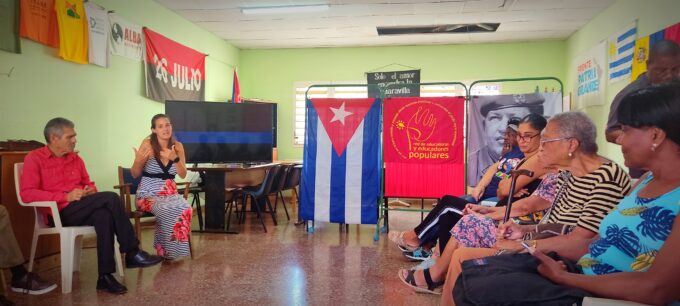
Network of Popular Educators in Alamar, La Habana del Este, Cuba, November 2025.
Now I know that there are many more things in heaven and earth than I’ve dreamt of. I never expected to find a Baptist-inspired project that enthusiastically defends gender and sexual diversity, socialism, and the Cuban Revolution. Yet that was precisely what I found at the Martin Luther King Center in Cuba when I visited in late November 2025 and was received in its offices by key members of its team, including Marilín Peña, Joel Suárez—son of the Center’s founder—and Sayonara Tamayo.
In fact, the MLK Center is full of paradoxes. First, it is a Christian-inspired initiative committed both to socialism and to the Cuban Revolution. Second, it has its roots in revolutionary Protestantism, on a continent where the liberatory current has been mostly Catholic. Third, it maintains links with progressive church groups in the United States—the very country that has tried to bring down Cuba’s government and has placed the island under a genocidal blockade for more than half a century. Yet revolutions are always made of paradoxes, as Lenin’s wartime train ride through Germany and Hugo Chávez’s military background both demonstrate.
Joel tells me how the MLK Center was born. His father belonged to a “terribly conservative” Baptist tendency (I later found out that the Ebenezer Church next to the Center is the very one that dictator Fulgencio Batista attended). So when the Revolution triumphed in 1959 many of its parishioners simply left, since they thought “God himself had gone to Miami.” However, there were others, including Joel’s father, the Reverend Raúl Suárez, who stayed. They were inspired by the Revolution’s project of social justice and wanted to move forward as part of it. As a result, they developed a progressive—even revolutionary—Christianity, somewhat in isolation from the powerful Catholic liberation theology that was emerging at the time.
Their initial work of distancing themselves from the conservative ideology of U.S. missionaries and walking the new path with the Revolution went on for several decades. The Center itself was formed in the late 1980s and named in honor of the great civil rights leader, because they wanted to take up work outside the remit of a church. Its two pillars were, on the one hand, “macro-ecumenical work” with a wide range of Cuban religious groups from the perspective of liberatory theology and, on the other hand, popular education in the communities. The latter was conceived in keeping with the original project of Paulo Freire, which involves raising political awareness while fostering popular protagonism and revolutionary transformation.
Over the years, the Center has trained thousands of popular educators. Marilín explains how the educators often find themselves in complex situations. “The Christians see us as communists, and the communists see us as Christians—though some of the latter recognize we are more communist than they are.” At one point, these educators felt themselves to be too spread out and isolated, each in their respective communities. They needed a support structure. That is why in 2007 the Center decided to create its networks of popular educators. There are now thirty-seven such networks established across the Cuban territory. The Center also works with popular movements across the continent, in the spirit of Cuba’s longstanding revolutionary internationalism.
+++
I am visiting Cuba with an interest in the question of how popular power combines with the revolutionary leadership exercised by the state and the Party. This combination seems to me to be an extremely important but underrecognized feature of every successful and sustainable anti-imperialist revolution. There can be no doubt that the principal contradiction in the world today is between imperialism and oppressed nations. However, one should not forget that carrying out the struggle against the main enemy—the U.S.-led imperialist system—requires addressing other, subordinate contradictions at the same time. That is how popular power is built and maintained in a mutually reinforcing relationship with revolutionary state power.
The subordinate contradictions that need to be addressed include those that are directly generated by capitalist exploitation and also by gender and racial oppression. Confronting these issues is important not only because it is right in itself, but also because doing so is necessary if the primary struggle against imperialism is to be viable and sustainable. In a general sense, it is only by addressing issues of social emancipation that one can guarantee the incorporation of the bases in what is necessarily a long-term anti-imperialist project.
Cuba has a long history of mobilizing people and building popular power as part of social emancipation. The history of its mass organizations that express popular power, such as the Committees in Defense of the Revolution (CDRs), the Federation of University Students (FEU), and the Federation of Cuban Women (FMC), is a glorious one. On an ideological level, the fusion of revolutionary leadership with popular power is reflected in how the Cuban Revolution adopted Marxism—Leninism as its guiding ideology and socialism as its goal, but grafted this project onto a deeply developed tradition of patriotic, democratic, and anticolonial thought that is an important part of Cuban national culture.
The central figure in that endogenous tradition is José Martí, a revolutionary leader, writer, and patriot of the 19th century who organized the struggle for Cuba’s independence. The fusion of popular and national components with the aspiration to achieve socialism through scientific means (i.e., the Party and Marxist theory) is one of the great achievements of the Cuban Revolution. Symbolically, one could represent it with a triangle at the base of which are Martí and Marx, both feeding into the revolutionary thought and action of Fidel Castro.
Beyond ideology and symbolism, however, the organizational expression of this fusion consists in how the state and party relate to the multiple expressions and institutions of popular power—the power of the base. In recent times, these grassroots-level institutions have suffered. The longstanding effects of the cruel U.S. blockade, along with the simple loss of momentum following the heroic “peak” first decades of the Revolution, have made them less dynamic. Sometimes the formal organizational component dominates over content and substance.
That is why the work of the MLK Center is so important at present. The people it brings together are revolutionaries and communists (many are Party members) who also connect with broad social bases—through their Christian-inspired work and through their efforts as popular educators, whose central mission is strengthening communities and activating popular participation.
+++
The day after my meeting with the MLK Center’s coordination, I was able to accompany Center team member Suray Cabrera in a visit to one of the networks of popular education in situ. The locale we visited is in a residential area of East Havana called Alamar, in the Micro X neighborhood, where the Center’s Network of Educators works jointly with one of the Neighborhood Integral Transformation Workshops created by the municipal government.
Seated before us in a circle are twenty people of different age groups who have come together in a space decorated with posters of Fidel, Chávez, and Che and banners of the 26th of July Movement. Their skills and backgrounds are very diverse. Some are teachers, some are retired professionals, others are social or natural scientists. All are involved in grassroots organizing or educational work. Their projects in the community include an extracurricular program with secondary schools, adult education, craft workshops, sports and tai chi sessions, and raising awareness about environmental issues in this coastal region.
Once a year, each network drafts a plan for its activities, objectives, and intentions with the Center, and in turn receives a budget. There is two-way coordination, guided by the idea of building the social fabric, strengthening participation, and expanding popular control in the territory. As we go around the circle of those assembled, they explain what their work is. An older man takes a different tack and refers to the importance of Fidel’s legacy in these times for both Venezuela and Cuba, highlighting his connections with ordinary people. A woman to my right recounts the success of their children’s baseball team, which they call the “peloteritos.”
When I ask what impact the network makes in this area, they respond that there is more participation here, better conflict mediation, better organized community activities, and better interaction with the delegates of popular power. They close the meeting referring to a strikingly appropriate quote by José Martí that they have taken as a motto: “One must teach through conversation, as Socrates did—from village to village, from house to house.”
+++
These projects in the communities are humble ones, but only in appearance. In that sense they resemble Raúl Suárez, the MLK Center’s soft-spoken founder, who turned 90 this year. Raúl was a Baptist pastor who remained loyal to the Revolution from the beginning, despite being treated with some suspicion at first for his beliefs, and was even wounded in its defense at Playa Girón. In 1993, he did a successful hunger strike in opposition to the U.S. blockade, specifically to force president Bill Clinton to allow a school bus and medical supplies to get through. Because he had the confidence of the people in his district, he became a deputy to the National Assembly of Popular Power.
Raúl’s son Joel, who is an electrical engineer by training, is also very much a man of the people. At the same time, he is a wide-ranging reader and deeply thoughtful intellectual. With a permanent cigarette in hand and wild mane of curly hair, Joel talks affectionately about his good friends from the ranks of revolutions around the continent and beyond—their sacrifices and their hopes. However, he constantly weaves these stories into larger reflections drawn from his reading.
What Joel most wishes to impress on me is that revolutionary transformation cannot do without revolutionary subjectivity and therefore cannot leave aside the question of religion. For many people around the world, especially in Latin America, religion orients their lives; it is central to their lived experience. Hence, it would be an error for revolutionary leadership and governments—potentially a grave one in certain contexts—to set aside religion and other spiritual impulses as merely private matters.
In fact, as Joel points out, there are basic features of even ostensibly secular revolutionary subjectivity—such as the idealistic fervor that motivated people to cut sugarcane for the Revolution in the 1960s—that operate on a terrain that is crisscrossed by both religion and revolution. He also notes that the Cuban Revolution inspired almost religious sacrifices in its internationalist endeavors, even as it invoked concepts of the promised land, transcendental hope, and expectations of a better future that are typical of religious subjectivity.
+++
Recent developments in Latin America, especially the rise of Christian fundamentalism, seem to offer vivid proof of Joel’s thesis about the need to attend to subjective consciousness as it develops in the religious sphere. The fundamentalist evangelical churches, which are spreading like wildfire across the continent, offer escape, ecstasy, and the promise of community. But along with these often-illusory promises usually come the hardened figures of patriarchy, submission, conformity, and conservative politicization.
The fundamentalist evangelical sector reared its head as a political force in Cuba when, in the wake of the 2019 constitution, a new Family Code came up for debate, prior to a plebiscite. The evangelical churches took to promoting the “original family”—mom, dad, and kids—by holding meetings on street corners and distributing posters that depicted their ideal household. Only the hard work of the Center, with its popular education practices, made it possible for the progressive rights promoted by Cuba’s LGBTQ+ and feminist groups to be understood by the masses as those that best served their own interests. This work contributed to the approval of a 2022 Family Code that defends those rights, which include same-sex marriage.
This was one battle that was won, and it served as a testing ground for the Center’s combination of spiritual and moral energy and community-oriented praxis. Now there are more battles to come. In the cultural struggle for the future of Cuba that is taking place in the present, one can see both light and shadows. The most troubling development is that a capitalist-inspired culture of radical individualism and success is entering the social base with force. These attitudes could undermine the revolutionary subjectivity of the masses, thereby eroding the popular power that is a key pillar of the Revolution’s anti-imperialism and socialism.
On the other hand, sixty-six years of revolutionary experience have left Cuba with huge reserves of social solidarity and anti-imperialist commitment in the bases. The work of the MLK Center in popular education and community organizing shows that this legacy of revolutionary subjectivity can still be tapped and also rekindled. The struggle is ultimately for people’s hearts and minds, and for the Revolution itself. As Fidel said, a revolution is the child of culture and ideas—and so is its continuity.
This article originally appeared in Monthly Review Online.


