It’s possible that I shall make an ass of myself. But in that case one can always get out of it with a little dialectic. I have, of course, so worded my proposition as to be right either way (K.Marx, Letter to F.Engels on the Indian Mutiny)
Wednesday, October 22, 2025
Pioneering green chemistry: Light and air combine to build key molecules for future medicines
The University of Osaka researchers unveil a groundbreaking method for producing key chemical bonds using only light, oxygen, and a vanadium catalyst
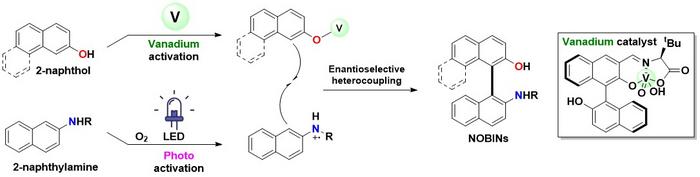
A research group led by The University of Osaka has achieved a world-first in catalytic asymmetric synthesis, developing an innovative method for efficiently producing NOBIN, a valuable molecule used in pharmaceuticals. Their approach combines a vanadium catalyst, LED light, and oxygen, drastically reducing waste by eliminating byproduct formation common in conventional methods, and establishing a highly sustainable synthetic pathway.
Many modern medicines and functional materials depend on molecules that come in “right-” and “left-handed” forms, known as chiral molecules. Traditionally, making these molecules requires multiple steps and often produces unwanted chemical waste. In the case of NOBIN, previous methods always produced additional unwanted byproducts, reducing efficiency and increasing environmental burden.
The team's innovation lies in cooperatively combining a vanadium catalyst and light. The catalyst selectively converts 2-naphthol into a radical species. Concurrently, LED light under oxygen generates a cationic radical species from 2-naphthylamine via a charge-transfer complex. These two radicals then efficiently couple, exclusively yielding NOBIN derivatives. This allows for an ideal 1:1 input ratio of starting materials and utilizes low-energy LED light, significantly minimizing environmental impact and making the synthesis highly sustainable.
This clean process yields only water as a byproduct, showcasing exceptional environmental compatibility and waste reduction. Activating molecules using light is energy-saving and safe, accelerating next-generation asymmetric synthesis research. Professor Shinobu Takizawa, senior author of the study states, "This achievement opens new avenues in chemical synthesis, with applications anticipated for more complex molecules and drug candidates. Cooperative catalysis, combining light and metal catalysts, embodies a sustainable chemical process. This study is a major step towards creating an environmentally harmonious future society."
###
The article, “Enantioselective Heterocoupling of 2-Naphthylamines with 2-Naphthol Derivatives via Cooperative Photoactivation and Chiral Vanadium(V) Catalysis,” was published in ACS Catalysisat DOI: https://doi.org/10.1021/acscatal.5c05038
About The University of Osaka
The University of Osaka was founded in 1931 as one of the seven imperial universities of Japan and is now one of Japan's leading comprehensive universities with a broad disciplinary spectrum. This strength is coupled with a singular drive for innovation that extends throughout the scientific process, from fundamental research to the creation of applied technology with positive economic impacts. Its commitment to innovation has been recognized in Japan and around the world. Now, The University of Osaka is leveraging its role as a Designated National University Corporation selected by the Ministry of Education, Culture, Sports, Science and Technology to contribute to innovation for human welfare, sustainable development of society, and social transformation.
Schematic illustrations of: (a) the methods dealing with pH for the classic CHE model and the electric field (EF) pH-dependent model; (b) surface coverage on Pt (111) revealed by the electric field model: HO* dominates under alkaline conditions, while H* prevails under acidic conditions; (c) simplified pH-dependent activity volcano.
The pH, or the acidity or alkalinity of an environment, has long been known to affect how efficiently catalysts drive key electrochemical reactions. Yet despite decades of research, the atomic-scale mechanisms behind these pH effects have eluded scientists.
A new study sheds light on this mystery by decoding how electric fields, surface properties, and charge dynamics intertwine to govern catalytic performance. The findings mark a significant step toward rationally designing catalysts that perform efficiently in a range of environments, paving the way for next-generation clean energy technologies.
Details were published in the Journal of Materials Chemistry A on 26 September 2025.
Traditional models have explained pH-dependent activity mainly through the computational hydrogen electrode (CHE) model and the Nernst equation. These frameworks linked shifts in activity to changes in potential and proton concentration. However, the new research shows that the reality is far more complex, involving a web of interfacial electric fields and molecular interactions that standard models cannot fully capture.
Recent advances in both experimental and computational methods have revealed that properties such as dipole moments, polarizability, and the potential of zero charge (PZC) play a critical role. These factors determine how molecules and ions interact with catalyst surfaces, directly influencing reaction rates and selectivity.
By bringing together insights from electrochemistry, physics, and computational modeling, the research highlights how these interfacial effects manifest across a wide array of reactions, including hydrogen evolution (HER), oxygen reduction (ORR), carbon dioxide reduction (CO₂RR), and nitrate reduction (NO₃RR). These are among the most important reactions for renewable energy conversion, fuel generation, and environmental remediation.
These new models offer scientists a powerful toolkit for predicting and optimizing catalyst behavior at the atomic scale. By integrating experimental data with computational simulations, researchers are now able to map how subtle changes in pH shift reaction pathways and determine overall efficiency.
Looking ahead, the research team plans to combine molecular dynamics with machine learning potentials to simulate reaction conditions in real time. This approach could unlock even deeper insights into how catalysts evolve during operation, further accelerating the design of high-performance materials for a sustainable energy future.
About the World Premier International Research Center Initiative (WPI)
The WPI program was launched in 2007 by Japan's Ministry of Education, Culture, Sports, Science and Technology (MEXT) to foster globally visible research centers boasting the highest standards and outstanding research environments. Numbering more than a dozen and operating at institutions throughout the country, these centers are given a high degree of autonomy, allowing them to engage in innovative modes of management and research. The program is administered by the Japan Society for the Promotion of Science (JSPS).
Advanced Institute for Materials Research (AIMR) Tohoku University Establishing a World-Leading Research Center for Materials Science AIMR aims to contribute to society through its actions as a world-leading research center for materials science and push the boundaries of research frontiers. To this end, the institute gathers excellent researchers in the fields of physics, chemistry, materials science, engineering, and mathematics and provides a world-class research environment.

No comments:
Post a Comment