It’s possible that I shall make an ass of myself. But in that case one can always get out of it with a little dialectic. I have, of course, so worded my proposition as to be right either way (K.Marx, Letter to F.Engels on the Indian Mutiny)
Wednesday, October 22, 2025
NUKE NEWZ
AP1000 under consideration for deployment in Alberta
Westinghouse and Energy Alberta have signed a memorandum of understanding to collaborate on exploring the deployment of an AP1000 reactor in the Canadian province of Alberta.
Energy Alberta CEO and President Scott Henuset and Westinghouse Canada President John Gorman signing the MoU (Image: Energy Alberta)
Under the MoU, the companies will conduct joint technical and commercial discussions, business development efforts and engagement.
"The collaboration will build upon Energy Alberta's engagement with Indigenous Nations and Communities in the province as part of the work underway to build Western Canada's first nuclear plant in the Peace River area of Alberta with Westinghouse's industry-leading technology and experience helping new-to-nuclear jurisdictions," the partners said.
"Collaborating with a trusted, clean technology provider marks a significant step forward in unlocking the full potential of nuclear energy for Alberta and Western Canada," said Energy Alberta CEO and President Scott Henuset. "Energy Alberta is committed to laying the groundwork for a cleaner, more reliable and resilient energy future for Albertans that supports broad-based industrial growth and long-term sustainability. This strategic collaboration is an important step in our process underway to consider the best technology for the project from a safety and delivery perspective. The project not only positions Alberta as the Western Canadian leader in nuclear power, but also paves the way for significant economic growth and job creation across the region."
Westinghouse Canada President John Gorman added: "Alberta is in an exciting position to be Canada's next greenfield nuclear province, and Westinghouse is ready now to bring its proven and already operating AP1000 advanced modular reactor to meet Alberta's nuclear ambitions. We're also looking forward to working with Alberta's strong and experienced industrial supply chains to deliver a large-scale 'made-in-Alberta' nuclear plant. Not only will this create good paying skilled trade and manufacturing jobs while diversifying the economy, it will provide export opportunities for suppliers that join the Westinghouse supply chain."
In April this year, Energy Alberta submitted its Initial Project Description to the Impact Assessment Agency of Canada for the proposed Peace River Nuclear Power Project. The company is proposing to build a nuclear power plant on a site covering 1,424 hectares in the Peace River area of Northern Alberta. The plant would include two to four Candu Monark reactors. The facility would produce up to 4800 MWe - representing up to 25% of the province's existing electricity generation - and operate for about 70 years.
Alberta does not currently have any nuclear power capacity, but in 2021 the province signed a memorandum of understanding with Ontario, New Brunswick and Saskatchewan to collaborate on small modular reactor (SMR) development, and has signed MoUs with several SMR developers.
province of Alberta launched a public engagement initiative and public survey about nuclear energy’s potential to meet future energy needs. The five-member Nuclear Energy Engagement and Advisory Panel is leading the engagement activities and will deliver a report with recommendations on what role Alberta's government should have in potential nuclear development.
A study by X-energy Canada has confirmed the feasibility and benefits of repurposing an existing thermal generation site in Alberta with X-energy's small modular reactors, World Nuclear News reports.
Funded by Emissions Reduction Alberta (ERA), the study found that the Xe-100 high-temperature gas-cooled reactor is uniquely suited to Alberta's energy needs. As well as producing electricity, it is specifically designed to provide 565°C heat and steam for industrial applications, unlocking a broad range of use cases for Alberta's industrial and oil and gas sectors, the company said. The province's established supply chain capabilities are well-positioned to support the manufacturing and construction of the technology, while the Xe-100's design means it can use air-cooling systems, significantly reducing overall water usage, and offering greater siting flexibility over conventional light-water reactors.
In August, Alberta Premier Danielle Smith said the government sees “tremendous potential” for nuclear in the province.
While Alberta does not currently have any nuclear generating capacity, in 2021 it signed a memorandum of understanding with Ontario, New Brunswick and Saskatchewan to collaborate on SMR development, and has signed MOUs with several SMR developers. According to World Nuclear News, Energy Alberta has proposed building a nuclear power plant based on large-scale Candu Monark reactors at a site in the Peace River region of northern Alberta.
It adds that Canada currently gets about 15 percent of its electricity from nuclear power, with 17 reactors mostly in Ontario providing 12.7 GWe of power capacity. SMRs are considered ideal for deployment to off-grid, remote locations such as mine sites or the oil sands, as well as communities in northern Canada reliant on diesel-fueled generators for electricity.
SMRs are constructed with prefabricated modules and can be transported by truck or by rail — making them ideal for remote locations where a conventional reactor would not be feasible. Another important advantage is they are less likely to overheat, because their small cores produce less heat than those of large reactors. They also have fewer moving parts, including coolant pumps, which reduces the likelihood of failures that could cause an accident. The fuel, steam and generator are all in one vessel.
SMRs are powered by a radioactive solution that blends fissionable isotopes with a liquid salt. While they can be powered using uranium, they run optimally on thorium, a cleaner, safer, and more abundant nuclear fuel.
X-energy Canada is a subsidiary of X-energy Reactor Company, LLC. Its first proposed plant at Dow Chemical’s Seadrift site in Texas will provide the operation with both power and steam. After that project, X-energy and Amazon have committed to deploy 5 gigawatts by 2039, beginning in Washington State.
The Ontario government recently green-lit Ontario Power Generation to build the first of four small modular reactors.
Ontario government support for the CAD$20.9 billion project came after OPG received a Licence to Construct in April from the Canadian Nuclear Safety Commission. The first SMR would cost $7.7 billion. All four SMRS are to be located next to the Darlington nuclear power plant east of Toronto and are expected to be running by 2035.
The BWRX 300 modular plant was designed by G.E. Hitachi Nuclear Energy. It will have capacity for 300 megawatts of electricity, enough to power 300,000 homes. By comparison, Darlington’s four conventional nuclear reactors each provide 935 MW.
In addition to OPG, other utilities including Saskatchewan’s SaskPower and the Tennessee Valley Authority have expressed interest in building BWRX 300s, as have companies in Poland and Estonia, The Globe and Mail reports.
Some of the most advanced research on SMR technology is being conducted in New Brunswick.
NB Power is currently working with two private-sector partners, ARC Clean Technology and Moltex Energy, to advance Generation IV Plus Grid-sized SMR technology for use at the existing Point Lepreau Nuclear Generating Station.
While no SMRs have yet been built in the United States, the Department of Energy has announced up to $5.5 billion in funding.
One of the more recent cheerleaders of nuclear is Donald Trump.
In May, the US president signed executive orders pledging to expand American nuclear energy capacity from approximately 100 gigawatts in 2024 to 400 GW by 2050.
"Swift and decisive action is required to jumpstart America’s nuclear energy industrial base and ensure our national and economic security by increasing fuel availability and production, securing civil nuclear supply chains, improving the efficiency with which advanced nuclear reactors are licensed, and preparing our workforce to establish America’s energy dominance and accelerate our path towards a more secure and independent energy future," World Nuclear News quoted from the executive order ‘Reinvigorating the Nuclear Industrial Base’.
There are currently 54 nuclear power plants operating in the United States, with 28 states having at least one reactor. According to the Energy Information Agency (EIA), Unit 3 at the Alvin W. Vogtle Electric Generating Plant in Georgia entered service on July 31, 2023 as part of a two-unit expansion project. It has 1,117 megawatts (MW) of net summer electricity generation capacity.
Unit 4, a Westinghouse AP1000 pressurized light water reactor, began commercial operations in April 2024. It is now the largest nuclear power plant in the United States, with four reactors and a total of 4,536 MW net summer electricity generation capacity.
2024 was a record year for nuclear power generation, according to the ‘World Nuclear Performance Report 2025’. The report says nuclear reactors worldwide generated 2,667 terawatt hours (TWh) of electricity last year, beating the previous record of 2,660 TWh set back in 2006.
The report by the World Nuclear Association also said the increase in global nuclear power generation over the past decade was mostly due to Asia, which accounts for 56 of the 68 reactors commissioned. Of the 70 reactors currently under construction, 59 are in Asia.
The government of Saskatchewan says it is committed to building a provincial electricity system powered by nuclear energy in its newly released strategy and supply plan.
Cameco's Tim Gitzel addresses the launch event (Image: Cameco/X)
The Saskatchewan First Energy Security Strategy and Supply Plan sets out the government's vision and long-term strategy for electricity in the province. Prioritising energy security, this vision involves a significant change in policy and thinking for Crown energy utilities, the document says.
The plan sees the provincial government reiterate its commitments to nuclear power, as communicated in the provincial Growth Plan and the Interprovincial Strategic Plan on Small Modular Reactors (SMRs). Specifically, it says, the Government of Saskatchewan will continue to examine the feasibility of two SMR units near Estevan, and evaluate the feasibility of large reactors and/or advanced SMRs to meet industry demand for electricity and heat to identify if either can be economically deployed in Saskatchewan.
To provide a reliable baseload power "bridge" to nuclear power generation, Crown utility SaskPower will extend the life of up to 1530 MW of existing coal-fired power assets "beyond 2030 and out as far as 2050". The strategy also lays out a new path going forward on grid reliability and transmission investments.
"The Government of Saskatchewan is committed to a nuclear future utilising our amazing Saskatchewan uranium resource to power our province and provide a secure energy future," Crown Investments Corporation Minister Jeremy Harrison said. "We are going to get to that future by extending the life of our coal facilities and utilising our Saskatchewan coal reserves that have kept the lights on in this province for generations. This plan is based in reality."
The plan was launched at an event hosted by Cameco, and the company's CEO Tim Gitzel said it was pleased to see the provincial government's ongoing commitment to introducing nuclear energy in Saskatchewan. "Jurisdictions around the world are turning to nuclear power to address the pressing issues of energy security, national security and climate security. Nuclear energy - fuelled by Saskatchewan uranium - can provide reliable, carbon-free baseload power to help meet increasing electricity demands into the future," he said.
SaskPower has previously selected GE Hitachi Nuclear Energy's BWRX-300 SMR for potential deployment in the province in the mid-2030s. It announced last year that it had identified two potential sites for SMR deployment, both in the Estevan area in the south-east of the province. A final site selection had been pencilled in for this year, although the government now says a decision is expected in 2026. It also signed a Memorandum of Understanding with Cameco and Westinghouse to explore technical and commercial pathways to deploy Westinghouse's reactor technology, including the advanced AP1000 reactor and AP300 SMR for long-term electricity supply planning.
The province will continue to support the development of micro-reactor technologies through the Saskatchewan Research Council. "The development of nuclear power in Saskatchewan could create a new industry that generates billions of dollars in annual economic activity for the province, but will require prudent decision making, careful assessment of long-term benefits and costs, planning, and the discipline to adhere to budgets and timelines," the strategy notes.
The provincial government said it will prioritise Indigenous partnerships, procurement, and training and employment, in the development of electricity projects.
The release of the new strategy comes as the provincial government proclaimed the week of 20-24 October as Saskatchewan's inaugural Nuclear Science Week, to highlight the "significant progress and strengths in advancing nuclear energy and research in the region".
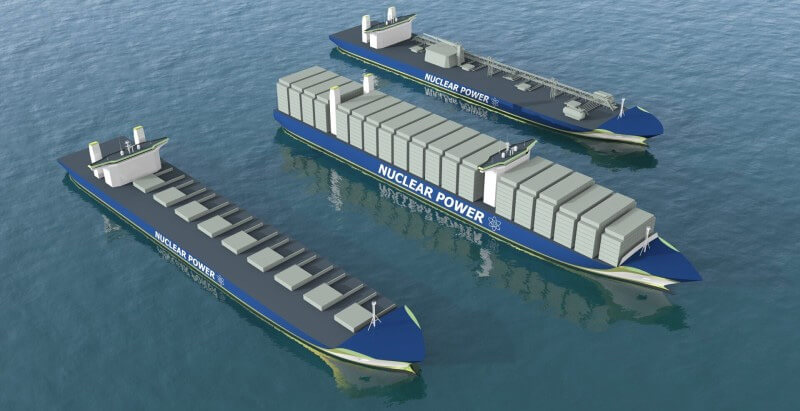
India to Explore Supplying Small Reactors for Nuclear-Powered Shipping
India is reported to be exploring supplying small reactors for merchants shipping (C-Job Naval Architects)
In the past two years, India has announced massive investments in its nuclear energy capacity. The focus currently is to design small modular reactors (SMRs) intended for use in off-grid sites in remote areas. However, local media reports this week indicate that the government wants to extend deployment of the SMRs to commercial shipping.
India’s Bhabha Atomic Research Center (BARC), run by the government, is developing two SMR designs of 55 MWe (megawatt electric) and 200 MWe capacities. The designs named as Bharat Small Modular Reactors (BSMRs) could be used as power plants in energy-intensive industries such as cement and steel manufacturing.
“The nuclear reactors are very safe and can even be used to power merchant ships,” reported the Business Standard newspaper, citing an unnamed senior government official. The Indian Navy has already embraced nuclear propulsion, with two nuclear submarines- INS Arihant and INS Arighaat. The two submarines operate the 83 MWe nuclear reactor. But reports indicate that future orders will feature the 200 MWe reactor, helping to improve endurance at sea.
Extending the technology to civil use, including merchant shipping, would help transform India’s domestic nuclear industry. With the shipping industry working to reduce its greenhouse gas emissions footprint, nuclear technology has been fronted to play a role in decarbonizing the sector. In June, IMO’s Marine Safety Committee endorsed revisions to the SOLAS convention to include new technologies such as SMRs.
Indeed, several technology providers are fast-tracking design and production of SMRs for commercial shipping. India sees this as a good opportunity and is even working on amendments to its nuclear energy laws to include the private sector. In the past year, India has also renewed nuclear cooperation with the U.S. and France. The focus is to build its capacity for designing and producing SMRs and Advanced Modular Reactor (AMR).
South African government approves draft 2025 IRP
The latest version of South Africa's Integrated Resource Plan outlines government plans to transform the energy sector to jump-start development and economic growth, including 5200 MW of new nuclear capacity as the country rebuilds its nuclear supply chain.
(Image: South African Government News Agency)
Announcing the Integrated Resource Plan (IRP) 2025 at a livestreamed event on 19 October, Minister of Electricity and Energy Kgosientsho Ramokgopa said South Africa's electricity crisis had stunted development and economic growth. But now the country has "turned the corner" on load-shedding, it can address the future with an IRP that aims to address electricity supply issues, promote economic growth, and create jobs, targeting a 3% growth in the South African economy by 2030.
The final version presented to the South African Cabinet represents a ZAR2.23 trillion (USD128 billion) investment.
The IRP is not a "wish list", the minister said. "This is not a guide. This is a policy of government. This is what is going to drive the electricity agenda in the country for the period that we are going to define and we're going to ensure that we achieve a number of elements going forward."
"There is no economy that grows if the lights are off. There are no industries that will decide to locate in South Africa if we can't guarantee them available electricity that is of good quality and that is affordable."
South Africa's current energy mix, as outlined by the minister, is heavily dependent on fossil fuels: 58% coal, 10% rooftop solar photovoltaics (PV), 10% grid-connected solar PV, 8% wind, 4.5% diesel, 4% pumped storage, 3% nuclear and the remaining 3% from "small" contributors such as biomass and hydro.
The IRP calls for the addition of more than 105 GW of new generation capacity by 2039, including expansion of solar PV, wind and nuclear. This, Ramokgopa said, would be akin to rebuilding state-owned utility Eskom "two and a half times" by 2039: "The biggest investment programme of the post-apartheid era is what we are presenting to the country today and to ensure that we are able to achieve energy security."
Fossil fuels do not disappear: the IRP calls for the introduction of 6000 MWe of gas-powered generation by 2030 which it says is critical for energy security and stability, as well as a vision for a clean coal technology demonstration plant by 2030.
The IRP calls for 5200 MW of new nuclear generation by 2039, but this could potentially be expanded further. "We think that there's an opportunity for another 4800 MW of nuclear, but that will be supported through our nuclear industrialisation plan so that we are able to participate in the entire value chain," Ramokgopa said.
The two biggest risks to not achieving the aims of the IRP are a limited skills pipeline - in part due to the decision to place on hold the country's pebble bed reactor development programme which meant skills had been "haemorrhaged" - and a "decimated" construction industry, the minister said. "So it's important that the industrialisation plan also answers the question 'where are the skills going to come from'."
Realism
Bismark Tyobeka, principal and vice-chancellor of South Africa's North-West University, former CEO of the National Nuclear Regulator and current chair of the Ministerial Expert Panel on Nuclear, described the IRP as "bold" and "progressive" for recognising the urgency needed to respond to climate change and scaling back reliance on fossil fuels, as well as repositioning South Africa as envisioning reviving the nuclear fuel-cycle value chain as the country repositions itself as Africa's "foremost nuclear nation".
The nuclear project timescales in the plan are realistic, he said.
“This would mark a return to the fundamentals of domestic nuclear capability by enriching our own fuel for peaceful electricity generation and for non-power applications. It would support not only power reactors but also non-power reactors such as the planned new multi-purpose reactor at Pelindaba, which will replace the ageing SAFARI-1 facility. This new reactor will strengthen South Africa’s position in producing radioisotopes and other nuclear-based innovations with applications in agriculture, mining, and manufacturing.
"It is indeed an ambitious plan, but I welcome the minister's pragmatic approach and its proposed implementation in manageable stages. Achieving the first 5200 megawatts by 2039, with the initial 1200 megawatts delivered by 2036, is a realistic target. Ten years is not an excessive timeframe if one considers that, for nuclear newcomer countries, the International Atomic Energy Agency (IAEA) milestones framework typically anticipates a 12- to 15-year process from planning to first electricity generation, including at least seven years of construction."
He added: "Given the preparatory work already done by the South African nuclear sector - including Necsa, the Department of Electricity and Energy, and the National Nuclear Regulator, which has been modernising its regulatory framework - the timeline is achievable. We also have the National Radioactive Waste Disposal Institute fully operational and expanding its capacity, and Eskom itself has shown encouraging signs of financial recovery, recently reporting a profit exceeding R100 billion.
"The time is right, and the key players are ready. From our side, as members of the Ministerial Advisory Panel, we must ensure that implementation happens as swiftly as possible. Our advice on the IRP should focus on achieving the shortest feasible delivery timelines while maintaining the necessary pace and scale of government action. Procrastination is the thief of time, and we cannot afford to delay further."
State-owned utility Eskom said it welcomed the launch of IRP 2025, which it said provides a clear investment framework for the supply of electricity needed to accelerate economic growth and inclusion in a context where overall unemployment stands at 30% and youth unemployment exceeds 50%. It will now conduct a "thorough review" of the IRP and subsequently publish a response along with an updated strategic plan.
The Integrated Resource Plan is described by the South African government as a "living plan" that is expected to be continuously revised and updated as necessitated by changing circumstances. It was first promulgated in March 2011, and last reviewed in 2023.
South Korea to submit safeguards report for SMR design
South Korea's SMART100 small modular reactor design is set to become the first SMR in the world to formally submit a Safeguards Technical Report to the International Atomic Energy Agency, the Korea Atomic Energy Research Institute has announced.
The layout of a SMART100 power plant (Image: KHNP/KAERI/KA-CARE)
"This milestone marks a significant step in ensuring that future SMRs incorporate international nuclear safeguards from the earliest stages of design, under the IAEA's safeguards by design (SBD) concept," the Korea Atomic Energy Research Institute (KAERI) said.
KAERI noted that the IAEA has emphasised the importance of implementing safeguards considerations as early as possible in the SMR design process to facilitate timely verification of nuclear material and minimise design changes at later stages. Work on safeguards by design for SMRs is being advanced with several member states through the Member State Support Programme (MSSP), integrating safeguards requirements alongside safety, security, and economic considerations in reactor design.
To develop innovative, effective safeguards concepts for emerging SMR types, the MSSP task on safeguards by design for SMRs was launched in 2018. Among the 24 member states providing extrabudgetary contributions to the IAEA through the MSSP, 10 member states are supporting the IAEA in addressing various SMR designs including land-based and marine-based integral pressurised water reactors, molten salt reactors, high-temperature gas-cooled reactors, lead-cooled fast reactors and microreactors within the framework of the safeguards by design for SMRs task.
KAERI said the SMART100 is at the forefront of this effort. Following standard design approval in 2024 for its advanced safety design and improved economics, SMART100 is now also leading in safeguards, it said. The Safeguards Technical Report (STR) submission scheduled for later this year is expected to be the first known such case among SMRs currently under development, construction, or operation worldwide.
"SMART100 is both a demonstration of Korea's advanced reactor technology and a commitment to transparency and international trust," said Chae Young Lim, Senior Vice President, SMART Export Promotion Group at KAERI. "By integrating safeguards considerations into the design from the beginning, we are setting a precedent that will benefit future SMR developers."
Jae Sung Lee, Task Officer for the SBD for SMRs task at the IAEA, added: "The IAEA is pleased to begin its internal process to finalise the STR submitted by the Republic of Korea, which represents the first task output of its kind. It is particularly important to note that the SBD is increasingly being integrated into SMR licensing processes in many countries."
The Safeguards Technical Report will be reviewed by the IAEA to ensure that the design can be efficiently safeguarded once deployed, including provisions for nuclear material accountancy, inspection access, and design information verification. This proactive approach is expected to reduce regulatory uncertainty and streamline deployment timelines for SMART100, while strengthening global non-proliferation confidence.
"As the first SMR to attain both safety and safeguards recognition at the international level, SMART100 is widely seen as a reference model for subsequent SMR projects worldwide," KAERI said. "Its progress demonstrates the feasibility of aligning advanced nuclear design with international standards on safety, security, and non-proliferation - key elements for the global expansion of SMR deployment."
The SMART100 (System-integrated Modular Advanced Reactor 100) is an advanced version of the original SMART design, which became the world's first SMR to receive standard design approval in mid-2012. SMART is a 330 MWt pressurised water reactor with integral steam generators and advanced safety features. The unit is designed for electricity generation (up to 100 MWe) as well as thermal applications, such as seawater desalination, with a 60-year design life and three-year refuelling cycle.
The SMART100 builds upon the safety, economic, and operational benefits of the SMART, offering enhanced power output and safety features. SMART100's development prioritised safety improvements, including the integration of a fully passive safety system. This system is capable of maintaining reactor cooling without the need for external power, using natural forces like gravity and fluid density differences to ensure the safe shutdown and cooling of the reactor during emergencies. Along with these safety enhancements, SMART100 also offers increased thermal output, rising from 330 MW to 365 MW, while its electrical output has been boosted from 100 MW to 110 MW, significantly improving efficiency while maintaining a compact design.
"Following standard design approval in 2024, SMART100 is under active consideration for international deployment, particularly in countries seeking low-carbon, flexible, and off-grid energy solutions," KAERI noted.
Netherlands aims to extend operation of Borssele plant
In a move to enable the continued operation of the Borssele nuclear power plant beyond 2033, the Dutch cabinet has submitted an amendment to the Nuclear Energy Act to the House of Representatives. The cabinet also announced plans to create a new state-owned company for the construction and operation of two new nuclear power plants.
Borssele (Image: EPZ)
The 485 MWe (net) pressurised water reactor at Borssele - operated by EPZ - has been in operation since 1973 and accounts for about 3% of the country's total electricity generation. It is scheduled to close in 2033, but the government has requested it remain in operation until 2054, if this can be done safely. The government has said it will consider acquiring a stake in the Borssele plant should a decision be made to extend its operation beyond 2033.
"The amendment to the law is an important step towards keeping the nuclear power plant operational longer," the government said. "If the amendment is adopted, Borssele's operator can apply to the independent regulator ANVS to keep the nuclear power plant operating beyond 2033. This will allow the Netherlands to continue consuming CO2-free energy for a longer period. The extension aligns with the government's policy of not relying solely on green energy sources, such as offshore wind or solar panels, but also fully committing to CO2-free and reliable nuclear energy. This will ensure our country can keep running, even when the sun doesn't shine and the wind doesn't blow."
In December 2021, the Netherlands' new coalition government placed nuclear power at the heart of its climate and energy policy. In addition to keeping the Borssele plant in operation for longer, the government also called for the construction of new reactors. Based on preliminary plans, two new reactors will be completed around 2035 and each will have a capacity of 1000-1650 MWe. The two reactors would provide 9-13% of the country's electricity production in 2035. The cabinet announced in December 2022 that it currently sees Borssele as the most suitable location for the construction of the new reactors. Three other locations are also being considered for the reactors: the Tweede Maasvlakte near Rotterdam, Terneuzen in Zeeland and Eemshaven in Groningen.
The government will establish a new state-owned company - the Nuclear Energy Organisation of the Netherlands (NEO NL) - for this purpose, Minister of Environment and Green Growth Sophie Hermans informed the House of Representatives. "This company will contract with the builder and will also operate the new plants. NEO NL will take the form of a 'policy participation', with the Ministry of Climate and Green Growth as the sole shareholder. At least EUR45 million (USD52 million) is available for its establishment," she said.
The government is also taking steps to prepare the Netherlands for the possible deployment of small modular reactors (SMRs). It said it is allocating EUR20 million "to stimulate developments in the Netherlands".
"In Europe, the United Kingdom is one of the frontrunners in this field," it said. "The Netherlands and the UK have therefore joined forces and signed a cooperation agreement in July 2025, allowing the Netherlands to learn from the British."
"Our country cannot survive without nuclear energy," Hermans said. "With the proposed establishment of NEO NL and the continued operation of Borssele, we are now taking a historic step towards a future with reliable nuclear energy. I hope that the next cabinet will continue on the path we have embarked on with the same energy and dedication."
Hungary committed to nuclear and radiation safety, IAEA mission finds
An International Atomic Energy Agency team said the special legal status of the Hungarian Atomic Energy Authority, which sees it reporting directly to Parliament, gives it a high level of effective independence.
Hungary has plans to expand nuclear energy capacity with the Paks II project (Image: Paks II)
The 12-day Integrated Regulatory Review Service mission, requested by the government, reviewed Hungary’s governmental, legal and regulatory framework for nuclear and radiation safety. The 20-plus-strong team reviewed Hungary's oversight of facilities and activities including nuclear power plants, research reactors, radiation sources facilities and waste management facilities.
In addition to the legal status praise, the mission also praised the Hungarian Atomic Energy Authority’s steps "in enhancing safety culture at the regulatory body".
Recommendations and suggestions to further enhance its regulatory framework included: "Clarifying allocation of tasks and responsibilities for regulatory control of medical exposures within the governmental, legal and regulatory framework for safety; establishing an integrated management system; documenting key regulatory processes and procedures within the management system; and reviewing and improving the existing arrangements between relevant regulatory authorities, as necessary, for the effective coordination of their regulatory functions."
The mission, which followed one in 2015 and a follow-up visit in 2018, noted that the authority's resources had been "incrementally increased" as the country’s nuclear industry grows and "emphasised the importance of continued government support - both financial and human resources - to ensure the regulator's capacity to fulfil its mandate".
Andrea Beatrix Kádár, Hungarian Atomic Energy Authority’s (HAEA) President, said: "Continuous improvement is of paramount importance to the Hungarian Atomic Energy Authority, as it strengthens the robustness of our regulatory framework and enhances nuclear safety to protect both the public and the environment."
Ramzi Jammal, Executive Vice-President and Chief Regulatory Operations Officer of the Canadian Nuclear Safety Commission, and the Integrated Regulatory Review Service Team Leader said: "Hungary has established a solid foundation for regulatory oversight through its independent regulatory body, the HAEA, and demonstrated a proactive approach to continuous improvement. We have found high levels of compliance with IAEA safety standards and evidence that HAEA is a competent and trusted national regulator."
Karine Herviou, IAEA Deputy Director General and Head of the Department of Nuclear Safety and Security, said: "The outcome of this mission demonstrates Hungary’s dedicated and strong commitment to strengthening its regulatory infrastructure and, consequently, enhancing nuclear and radiation safety nationwide."
Hungary generates about half of its electricity at four reactors at the Paks nuclear power plant. The country is planning to construct another two units at Paks. It also operates research reactors for training and research as well as the production of radioisotopes.
Nuclear island completed at third Haiyang unit
The concreting of the containment water tank has marked the completion of the civil construction of the main nuclear island structure of unit 3 at the Haiyang nuclear power plant site in China's Shandong province.
(Image: CNNC)
China National Nuclear Corporation subsidiary CNNC 24 completed the concrete pouring of the inner and outer ring walls and top plate of the CB20 module on 20 October, "laying a solid foundation for the subsequent containment sealing test and hot functional test".
The containment water tank, the final module, was hoisted into place on top of the containment building roof at Haiyang 3 on 4 August. The hoisting of the module - measuring 26 metres in diameter, 10 metres in height and weighing about 419 tonnes - took one hour and 52 minutes to complete.
The CB-20 module will store more than 3,000 tonnes of water, which can be used to help cool the reactor in an emergency. The water can also be directed into the reactor's used fuel pool, while the tank itself can be refilled from water stored elsewhere on site. The tank is part of the plant's passive safety systems which require no operator actions to mitigate potential emergency situations, using natural forces such as gravity, natural circulation and compressed gas to achieve their safety function. In conjunction with other passive safety features, the CB-20 module can maintain unit safety for 72 hours without human intervention.
The construction of two CAP1000 reactors - the Chinese version of the Westinghouse AP1000 - at each of the Haiyang, Sanmen and Lufeng nuclear power plant sites in China was approved by the country's State Council on 20 April 2022. The approvals were for Haiyang 3 and 4, Sanmen units 3 and 4 and units 5 and 6 of the Lufeng plant. The Sanmen and Haiyang plants are already home to two AP1000 units each.
Unit 1 of the Haiyang plant entered commercial operation in October 2018, with unit 2 following in January 2019.
The first safety-related concrete was poured for the nuclear island of Haiyang unit 3 in July 2022, and in March the outer steel dome of the nuclear island containment building was hoisted into place. Construction of Haiyang 4 began in April last year. The planned construction period for Haiyang 3 and 4 was 56 months, with the two units scheduled to be fully operational in 2027.
Palisades receives fuel ahead of restart
The Palisades nuclear power plant in Michigan has taken delivery of 68 new nuclear fuel assemblies as efforts to restart the plant later this year continue, Holtec International announced.
(Image: Holtec)
"Procuring new fuel was among the earliest long-lead activities in the project, requiring months of technical preparation and regulatory coordination," the company said. "Palisades' historic transition from decommissioning to operations status that occurred with the US Nuclear Regulatory Commission's authorisation in late August 2025 enabled the plant to receive new fuel at the site."
The fuel was fabricated domestically "by a highly respected nuclear fuel manufacturer that has supplied Palisades and others in the nuclear industry for decades", Holtec said.
Upon arrival at the plant and an in-depth quality inspection, the accepted batch of fuel was placed in secure storage within the used fuel storage pool building, where it will remain until it is loaded into the reactor core.
Palisades, a single-unit pressurised water reactor, ceased operations in May 2022 and was defuelled the following month, although it was licensed to operate until March 2031. The unit's licence was transferred from previous operator Entergy Nuclear Operations to Holtec Decommissioning International, LLC and Holtec Palisades, LLC, for decommissioning, but in late 2023, Holtec began the process of obtaining the licensing approvals needed to return the plant to operational status for the remainder of its licensing term.
Following the completion of technical reviews, the US Nuclear Regulatory Commission (NRC) on 24 July this year approved the transfer of operating authority for the plant and its independent used fuel storage facility from Holtec Decommissioning International LLC to Palisades Energy LLC. It also approved the reinstatement of various documents and programmes that were in place prior to the shutdown, including the technical specifications, emergency plan, emergency action levels, and physical security plan, as well as programmes for quality assurance, maintenance, and in-service inspections. In late August, Holtec announced that Palisades had resumed operational status.
Holtec earlier said it was targeting to restart Palisades in the fourth quarter of this year.
Major equipment restoration work is progressing across the plant, the company said. Reassembly of the main turbine generator is under way following more than a year of inspection, testing, and maintenance work. The plant also recently received and installed the second of two fully refurbished primary coolant pump motors, which is essential to recirculate the reactor coolant. The chemical cleaning of the secondary side of the steam generators is also under way. This work follows successful completion of refurbishing of the steam generators' tubes earlier this summer and is intended to ensure long-term reliability and efficiency of the plant.
"The esprit de corps of our tirelessly toiling worker force, over 1,800 strong boosted by the stout support of federal, state, and local government as well as our industry partners, labour, and the Southwest Michigan community, is a testament to the national consensus and our collective will to harness nuclear energy to meet the galloping demand for power in our country," said Holtec CEO Kris Singh.
At the time it was taken out of service, Palisades was licensed to operate until 2031. Holtec notified the NRC last year that it intends to apply for a second, or subsequent, licence renewal for the plant during the first quarter of 2026. This would extend the plant's operating period by a further 20 years, to 2051.
Because patient perceptions of radiation can influence their willingness to receive it as treatment, researchers recently examined how radiation therapy is represented in different forms of art.
The analysis in theJournal of Medical Radiation Sciences found that overall, novels, poems, music, film, and paintings tend to depict radiation therapy as associated with fear, mystery, and fascination.
The authors note that radiation therapy is widely perceived as having both lifesaving and life-threatening potential. As such, exploring how radiation therapy is represented in various art genres, and thus how it is likely to be appreciated by patients and the general public, has scientific, intellectual, and clinical value. Also, different forms of art might be harnessed to help patients cope with the burdens of radiation interventions.
“Exploring how patients perceive radiation and radiotherapy treatment helps patients and health care providers align the preparation and performance of radiotherapy treatment. Reduced stress, improved coping, and more efficient treatment are potential results,” said corresponding author Ad A. Kaptein, PhD, of Leiden University Medical Centre, in the Netherlands. “In patients with moderate to severe psychological issues, bibliotherapy, expressive writing, photovoice, and drawing about the radiation experience may be additional therapeutic measures that can help improve patients’ quality of life.”
Additional Information NOTE: The information contained in this release is protected by copyright. Please include journal attribution in all coverage. For more information or to obtain a PDF of any study, please contact: Sara Henning-Stout, newsroom@wiley.com.
About the Journal Journal of Medical Radiation Sciences is an international journal in radiation therapy, nuclear medicine, medical imaging/diagnostic radiography, medical ultrasound/sonography, and the complementary disciplines of medical physics, radiology, radiation oncology, nursing, psychology and sociology research and practice.
About Wiley Wiley is a global leader in authoritative content and research intelligence for the advancement of scientific discovery, innovation, and learning. With more than 200 years at the center of the scholarly ecosystem, Wiley combines trusted publishing heritage with AI-powered platforms to transform how knowledge is discovered, accessed, and applied. From individual researchers and students to Fortune 500 R&D teams, Wiley enables the transformation of scientific breakthroughs into real-world impact. From knowledge to impact—Wiley is redefining what's possible in science and learning. Visit us at Wiley.com and Investors.Wiley.com. Follow us on Facebook, X, LinkedIn and Instagram.
_64496.jpg)
_71232.jpg)
_36717.jpg)
_83475.jpg)
_78957.jpg)

_55942.jpg)
_24027.jpg)


No comments:
Post a Comment