It’s possible that I shall make an ass of myself. But in that case one can always get out of it with a little dialectic. I have, of course, so worded my proposition as to be right either way (K.Marx, Letter to F.Engels on the Indian Mutiny)
Wednesday, October 22, 2025
Companies Change Stockholding and Board Members to Avoid China’s Port Fees
There had been reports that companies were considering restructuring steps in the face of the uncertainties created by the special port fee programs introduced by the U.S. and China. Several companies, based on recent stock exchange filings, have quietly taken several steps targeting their ownership profile and composition of their boards to reduce the risk of being deemed a “U.S.-controlled” company by the Chinese authorities.
Lawyers pointed to the ambiguities in the programs and the definitions of ownership. Both China and the United States included percentages of ownership that could cause a company to be deemed to be eligible for inclusion in the fee programs. Public companies have highlighted that much of their stock may be held in brokerage accounts where they have no knowledge of the beneficial owner. Only the large institutional investors can be readily identified.
One example of the steps companies are taking was revealed in a series of filings by Costamare, a larger owner/charterer of containerships, and its recently established sister company Costamare Bulkers, which spun off earlier this year to control the dry bulk portion of the fleet. Although both companies are majority owned by entities linked to Konstantinos Konstantakopoulos and headquartered in Monaco, they trade on the New York Stock Exchange.
In filings dated October 14, the two companies revealed they were selling new, non-economic shares to Konstantakopoulos. In the case of Costamare, they sold 1,200 shares for $1,200, and Costamare Bulkers sold 235 shares for $235. After these transactions, Konstantakopoulos’ voting rights rose to over 75 percent ownership of each company.
In the filings, the companies said the steps were being taken in connection with the announcement by China’s Ministry of Transport about U.S.-linked vessels being subject to the new port fees. While the companies said they did not believe they were exposed, they said it was not possible to ensure that U.S. persons did not control more than 25 percent of the voting power. The solution, increase Konstantakopoulos’ voting power.
The companies took a second step, announced in filings on October 21. Commonly known as a “poison pill,” they amended their stock rights programs to further protect against tripping the U.S. interests’ provision in the port fee program. Costamare Bulkers reports that it lowered the ownership threshold to 5 percent for a U.S. owner’s beneficial position to trigger the rights offering. They excluded current holders or passive investors below a 6.5 percent threshold currently, again saying it was due to the Chinese port fee program.
Several other publicly traded shipping companies have quietly moved to reformulate their boards. Okeanis Eco Tankers and Danaos, for example, accepted the resignations of American directors, saying it was not due to a dispute with the company.
These steps are examples of the measures companies are taking in response to the Chinese special port fees. Companies that can are also reported to be redeploying ships in their fleets, or in the case of cruise companies based in the United States, skipping scheduled port calls in China.
Costamare advised shareholders that it would review the changes to the right plan at the appropriate time. The U.S. has continued to say it expects a strong trade deal with China, but it is unclear if the port fees, which the U.S. started to reduce to counter China's dominance of the maritime trade and shipbuilding, could be included in the trade agreements.
HII’s Newport News Shipbuilding Buys 3D Printing from AML3D
HII's Newport News is expanding 3D printing with the purchase of two large systems (HII)
AML3D Limited announced an order for approximately A$4.5 million ($US2.9 million), for 2 custom ARCEMY® systems from HII’s Newport News Shipbuilding (“NNS”) division. HII is America’s largest military shipbuilder delivering ships, submarines and defense technology. AML3D expects the NNS custom ARCEMY® system to be installed and operational during the second quarter of 2026.
The NNS custom systems are based on the large scale ARCEMY® X but use a 10,886kg positioner to create a heavy capacity build capability. The NNS custom ARCEMY® system will be used for a variety of shipbuilding applications. These systems are the second and third heavy capacity ARCEMY® systems to be deployed and represent the 9th and 10th ARCEMY® systems overall, ordered to support the US Navy Maritime Industrial Base.
HII is integrating AML3D’s advanced additive manufacturing into its technology suite to expedite lead times and provide alternatives to traditional manufacturing techniques. AML3D’s ARCEMY® systems produce components that meet or exceed traditional manufacturing standards with significant reductions in lead times, waste and environmental impacts.
AML3D CEO Sean Ebert said:
During my recent visit to our US operations it was clear AML3D had a huge opportunity to build on our success supporting the US Navy submarine program and expand into US Navy shipbuilding and munitions as part of US Government’s ‘Make Shipbuilding Great Again’ initiatives. These custom large capacity ARCEMY®X systems, are similar in scale to the ARCEMY® X that we recently brought online for another US Defense shipbuilding prime contractor. It is pleasing to see demand for our technology across the US and other globally, significant defense markets is continuing to accelerate.
In parallel, we are making progress on our strategic goal to access additional non-defense sectors. Our US operations recently delivered a large capacity ARCEMY X® to the Tennessee Valley Authority, the largest public utility in the USA. Having an established US manufacturing base means AML3D is advantaged when supporting US customers as the US Government’s tariff policy evolves. AML3D is also well positioned to leverage our US playbook to accelerate our entry into the UK and other European Defense markets and expand our defense and non-defense work in Australia.
The products and services herein described in this press release are not endorsed by The Maritime Executive.
Cruise Industry on Track for Fourth Consecutive Growth Year
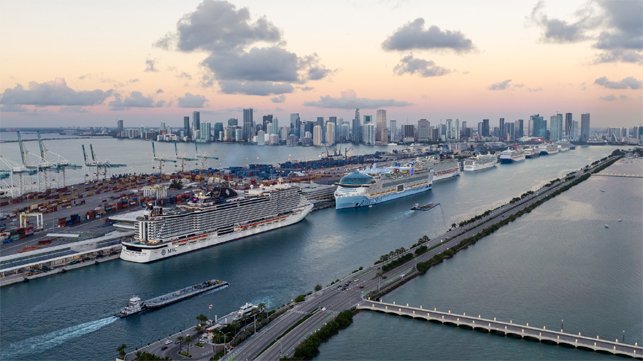
PortMiami is expecting another strong year with 10 new cruise ships scheduled for calls in 2025-2026 (PortMiami)
The cruise industry has roared back since the pandemic, as almost everyone in the travel industry is well aware. AAA and Tourism Economics, however, published new numbers to show just how strong the industry is, and specifically the significance of the U.S. market to the industry.
In a new report, they highlight that the industry is expected to mark the fourth consecutive year of record cruise passenger volume in 2026. They note as well that 2025 is turning out to be a better-than-expected year.
The trade group Cruise Lines International Association (CLIA) in May had forecast a global total of 37.7 million cruise passengers projected for 2025. That represents nearly nine percent growth from CLIA’s reported total of 34.6 million cruise passengers worldwide in 2024 among the group’s membership of ocean, expedition, and river cruise lines. CLIA reported that North America remains the top source market for cruise, with a 13 percent increase in 2024 over 2023.
AAA and Travel Economics are forecasting the American segment of the market will reach 20.7 million passengers this year and will grow to 21.7 million in 2026. AAA is forecasting that the year-over-year increase will be an 8.4 percent jump from 2024 to 2025 and a further 4.5 percent bounce from 2025 to 2026.
“These numbers reflect the growing demand for ocean cruises among U.S. travelers,” said Stacey Barber, Vice President of AAA Travel. “Our travel agents see this every day.”
The contribution of the American segment is demonstrated in all parts of the industry. PortMiami, for example, reports that on April 20, 2025, it set a new one-day record, handling 72,401 passengers. It also had a record-breaking 10 cruise ships on February 8, 2025. PortMiami continues to be the largest cruise homeport, highlighting that it will welcome 10 new cruise ships, including five newbuilds, during its 2025-2026 cruise season.
Numbers are just coming in from the Alaska cruise season that was completed in the last few days. Seattle, Victoria, BC, and Vancouver have each announced they set new records for the number of passengers at their ports. AAA calculates that about seven percent of U.S. passengers are traveling to Alaska.
The U.S., according to AAA, is also the home of four of the top embarkation ports in the industry. Following Miami, it is Port Canaveral, Port Everglades, and Galveston. Barcelona is the largest international cruise embarkation port.
AAA’s data diverges from CLIA as it says nearly two-thirds (65 percent) of people going on cruises are 55 or older. They report that 27 percent are between the ages of 35 and 54, and seven percent are between 18 and 34. Most adults, they report, travel with someone on a cruise, with nearly 50 percent traveling as a couple, 20 percent traveling with kids, and only seven percent are solo travelers. They point to the opportunities for a “date night” as well as multigenerational families who find cruising more affordable than booking flights and hotel rooms.
“The Caribbean is by far the most popular cruise destination for Americans,” reports AAA, capturing 72 percent of U.S. cruise passengers. They note the strong growth in ultra-luxury small ship cruising and expedition destinations.
The good news for the industry is a high satisfaction rate. AAA says 90 percent of U.S. cruise passengers rate their experiences as “very good or good.” They also report that 91 percent of people have taken multiple cruises.
The strength of the numbers encouraged the cruise lines to keep the momentum going, and they returned to the shipyards, placing the first large orders since the pandemic. Carnival Cruise Line ordered two 180,000 gross ton cruise ships and three nearly 230,000 GT ships. Norwegian Cruise Line ordered a new class of three 225,000 gt cruise ships in addition to the large ships from its prior order. Royal Caribbean confirmed the order for two more 250,000 GT ships, along with options for two more in the Icon class, and MSC Cruises added two more 217,000 GT ships for its World Class. This industry is mapping out new ship introductions at least through 2033, and more orders are expected to follow.



No comments:
Post a Comment