Trump approves covert CIA operations in Venezuela, escalating pressure on Maduro
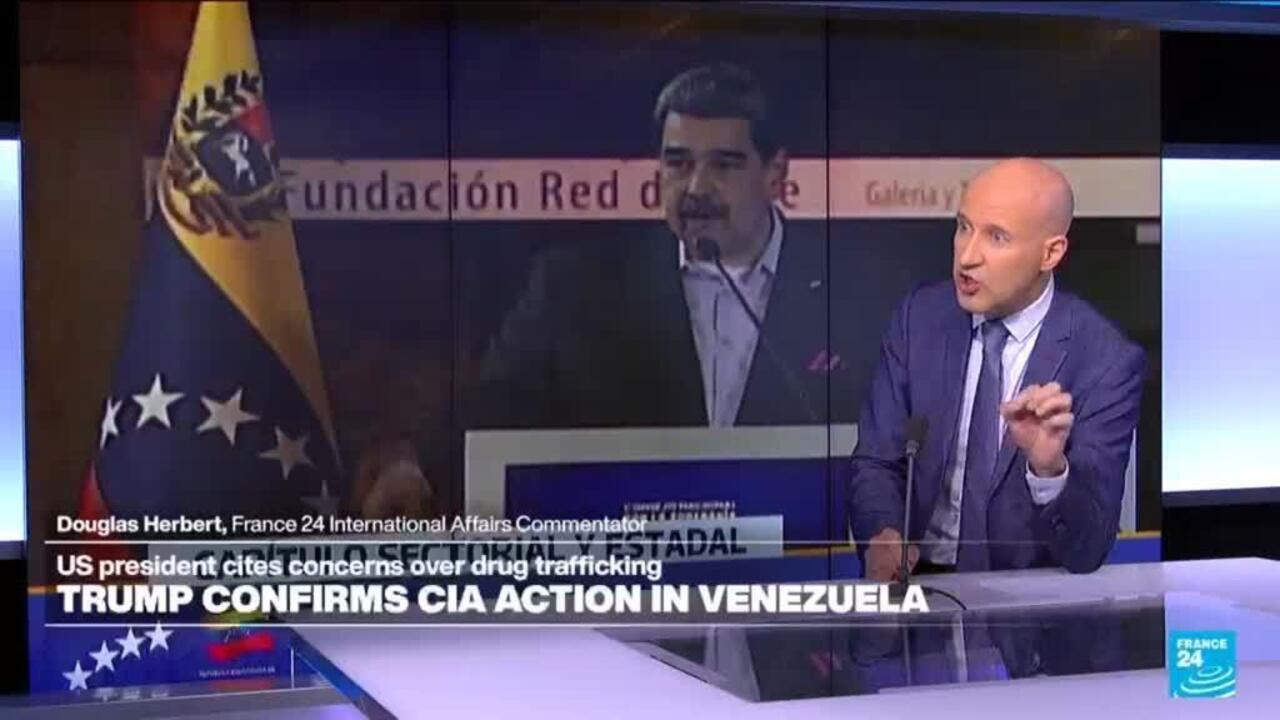
US President Donald Trump confirmed Wednesday that he had authorised covert CIA operations in Venezuela, significantly intensifying US pressure on President Nicolas Maduro's government. Trump also revealed he was considering launching strikes against Venezuelan drug cartels on land, following a series of deadly maritime operations targeting alleged narcotics-smuggling vessels.
By: FRANCE 24
Video by: Florent MARCHAIS
US President Donald Trump confirmed on Wednesday that he authorised the CIA to conduct covert operations in Venezuela, marking a sharp escalation in US efforts to pressure President Nicolas Maduro's government.
The New York Times first reported the classified directive, citing US officials familiar with the decision, saying the Trump administration's Venezuela strategy aims to remove Maduro from power. The administration has offered $50 million for information leading to Maduro's arrest and conviction on drug trafficking charges.
Trump said he authorised the action because large amounts of drugs were entering the United States from Venezuela, much of it trafficked by sea.
"We are looking at land now, because we've got the sea very well under control," Trump said.
The Venezuelan government said Trump's statement constituted a violation of international law and the United Nations charter. It added that US actions aimed to legitimise a "regime change" operation with the ultimate goal of seizing Venezuela's oil resources.
Venezuelan President Nicolas Maduro decried what he called "coups d'etat orchestrated by the CIA" shortly after Trump's comments.
"No to war in the Caribbean...No to regime change...No to coups d'etat orchestrated by the CIA," the leftist leader said in an address to a committee set up after Washington deployed warships in the Caribbean for what it said was an anti-drug operation.
Trump: Venezuela 'feeling heat'
Trump has repeatedly accused Venezuela of being a hub for trafficking of the deadly drug fentanyl, but US records have shown that Mexico is the main source of fentanyl.
Trump was asked by a reporter why he did not have the Coast Guard stop suspected drug trafficking boats, which has been US practice for decades. Trump called such efforts "politically correct" and said they had not worked.
Trump declined to answer when asked if the CIA has the authority to execute Maduro, saying, "I think Venezuela is feeling heat."
Trump has ordered a large US military buildup in the southern Caribbean, and the troops have conducted at least five strikes on vessels the Trump administration has described as involved in drug trafficking, without providing evidence.
03:06
The campaign is the most recent example of Trump's efforts to use US military power in new, and often legally contentious, ways, from deploying active-duty US troops in Los Angeles to carrying out counterterrorism strikes against drug trafficking suspects.
The Pentagon recently disclosed to Congress that Trump has determined the United States is engaged in "a non-international armed conflict" with drug cartels.
Trump: Venezuela released prisoners into US
Trump also accused Venezuela of releasing large numbers of prisoners, including individuals from mental health facilities, into the United States, although he did not specify which border they were crossing.
The Trump administration has provided scant information about the strikes, frustrating members of Congress, including some of his fellow Republicans.
On Wednesday, Senator Jeanne Shaheen, the top Democrat on the Senate Foreign Relations Committee, said the administration moved the US closer to outright conflict.
"The American people deserve to know if the Administration is leading the US into another conflict, putting service members at risk or pursuing a regime-change operation," she said in a statement.
(FRANCE 24 with AFP and Reuters)
Imperial Double Standards: Warfare for Venezuela and Welfare for Argentina
Venezuela’s Bolivarian Revolution has been in the vanguard of the Global South. In contrast, President Javiar Milei’s government in Argentina represents the logical, though absurd, consequence of extreme neoliberalism, which he calls “anarcho-capitalism.”
Western Hemispheric geopolitics reflect the weakening of US hegemony and an emerging multipolarity, especially with China’s entry as a major regional trading partner. US imperialism’s response, started well before Trump, has been to weaponize the dollar, impose illegal and crippling economic sanctions, and levy arbitrary tariffs. When these fail, the recourse is to military aggression.
US War Secretary Pete Hegseth announced preparations for war with China. Washington has concluded that it must put a halt to multipolarity to maintain its global supremacy. Thus, the Trump administration is simultaneously rushing to rescue Milei’s government while hurrying to overturn Venezuela’s under their President Nicolás Maduro.
Role of Venezuela under Chavismo
Venezuela is a beacon of national sovereignty and social progress. It has consistently opposed imperialist aggression, not just in Latin America, but globally. Under the movement known as “Chavismo” it aimed for Latin American integration and the pooling of its huge natural resources, offering an independent pathway to development to withstand US imperialism.
Consequently, it has been under attack, enduring US-financed far-right violence, destabilization, a US-led asphyxiating economic blockade, assassination attempts on the president and leading Bolivarian officials, mercenary attacks, coups and terrorism – the full arsenal of Washington’s aggressive toolkit.
Role of Argentina under Milei
In 2023, anti-establishment anger propelled libertarian populist Javier Milei to the Argentine presidency. His Trump-like “chainsaw plan” – radical spending cuts and a war on government institutions and services – fitted with the orthodoxy dictated by the International Monetary Fund (IMF). Milei closed 13 government ministries, including those for education, labor and social security. Foreign lenders welcomed Milei’s elevation of austerity to a moral imperative.
Milei is still favored by the IMF. But while his unwillingness to devalue the peso helped cut inflation, it slowed economic growth and reduced the country’s capacity to sustain its huge debt. Argentina is now over $450 bn in the red. Employment fell steeply, while poverty soared to affect 53% of the population in 2024 (allegedly reducing since then). Budget cuts raised the cost of basic needs.
Corruption scandals emerged. A close political associate of Milei admitted receiving “donations” from a narco-entrepreneur. A US$4.6 bn crypto scandal followed; the largest ever crypto-theft. Milei’s left opposition demanded his impeachment, and a judge launched a fraud probe. Later, Milei’s sister was accused of receiving hefty bribes. On top of this came the crushing defeat for Milei’s libertarian party in the Buenos Aires provincial elections in September.
All that has triggered a run on the peso and a new economic crisis.
Trump’s recent decision to bail out Milei’s predictably disastrous economic performance is consistent with the profligacy of IMF-US lending to right-wing Argentine governments. In April 2025, the Buenos Aires Times reported that the IMF praised Milei’s efforts and projected that the Argentine economy would grow faster than the global average. In fact, Milei tipped the country into recession and sent millions of people into poverty in the first months of his government.
In short, Milei’s “narco-capitalist” government is not only corrupt but has savaged Argentina’s economy. Milei represents the logical culmination of Argentina’s ruling class servitude to US geopolitical objectives, even extending to his enthusiastic support for genocide in Gaza. Slavishly supporting anything Trump does or says, Argentina was one of only ten countries to vote with the US against the UN’s two-state solution for Israel-Palestine.
IMF wages financial war against Venezuela
The IMF is a key institution through which the US enforces its imperial dominance, part of an architecture shaped largely by Washington. Often functioning as a financial arm of US foreign policy, it rewards compliant right-wing regimes such as those of Argentine presidents Macri and Milei, while punishing independent governments like Venezuela’s that are striving for socialism.
An example is the IMF response to the 2002 coup against Venezuela’s democratically elected President Hugo Chávez. The IMF publicly stated its readiness to collaborate with coup-monger Pedro Carmona, whose “government” abolished the constitution and key democratic institutions. Within hours after Chávez was kidnapped, the IMF’s Thomas Dawson said: “we stand ready to assist the new administration in whatever manner they find suitable.” Fortunately for democracy, the coup lasted only 47 hours. The people spontaneously rose up and returned their rightful president to his office.
More recently, during the Covid-19 crisis, IMF chief Kristalina Georgieva announced an emergency response which could disburse US$50 bn to developing countries and US$10 bn to low-income countries at a zero-interest rate. Venezuela had tried to exercise its “special drawing rights” for US$5 bn to combat the pandemic. This required IMF officials to engage in acrobatics to justify rejecting Venezuela’s request. The real reason was the US government’s farcical recognition of Juan Guaidó as “interim president.”
US-IMF props up rightist Argentina
In 1999-2002, when Argentina had a right-wing government, the IMF overestimated GDP growth. Then, conversely, in 2003-2015 when Argentina had left-wing governments under the Kirchners, the IMF underestimated the strength of the country’s economic recovery. IMF debt was paid off, Argentina’s notorious external debt fell sharply, no new IMF loans were granted.
But for the past decade, its politics have revolved around chronic economic crises and persistent IMF influence. Across three presidencies, Argentina swung from market liberalization (Macri, who succeeded the Kirchners), to state intervention (Fernández), to radical austerity (Milei). Right-wing Mauricio Macri acquired a US$57 bn loan, the largest in the fund’s history. The IMF itself admitted the bailout “was not fit for purpose.” The country is now on its twenty-third IMF bailout, a global record. It is the fund’s biggest debtor, owing a “staggering” $41.8 bn.
US aggression against Venezuela
The US finds it intolerable that Venezuela – a “threat” of a good example – has successfully resisted US policy of “maximum pressure.” Its military build-up against Venezuela is an escalation from hybrid to open warfare aimed at suppressing an alternative model of sovereignty and social justice, with the possible bonus of reclaiming control over the country’s oil resources.
Trump has deployed a fleet of warships, F-35 stealth fighter jets, and several thousand marines. Washington is positioning military forces in Puerto Rico, has a substantial military presence in Guyana, and asked Grenada to deploy US military forces in its territory. Trump has declared the US to be at war with drug cartels, potentially extending to those supposedly inside Venezuela itself. Commentators, including officials of the Bolivarian government, conclude that a US military strike seems imminent.
Washington’s justification is a monumental lie: Venezuela is alleged to be a narco state, led by the non-existent Cartel de los Soles. Rubio and Trump falsely accuse the Bolivarian government of shipping hundreds of tons of drugs into the US. The United Nations Office on Drugs and Crime has consistently reported that up to 92 percent of the cocaine produced in Colombia and Ecuador reaches the US through the Pacific (Venezuela’s entire coastline faces the Caribbean Sea).
Trump and Milei
In sharp contrast to the economic punishment being meted out to Venezuela, Trump’s “favorite president” is getting a bailout for the economy he that has destroyed. Milei is promised a direct purchase of pesos with dollars, together with a $20 bn central bank “swap line.” Milei swiftly thanked Trump for his “vision and powerful leadership.”
Washington openly admits its ideological motives. Treasury Secretary Scott Bessent said the US should help conservatives win elections in Latin America. He tweeted: “The success of Argentina’s reform agenda is…in the strategic interest of the United States.” Praising Argentina’s “strong and stable” economy, he failed to address why it would collapse without US support.
The bailout appears to have several undeclared aims. One, according to the New York Times, is to help rich investors whose bets could falter if Argentina’s economy sinks. The same source claims that US officials are also pushing Argentina to scale back its ties with China and want access to its uranium and lithium supplies. The rescue plan may even involve dollarizing Argentina’s economy.
Nearly half of Argentinians (44%) see the deal as more likely to benefit the US than their own nation, while 36% have a negative view of Milei’s relationship with Washington. The irony of Trump’s economic lifeline for Milei is that it may kill off his chances of political survival.
Neoliberal misery vs multipolar-oriented sovereign development
Bolivarian Venezuela and Milei’s Argentina present two starkly different paths for Latin America—Venezuela’s sovereign defiance of US imperialism and Argentina’s deepening subservience and dependency. One suffers imperial “hybrid warfare” while the other gains imperial “welfare.”
Washington uses coercive tools—sanctions, economic warfare, and military threats—to preserve hemispheric dominance. Venezuela embodies resistance and regional integration. Argentina, under Milei, epitomizes the collapse into “narco-capitalism,” social devastation, and foreign subjection.
Ultimately, neoliberal austerity brings only poverty and dependency, while multipolar cooperation among Global South nations offers a viable path toward genuine independence, equitable development and resistance to imperial domination. US military actions against Venezuela violate international law and rest on unfounded claims. Latin America is a declared Zone of Peace. To respect that and allow the people their right to live without fear of war, the US must withdraw its forces.
Nicaragua Solidarity Coalition Statement on
US Aggression against Venezuela
The Nicaragua Solidarity Coalition demands an end to US aggression against Venezuela, which is on the brink of outright war. Any escalation in the violence against Venezuela will cause more suffering and deaths in the South American country, destabilize the region, and endanger all countries seeking a path independent from US domination, especially Cuba and Nicaragua.
US actions indicate a strike on Venezuela is imminent:
- After the Trump administration designated international drug-trafficking groups as “foreign terrorist organizations” (FTOs), without any evidence it accused Venezuelan President Nicolás Maduro of being their ringleader. By July, a “secret directive” authorized military operations against FTOs at sea and on foreign soil.
- In August, the administration raised its illegal “bounty” on President Maduro to $50 million and launched a massive naval deployment off the coast of Venezuela, which includes nuclear capable submarines and jets and quickly grew to 10,000 troops.
- On September 2, in international waters off of Venezuela, the US blew up the first of four or five boats that Trump claims carried drugs, committing extrajudicial executions.
- By mid-September, the Pentagon notified Congress under the War Powers Resolution that US forces were engaged in a “non-international armed conflict” with drug cartels.
- On October 1, the Defense/War Department issued a “confidential memo” and told Congress that the US was engaged in armed conflict.
- On October 6, Trump ended back-channel diplomatic contacts with Venezuela, which had been essential since the rupture of diplomatic relations in 2019. That same day, Venezuela informed the US of a thwarted plan by Venezuelan right-wing extremists to plant explosives at the US embassy in an attempted false-flag operation.
- On October 10, Maria Corina Machado—a US-paid, violent, Zionist, extreme right-wing Venezuelan political opposition figure—received the Nobel Prize after being endorsed by Secretary Marco Rubio, in a clear a maneuver to manufacture consent for regime change in Venezuela.
We must not be fooled by this perversion of the peace prize or the countless unfounded accusations against Venezuela and its democratically elected president. The United Nations Office on Drugs and Crime, and even the DEA, report that Venezuela is not a drug trafficking country, nor are Cuba or Nicaragua. Like its lies about migrants, the Trump administration has fabricated the “threat” posed by Venezuela. The real reason the administration is pushing for war against Venezuela is to regain control of its vast resources—including the world’s largest oil reserves.
We demand an end to US impunity and the withdrawal of US troops and war materiel from the Caribbean before the situation escalates any further. We vehemently object to the deployment of nuclear capable vessels in a region which, in response to the Cuban Missile Crisis, declared itself a nuclear-free zone in 1967, and which the US committed itself to respect in 1971. We demand respect for international law and the sovereignty of nations. The people of Venezuela and the rest of Latin America and the Caribbean must be allowed to live in peace with the form of government they have chosen.
Hands Off Venezuela! Venezuela is Hope! Venezuela is not a threat!
US Hands Off Latin America and the Caribbean!
Essequibo Tensions Rise as Trump Engages in Gunboat Diplomacy
- The long-standing territorial dispute between Venezuela and Guyana over the Essequibo region has intensified following significant oil discoveries by ExxonMobil in Guyanese waters.
- Venezuela's President Maduro has escalated his claims and actions, including a referendum and military posturing, aiming to annex the Essequibo, which comprises two-thirds of Guyana's territory.
- Guyana, a newly emerging oil-producing nation, has sought and received security assurances and military cooperation from the United States to deter Venezuelan aggression and protect its sovereignty.

The dispute between Venezuela and Guyana over the mineral-rich Essequibo escalated after ExxonMobil made over 30 world-class discoveries, containing 11 billion barrels of crude oil, in the prolific Stabroek Block. By late 2023, Guyana was a regular target of Caracas’ bellicose saber rattling with threats of annexation and invasion, forcing the government in Georgetown to seek security assurances from Washington. While the White House’s deployment of U.S. warships off the coast of Venezuela sparked considerable consternation across Latin America, it was applauded by Guyana.
The Essequibo conflict dates from 1841, when a recently independent Venezuela claimed the region ceded by the Dutch to Great Britain in 1814 during the Napoleonic Wars. In 1831, Britain merged Essequibo with other former Dutch territories, Demerara and Berbice, to form the British colony of Guiana. Caracas argued the Essequibo had originally belonged to the Viceroyalty of New Granada, which encompassed the territories now comprising Venezuela, Colombia, Panama and Ecuador, during the Spanish colonial period. When efforts to settle the dispute failed, Caracas sought U.S. assistance to resolve the matter toward the end of the nineteenth century.
The dispute was eventually arbitrated, with the Essequibo awarded to British Guiana, despite Washington’s representation of Venezuela. This decision was finalized in the Paris Arbitral Award of 1899, with boundaries officially demarcated in 1905. Tensions ebbed and flowed since then, rising in 1962 as Guyana’s independence from Britain approached, with Venezuela claiming the 1899 decision was null and void. Tensions since then have ebbed and flowed with little progress made to resolve the territorial dispute, even after it was referred to the International Court of Justice (ICJ) in 2018, which, during 2023, ruled it had jurisdiction to arbitrate the dispute.
Regardless, Venezuela’s dictatorial President Maduro ratcheted ever higher his bellicose saber-rattling against Guyana. Indeed, gaining control of the Essequibo is a rare point of consensus among the Maduro regime, opposition groups, and ordinary citizens in Venezuela. It became a facet of national identity, with the mineral-rich region long coveted by all governments of Venezuela. But autocratic President Maduro is the first Venezuelan leader to resort to threats of annexing the Essequibo by force. Venezuela’s illegitimate president views the dispute as an opportunity to unify the country’s people behind his brutal regime after the country’s horrific economic collapse, which left over 90% of the population living in poverty.
The event that triggered President Maduro’s militant stance on the Essequibo was Guyana's emergence as a major oil-producing nation. During 2015, Exxon made the first of a swathe of world-class discoveries in the offshore 6.6-million-acre Stabroek Block. In a mere four years, in an industry where it can take a decade or longer to bring major oilfields online, Guyana went from first discovery in 2015 to first oil in 2019. The tiny English-speaking country is now pumping an impressive 750,000 barrels per day, making Guyana South America’s fourth-largest oil producer, ahead of Colombia and behind Argentina.
Petroleum is a crucial source of revenue for the near-bankrupt regime in Caracas. Decades of mismanagement and endemic corruption, since Hugo Chavez’s 1999 Bolivarian Revolution, have destroyed Venezuela’s oil industry and economy. Even control of the world’s largest petroleum reserves, estimated at over 303 billion barrels, has done little if anything to alleviate the pain because of harsh U.S. sanctions. Indeed, in defiance of those sanctions, Caracas built a web of alliances with other countries opposed to the U.S., notably Russia, China and Iran. A dark fleet of tankers provided by those allies allows Caracas to resist sanctions, rebuild shattered petroleum infrastructure and keep exporting crude oil, providing a vital economic lifeline.
For decades, Guyana resisted Caracas’ demands relating to the Essequibo. In response to Georgetown’s defiance, Caracas launched a large-scale military buildup along Guyana’s border during 2023. This included installing bases, runways and other military infrastructure while units of the National Bolivarian Armed Forces of Venezuela probed the border, harassing civilian installations and Guyana’s tiny defense force. This culminated with authoritarian President Maduro threatening to annex the Essequibo. To legitimize Venezuela’s demands in preparation for such a move, Caracas held a 2023 referendum where voters (95.9%), apparently, supported President Maduro’s actions despite what appeared to be a poor turnout.
After this successful vote, President Maduro announced the implementation of a series of measures to strengthen Venezuela’s claim to the mineral-rich territory. Among the most important actions were the creation of the Venezuelan state of Guayana Esequiba, the issuance of national identity cards to the population, the declaration of a military zone, and the granting of operating licenses by the national oil company PDVSA in the territory. President Maduro also threatened Exxon, which he alleged was meddling in regional politics to enrich itself at Venezuela’s expense. To discredit Venezuelan opposition leader Maria Corina Machado, President Maduro asserted she was aiding Exxon to prevent Caracas from taking control of Essequibo.
During May 2025, these events culminated in Venezuela electing officials to represent the Essequibo, which is the country’s 24th state, called Guayana Esequiba. Autocratic President Maduro declared his representatives won the roles of governor, along with eight deputies and regional councilors. The newly appointed governor, Neil Villamizar, declared the symbolic event, which further legitimizes Caracas’ claim to the territory, to be an important step toward securing full sovereignty for Essequibo. Guyana’s President Ali, who secured a second five-year term in September 2025’s general election, declared the election as a threat to Guyana and the nation’s territorial integrity, stating it, “will do everything to ensure our territorial integrity and sovereignty is kept intact".
In response to Caracas ratcheting up tensions and attempting to legitimize claims to the Essequibo, Guyana’s President Irfaan Ali met with autocratic President Maduro in December 2023. Guyana’s legitimately elected president made it clear that the mineral-rich territory is part of the tiny South American country, stating, “Essequibo is not up for discussion, negotiation or deliberation.”
Georgetown’s sentiments are easy to understand. Not only did the Paris Arbitral Award assign Essequibo to Guyana, but the region is an essential part of the former British colony’s sovereign territory. At 61,600 square miles, Essequibo, which is slightly smaller than Florida, makes up two-thirds of Guyana’s territory. Aside from petroleum in the Stabroek Block, the region is rich in gold, diamonds, bauxite and iron ore. This mineral wealth will one day be a game changer, as oil is now proving to be, for Guyana, once one of South America’s poorest nations.
Georgetown’s resistance, including seeking assistance from the U.S., enraged Caraca,s triggering further intimidation by way of military incursions. Reportedly, the most recent occurred on March 1, 2025. A Venezuelan gunboat, ABF Guaiqueri PO-11, armed with a 76mm cannon, a 35mm Oerlikon weapon system and two 12.7mm machine guns, navigated into Guayana’s exclusive economic zone, where it entered the Exxon-controlled Stabroek Block. There, the warship approached Exxon’s floating production storage and offloading (FPSO) vessels Liza Destiny, Liza Unity and Prosperity. The Guaiqueri’s captain interrogated the FPSO crews and warned them that they were operating in Venezuelan waters.
In response, Georgetown mobilized Guyana’s military, deploying air assets and sending coast guard vessels to the contested area. The event sparked considerable consternation in Guyana’s government, especially given the country’s defense force of fewer than 5,000, which is incapable of resisting any large-scale assault by Venezuela. It is for that reason that President Ali urgently sought closer ties with the U.S. and assistance from Brazil. Indeed, it was Brazilian military intelligence that warned of Venezuela’s military readiness for a strike on the mineral-rich Essequibo in 2023. Brazil, at that time, also ramped up its military presence in the territory bordering the contested region as a deterrent to Venezuela.
Georgetown is seeking closer ties with Washington because the U.S. military, the most powerful in the world, is a key regional counterweight to rogue states like Venezuela. In July 2023, President Ali, during a meeting with U.S. Secretary of State Antony Blinken, lauded the relationship between the two countries and stressed the need for stronger security ties. This included the need to bolster cooperation between Guyana’s defense force and the U.S. Southern Command. Due to Maduro’s persistent threats, Georgetown pressed Washington for help to strengthen Guyana’s military. Only last month, U.S. Secretary of State Marco Rubio met with President Ali, where he emphasized the importance of continued joint security and economic collaboration.
Venezuela poses a dire threat to South America’s newest petro-state, with Caracas’ bellicose saber-rattling putting Guyana’s sovereignty at risk. Maduro’s illegitimate regime purposefully created a framework to legitimize the annexation of Essequibo, all while Venezuela’s powerful military infiltrated Guyana to harass and threaten civilian installations. It is unsurprising that Guyana, along with nearby Trinidad and Tobago, expressed support for the Trump White House’s deployment of warships off the coast of Venezuela. The U.S. flotilla is a powerful force acting as a counterweight to Venezuela’s military, which is essential to guaranteeing Guyana’s sovereignty and territorial integrity, with Georgetown’s military incapable of repelling an invasion of the Essequibo.
By Matthew Smith for Oilprice.com


No comments:
Post a Comment