'Bigger, hotter, faster': extreme blazes drive rise in CO2 fire emissions
Paris (AFP) – Rampant wildfires in the Americas drove a jump in global greenhouse gas emissions from fires in the year to February, new research found Thursday, warning that climate change was fanning the flames.
Issued on: 16/10/2025 - FRANCE24
Paris (AFP) – Rampant wildfires in the Americas drove a jump in global greenhouse gas emissions from fires in the year to February, new research found Thursday, warning that climate change was fanning the flames.
Issued on: 16/10/2025 - FRANCE24
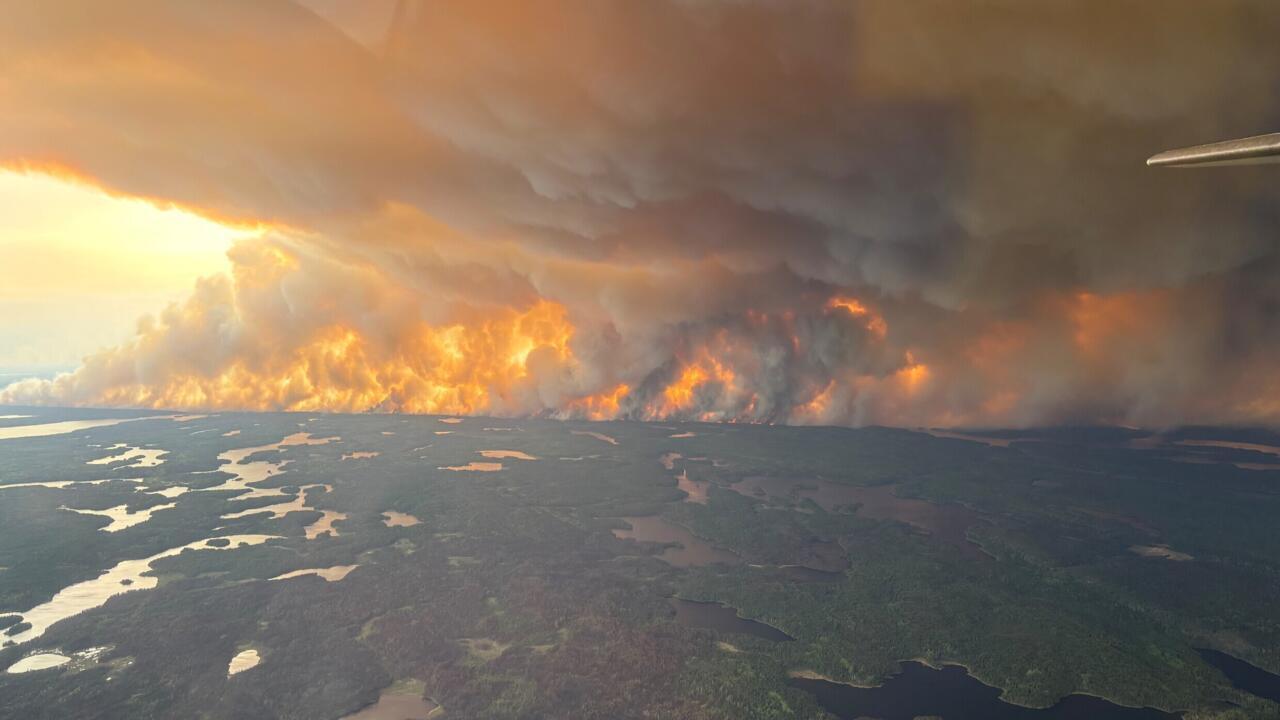
Wildfires fuelled by climate change have driven a rise in global greenhouse emissions © HANDOUT / Manitoba Government/AFP
Infernos that ravaged huge areas of Canada's boreal forest and swept through the dry forests and vulnerable wetlands in South America drove global fire CO2 emissions 10 percent above the 20 year average, the State of Wildfires report found.
That is despite a below-average total of areas burned across the world, the international team of researchers said.
The report found that heat, drought and human activities helped intensify blazes in particularly carbon-rich forests and ecosystems.
"It's the scale and frequency of these extreme events that I find most staggering," said co-author Matthew Jones, of the University of East Anglia in eastern England.
He said satellite monitoring has shown that fires are becoming more intense across the world, expanding in key ecosystems and burning more material than in the past.
"During these extreme wildfire years, we see more fires, bigger fires, hotter fires and faster fires and these properties all aggregate up to extreme extent and destructive impacts on people and nature," Jones told AFP.
Climate change is one key factor, helping to create the optimal hot, dry conditions for fire to spread and burn.
The report, which looked at extreme wildfires from March 2024 to February 2025, found that devastating infernos in Los Angeles and parts of South America were two to three times more likely due to climate change.
Warming also made the area burned during those events 25 to 35 times larger, the authors said.
Global temperatures in 2024 were the hottest on record, going above 1.5C relative to the pre-industrial period for the first time.
Flames engulfed millions of hectares of forests and farmland last year in Canada, western parts of the United States and the Amazon, as well as in the Pantanal, the world's largest tropical wetland, which is shared by Brazil, Bolivia and Paraguay.
Across the world, the authors said wildfires killed 100 people in Nepal, 34 in South Africa and 31 in Los Angeles during the report period, with smoke drifting across continents and causing dangerous levels of air pollution far from the heat of the flames.
Globally, the report said fires emitted over eight billion tonnes of CO2 in the 2024-2025 period -- about 10 percent above average since 2003.
It comes after the World Meteorological Organization on Wednesday warned that the increase in the amount of carbon dioxide in the atmosphere last year was the biggest ever recorded.
The WMO voiced "significant concern" that the land and oceans were becoming unable to soak up CO2, leaving the greenhouse gas in the atmosphere.
It warned that the planet could be witnessing a so-called "vicious cycle" of climate feedback -- whereby increasing greenhouse gas emissions fuel rising temperatures that help stoke wildfires that release more CO2, while warmer oceans cannot absorb as much CO2 from the air.
© 2025 AFP
Infernos that ravaged huge areas of Canada's boreal forest and swept through the dry forests and vulnerable wetlands in South America drove global fire CO2 emissions 10 percent above the 20 year average, the State of Wildfires report found.
That is despite a below-average total of areas burned across the world, the international team of researchers said.
The report found that heat, drought and human activities helped intensify blazes in particularly carbon-rich forests and ecosystems.
"It's the scale and frequency of these extreme events that I find most staggering," said co-author Matthew Jones, of the University of East Anglia in eastern England.
He said satellite monitoring has shown that fires are becoming more intense across the world, expanding in key ecosystems and burning more material than in the past.
"During these extreme wildfire years, we see more fires, bigger fires, hotter fires and faster fires and these properties all aggregate up to extreme extent and destructive impacts on people and nature," Jones told AFP.
Climate change is one key factor, helping to create the optimal hot, dry conditions for fire to spread and burn.
The report, which looked at extreme wildfires from March 2024 to February 2025, found that devastating infernos in Los Angeles and parts of South America were two to three times more likely due to climate change.
Warming also made the area burned during those events 25 to 35 times larger, the authors said.
Global temperatures in 2024 were the hottest on record, going above 1.5C relative to the pre-industrial period for the first time.
Flames engulfed millions of hectares of forests and farmland last year in Canada, western parts of the United States and the Amazon, as well as in the Pantanal, the world's largest tropical wetland, which is shared by Brazil, Bolivia and Paraguay.
Across the world, the authors said wildfires killed 100 people in Nepal, 34 in South Africa and 31 in Los Angeles during the report period, with smoke drifting across continents and causing dangerous levels of air pollution far from the heat of the flames.
Globally, the report said fires emitted over eight billion tonnes of CO2 in the 2024-2025 period -- about 10 percent above average since 2003.
It comes after the World Meteorological Organization on Wednesday warned that the increase in the amount of carbon dioxide in the atmosphere last year was the biggest ever recorded.
The WMO voiced "significant concern" that the land and oceans were becoming unable to soak up CO2, leaving the greenhouse gas in the atmosphere.
It warned that the planet could be witnessing a so-called "vicious cycle" of climate feedback -- whereby increasing greenhouse gas emissions fuel rising temperatures that help stoke wildfires that release more CO2, while warmer oceans cannot absorb as much CO2 from the air.
© 2025 AFP
Carbon dioxide levels in the atmosphere jumped by a record amount in 2024, reaching the highest concentration ever measured and locking the planet into more long-term warming, the UN weather agency warned on Wednesday.
Issued on: 16/10/2025 - RFI
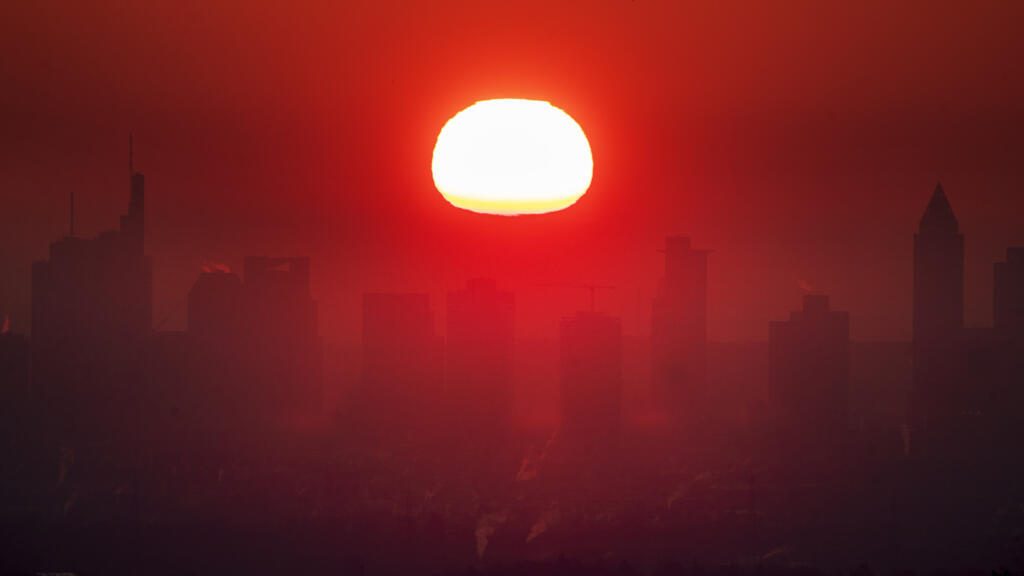
Morning sunlight over Frankfurt’s banking district. The World Meteorological Organisation says record carbon dioxide levels in 2024 signal worsening long-term climate impacts.
AP - Michael Probst
The World Meteorological Organisation (WMO) said the rise was fuelled by human-caused emissions, massive wildfires and a drop in the ability of forests and oceans to absorb carbon – a feedback loop that scientists fear could make climate change spiral faster.
From 2023 to 2024, the global average concentration of carbon dioxide surged by 3.5 parts per million (ppm), the biggest increase since records began in 1957.
The annual growth rate has now tripled since the 1960s, climbing from 0.8ppm per year to 2.4ppm per year between 2011 and 2020.
“The heat trapped by CO2 and other greenhouse gases is turbo-charging our climate and leading to more extreme weather,” WMO Deputy Secretary-General Ko Barrett said in a statement.
“Reducing emissions is therefore essential not just for our climate but also for our economic security and community well-being.”
The World Meteorological Organisation (WMO) said the rise was fuelled by human-caused emissions, massive wildfires and a drop in the ability of forests and oceans to absorb carbon – a feedback loop that scientists fear could make climate change spiral faster.
From 2023 to 2024, the global average concentration of carbon dioxide surged by 3.5 parts per million (ppm), the biggest increase since records began in 1957.
The annual growth rate has now tripled since the 1960s, climbing from 0.8ppm per year to 2.4ppm per year between 2011 and 2020.
“The heat trapped by CO2 and other greenhouse gases is turbo-charging our climate and leading to more extreme weather,” WMO Deputy Secretary-General Ko Barrett said in a statement.
“Reducing emissions is therefore essential not just for our climate but also for our economic security and community well-being.”
Storage systems weakening
Average carbon dioxide levels reached 423.9ppm in 2024, compared to 377.1ppm when the WMO first began issuing its annual greenhouse gas bulletin in 2004.
About half of all CO2 released each year stays in the atmosphere, while the rest is absorbed by land ecosystems and oceans.
But that balance is shifting. Hotter oceans hold less gas, and drought and fires are reducing forests’ capacity to store carbon. The effect was especially strong in 2024, the hottest year ever recorded, as a powerful El Niño caused extreme drought and wildfires in the Amazon and southern Africa.
“There is concern that terrestrial and ocean CO2 sinks are becoming less effective, which will increase the amount of CO2 that stays in the atmosphere, thereby accelerating global warming,” Oksana Tarasova, a WMO senior scientific officer, said.
“Sustained and strengthened greenhouse gas monitoring is critical to understanding these loops.”
The likely reason for the record rise between 2023 and 2024 was the combination of wildfire emissions and reduced CO2 uptake by land and sea. Warmer ocean waters are less able to dissolve carbon dioxide, while dry vegetation and fire damage further limit natural absorption.
Record highs
Methane and nitrous oxide – the second and third most important greenhouse gases linked to human activities – also hit record highs in 2024.
Methane levels climbed to 1,942 parts per billion, up 166 percent from pre-industrial times. About 60 percent comes from human sources such as cattle farming, rice cultivation, fossil fuel extraction and landfills, while the rest comes from natural sources like wetlands. Methane accounts for roughly 16 percent of the warming effect from long-lived greenhouse gases.
Nitrous oxide, mostly produced through fertiliser use and industrial processes, reached 338 parts per billion – a 25 percent rise above pre-industrial levels.
The WMO released its findings ahead of the UN Climate Change Conference in Belém, Brazil, in November, where governments are expected to seek stronger commitments on emissions.
Today’s carbon dioxide emissions will continue to heat the planet for centuries, the agency warned, underscoring the need for urgent action to cut greenhouse gases.
Average carbon dioxide levels reached 423.9ppm in 2024, compared to 377.1ppm when the WMO first began issuing its annual greenhouse gas bulletin in 2004.
About half of all CO2 released each year stays in the atmosphere, while the rest is absorbed by land ecosystems and oceans.
But that balance is shifting. Hotter oceans hold less gas, and drought and fires are reducing forests’ capacity to store carbon. The effect was especially strong in 2024, the hottest year ever recorded, as a powerful El Niño caused extreme drought and wildfires in the Amazon and southern Africa.
“There is concern that terrestrial and ocean CO2 sinks are becoming less effective, which will increase the amount of CO2 that stays in the atmosphere, thereby accelerating global warming,” Oksana Tarasova, a WMO senior scientific officer, said.
“Sustained and strengthened greenhouse gas monitoring is critical to understanding these loops.”
The likely reason for the record rise between 2023 and 2024 was the combination of wildfire emissions and reduced CO2 uptake by land and sea. Warmer ocean waters are less able to dissolve carbon dioxide, while dry vegetation and fire damage further limit natural absorption.
Record highs
Methane and nitrous oxide – the second and third most important greenhouse gases linked to human activities – also hit record highs in 2024.
Methane levels climbed to 1,942 parts per billion, up 166 percent from pre-industrial times. About 60 percent comes from human sources such as cattle farming, rice cultivation, fossil fuel extraction and landfills, while the rest comes from natural sources like wetlands. Methane accounts for roughly 16 percent of the warming effect from long-lived greenhouse gases.
Nitrous oxide, mostly produced through fertiliser use and industrial processes, reached 338 parts per billion – a 25 percent rise above pre-industrial levels.
The WMO released its findings ahead of the UN Climate Change Conference in Belém, Brazil, in November, where governments are expected to seek stronger commitments on emissions.
Today’s carbon dioxide emissions will continue to heat the planet for centuries, the agency warned, underscoring the need for urgent action to cut greenhouse gases.

No comments:
Post a Comment