
FILE - Monks in saffron robes walk in front of the BAPS Swaminarayan Akshardham, the largest Hindu temple outside India in the modern era, on Wednesday, Oct. 4, 2023, in Robbinsville, N.J. (AP Photo/Luis Andres Henao)
(RNS) — Federal authorities, led by the U.S. Department of Justice, have ended a four-year-long investigation into alleged human rights violations in the construction of the largest Hindu temple in the United States — an extensive probe that spanned two presidential administrations. No charges were brought against BAPS, the Hindu denomination accused of alleged human trafficking and forced labor in the building of the temple. But while the federal probe is closed, years of intense media scrutiny following a very public raid on the temple grounds leave critical questions about government overreach when targeting minority faiths.
In the predawn hours of May 11, 2021, 200 or more federal agents from various entities including the FBI stormed what was then a construction site in Robbinsville, New Jersey. The area’s congressman, U.S. Rep. Jeff Van Drew, described the raid as “an aggressive show of force,” with agents “(holding) guns to the faces of swamis — holy men devoted to peace, nonviolence, and prayer; yet they were treated like dangerous criminals.”
The federal investigation into BAPS appears to have been coordinated with law firms that had filed a civil lawsuit in New Jersey on behalf of some who had worked at the temple, alleging low wages and caste-based discrimination.
But the accusations struck anyone familiar with BAPS (the Bochasanwasi Akshar Purushottam Swaminarayan Sanstha). Rooted in the core teachings of Bhagwan Swaminarayan, the founder of the Swaminarayan Hindu tradition, BAPS has long rejected caste hierarchy and upheld the fundamental principle articulated in its central scripture, Satsang Diksha: ‘No one is superior or inferior by birth.
This principle is reflected in the organization’s history, which includes the veneration of leaders from marginalized castes such as the 19th-century guru Bhagatji Maharaj, and in its policy of conducting monastic ordination and congregational governance without regard to caste.
In addition, as in many Hindu traditions, BAPS members consider the building of temples an act of devotion, a means to connect with God through spiritual service. This was reflected in their presence in the United States thanks to R-1 visas, which specifically allow non-immigrant individuals to enter the U.S. to perform volunteer services. As BAPS’ lawyer Paul Fishman noted in a court filing after the raid, federal officials had long authorized the denomination’s use of R-1 visas, and for two decades, federal, state and local government agencies had regularly inspected all of BAPS’ construction projects.
In a telling turn of events, on July 13, 2023, 12 of the 21 plaintiffs in the civil lawsuit withdrew, telling authorities through their attorney that “they have never experienced any pressure, any casteism or discrimination at BAPS temples.” Lawyers, they said, had “convinced them to make false allegations in court, tempting them with promises of American citizenship for them and their families, and huge amounts of money.”

FILE – A 49-foot statue of Nilkanth Varni greets visitors to the BAPS Akshardham campus in Robbinsville, N.J., Sept. 20, 2023. (RNS photo/Richa Karmarkar)
Mostly artisans who had come to work on stone and wood carvings, they said that they saw themselves as religious volunteers serving “of their own accord,” and that they were “treated with love and respect.”
While the government investigated, construction work on Akshardham continued. More than 12,000 volunteers of diverse backgrounds from across the United States spent years completing the Hindu place of worship. Their efforts culminated in the inauguration of the BAPS Akshardham temple in October 2023. It has since become an important place of worship, with more than 2 million pilgrims and visitors coming to celebrate festivals, perform devotional rituals and seek solace.
But the aftershocks of the raid and the investigation have not ended. Hindu Americans living in northern New Jersey say the relentlessly negative media portrayals of the false allegations have fueled anti-Hindu sentiment in their communities, leading to violence, harassment, vandalism of temples and a hostile environment for Hindu children and youth in their schools.
“It’s not only about one temple or one case,” said Niki Patel, a social influencer on Hindu-American parenting who lives in New Jersey. “It’s about how easily Hindus can be vilified, and how that rhetoric creates real-world violence against our communities.
While the outcome may bring Hindu-Americans a measure of relief, the civil lawsuit is still unresolved. More importantly, the BAPS temple episode underscores how allegations and unbalanced media coverage can leave enduring marks on targeted minority communities long after public attention has shifted. The conclusion of the investigation ends a protracted period of scrutiny for this community, but it compels a deeper examination of how minority faiths are perceived, policed and portrayed within American society.
(Kalpesh Bhatt, an assistant professor of Asian Religions at the University of Mary Washington, is president of the Society for Hindu-Christian Studies and co-director of the Leidecker Center for Asian Studies. The views expressed in this commentary do not necessarily reflect those of Religion News Service.)
This story has been corrected. An earlier version inaccurately said BAPS was founded by Bhagwan Swaminarayan; the denomination was inspired by Swanimarayan’s teachings, but he did not found it directly. RNS apologizes for the error.
'We have arrived': Mammoth deity statues
announce Hindus' rising status in the West
(RNS) — At least five towering statues of Hindu gods have been built across Canada and the US in the past decade.
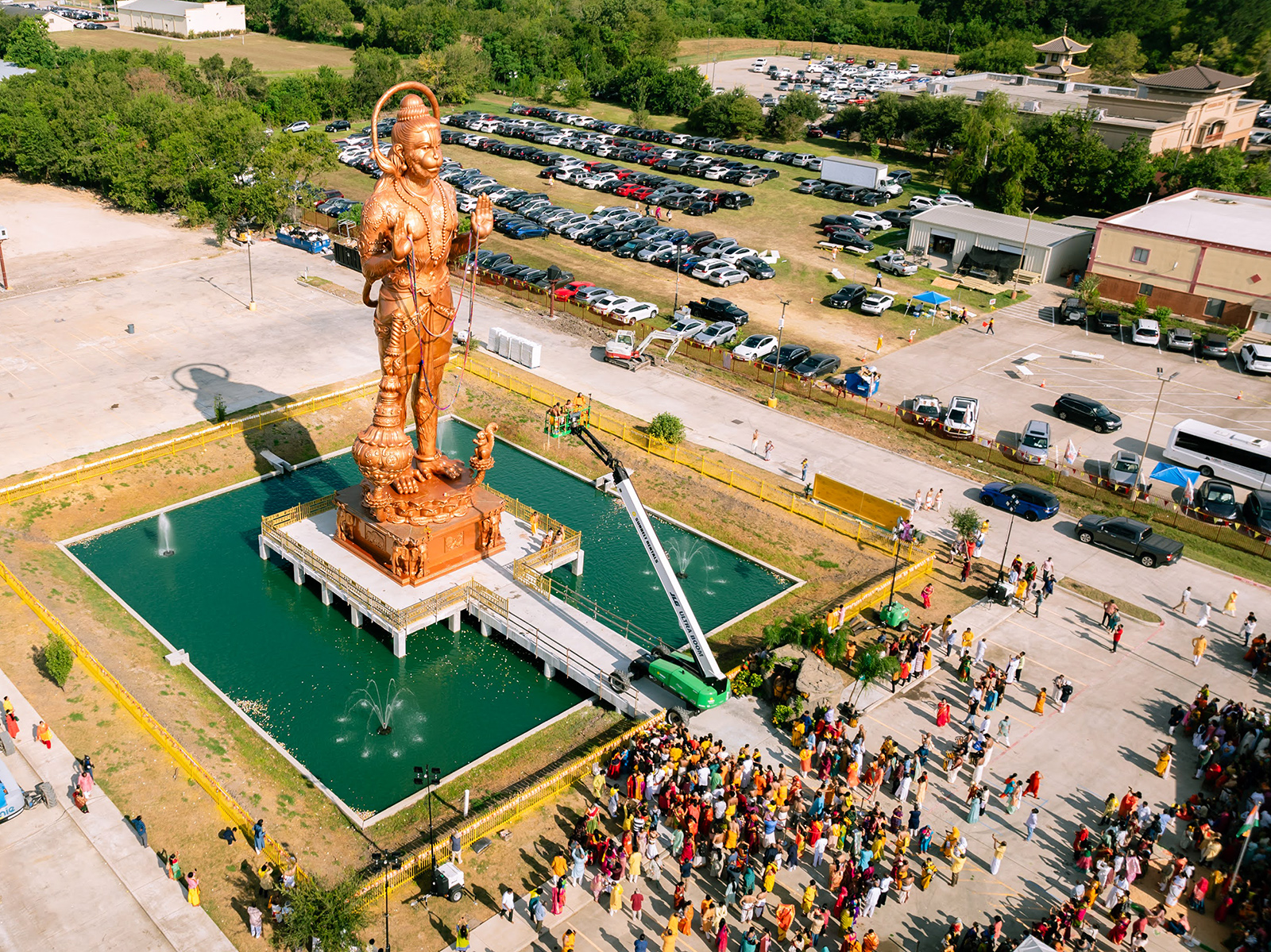
A crowd watches the inauguration ceremony for the Statue of Union, a 90-foot bronze statue of Hindu deity Hanuman, in Sugar Land, Texas, in Aug. 2024.
Richa Karmarkar
September 25, 2025
RNS
(RNS) — Days after U.S. President Donald Trump announced his most recent executive order, one that would raise the application fee for H-1B visa hopefuls to $100,000 from $10,000, Indian immigrants, who make up the bulk of recipients of the H-1B visas, noticed a spike in anti-Indian rhetoric on social media. Curiously, some posts leveled their outrage at a 90-foot-tall bronze cast of a Hindu deity that has stood outside Houston for more than a year.
“Why are we allowing a false statue of a false Hindu God to be here in Texas?,” wrote a Republican congressional hopeful in Texas in a popular X post on Monday (Sept. 22). “We are a CHRISTIAN nation!”
The statue the candidate, Alexander Duncan, referred to is a bronze cast of Hanuman, the divine monkey who is recognized in the Hindu pantheon as a symbol of protection and courage. The fourth-largest statue in the United States, the “Statue of Union” was erected outside of the Sri Ashta Lakshmi temple in Sugar Land, Texas, last August. Shortly afterward, a group of about 25 Christian protesters circled the statue for hours, praying and preaching against the “demon god.”
Shrinivasachary Tamirisa, a retired gynecologist and founder of the temple, said Hindu culture teaches knowledge in response to ignorance. Tamirisa said he was not upset by the protest and instead offered information about the faith and the deity to any of the protesters who would listen. “Our belief system is worship your own and respect all,” he told Religion News Service last year. “People of other religions will have a problem with us; that is always constant. But the power of Hanuman is that evil cannot come there. Evil cannot stand Hanuman.”
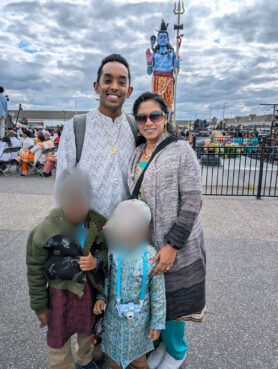
Shawn Binda, top left, with his family at the new Shiva statue at the Bhavani Shankar Mandir in Brampton, Ontario, Canada. (Photo courtesy of Shawn Binda)
Hanuman is one of at least five towering statues of Hindu gods that have been built in the past decade.
RELATED: Hindu devotional singing is having a moment
On Sept. 6, North America’s tallest Shiva, a 54-foot-tall statue of the god many Hindus worship as the supreme God, or source of creation, was built at the Bhavani Shankar Mandir in Brampton, Ontario.
Shawn Binda, a Canadian Hindu community leader, argued that the mammoth Shiva should not disturb its neighbors. “It’s not imposing,” he said. “It is not trying to convert. But we are now becoming more comfortable in sharing that with the rest of the world. This is now setting up a new normal.”
These very public displays of Hinduism come as Indian immigrants have been carving out a larger part of the public square, from politics to entertainment. As they become more vocal participants in the life of their new countries, Hindus are becoming more open about their faith.
Hardat Ashwar, the founder of the temple in Brampton, the largest Indo-Caribbean Hindu congregation in Canada, said Lord Shiva’s statue — “tall, towering, handsome and very masculine” — is a representation of the strength, force and power that Hindus now hold in numbers and in influence. “Political leaders need to understand that we are not people who just pray,” said Ashwar, who immigrated from Guyana.
“We see how other religions are very out there in the face of people,” Ashwar said, pointing to Christian symbols in public places. “There’s crosses everywhere on the intersection of big churches. I thought that, you know, Hinduism deserves to have that platform as well.”
Having such a large, visible murti, as figures of deities are called in Sanskrit, has inevitably led to a large number of hateful comments online, many suggesting “tearing the statue down,” Ashwar said.
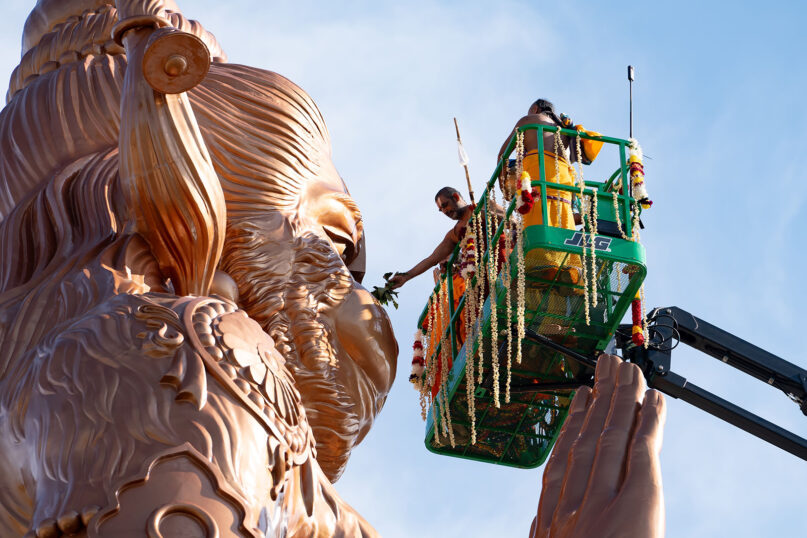
Inauguration ceremony for the Statue of Union in Sugar Land, Texas, in Aug. 2024. (Photo courtesy of Sri Ashta Lakshmi Temple)
But pushing back against anti-Hindu sentiment is precisely the point, he said. “Our children who are afraid to talk about Hinduism and religion in their school, and who are sometimes shy to be a Hindu, they will be proud now to know that we are here,” he said. “We are global. We’re in the mainstream. We have a Shivji murti, and the world is talking about it.”
Some of the hate, said Binda, comes from Indians themselves, who say the public displays of Hinduism are “too much.”
Journalist Rupa Subramanya said in an X post recently that the Brampton Shiva statue was an “unnecessary assertion” that “reeks of insecurity and religious chauvinism.” Texas’ Hanuman has also been assailed for diverting millions of dollars that could be spent on good works.
Behind many of the Canadian statues is Naresh Kumar Kumawat, who comes from three generations of sculptors and artists. He has designed and built more than 600 statues of Hindu gods and figures from Indian legends in more than 45 countries, including the 369-foot-tall Statue of Belief in Rajasthan, India — the fourth-largest statue in the world.
Kumawat, who attended the Shiva inauguration in Brampton, said it gives him “goosebumps” to see Hindus in the diaspora honoring their deities in this way — more, maybe, than Hindus in India. “It gives me pleasure to say that my statues are being celebrated in such a way where they’re uniting Hindus from every corner of the world,” he said.
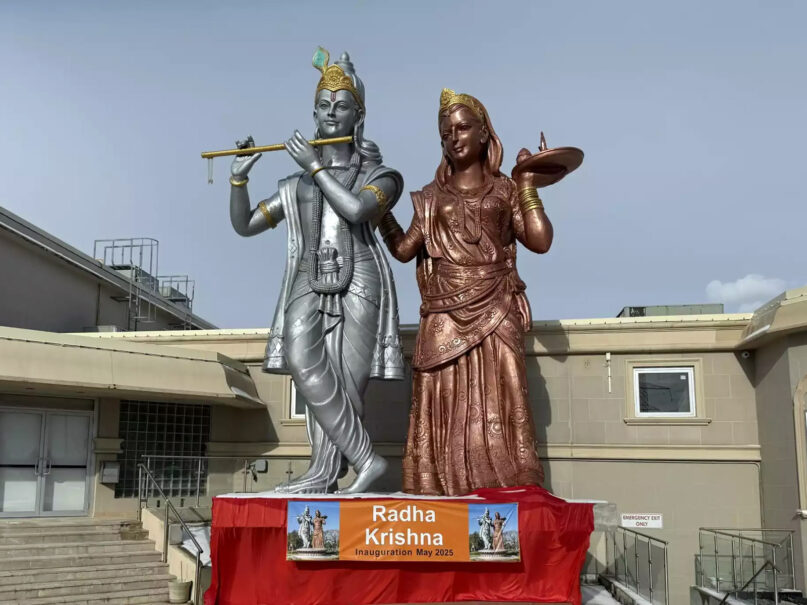
A new 25-foot duo statue of Lord Krishna and his wife, Radha, at Vishnu Mandir in Richmond Hill, Ontario, Canada. (Photo courtesy of Vishnu Mandir)
According to Hindu tradition, the presence of a deity outside a mandir’s walls means the devotees inside “have elected a god to protect the temple itself,” said Ramnaresh Vajpayee, resident priest of Hari Om Mandir in Medinah, Illinois, which has its own 15-foot-tall Hanuman statue.
“In Hinduism, it is said that Hanuman safeguards Ram’s temple along with safeguarding everyone else,” he said in Hindi. “He listens to everyone’s prayers at the doorstep of the temple, and those get relayed to the god inside.”
Budhendranauth Doobay, founder of the Vishnu Mandir in Richmond Hill, Ontario, began building larger-than-life murtis at the temple in 2016. Today the campus boasts a 50-foot-tall Hanuman statue, an 18-foot-tall Shiva and, most recently inaugurated, a 25-foot duo of Lord Krishna and his wife, Radha. “People are coming here just to take photographs,” Doobay said, “and many of them are non-Hindus!”
Though he did not foresee the trend taking off, he is proud of what it means for the visibility of the Hindu community, especially in the face of internet trolls. “Lots of Hindus are very proud to see these murtis towering up into the sky,” he said. “On the other hand, Canadians are saying, ‘These foreign people are coming here and putting all these foreign things.’ There are repercussions, as one would expect with anything, because in a Judeo-Christian society, it can cause a little bit of turmoil among their people.
“But a huge statue of Christ, yeah, no one says anything about that.”

No comments:
Post a Comment