Senate Confirms Hung Cao as Undersecretary of the Navy
IRONY;HE'S ANTI-D.E.I.
Post has been filled in an acting capacity since last year
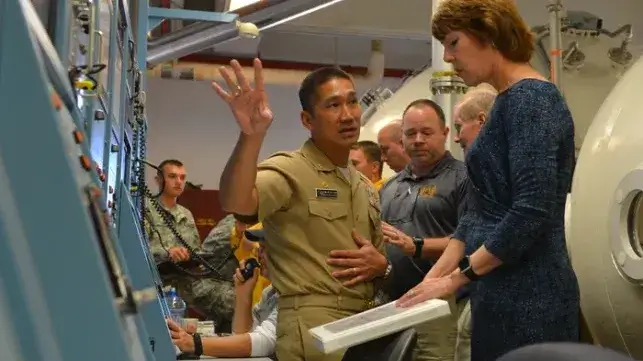
The U.S. Senate has confirmed Capt. Hung Cao (USN, ret'd) as the next Undersecretary of the Navy.
Cao, the son of a high-ranking South Vietnamese official, came to the U.S. as a refugee after the end of the Vietnam War. He attended Annapolis and commissioned as a special operations officer in 1996, working his way up through the ranks in deployments overseas during the wars in Iraq and Afghanistan.
After retiring at the rank of captain in 2021, he mounted two campaigns for elected office in Virginia as a Republican candidate, with President Donald Trump's endorsement. Both were both unsuccessful.
The undersecretary's role is powerful, responsible for the day-to-day affairs of the department as the Navy's chief operating officer and chief management officer. Cao faces serious challenges ahead, including cost overruns and delays in shipbuilding, rising Chinese pressure in the Strait of Taiwan and South China Sea, and the need to operationalize unmanned technology to maintain the Navy's edge.
Cao, an outspoken opponent of diversity, equity and inclusion (DEI) initiatives, is aligned well with Defense Secretary Pete Hegseth's policies for the defense establishment. He also has strong ties to the White House, having campaigned with the president in the 2024 election cycle. Politico Pro reports that Cao's new supervisor, Navy Secretary John Phelan, has taken steps to contain Cao's potentially significant sway: By reassigning aides, routing correspondence through Phelan's chief of staff, and vetting any new hires for Cao's office, they hope to limit the undersecretary's reach to policy implementation rather than policymaking - maximizing control at the level of the secretary's office, Politico's sources reported.
U.S. Navy Exceeds Recruiting Goals for FY2025
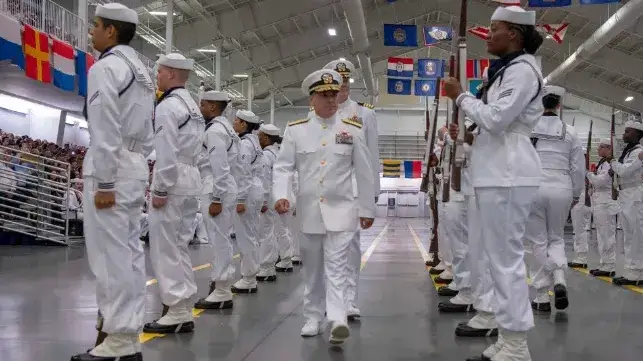
The U.S. Navy has exceeded its recruiting goals for FY2025, the service announced Wednesday - a clear sign of a turnaround after the doldrums of 2023.
After missing its targets by 20 percent in FY2023, the Navy made an all-out push to make it easier and faster to sign up and enlist. It reduced its minimum acceptable score on the Armed Forces Qualification Test to the lowest level allowable by law (subject to conditions), and increased the maximum recruit age to 41, the oldest it can accept without new permission from Congress. A new preparatory program for recruits who did not meet test standards or physical fitness requirements further broadened the applicant pool, making the opportunities of a Navy career accessible to people who would not qualify at the time of first contact with a recruiter.
The service also aimed for speed. It hammered out ways to get medical waivers and tattoo approvals done more quickly, since (in a hot employment market) applicants would often take another job if they had to wait weeks for an answer. Tattoo reviews now take less than three days, down from 30 days, according to Navy Times.
To get at the problem of processing speed, the service tripled the number of office staff assigned to perform medical reviews. It also pushed successfully for faster operations at regional Military Entrance Processing Stations, where future servicemembers go for aptitude testing and medical evaluation.
All of these policy changes - plus 100% manning in front-line recruiter roles, and a cooling private-sector job market - have added up to better numbers for recruits in the door. In FY2025, the Navy brought in more than 44,000 future sailors, more than in any year in the last two decades.
“Culture drives outcomes,” said Rear Adm. James Waters, Commander, Navy Recruiting Command. “We’ve shown what’s possible when we adapt, move fast, and stay accountable. Every recruiter in the field can take pride in knowing they played a direct role in strengthening our Navy and our nation.”
The topline number is big, and big enough to allow the Navy the flexibility to be more selective than it appears on paper. It isn't using its low-test-score applicant pool as much as it might have planned, and is now taking recruits only at the 26th percentile of performers and above.
Other service branches are also seeing good numbers: the Army met its FY2025 goal four months ahead of schedule, the Air Force has reported exceptionally strong monthly recruitment, and the Marine Corps met its annual target without difficulty.

No comments:
Post a Comment