Unwavering support for Ukraine
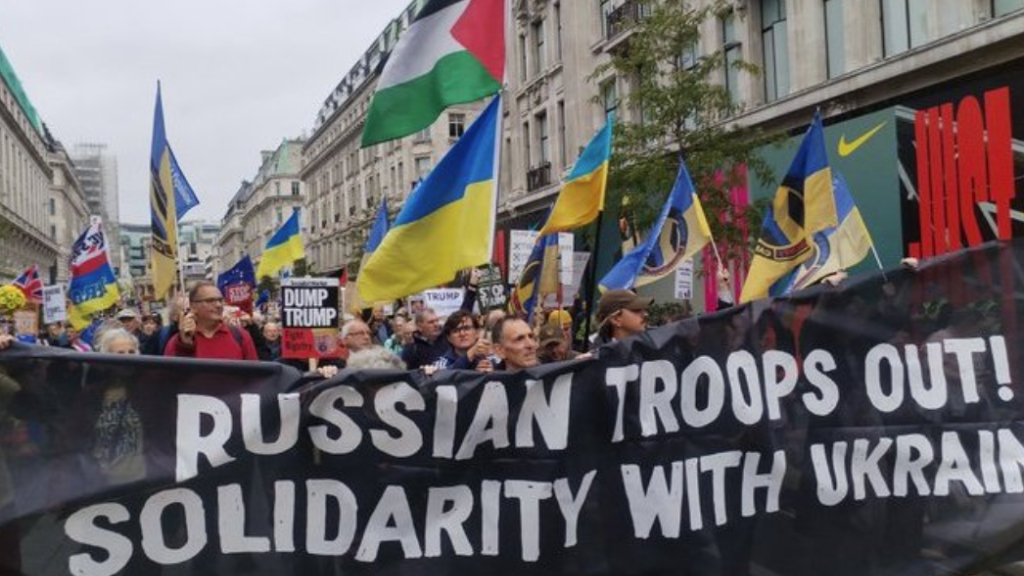
First published at Anti*Capitalist Resistance.
Hopes had been placed on the Trump-Putin summit in Alaska for a ceasefire. But in the run-up to the summit and since , Russia escalated its attacks on Ukraine with more drones and missiles targeting civilian housing and infrastructure while making only limited progress on the ground. Russia has now also sent drones over Poland and Romania.
The escalation of attacks on civilians in August prompted Trump to threaten harder sanctions on Russia if it did not agree to a ceasefire and enter into negotiations. The summit in Alaska turned out to be a big success for Putin. He conceded nothing while Trump gave him international legitimacy despite having arrest warrants against him issued by International Criminal Court for war crimes and genocide.
Trump turned against Ukraine by suggesting that it should exchange territories with Russia for peace deal, which means Ukraine accepting Russian annexation of the Donbass and Crimea. Trump now leaves it up to European countries to buy arms from the US for Ukraine’s war effort. Tariffs of 50% by the US on countries such as India that are buying Russian oil is more about Trump’s protectionism and his attempts to split the pro-Russia alliance of countries such as China than support for Ukraine. Having got no concessions from Putin, Trump now says that he is angry and has been “played” by him. But these words have not frightened Putin.
Putin has made it clear that his war objectives remain unchanged: recognition by Ukraine of the occupied territories; the removal of Zelensky; a veto on Ukraine’s membership of NATO; and drastically reducing the size of Ukraine’s armed forces. Putin has rejected any ceasefire as a pre-condition for peace talks. In fact, he does not want peace talks as he hopes to slowly grind down Ukrainian resistance. He even proposed that Zelensky should travel to Moscow for peace talks. Apart from being a huge threat to Zelensky’s safety, it would be seen as a capitulation by Ukraine.
Russia believes that it can win the war with its bigger resources and it knows that the West is reluctant to wholeheartedly support Ukraine. The West is divided between countries that would like a rapid end to the war to normalise trade relations with Russia and those that want a longer war to weaken Russia. That’s why Ukraine has not been receiving the military and other aid fast enough and in sufficient quantities.
The US is probably the country the keenest to normalise relations with Russia, not just because Trump admires Putin as a “strong leader” on the far right like him, but for the interests of US capital. Indeed, US envoy Kellogg recently visited Belarus, a key ally of Russia, to meet its authoritarian president Lukashenko. The outcome was the freeing of some political prisoners in exchange for the US allowing Boeing to supply spare parts for Belarus’ airline.
After over three years of war, it is not surprising that many Ukrainians would like to negotiate a peace agreement, but Putin is not interested. The Ukrainians have no choice but to carry on resisting Russia’s invasion, and while they do want peace they also don’t want to capitulate to Russia. The fact that after more than three years of war Russia has not been able to achieve its original war aims, which it had hoped would occur within a few weeks, demonstrates that the Ukrainian population is still supporting the war effort.
Neoliberal attacks
But the people of Ukraine are not just resisting Russia’s war of annexation, they are also resisting Zelensky’s neoliberal attacks.
In May, the Rada of Ukraine voted for an agreement with the US for the extraction and supply of rare earth minerals, which gives the US new levers of influence over Ukraine’s economic and political situation. The Zelensky government is attracting risky foreign capital rather than nationalising strategic industries, introducing a progressive tax and fighting against the shadow economy.
In June, demonstrators protested at the Trade Union House being seized by the private company KAMparitet, and demanded that it be returned to its rightful owner, the Federation of Trade Unions of Ukraine.
In July, mass protests erupted around the country against the Zelensky government rushing a law through the Rada that deprived the anti-corruption units National Anti-Corruption Bureau (NABU) and the Specialised Anti-Corruption Prosecutor’s Office (SAPO) of their independence. The protests were sustained until Zelensky was forced to retreat by introducing a new law which restored the independence of NABU and SAPO.
On 5 September, hundreds of demonstrators gathered in Kyiv’s Independence Square to protest at parliamentary bills that would impose tougher criminal penalties on soldiers for disobedience. However, the experience of recent years proves the opposite: punitive measures not only do not solve problems, but also create new ones. Again, in the face of protests, the government backed down and removed some of the harshest measures.
The fact that these demonstrations and protests could and did take place in Ukraine, despite the fact that the country is at war, shows how different the situation is in Ukraine from the situation in the Russian Federation, where protests against the government are not tolerated.
In stark contrast to Russia and despite the conditions of war, there is a lively civil society in Ukraine. There is self-organisation providing mutual aid and support to other citizens when the state is absent, but there are also independent socialist, trade-union and feminist organisations providing an alternative to Zelensky’s neoliberalism. Trade unionists and the youth are defending their wages, rights and working conditions against neoliberal reforms, corruption and oligarchs, while ensuring the defence of their homeland both on and behind the front line. The Ukrainians are not pawns of Western imperialism, despite its obvious cynical self-interest in backing Ukraine.
Western imperialism obviously wants a capitalist neoliberal reconstruction of Ukraine. That’s why amongst other things, it is not cancelling Ukraine’s debt. There are some immediate steps that Britain and other countries could take in support of Ukraine such as seizing Russian frozen assets; reversing cuts to foreign aid; imposing stronger sanctions against the Russian regime; punishing companies, such as UK-based Seapeak, that are evading existing sanctions; extending protection to Ukrainian refugees beyond 2026; and giving asylum to Russian and Belarusian opponents of the war. The latter may become increasingly necessary if Russian and Belarusian opponents of Putin who are currently living in the USA face threats of deportation.
The West is seizing the opportunity of war in Ukraine to push through a remilitarisation of Europe with the EU’s ReArmEurope and the UK Defence Review. While Ukraine should receive all the arms and aid necessary to resist Russia, this does not have to entail a massive increase in military budgets. Arms sales should be immediately stopped to countries such as the brutal Saudi regime or the genocidal Israeli government. Opposing militarism and imperialist wars does not mean pacifism as countries should have the right to defend themselves against occupation and annexation including by military means.
The post-World War Two order is changing as we are entering a new multipolar world where US imperialism confronts Russia and China increasingly directly. Some people – even on the left – celebrate these developments. They are rightfully critical of the history of western imperialism but they see the rise of Russia and China as economic and military powers as a progressive development. They operate on the mistaken principle that the enemy of my enemy is my friend. Instead, the left has to root itself in internationalism and anti-imperialism, backing working class and democratic struggles globally. The priority has to be putting people first instead of reducing politics to geopolitical manoeuvres between governments.
Ukraine must receive all it needs to win a just peace
- .Sign the international petition hereand share on social media
- Donate to fund a vehicle for rapid response operations defending against Russian drone and missile strikes in the Sumy region.
- Follow solidarity news with Ukraine at the European Network for Solidarity with Ukraine and the Ukraine Solidarity Campaign.
Fred Leplat is a member of ACR and is active in the Ukraine Solidarity Campaign
What’s really at stake in Ukraine
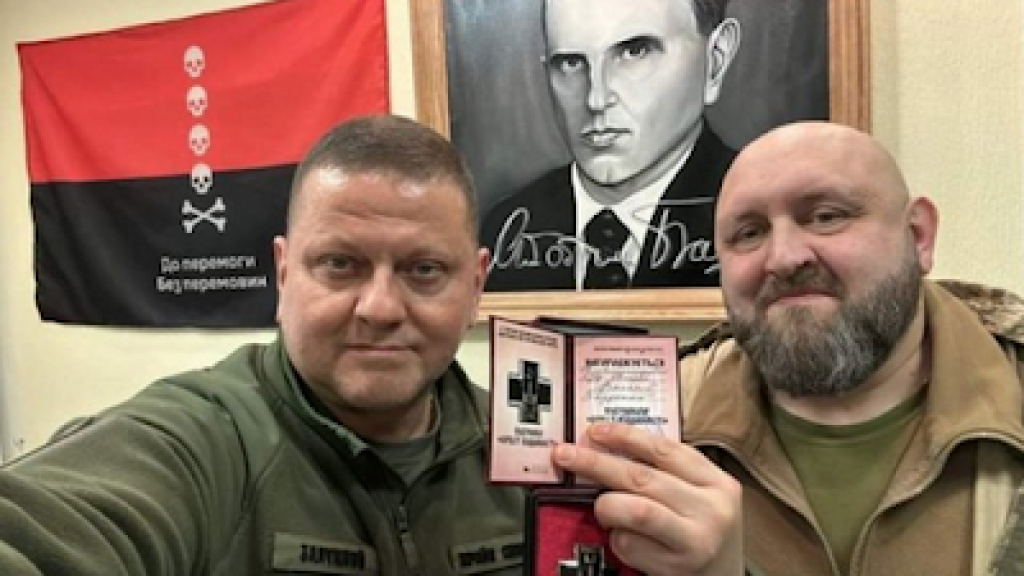
Ukrainian Nazis (harking back to wartime Nazi-collaborator Stepan Bandera) have grown markedly stronger during the war and are now a significant force.
First published at Arguing for Socialism.
For many years the mainstream media has been full of relentless, wall-to-wall propaganda against Russia and China. As the US-NATO defeat in Ukraine becomes impossible to deny, the campaign against Russia and its ally China has intensified.
Recently, for instance, former Victorian Labor premier Daniel Andrews was excoriated by the media because he appeared in a photo in Beijing with “rogues and dictators” (ABC News), namely, Putin, Xi and Kim Jong-un — currently the top hate figures for the West. If he had appeared in a photo with, say, Trump, Starmer, Macron and Merz — lying Western capitalist politicians who specialise in blighting the lives of ordinary people in the interests of the corporate rich — nothing would have been said.
Unfortunately, this unrelenting anti-Russia campaign has its reflection within the left in Western countries. Specifically, many leftists have bought into the myth that Ukraine is fighting for self-determination against a supposedly expansionist, imperialist Russia.
An extreme example of this mistaken view is to be found in the August 26 statement of the European Network for Solidarity with Ukraine. It contains nothing about the responsibility of the US-NATO bloc and the Ukrainian elite for the war — not a single word! The war is sheeted home solely to “Russian aggression” and its “murderous invasion”.
The ENSU statement calls for stepping up the supply of Western weapons to Ukraine as well as building up Ukraine’s military production sector. However, this is a fantasy on so many levels: The West manifestly cannot supply the weapons, those that do arrive are quickly destroyed by Russia and any Ukrainian production plants are likewise destroyed by missile and drone strikes. But perhaps the biggest problem here is that Ukraine simply does not have enough soldiers and war weariness is spreading fast.
Socialists should have nothing to do with the ENSU statement and its associated sign-on letter. It’s a call for endless war — and risks World War III. The Ukrainian people don’t want the war to continue; they want peace (see chart below).
Western arms build-up
As Martin Luther King said in a celebrated 1967 speech, the US government is “the greatest purveyor of violence in the world today”. In the almost six decades since that penetrating remark, nothing fundamental has changed.
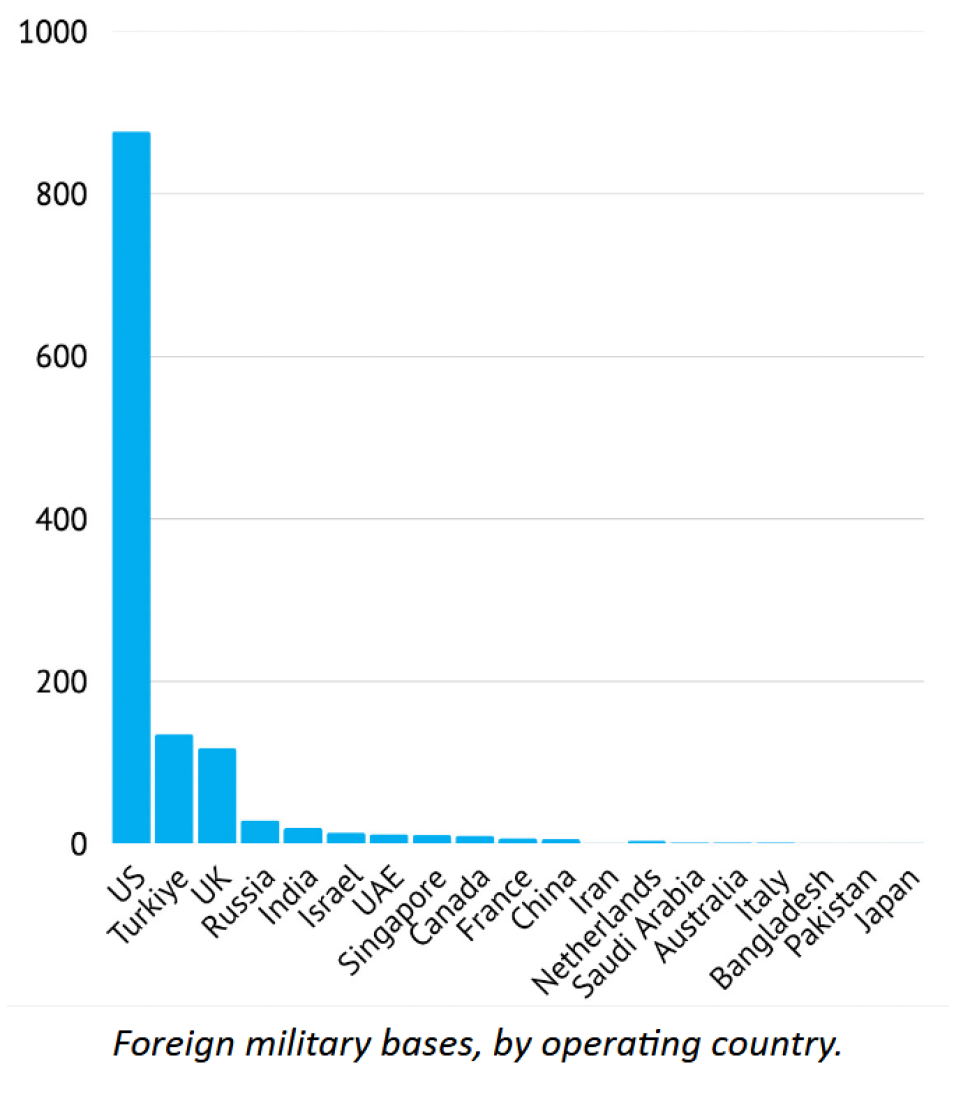
According to World Beyond War, the US has 877 foreign military bases, absolutely dwarfing all other countries put together. The bases are there to defend Washington’s world empire.
We see the same thing when we compare US and NATO military expenditures with those of Russia and China. The US and its European vassals (“allies”) are massively out in front. (The data is from 2023, in US trillion dollars; MER = Market Exchange Rate and PPP = Purchasing Power Parity, a much better measure.)
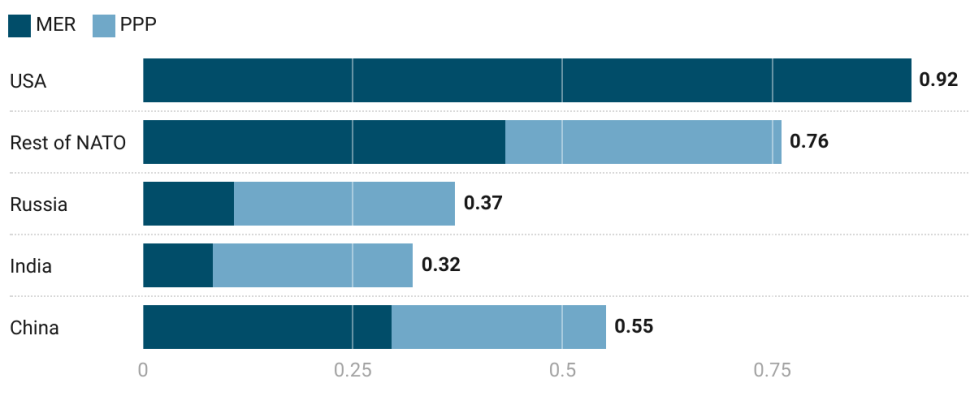
Russia’s military build-up is fundamentally defensive, a counter to the US and its allies and proxies. That doesn’t mean that we have to support everything the Russian military does but we do have to recognise the basic reality that the country is under a real attack by the US-NATO bloc.
In Ukraine, for example, Russia soon found that its forces were inadequate to counter Ukraine and its US-NATO masters and it had to seriously increase the size of both its military and military-industrial sector. Among other things, it has had to develop its anti-missile and anti-drone technology, especially to deal with the NATO-Ukraine deep strikes against it. Russia has also had to develop hypersonic missiles to counter the threat of a US decapitation strike. (See the illuminating article by John Bellamy Foster, 'Notes on Exterminism ' for the Twenty-First-Century Ecology and Peace Movements.)
And ever since the Gulf War China has been engaged in a gigantic effort to modernise and strengthen its military to deter any US strike against it. As part of this China has made an enormous effort to build up its nuclear forces (including hypersonic missiles) to counter the US nuclear threat.
US hostility to Russia key to conflict
We can trace US hostility to Russia back to the 1917 Bolshevik-led revolution. Washington even sent troops to fight the Reds. The hostility never stopped. Even during the alliance with the Soviet Union in World War II, the US was preparing for future conflict. Wartime cooperation was replaced by the Cold War and preparations for a nuclear strike against the USSR.
Even after the collapse of the Soviet Union, the hostility continued. In one sense Russia is a big capitalist country: It is the world’s largest country by area and measured by PPP its GDP is fourth in the world. But its per capita GDP is way down on the list making it definitely part of the Global South, and in no way a part of the imperialist club.
It wants normal relations with the US but it does not want to be dominated and subordinated to Washington. And that is the problem. The US wants to crush Russia, to dominate it, to break it up into smaller pieces. And if necessary, the US is prepared to destroy it through nuclear war.
Ukraine is just a means — a proxy — in the West's war against Russia. It is being destroyed in this war but that is of no consequence to its US-NATO masters.
Shortly after the Russian invasion, negotiations between Ukraine and Russia took place in Istanbul in March-April 2022. An agreement was reached with final details to be worked out. The key points were that Ukraine would declare its neutrality and Russian forces would withdraw to their pre-February 24 positions.
But the West pressured Zelensky to reject peace and fight on. Boris Johnson made an unscheduled visit to Kiev to deliver the message. The US-NATO aim was not peace but to embroil Russia in an endless war. Ukraine has since paid a horrendous price for going along with the West.
Washington's long focus on Ukraine
We can date Washington’s focus on Ukraine to 1991 when the old USSR dissolved. (US interest actually goes back at least to 1957 when the CIA explored the possibility of using right-wing Ukrainian forces to launch an insurrection within the Soviet Union.)
In The Road to War in Ukraine, US military-political commentator Larry Johnson lists 30 years of US-Ukraine military exercises. He introduces the series:
This is the first of a three-part series on the history of NATO and US European Command military exercises with Ukraine This shows how the West, acting like a camel, slipped its big nose under the Ukrainian tent as part of a long-term strategy to defeat Russia. While many of these exercises were touted as peacekeeping in nature, the real purpose was to train and equip Ukraine with the ultimate goal of fighting and defeating Russia. In July 1998, for example, NATO’s Sea Breeze maritime exercise included anti-submarine warfare. WTF??? That ain’t peacekeeping. That is preparation to fight Russia in the Black Sea.
The process of making Ukraine a de facto member of NATO started in 1992, one year after the collapse of the Soviet Union. 1994 marked the first year that Ukrainian forces participated in NATO exercises, although these were held in Poland and the Netherlands. The following year, 1995, witnessed the creation of Ukraine’s Yavoriv military base as the NATO training center, although this was not formalized until 1999 …
I spent 23 years scripting military exercises for US Special Forces. While I was not involved in the scripting of any of these NATO/US military exercises, I understand the purpose and process of them. These were not harmless games. They were designed to train and equip the Ukrainian military to fight Russia, potentially with NATO’s direct involvement. We have seen that come to fruition since the start of the Special Military Operation in 2022. It is no coincidence that Russia hit the Yavoriv NATO military facility on March 13, 2022.
Maidan coup
The February 2014 Maidan upheaval in Ukraine was a watershed moment in the country’s history. Its meaning is completely clear. An elected government (actually not at all opposed to the West) was overthrown and a more nakedly pro-US regime was installed, based on the far right.
Washington’s footprint was all over the Maidan events. Republican senator John McCain spoke to the crowd. Key US operative Victoria Nuland was ostentatiously handing out cookies. At the end of 2013 Nuland boasted that the US had spent $5 billion on securing regime change in Ukraine (financing pro-Western, anti-Russia NGOs, media and politicians). After the Maidan she was recorded in a phone call choosing the new prime minister (she plumped strongly for Arsenyi Yatseniuk over Vitali Klitschko).
Shortly afterwards, on April 11, 2014, Andriy Manchuk presented an analysis on behalf of the left-wing Borotba organisation (later banned by Zelensky).
Our East European country is witnessing one of the most dramatic moments in its modern history. The Ukrainian left faces challenges we have not confronted for many years. After violent and bloody clashes in the centre of Kiev, the power in our country was seized by a coalition of ultra-right and neoliberal political forces. The newly established regime immediately started close cooperation with the richest oligarchs — with those who (along with the representatives of the European Union and the United States) provided the financial aid and international support to the Euromaidan protests. Some of these oligarchs were recently appointed as governors in the key industrial regions that are the least loyal to the new right-wing government with the expectation that they would suppress the anger of indignant protesters there.
The right-wing ideology is a kind of synthesis of neoliberal illusions about the nature of “decent European capitalism” and clerical bigotry of Ukrainian nationalism. It dominated in the Euromaidan protests from the very beginning and almost everything there was under control of right-wing politicians. They managed to exploit the anger of many impoverished and marginalised Ukrainians dissatisfied with the corrupt bourgeois regime of Yanukovich — the regime that we also have been fighting against for many years.
After 20 years of mass anti-communist propaganda, the left in Ukraine was pushed into the margins of politics while the right wing used social populism combined with pro-capitalist and nationalist slogans to make political gains.
Struggle in the Donbass
It is part of the received wisdom of both left and far-right nationalists that Russia was behind the revolt in the Donbass following the Maidan coup. The truth is very different. Renfrey Clarke’s comprehensive 2016 study makes this clear.
Russia was very reluctant to become involved but Russian public opinion would not allow Moscow to stand aside while the Russia-oriented population was massacred by the far right. Even so, Russia tried for eight years (with the 2014 and 2015 Minsk Accords) to secure autonomy for the region within Ukraine. But Ukraine and the West had no real commitment to this perspective. They used this time to re-arm and prepare for war. As Clarke explains:
In Western political commentary, ill-fitting ideological templates have largely obscured the social origins and political content of the 2014 rebellion in the Ukrainian Donbass provinces of Donetsk and Lugansk. The mainstream Western press has encouraged its readers to view the revolt as Russian-instigated, the result of an alleged aggressive drive by the Kremlin to assert its control over Ukrainian affairs. Echoing this account at least in part, left-wing writers have often depicted the conflict as stemming from a clash of imperial ambitions, with Russian ruling circles pitted against Western elites in seeking a “carve-up” of Ukraine. Neither version has much use for analysis of the social and political processes unfolding in the Donbass.
In reality, and as this article will demonstrate, the Donbass revolt was a local initiative that had very robust popular origins, particularly in the region’s coal-mining communities. A key immediate source was a spontaneous, defensive response to the threat of armed attacks by ultra-right Ukrainian nationalist bands allied with the new Kyiv government of Prime Minister Arsenyi Yatseniuk. At a more elemental level, the uprising rested on working-class resistance to a program of neoliberal austerity being readied for implementation by the new Kyiv authorities.
With its pronounced component of working-class struggle, the Donbass revolt was at odds in fundamental respects with the Russian administration — conservative, despite its populism — of President Vladimir Putin. The formidable sympathy for the rebellion among the population in Russia nevertheless constrained Putin from joining with the new Ukrainian authorities to suppress an essentially unwelcome development. Obliged to support the revolt to the point needed to allow its survival, the Russian government exerted strong pressure on the rebels to limit their radicalism. At the same time, the Moscow authorities pursued a subtle diplomatic and military course designed to stabilise the regional situation while serving the general Russian aim of deterring any further advance by NATO to the east. The Donbass uprising and its international repercussions thus allow important insights into the nature and motivations of Russian foreign policy.
‘Nationalists’ not really nationalist at all
Under the post-Maidan regimes Ukraine has become completely subordinated to the West. Western advisers are everywhere, not only in the military and security services but also in other state institutions. “Anti-corruption” bodies staffed by foreigners have been established which are basically instruments of Western control. Large parts of the economy have been sold off. As Dmitri Kovalevich explains, the far right’s “nationalism” is solely in the sphere of ideology and culture. If nationalism means fighting for the real national sovereignty of a country in the interests of the mass of the population, then the Ukrainian far right doesn’t remotely qualify.
The result of this reliance on the bayonets of the imperialist states is the complete absence of an independent economic concept or an economic program for the development of Ukraine. The nationalism of the privileged Ukrainians was hostile to the development of industry in Soviet Ukraine, believing that urbanization and industrialization would destroy the foundation of Ukrainian nationalism, which romanticized the pastoral rural life of the Middle Ages.
Salvation from the “sins” of Bolshevism and communism was seen in a return to an archaic and fictional “golden age” in the past. Throughout the 20th century and into the early 21st century, Ukrainian nationalism has focused exclusively on cultural issues. Since 1991, Ukrainian nationalists sought to control only the humanitarian, cultural and educational spheres in the country while leaving the economy under the control of oligarchic groups or Western states. As a result, Ukrainian nationalism is not only financially dependent on infusions from outside but has also turned into a kind of theatrical decoration of statehood, having little consequence for economic development and the operations of financial institutions.
Kovalevich continues:
A Ukrainian economist, Oleksiy Kushch, stressed again last month that even after the Euromaidan upheaval in 2014, Ukrainian nationalism did not manifest itself in the economy, focusing only on issues of language and religion. According to him, Ukrainian authorities needed to launch a model of economic nationalism that would use protectionism to protect and enhance the economic interests of their country. Instead, they brought a whole herd of people into the state apparatus who believed that what was needed was to destroy “inefficiencies” while relying on the “effective outside”, with foreign creditors paying for a veritable “banquet”. Instead of economic nationalism, we got privatization, the IMF, supervisory boards (whose main function is cutting property owners off from their property, with salaries paid by taxpayers), the opening of the domestic market, and much more.
Western loans since 2014, which have always been issued with big strings attached, have actually introduced external management. ‘Supervisory’ boards of Western experts at all large state-owned companies play a decisive role. Deregulation, the privatization of valuable assets, the introduction of an agricultural land market, the abolition of restrictions on the export of timber – all these changes and more have been carried out in Ukraine following the Euromaidan as a condition for Western governments and financial institutions to issue loans that already exceeded the country’s GDP. In fact, the supervisory role is imperialist external control, which is typically carried out through financial mechanisms.
Nazis
There may well be Nazi-minded groups in Russia but they are small, isolated and reviled and don’t remotely control or set government policy. The Putin regime’s ideological stance is not Nazi but stresses conservative and Russian nationalist themes (restrictions on LGBTIQ rights, lauding the Russian Orthodox church, and so on).
But in Ukraine today, Ukrainian Nazis (harking back to wartime Nazi-collaborator Stepan Bandera) have grown markedly stronger during the war and are now a significant force.
These are real Nazis with all the racist, white-supremacist ideology of the historical originals. (See Gordon Hahn’s article Ukrainian Neofascism examining the Ukrainian Nazi movement.)
A study by retired US army officer Alex Vershinin shows the alarming growth of Ukrainian fascism. The Azov forces now control more than 10% of the army and this includes the remaining effective combat units. They have threatened to kill Zelensky if he concedes territory.
… the presence of an entire “Azov” Corps and its sister corps in the regular army has come as a surprise to many observers. Most remember it as a single regiment of about 1000 men and are shocked to find it has grown into two multi-brigade structures of over 20,000-40,000 soldiers each. The growth and far-right leaning of this formation could have an impact on the future of any Ukraine peace deal …
As of today, Azov leadership is in charge of nine brigades, the Kraken SOF Regiment, and numerous other support units, for a total of about 40,000-80,000 men or 10% of Ukrainian armed forces.
This does not account for other Ukrainian far right associated formations like the 67th Mechanized Brigade.
Azov is now positioned as one of the very last combat capable formations in Ukraine. Its soldiers are still motivated and trained to conduct organized offensive operations. Other formations still exist but the soldiers manning them are unwilling recruits increasingly pulled off the streets by press gangs …
Azov’s leadership isn’t likely to be democratically elected to political office. In a survey of 13 possible candidates, Azov leaders have a combined 4.1% of population behind them, trailing Gen.Valerii Fedorovych Zaluzhnyi by almost 20% — but the combat power at their disposal makes it impossible to ignore. In essence Azov stands to become a modern day equivalent of the Ottoman Janissary Corps, enjoying veto power over the government’s decisions and ability to make and unmake presidents.
Rapid growth of peace sentiment
Peace is the key need for ordinary Ukrainians: A stop to the war and the killing, reconstruction and a return to some sort of normality.
An August 7 Gallup poll found that 69% of Ukrainians want peace as soon as possible even if it it means territorial concessions; only 24% want to keep on fighting. This is a sharp reversal of the sentiment several years earlier.
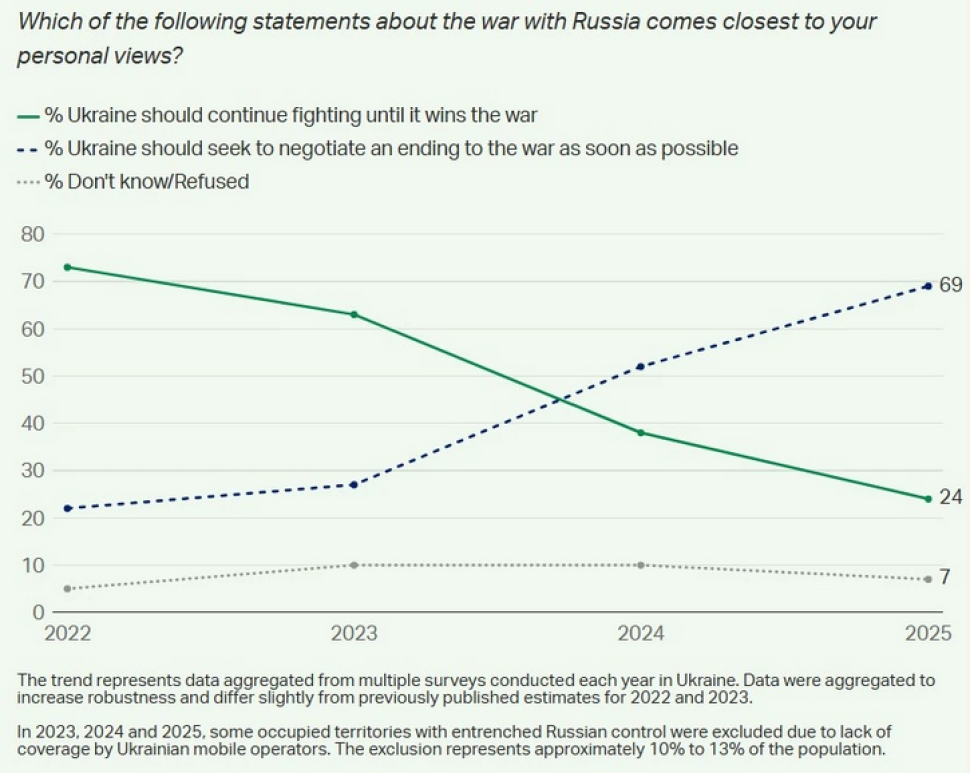
Of course, Zelensky and his gang want the war to continue. It is extremely profitable for some; furthermore Zelensky’s life is at risk from the far right if he endorses any peace with territorial concessions.
For its own reasons, the Trump administration wants to end the war either with a peace deal or by handing it over to the the Europeans. But Trump appears to be floundering and buffeted by neo-cons in his immediate circle. There will be no ceasefire until there is an agreement which addresses what the Russians call “root causes”, i.e, NATO’s remorseless expansion to the east.
Furthermore, the Europeans can’t supply the necessary resources. The slow but relentless Russian advance will settle the matter.
Addressing 'root causes'
In December 2021 Russia published a proposed Treaty between the United States of America and the Russian Federation on Security Guarantees. Paul Atkins explains the eight points:
1. No further NATO expansion
• The US would commit to preventing further enlargement of NATO, specifically barring Ukraine and other former Soviet republics from joining the alliance.
• This also included a ban on NATO military activity in Ukraine, Eastern Europe, the Caucasus, and Central Asia.
2. No deployment of US forces or weapons in certain countries
• The treaty would forbid the US from deploying military forces or weaponry in countries that joined NATO after May 1997 (such as Poland, the Baltic states, Romania, and others).
• NATO infrastructure would have to be rolled back to pre-1997 locations.
3. Ban on intermediate-range missiles
• Both Russia and the US would be prohibited from deploying ground-launched intermediate-range and shorter-range missiles outside their national territories, as well as in areas of their own territory where such missiles could strike the other’s territory.
4. Limit military maneuvers and activities
• Limits on heavy bombers and surface warship deployments: Both sides would restrict the operation of heavy bombers and warships in areas from which they could strike targets on the other’s territory …5. Nuclear weapons restrictions
• All nuclear weapons would be confined to each country’s own national territory. Neither side could deploy nuclear weapons outside its borders …
• Withdrawal of all US nuclear weapons from Europe and elimination of existing infrastructure for their deployment abroad.
6. Mutual security pledge
• Each side would agree not to take any security measures that could undermine the core security interests of the other party.
7. Establishment of consultation mechanisms
• Proposals included the renewal or strengthening of direct consultation mechanisms, such as the NATO–Russia Council and the establishment of a crisis hotline.
8. Indivisibility of security principle
• Included a reaffirmation that the security of one state cannot come at the expense of the security of another, formalising Russia’s interpretation of the “indivisible security” concept.
These extremely rational and positive proposals were summarily rejected by the West. A Guardian article called them “highly contentious” and said “the Kremlin’s aggressive proposals are likely to be rejected in western capitals as an attempt to formalise a new Russian sphere of influence over eastern Europe.”
Obviously, if you have a Russophobic view of the world and believe — or, more precisely, pretend to believe — that Russia plans an attack on the West, then the proposals are indeed “highly contentious” and “aggressive”! But had the West engaged meaningfully with the Russian proposals at the time, the Ukraine war most likely would not have happened.
Even now, the Russian proposals offer a way forward. But for the US to embrace any of this would amount to a seismic shift in political orientation and we would be in a completely new world situation.
Why did Russia invade?
In a contribution by Chris Slee criticising my earlier article The Wheels Are Falling Off the System, he writes:
If Russian President Vladimir Putin was genuinely concerned with NATO expansion, the invasion of Ukraine has been only counter-productive. In fact, it actually boosted NATO expansion. Sweden and Finland joined NATO soon after the invasion. Public opinion in both countries had previously been against joining. Russia’s invasion changed this. The Finnish border is very close to St Petersburg, so the NATO threat has increased as a result of Putin’s invasion.
This should come as no surprise. It was completely predictable. Why then did Putin invade? Was it Putin’s poor political judgement? Or was NATO expansion not his real concern? Boris Kagarlitsky points to growing popular discontent in Russia as a motive. The war gave Putin an excuse for increased repression. To justify the repression and promote “national unity” under his leadership, Putin needed a foreign enemy, and NATO fitted the bill.
Firstly, there is no argument that NATO has used the Russian invasion to massively ramp up anti-Russia propaganda. There is also no doubt that Swedish and Finnish ruling circles got agreement to join NATO through a scare campaign about the supposed (actually non-existent) Russian threat.
Slee asks: “Why then did Putin invade? Was it Putin’s poor political judgement?” The simple answer is that Russia invaded because it was seriously worried about NATO’s intentions; it had warned for years and years that NATO activity in Ukraine was an existential red line for Moscow.
In a 2022 article based on the massive Wikileaks dump of US diplomatic cables, Ray McGovern explained that even in 2008 (!) the US was well aware of what Ukrainian membership of NATO would mean to Russia:
14 years ago, then U.S. Ambassador to Russia (current CIA Director) William Burns was warned by Russian Foreign Minister Sergei Lavrov that Russia might have to intervene in Ukraine, if it were made a member of NATO. The subject line of Burns’s Feb. 1, 2008 Embassy Moscow cable (#182) to Washington makes it clear that Amb. Burns did not mince Lavrov’s words; the subject line stated: “Nyet means nyet: Russia’s NATO enlargement redlines.” Thus, Washington policymakers were given forewarning, in very specific terms, of Russia’s redline regarding membership for Ukraine in NATO.
After the clear failure of the Minsk Accords, the alarming buildup of Ukraine's armed forces, and the West's absolute lack of interest in negotiating anything, Moscow realised the time for talking had passed and acted decisively.
Has Russia's intervention been a failure?
Has the Russian military intervention been a failure? Has it simply been “counterproductive”? I don’t think so.
Firstly, there is the military balance sheet. After three and half years of fighting, Moscow is clearly inflicting a serious defeat on the US-NATO-Ukraine forces. There is a way to go but it is hard to see Russia’s battlefield dominance being reversed. There is a real danger of World War III, given Ukraine’s repeated deep strikes into Russia (all of which necessitate Western approval, planning and technical involvement).
Secondly, on the political front, European ruling circles are in the grip of an extreme bout of Russophobia and have committed to a massive program of rearmament which will necessitate deep cuts in social programs. Breaking off most relations with Russia has badly hurt their economies (especially that of Germany). All this is deeply unpopular with most of their populations. It is fueling the rise of the far right (Reform in the UK, the AfD in Germany and so on) but also the progressive “Blockade everything” movement in France.
Thirdly, we might well ask: Do our critics think there is ever a place for military action? After the Maidan coup, Russia tried for eight long years, through the Minsk Accords, to secure a settlement of the Donbass question within Ukraine. But Ukraine and its Western backers were simply playing for time. Finally, faced with NATO’s belligerence and refusal to negotiate meaningfully, and a likely Ukrainian attack across the line of contact in the Donbass, Moscow struck back militarily.
Where to now?
The Russian forces will roll on with their slow but accelerating advance. The already intense difficulties of the Ukrainian army will only increase. The desire of the Ukrainian people for peace will only increase. Progressive forces in the West should support them, not call for supplying more weapons.Of course, any peace deal will be denounced by the far right. Perhaps the West will at long last be forced to recognise the outsize role that Ukraine's Nazi movement plays in the country's politics. But NATO may well opt for endless war with all the risks of an out-of-control escalation. With the recent supposed sightings of unidentified drones over Europe it seems NATO may be preparing a major propaganda operation. According to a BBC report:
Drones have been seen near military facilities including Denmark's largest, following a series of incidents that caused air disruption earlier this week.
The devices were observed above Karup airbase, among others, forcing it to briefly close its airspace to commercial traffic. Possible sightings were also reported in Germany, Norway and Lithuania.
It is the latest in a string of suspicious drone activity in Denmark, raising concerns about the nation's vulnerability to aerial attack and sparking fears of potential Russian involvement.
Danish authorities said Thursday's incursions appeared to be a "hybrid attack", but cautioned that they had no evidence to suggest Moscow was behind it.
Watch this space and be prepared for anything.

No comments:
Post a Comment