The ICJ, Israel, and Humanitarian Aid in Gaza
Reviving UNRWA’s Remit
Few times in its history has the International Court of Justice been this busy, if ever. For anyone ignorant of the world court’s existence till now, it has blanketed news coverage with provisional orders and advisory opinions on the humanitarian catastrophe in Gaza. Each order is accompanied by another layering of exasperation and, it must be said, hope that the situation on the ground will somehow alter. The topics have been sanguinary and cruel in their consistency: starvation, the restriction of humanitarian aid, policies of racial segregation and apartheid, population displacements masquerading as evacuation orders and the possibility (to be officially ruled upon) that Israel has committed genocide in the enclave.
The October 22 advisory opinion is the first to be handed down after the cease fire centred on the straining 20-point peace plan of President Donald Trump. The view of the Court was sought by the United Nations General Assembly in December on Israel’s obligations as both a UN member and an occupying power, towards the body’s agencies and other relevant international entities operating in Gaza and the occupied West Bank, including East Jerusalem.
The request was prompted by Israel’s passage of two laws on October 28, 2024 banning any activity by the United Nations Relief and Works Agency for Palestine Refugees in the Near East (UNRWA) on Israeli soil and areas of its control and prohibiting state agencies from having contact with UNRWA. These actions effectively excluded an aid body familiar with the vicissitudes and problems of supplying assistance to Palestinian civilians, leaving the way open for the murderous invigilating model of distribution run by the US-Israeli backed Gaza Humanitarian Foundation. (The Israeli submission thought that arrangement perfectly suitable, despite the mass killings of aid recipients by the IDF and woefully inadequate distribution channels.)
The hoary contention by Israeli authorities is that the aid organisation has been an active nest of Hamas militants, some of whom participated in the October 7, 2023 attacks. Despite the findings of the Office of International Oversight Services (OIOS) that such infiltration had not taken place to any appreciable degree, or the more thorough review on the neutrality of the organisation undertaken in the Colonna Report, obstinacy remains. (The Colonna Report, while noting breaches of neutrality in UNRWA in the expression of political opinions by staff and the use of certain textbooks, identified “a significant number of mechanisms and procedures to ensure compliance with humanitarian principles, with the emphasis on the principle of neutrality, and that it possesses a more developed approach to neutrality than other similar UN and NGO entities”.)
Of enormous irritation to the Israeli authorities is the continued insistence on cooperation with UNRWA. Israel’s obligations, along with other Member States, to cooperate with the UN “with respect to the question of Palestine is of paramount importance in addressing the critical situation on the ground since October 2023, in which the United Nations, together with other actors, plays a crucial role in delivering and co-ordinating humanitarian aid and development assistance to the Occupied Palestinian Territory, in particular through UNRWA in the Gaza Strip”.
While Israel was, as an occupying power, free to pick the humanitarian organisations of its own choosing, Article 59 of the Fourth Geneva Convention limited “an occupying Power’s discretion in so far as it requires that Power to allow and facilitate sufficient relief to ensure that the population is adequately supplied.” UNRWA, in that regard, has shown itself to be “an indispensable provider of humanitarian relief in the Gaza Strip” thereby obligating Israel to deal with it.
In brutal contrast, the Gaza Humanitarian Foundation, along with the private security firm Safe Reach Solutions, had overseen a constricted aid system characterised by “chaotic and militarized distribution centres unable to deliver aid at the scope and scale needed.” As of September 2025, over 2,100 Palestinians had been killed seeking humanitarian assistance at or in proximity to the distribution sites. Israel, furthermore, was prohibited from restricting and limiting the presence and activities of the UN, other international organisations and third States “in and in relation to the Occupied Palestinian Territory to a degree that creates, or contributes to, conditions of life that would force the population to leave.” But leave, they have, by the hundreds of thousands, displaced, dislocated and relocated.
On a logistical level, the Court noted that Israel, as an occupying power, was unconditionally obligated by Article 59 “to agree to and facilitate relief schemes if the local population is inadequately supplied”. While States were within their rights to inspect consignments of aid, this did not extend to impeding “the delivery of relief consignments in a manner that undermines the performance of [their] obligations as set out in Article 59.”
Israel could count on the dissenting view of one judge – that of Julia Sebutinde. The familiar talking notes were issued: her fellow justices had given inadequate consideration to the infiltration of UNRWA by Hamas. Israel retained discretion to determine how humanitarian aid would be distributed and was hardly obligated to do so through UN aid channels, especially those “acting contrary to the Charter’s principles”.
In its savage response, the Israeli Foreign Ministry continued to rage about 1,400 Hamas operatives in UNRWA whose existence it has never confirmed, dismissing the legal outcome as “yet another political attempt to impose political measures against Israel under the guise of ‘International Law.’” With unequivocal solidarity, the US Department of State showed contempt verging on the puerile, complaining that the judges issued an opinion that “unfairly bashes Israel and gives UNRWA a free pass for its deep entanglement with and material support for Hamas terrorism.”
When a UN member state takes issue with any injunction of international law, the affirmed tendency, especially for the powerful, is to dismiss such strictures as all sham and naked politics. Despite this, the body of jurisprudence directing states to protect civilian populations and avoid murdering and starving them, continues to swell.
The Genocide Will Not End Unless Palestinian Political Leaders are Free
Photograph by Nathaniel St. Clair
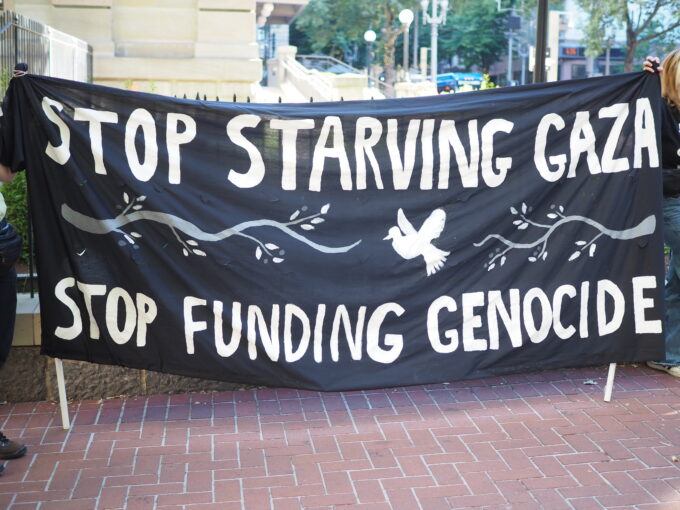
Slowly, a full picture of the devastation of Gaza by Israel is becoming clear. The Palestinian Central Bureau of Statistics (PCBS) released a report around the time of the ceasefire that began to lay out the numbers: Israel’s bombardment of Gaza resulted in the total destruction of 190,115 buildings and the almost total destruction of another 330,500 housing units. The constant artillery and aerial fire over the 734 days of the genocide resulted in the wrecking of eighty-five percent of Gaza’s water and sewage system. Only one medical facility remained open in Gaza City at the time of the ceasefire, with ninety-four percent of hospitals and clinics destroyed or badly damaged. In fact, according to the PCBS, Gaza is currently unlivable.
It is impossible to know the full extent of the physical and mental damage inflicted upon the Palestinian people of Gaza: the Ministry of Health has inadequate numbers for the dead and injured, and the trauma will only be known over the course of the years —if specialists are indeed able to return to the area. The United Nations reports that its entire child protection apparatus in Gaza has ‘almost collapsed’. Stunningly, the UN notes that one in five babies in Gaza is born preterm or underweight, and that in June 2025, 11,000 pregnant women faced famine conditions while 17,000 more struggled with acute malnutrition without much relief.
The Cost of Rebuilding
To rebuild the lives of the survivors of the genocide is a task that has not yet been fully understood. Gaza has been pummelled by Israel since at least the time when Hamas prevailed in the 2006 parliamentary elections. These punctual attacks by Israel on Gaza’s Palestinian population and infrastructure – including near genocides in 2009 and 2014 —resulted in major rebuilding efforts largely financed by the Gulf Arabs (led by the Qataris) and by the European Union (in 2014, at the Cairo Conference on Gaza Reconstruction, the donors pledged $5.4 billion but only spent $2.6 billion, partly due to Israeli intransigence regarding the Gaza Reconstruction Mechanism).
In February 2025, the UN, the European Union, and the World Bank released an Interim Rapid Damage and Needs Assessment thatestimated that $53.2 billion would be needed for recovery and reconstruction over a decade and that $20 billion would be needed over the next three years to rebuild infrastructure, restore essential services, and restart the destroyed economy. An Egyptian plan came up with the same estimate of $53 billion, but to be spent over five years. All eyesare on the Gulf states to foot the bill, but this is not something that can be relied upon for the Palestinians. There is no voice in the debate that says that Israel must pay for the reconstruction, since it was Israel that destroyed Gaza.
Politicide of the Palestinians
One of the reasons why there is no such clear voice that demands reparations from Israel is that Palestinian politics itself has been wounded by the long-term occupation, going back decades, and by Israel’s policy of targeted assassination and incarceration of popular Palestinian leaders. For instance, of the five major factions, their most popular leaders have suffered in prison for over two decades: Marwan Barghouti, by far the most popular Palestinian leader and one of the key figures in Fatah and the Palestinian Liberation Organisation (PLO), has been a political prisoner for twenty-three years and six months, while Ahmad Sa’adat, the leader of the Popular Front for the Liberation of Palestine (PFLP), has been a political prisoner for twenty-three years and eight months. Hamas and Islamic Jihad leaders have either been in exile or killed regularly in Gaza (for example, from Hamas, its founder Sheikh Ahmed Yassin was killed by an Israeli strike in Gaza in March 2004, followed by Abdel Aziz al-Rantisi in April 2004, and then a wave of assassinations in the past few years —including Saleh al-Arouri, Muhammad Ismail Darwish, Osama Mazini, Ismail Haniyeh, and Yahya Sinwar).
Between the prison and the bomb, almost the entire leadership structure of the major Palestinian political parties has been decimated. The fourteen Palestinian leaders who came to Beijing in 2024 to sign a joint agreement certainly represented their organisations, but they were not the most widely known or popular figures (such as Fatah’s Mahmoud al-Aloul, who is often spoken of as a successor to Mahmoud Abbas; Musa Abu Marzouk, often thought of as the Hamas foreign minister; and Jamil Mazhar, who is a leader of the PFLP). The seriousness of the fourteen-party talks would have been amplified had Marwan Barghouti and Ahmad Sa’adat been at the table. But Israel will not permit them to leave the prisons, even as the Palestinians continue to put them high up on their prisoner exchange lists. Israel knows that if it can continue to decapitate the Palestinian political leadership, it will make Palestine rely more on the compromised presidency of Abbas, on the Gulf Arabs, and on the spineless Arab neighbours (such as Egypt and Jordan). No one will speak directly for the Palestinians or for the need to end the occupation; they will only talk of rebuilding in the mildest way for the refugees and of security guarantees for the Israelis to continue their occupation.
Who will speak for the Palestinians?
One cannot judge Yasser Arafat, the leader of the PLO, merely for his surrender of the Palestinian position at the Oslo Accords in 1994. That will not allow one to properly understand his role, which was cemented when he led the founding of the PLO thirty years previously, in 1964 in Kuwait. From that date until the late 1980s, Arafat was highly respected as the visible face of the Palestinian cause, and whatever differences existed amongst the factions, Arafat spoke for the Palestinian people as their undisputed spokesperson. Since Oslo, since the delegitimization of Arafat, no such political figure has been permitted to articulate the Palestinian position in any negotiation or dialogue. The Israeli policy of incarceration and assassination of Palestinian leaders and its policy of demonization of Palestinian political organisations (designating them all as terrorists, for instance) has meant that no figure has been able to emerge in Arafat’s place as the voice of the Palestinian people.
What this has meant is that others speak for Palestine, and often misrepresent the Palestinian position because that position cannot be democratically arrived at without regular meetings of the factions and without their main political leaders being at the table. Israel knows this very well, which is why it has either held the political prisoners for decades (unlawfully) without allowing them access to any media or to their colleagues, or it has assassinated any leader, even mid-level leaders, who shows any promise of being an articulate spokesperson for the Palestinian cause (such as the PFLP’s Abu Ali Mustafa in 2001 and Hamas’ Salah Shehade in 2002).
For decades now, the Israelis have complained that there is no ‘partner to peace’ from the Palestinian side. But how can there be a ‘partner to peace’ if the Israelis routinely murder Palestinian political leaders or hold them in terrible conditions inside Israeli jails on administrative —or non-criminal— grounds? To say that every one of the Palestinian factions is a terrorist organisation, which the Israelis have done with full US backing, is to delegitimize all Palestinian politics. This is why the Israelis and the United States, as well as the Gulf Arabs, are quite happy to talk about the rebuilding of Gaza without any Palestinian representation at the table; indeed, even the Egyptian plan, which suggests the need to have Palestinian involvement, is content to speak of the need for ‘Palestinian professionals’ to be at the table and not the actual political organisations that represent the Palestinian people’s interests. The systematic attempt to destroy Palestinian politics results in a situation where Israel can determine when it bombs Palestinians and how it rebuilds their homes with the money of the Gulf Arabs; it is to Israel’s advantage to prevent any Palestinian representation from being built and from being at the table.
Release Barghouti and Sa’adat
But, indeed, the continued resilience of the Palestinian factions frustrates Israel’s ambitions. The political organisations remain alive and well and they will demand a role in the reconstruction of Gaza as well as in any talks that take place regarding Palestine. It is easy for the US government to designate whomever it wants unilaterally as a terrorist organisation, just as it is easy for Israel to do so (and for the European Union). The United Nations has never placed any Palestinian group on its sanctions list, and it has not designated any of these groups as a terrorist organisation. Despite the parochial nature of the Western idea that Hamas or the PFLP are terrorist organisations, this is not the view of most of the world. They see them as political groups, indeed as national liberation groups that are fighting for Palestinian emancipation from apartheid, occupation, and now genocide. Because of the overwhelming role of the US and the European Union on the side of Israel, the Palestinian organisations are often absent from the discussions about the future of Palestine. This means, in fact, that Palestine is absent from the conversations about its own future.
One way to change this equation is to release the political leaders (such as Marwan Barghouti and Ahmad Sa’adat), allow their organisations to openly deliberate the future of Palestine, and then allow them to represent those views at the rebuilding and negotiation table. Anything other than that is merely the continuation of the genocide by other means.

No comments:
Post a Comment