China’s Arms Control White Paper Reconfigures Global Security Governance
China’s newly released White Paper, “China’s Arms Control, Disarmament, and Nonproliferation in the New Era,” is not simply a catalogue of policies. It is a strategic text that reveals how Beijing intends to shape the governance of the domains that will define global security in the decades ahead. While reaffirming familiar principles, its “No First Use” nuclear doctrine, and the defensive nature of its military posture, the document’s real significance lies in what it elevates: artificial intelligence, cyberspace, and outer space as the new frontiers of global governance.
This is no mere bureaucratic exercise. It arrives against the backdrop of a world teetering on the edge of renewed arms races, with the eightieth anniversary of the United Nations serving as a stark reminder of how fragile the post-World War II order remains. And although the paper dutifully reaffirms China’s longstanding “no-first-use” nuclear pledge, a commitment that stands in poignant contrast to the doctrines of the other nuclear powers, it signals something far more ambitious. It reveals Beijing’s determination to lead the regulation of the invisible battlefields that will define the future, from artificial intelligence to outer space.
For those familiar with Chinese diplomacy, white papers like this are less about raw transparency and more about strategic storytelling. They frame narratives, rally allies, and stake claims on the global stage. This one, timed amid reports of China’s rapid advancements in space-based military technologies—which U.S. Space Force leaders have described as “concerning” in their pace of development—positions China not as a disruptor but as a guardian of stability. It invokes the Global Security Initiative, Xi Jinping’s vision for a multipolar world, and calls for an “equal and orderly” international order.
Yet beneath the multilateral rhetoric lies a calculated bid to institutionalize Beijing’s influence over the domains where power will increasingly reside. It also coincides with the Trump administration’s December 2025 National Security Strategy (NSS), which signals a U.S. pivot toward economic rebalancing with China. As such, the two superpowers are potentially opening doors for bilateral talks on these very issues.
Let’s start with the familiar terrain. The paper reaffirms China’s nuclear restraint: a “minimum level” arsenal for self-defense, unwavering adherence to the Nuclear Non-Proliferation Treaty (NPT), and active participation in P5 dialogues, including the coordination efforts over the last year that produced glossaries to build trust among nuclear states. It highlights Beijing’s moratorium on nuclear testing since 1996 and its push for negative security assurances to non-nuclear states at the NPT review process last July.
These are not trivial gestures. In a year when Russia’s suspension of New START has unraveled arms control gains and U.S. modernization programs balloon under the shadow of a second Trump term, China’s posture burnishes its image as the responsible steward, implicitly shaming Washington and Moscow for their expansive and first-strike-oriented arsenals. The NSS’s sparse treatment of arms control—focusing instead on deterrence and burden-sharing—only amplifies this contrast, as Beijing’s pledges offer a foil to Trump’s “Peace Through Strength” doctrine, which prioritizes U.S. military overmatch without emphasizing reciprocal restraints.
However, the focus of China’s document is in its forward gaze. The “emerging fields” of AI, cyberspace, and outer space are declared “new frontiers for human development” and “new territories of global governance.” Here, China proposes a pivotal role for the UN, urging universal participation to forge consensus-based standards that amplify the voices of developing nations. This is classic Beijing, wrapping a power play in the language of equity. By elevating the UN, a forum where China’s Security Council veto and alliances with the Global South give it outsized leverage, it seeks to preempt the “minilateral” clubs favored by the West such as the U.S.-led Artemis Accords for space or the Wassenaar Arrangement for export controls. Yet the NSS’s “America First” lens—stressing economic reciprocity over ideological confrontation—could inadvertently align with China’s call for “mutually advantageous” rules, particularly around AI and cyber, where Trump has eased export barriers to foster U.S. innovation while countering Beijing’s dual-use advances.
Consider the stakes in each domain. In AI, China’s recent regulatory tweaks, amending the Cybersecurity Law in October to address AI risks and mandating swift incident reporting for critical infrastructure, coincide with breakthroughs like DeepSeek-R1, the January 2025 model that vaulted Chinese AI to the global frontier. This has led to a policy crossroads where Beijing balances innovation with state control over data and outputs.
The white paper’s call for UN-led norms is not just defensive. It is an offensive move to shape rules that could hobble U.S. dominance in generative AI while advancing China’s “civil-military fusion” strategy. The NSS, by contrast, frames AI as a cornerstone of U.S. economic and military edge, directing billions toward domestic infrastructure like the Stargate initiative while revoking prior safety barriers. Such moves echo China’s fusion model but risk accelerating an unregulated race, where Beijing’s state-backed scaling could outpace Washington’s private-sector leads.
Cyberspace follows suit. As the United States grapples with ransomware waves and election interference, China, having hosted the UN’s Open-Ended Working Group on ICT security through 2025, positions itself as the architect of equitable digital governance and dilutes Western influence in bodies like the Budapest Convention. The NSS’s forthcoming cyber strategy, previewed as a muscular push for “costs and consequences” against adversaries like China, hardens this divide. While Beijing preaches consensus, Trump’s approach favors offensive deterrence and uniform regulations to shield critical infrastructure, potentially sidelining UN forums in favor of bilateral pressure points.
In outer space, where Beijing’s counterspace capabilities have drawn U.S. warnings of a closing technological gap, the paper advocates treaties to prevent weaponization. It echoes China’s no-first-use ethos but conveniently ignores its own hypersonic tests and anti-satellite maneuvers. The NSS reinforces U.S. resolve here, committing to “Golden Dome” missile defenses and Indo-Pacific alliances to deny Chinese aggression in the First Island Chain. Yet its economic focus on securing trade routes through the South China Sea could create openings for joint governance talks, if Washington views Beijing’s stability rhetoric as a pragmatic counterweight to escalation.
This vision is a masterstroke of soft power, but it harbors a profound irony that should give pause to policymakers in Washington and beyond. China preaches restraint in the nuclear age while pouring resources into the very technologies that could upend it. Autonomous systems compress decision loops to milliseconds, cyber tools blur war and peace, and space assets turn the heavens into high ground. As the U.S.-China Economic and Security Review Commission’s 2025 report warns, Beijing’s dual-use investments, from quantum computing to commercial rocketry, threaten to hollow out global standards in favor of Chinese overcapacity. The result is a future where Cold War-era deterrence crumbles under the weight of algorithmic unpredictability. The NSS acknowledges this risk in its deterrence pillars even as it underplays it by prioritizing profit-driven ties over comprehensive multilateral safeguards.
For the Trump administration, China’s white paper is less propaganda than provocation. Dismissing it as such would cede the narrative. Beijing has shifted the debate from arsenal transparency to governance architecture and has invited engagement on its terms. The NSS’s blueprint—rebalancing economics with China, deterring Taiwan contingencies, and demanding ally burden-sharing—offers a ready rejoinder. But its retreat from global leadership in forums like the UN risks ceding control to Beijing on emerging domains. The path forward demands pragmatism. The United States must bolster UN forums with American leadership where it aligns with deterrence goals, forge bilateral AI safety pacts with verifiable benchmarks (perhaps tied to trade reciprocity), and rally the Global South not through aid alone but through shared technological equity that counters China’s Belt and Road footholds.
This document is not the close of an era but its reconfiguration. China, once content to play catch-up, now offers the blueprint for tomorrow’s rules. The question for the West is whether to join the drafting table or watch as Beijing inks the future alone. The anniversaries of 2025 serve as a reminder that peace is not inherited. It must be engineered, domain by domain.
Did Napoleon Predict China’s Rise?
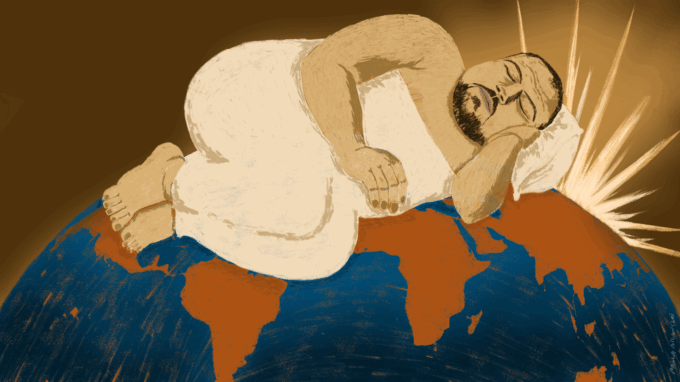
Image by Paola Bilancieri.
When I first traveled to China in 1990, I expected a demanding professional assignment. What I did not anticipate was an encounter that would shape my understanding of a nation on the cusp of a transformation whose magnitude few could then foresee.
Two weeks before the trip, I had lunch in Washington with Dr. Albert Sabin, the developer of the oral polio vaccine. When I mentioned my plans, he urged me to contact Zhou Sufei, the widow of Dr. Ma Haide—one of Mao Zedong’s closest physicians and a pivotal figure in modern Chinese public health.
Born George Hatem to a Lebanese-American family in New York State, Ma Haide traveled to Shanghai after medical school. Disillusioned by the city’s corruption, he abandoned private practice and joined Communist forces in Yan’an, where he treated Mao’s troops. Among his earliest assignments was evaluating rumors that Mao was gravely ill. His conclusion—that the leader was not—carried particular credibility because he was a foreigner.
Ma Haide remained with the Communists through their victory in 1949 and later became a senior public-health official. His work contributed to the eradication of leprosy in China and major advances in controlling venereal diseases, earning him the prestigious Lasker Award.
A City Between Eras
Soon after arriving in Beijing, I called Zhou Sufei. Upon hearing Dr. Sabin’s name, she invited me for tea the following day at her traditional siheyuan home, nestled among the narrow hutongs of the old city.
The visit offered a rare glimpse of a Beijing in transition. Siheyuan—courtyard homes that once fostered close-knit communal life—were rapidly disappearing, replaced by high-rise buildings that now dominate the capital’s skyline. The shift marked more than architectural change; it signaled the fading of an urban culture rooted in shared spaces and neighborly intimacy.
Zhou, a respected artist and film director, greeted me alongside her secretary. She was petite, elegant, and strikingly beautiful. We spent the afternoon discussing the changes they saw the city was experimenting. Surrounded by dark, finely crafted wooden furniture, her living room felt like a preserved fragment of a Beijing already slipping into history.
When I left, as my taxi navigated the labyrinth of hutongs—my jet lag compounded by a strong local liqueur she had insisted I sample—I reflected on the changes already underway. China was just beginning the economic surge that would soon reshape the global order.
The Scale of the Awakening
Covering 9.6 million square kilometers, China is home to one of the world’s oldest civilizations. After Japan’s defeat in World War II, the Communist Party established the People’s Republic of China on October 1, 1949.
Market reforms launched in 1978 set the stage for decades of rapid growth, averaging 8 to 9 percent annually. By 2008, China had become the world’s second-largest economy by GDP. Today it is the leading exporter and the second-largest importer globally. Yet it ranks only 71st in GDP per capita, underscoring the persistent inequalities that Mao’s revolution once pledged to eliminate.
Those disparities coexist with a consumer boom once unimaginable. In 2023, China’s automotive industry reached an estimated $1.6 trillion in production value, symbolizing the country’s shift from bicycles to cars. Fast-food sales have risen by more than 20 percent. Luxury consumption has surged, with record sales of champagne and cognac. China, including Hong Kong, now counts 516 billionaires—second only to the United States, which has 902.
Growth at a Cost
China’s economic ascent has exacted a heavy environmental toll. Sixteen of the world’s 20 most polluted cities are located in China. The country is the second-largest emitter of carbon dioxide, and Beijing alone has nearly eight million vehicles—roughly one for every three residents.
Air pollution stems not only from traffic but also from the country’s heavy dependence on coal. Water pollution remains severe, with children and the elderly particularly vulnerable. The problem is compounded by limited arable land: only 7 percent of China’s territory can be farmed, and urban expansion consumes about one million hectares annually.
As a result, China increasingly relies on imports of soybeans, wheat, metals, cement, and oil.
There is no question that economic growth has lifted millions out of poverty. But the relentless exploitation of natural resources has produced a mounting environmental and public-health crisis, especially in major cities.
Chinese authorities have stepped up efforts to curb pollution, and domestic companies—after saturating the local market with solar panels, wind turbines, and batteries—are now exporting clean-energy technologies to developing countries.
Also, this progress has been achieved at the cost of limiting civil liberties and workers’ rights, as well as people’s freedom of expression.
Even so, the momentum of China’s rise appears undiminished, despite significant political, social, and environmental challenges.
Napoleon Bonaparte once remarked: “China is a sleeping giant. Let her sleep, for when she wakes, she will shake the world.”
More than two centuries later, the statement reads less like a warning than a simple observation of reality.

No comments:
Post a Comment