Farmers descend on Brussels to protest against EU Mercosur trade deal
Thousands of farmers have taken to the streets in Brussels to protest against European Union plans for a trade deal with the South American Mercosur bloc and the reform of agricultural subsidies.
Issued on: 18/12/2025 - RFI
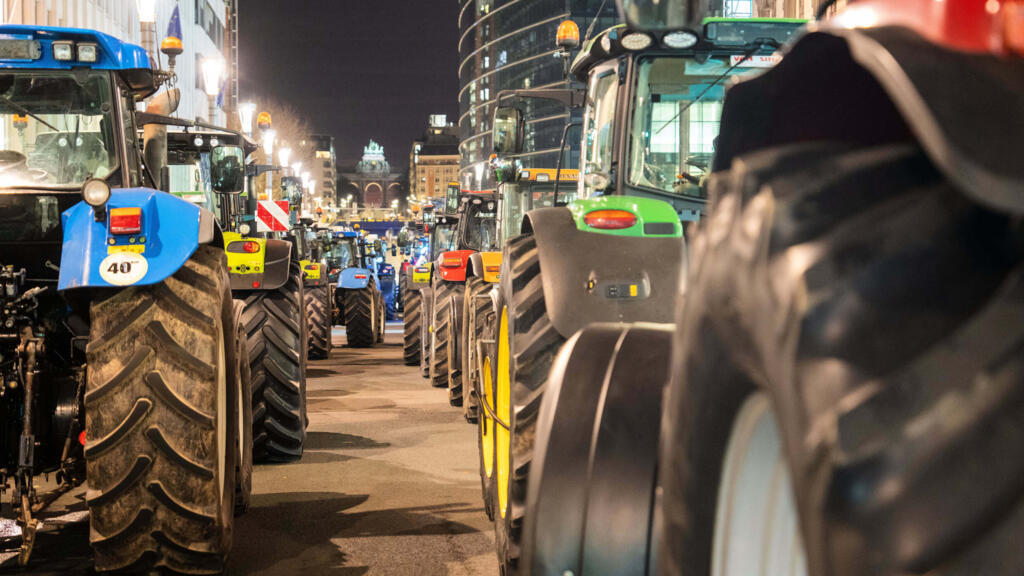
Thousands of farmers have taken to the streets in Brussels to protest against European Union plans for a trade deal with the South American Mercosur bloc and the reform of agricultural subsidies.
Issued on: 18/12/2025 - RFI
Farmers block a road with their tractors during a demonstration in Brussels, 18 December. © AP - Marius Burgelman
Hundreds of tractors began rolling into the European quarter of the EU capital on Thursday morning, ahead of a high-stakes summit among European Union leaders.
Convoys of farmers had arrived overnight, coming primarily from the Netherlands – scene of strong mobilisation among farmers in recent years – but also from Belgium and northern France.
French and Belgian farmers also began demonstrating on Wednesday around Bierset airport, near Liège – a symbolic gathering place, as the airport is a logistics hub and could be the gateway for South American agricultural imports in the future.
Farmers, particularly in France, worry that the Mercosur deal – which will be discussed at the EU leaders meeting – will see them undercut by a flow of cheaper goods from agricultural giant Brazil and its neighbours.
They also oppose plans put forward by the European Commission to overhaul the EU's farming subsidies.
'Unprecedented anger'
France's President Emmanuel Macron warned on Thursday that Paris would not support the Mercosur deal without stronger safeguards for its farmers.
"I want to tell our farmers, who have been making France's position clear all along: we consider that we are not there yet, and the deal cannot be signed [as it currently stands]', he told reporters, vowing that France would oppose any "attempt to force this through".
Is France misguided to keep rejecting the EU-Mercosur trade deal?
Belgium's Walloon Agricultural Federation (FWA) said that Brussels' plans to slash the subsidies scheme by 20 percent while pushing ahead with the Mercosur deal were "totally unacceptable".
The FWA will be among more than 40 national farming groups represented at Thursday’s demonstration. Pan-European agriculture lobby group Copa-Cogeca said it expected 10,000 people to show up.
French agricultural union Confederation Paysanne told French news agency AFP that "anger in rural areas is reaching unprecedented levels”.
'We are preparing to win a war'
For French farmers like Bertrand Chauffier, who grows sugar beets among other crops, Mercosur directly threatens the sugar industry in France.
"We said it loud and clear 18 months ago when we went out on the highways. We didn't want products that weren't produced the same way as ours. The price of sugar will be wiped out. It's unfair competition."
To make his point, he has attached a large wooden coffin to the front of his tractor, symbolising the impending demise of his business.
"We put it on hinges so it's clearly visible that it's empty," he explained to RFI. "Empty like the shopping carts of consumers if French agriculture disappears."
French lawmakers unanimously opposed to EU-Mercosur trade deal
He says the protesters will stay mobilised as long as necessary.
"We are preparing to win a war. A war is fought with well-fed men, tables, camp beds and water so that we can withstand a siege if our policies do not give us conclusive results," Chauffier said.
Adding to anger over the trade deal are problems closer to home, notably in French cattle farming. The industry has been facing an acute crisis over the past 10 days, dealing with an outbreak of nodular dermatosis – lumpy skin disease in cows – with disagreements and protests over how to handle the fallout, whether through vaccination or culling.
Calls for tougher regulations
The EU-Mercosur agreement would create the world's biggest free-trade area and help the EU to export more vehicles, machinery, wines and spirits to Latin America, at a time of global trade tensions.
But farmers say it would also facilitate the entry into Europe of beef, sugar, rice, honey and soybeans produced by their less regulated South American counterparts.
EU plans to seal the agreement by the end of this week were thrown into disarray on Wednesday after Italy joined fellow heavyweight France in seeking a delay.
Paris and Rome are calling for more robust safeguard clauses, tighter import controls and more stringent standards for Mercosur producers.
The European Commission has proposed some measures of that type, but Hugues Falys of Belgian union Fugea said farmers had "little confidence" in them.
(with newswires)
Hundreds of tractors began rolling into the European quarter of the EU capital on Thursday morning, ahead of a high-stakes summit among European Union leaders.
Convoys of farmers had arrived overnight, coming primarily from the Netherlands – scene of strong mobilisation among farmers in recent years – but also from Belgium and northern France.
French and Belgian farmers also began demonstrating on Wednesday around Bierset airport, near Liège – a symbolic gathering place, as the airport is a logistics hub and could be the gateway for South American agricultural imports in the future.
Farmers, particularly in France, worry that the Mercosur deal – which will be discussed at the EU leaders meeting – will see them undercut by a flow of cheaper goods from agricultural giant Brazil and its neighbours.
They also oppose plans put forward by the European Commission to overhaul the EU's farming subsidies.
'Unprecedented anger'
France's President Emmanuel Macron warned on Thursday that Paris would not support the Mercosur deal without stronger safeguards for its farmers.
"I want to tell our farmers, who have been making France's position clear all along: we consider that we are not there yet, and the deal cannot be signed [as it currently stands]', he told reporters, vowing that France would oppose any "attempt to force this through".
Is France misguided to keep rejecting the EU-Mercosur trade deal?
Belgium's Walloon Agricultural Federation (FWA) said that Brussels' plans to slash the subsidies scheme by 20 percent while pushing ahead with the Mercosur deal were "totally unacceptable".
The FWA will be among more than 40 national farming groups represented at Thursday’s demonstration. Pan-European agriculture lobby group Copa-Cogeca said it expected 10,000 people to show up.
French agricultural union Confederation Paysanne told French news agency AFP that "anger in rural areas is reaching unprecedented levels”.
'We are preparing to win a war'
For French farmers like Bertrand Chauffier, who grows sugar beets among other crops, Mercosur directly threatens the sugar industry in France.
"We said it loud and clear 18 months ago when we went out on the highways. We didn't want products that weren't produced the same way as ours. The price of sugar will be wiped out. It's unfair competition."
To make his point, he has attached a large wooden coffin to the front of his tractor, symbolising the impending demise of his business.
"We put it on hinges so it's clearly visible that it's empty," he explained to RFI. "Empty like the shopping carts of consumers if French agriculture disappears."
French lawmakers unanimously opposed to EU-Mercosur trade deal
He says the protesters will stay mobilised as long as necessary.
"We are preparing to win a war. A war is fought with well-fed men, tables, camp beds and water so that we can withstand a siege if our policies do not give us conclusive results," Chauffier said.
Adding to anger over the trade deal are problems closer to home, notably in French cattle farming. The industry has been facing an acute crisis over the past 10 days, dealing with an outbreak of nodular dermatosis – lumpy skin disease in cows – with disagreements and protests over how to handle the fallout, whether through vaccination or culling.
Calls for tougher regulations
The EU-Mercosur agreement would create the world's biggest free-trade area and help the EU to export more vehicles, machinery, wines and spirits to Latin America, at a time of global trade tensions.
But farmers say it would also facilitate the entry into Europe of beef, sugar, rice, honey and soybeans produced by their less regulated South American counterparts.
EU plans to seal the agreement by the end of this week were thrown into disarray on Wednesday after Italy joined fellow heavyweight France in seeking a delay.
Paris and Rome are calling for more robust safeguard clauses, tighter import controls and more stringent standards for Mercosur producers.
The European Commission has proposed some measures of that type, but Hugues Falys of Belgian union Fugea said farmers had "little confidence" in them.
(with newswires)
By Euronews
18/12/2025
Proponents argue the agreement would provide an alternative to Beijing's export controls and Washington's tariff policies. Critics warn it would weaken environmental regulations and damage the EU's agricultural sector.
Police deployed tear gas and water cannon against thousands of farmers who converged on Brussels Thursday, blocking roads with tractors and hurling potatoes and eggs as European leaders gathered to debate a contentious trade pact with South America.
Demonstrators on tractors opposing the EU-Mercosur agreement massed near the Europa building, where leaders of the 27 EU member states met to discuss amending or postponing the trade deal, while a twin rally converged on Place Luxembourg, just steps away from the European Parliament.
The accord, which would eliminate tariffs on nearly all goods traded between the EU and five Mercosur nations — Brazil, Argentina, Uruguay, Paraguay and Bolivia — over 15 years, faces mounting resistance.
Italy signalled Wednesday it had joined French-led opposition to the transatlantic free-trade pact, after Prime Minister Giorgia Meloni told parliament that signing the agreement "would be premature" and said Italy wanted "adequate reciprocal guarantees for our agricultural sector" before approving the deal.
French President Emmanuel Macron arrived at the summit maintaining his opposition and calling for further negotiations in January. "We are not ready. It doesn't add up," he said. "This accord cannot be signed."
Macron said he had discussed delaying the agreement with counterparts from Italy, Poland, Belgium, Austria and Ireland. His government has demanded safeguards against economic disruption, increased regulations on Mercosur nations including pesticide restrictions, and enhanced inspections at EU ports.
Italy's stance gives France sufficient votes to veto European Commission President Ursula von der Leyen's planned inking of the accord on Saturday, as she requires backing from at least two-thirds of EU nations to proceed with the agreement.
"This doesn't mean that Italy intends to block or oppose (the deal), but that it intends to approve the agreement only when it includes adequate reciprocal guarantees," Meloni said.
Von der Leyen still going to Brazil?
Negotiations on the accord have stretched across 25 years. Once ratified, it would encompass a market of 780 million people and roughly a quarter of global gross domestic product.
Proponents argue the agreement would provide an alternative to Beijing's export controls and Washington's tariff policies. Critics warn it would weaken environmental regulations and damage the EU's agricultural sector.
German Chancellor Friedrich Merz said ahead of the Brussels summit that delaying or abandoning the deal would harm the EU's global standing. "If the European Union wants to remain credible in global trade policy, then decisions must be made now," he said.
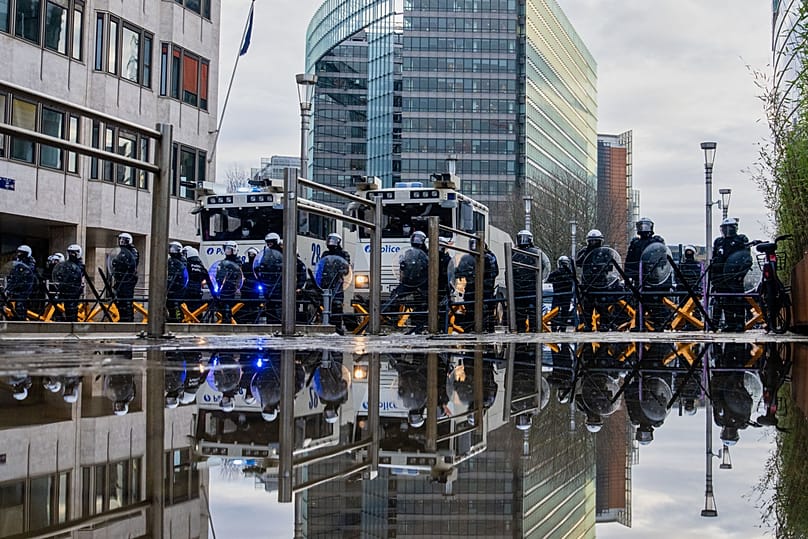 Police stand behind a barrier as European farmers block a road with their tractors during a demonstration outside the EU Summit in Brussels, 18 December 2025 AP Photo
The agreement also represents strategic competition between Western nations and China over Latin America, said Agathe Demarais, a senior fellow at the European Council on Foreign Relations.
"A failure to sign the EU-Mercosur free trade agreement risks pushing Latin American economies closer to Beijing's orbit," she said.
Despite the likelihood of postponement, von der Leyen and European Council President António Costa remain scheduled to sign the deal in Brazil this weekend.
"We have to get rid of our over-dependencies, and this is only possible through a network of free-trade agreements," von der Leyen said. "It is of enormous importance that we get the green light for Mercosur."
Milei vs Lula
Political tensions within Mercosur in recent years — particularly between Argentina's libertarian President Javier Milei and Brazil's centre-left Luiz Inácio Lula da Silva — have not diminished South American leaders' commitment to sealing an alliance with Europe.
"We remain optimistic that next Saturday we will have approval from the European Union and, therefore, that we can proceed with the signing of the treaty," said Gabriel Oddone, Uruguay's economy and finance minister.
Lula has championed the agreement from South America's largest economy. As host of the upcoming summit, the Brazilian president is staking his diplomatic credibility on closing the deal ahead of next year's general elections, in which he will seek re-election.
At a cabinet meeting Wednesday, Lula expressed frustration with Italian and French opposition. He said Saturday would determine the fate of the accord.
"If we don't do it now, Brazil won't make any more agreements while I'm president," Lula said, adding that the pact would "defend multilateralism" as US President Donald Trump pursues unilateralism.
Milei, a close ideological ally of Trump, also supports the deal. "We must stop thinking of Mercosur as a shield that protects us from the world and start thinking of it as a spear that allows us to effectively penetrate global markets," he said.


No comments:
Post a Comment