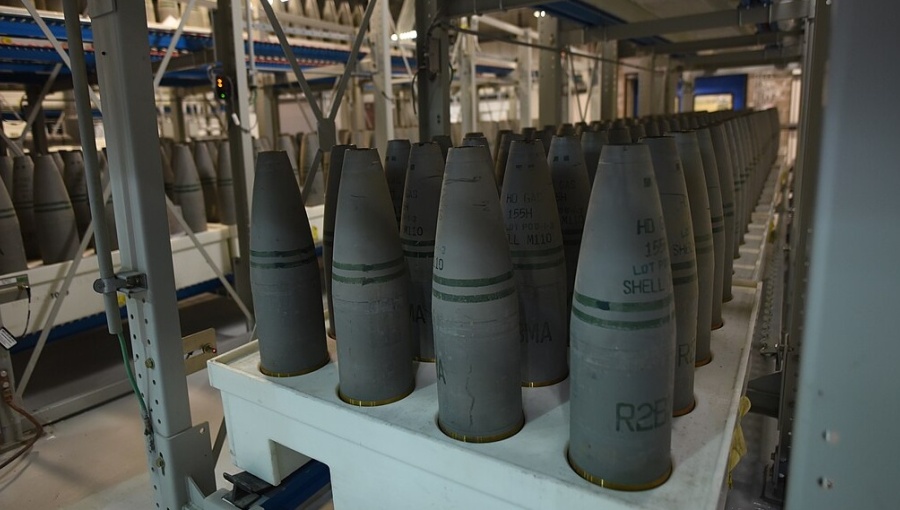
Voices in Moscow have expressed serious disquiet over Kazakhstan’s plan to not only build artillery ammunition factories, but to build them in line with Nato standards.
“We try not to notice how a seemingly brotherly republic has briskly abandoned not only the Russian language but even [the] Cyrillic [alphabet]. How they set up ‘yurts of resilience’ in support of Ukraine. And now they are switching to Nato standards for ammunition, clearly planning to abandon Russian weapons models in the future and replace them with Western ones,” was the sharp response to the “unfriendly” Kazakh move from Alexey Zhuravlev, a nationalist and militarist politician who serves as the first deputy chairman of the Russian State Duma’s defence committee, in comments reported by Gazeta.ru.
The $1bn arms production initiative, reported by The Moscow Times on December 17, represents a major shift for ex-Soviet Kazakhstan. For decades, the country has had almost no domestic production of artillery shells, mines or even basic small-arms ammunition, according to a report from the Ukrainian news outlet United24. The arms manufacturing gap is said to have left the country heavily reliant on Soviet-era weapons stockpiles and foreign suppliers.
The Gazeta.ru report referred to a senior Kazakh military official as telling RTVI that a lack of local production meant that the Kazakh armed forces’ combat readiness depended almost entirely on inherited Soviet arms depots located in Kazakhstan and on supplies from Russia and other former Soviet republics. He reportedly emphasised that, in the current geopolitical climate, building an independent ammunition manufacturing base has become critically important to national security.
The arms factory construction programme, known as the ASPAN project, plans on constructing four plants that will produce both legacy-style munitions and Nato-standard ammunition, the Gazeta.ru report said. The first factory is expected to begin operations in 2027, with the remaining facilities coming online in later stages.
Zhuravlev was also reported as pointing to Kazakhstan’s longstanding ties with Nato, noting that the country joined the North Atlantic Cooperation Council in 1992 and signed the Partnership for Peace agreement in 1994.
He questioned Nato's interest in Kazakhstan, suggesting it was linked to the country’s shared border with Russia and claiming that such cooperation could turn Kazakhstan into what he called another “Russophobic outpost,” drawing parallels with Ukraine.
In mid-November, Kazakhstan’s President Kassym-Jomart Tokayev reaffirmed his country’s close ties with Russia as he paid a state visit to Moscow. Vladimir Putin received Tokayev at the Kremlin just days after the Kazakh leader and four other presidents of Central Asia met Donald Trump at the White House.

No comments:
Post a Comment