WITHOUT BLOWING THEM OUT OF THE WATER
U.S. Coast Guard Delivers $200M in Cocaine to the Pier in San Diego
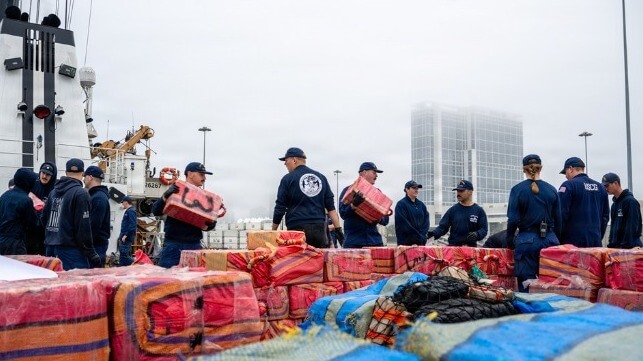
The crew of the Coast Guard cutter USCGC Active has delivered $200 million worth of cocaine to the pier in San Diego, adding to the service's growing tally from an enforcement surge in the Eastern Pacific.
USCGC Active is a 60-year-old medium endurance cutter (WMEC), and is among the longest-tenured vessels still serving in the U.S. armed forces. Still running on reliable ALCO 251 diesel engines, Active remains a top contributor to the counter-smuggling effort in the Pacific. The WMEC fleet is due for eventual replacement by the future Offshore Patrol Cutter (OPC), currently being constructed by Austal; in the interim, the efforts of crewmembers are essential for maintaining the existing fleet at sea.
"I could not be prouder of this crew," said Cmdr. Earl Potter, commanding officer of the Coast Guard Cutter Active. "Their determination, resilience, and professionalism make it possible to complete these dynamic and dangerous missions at sea. The conditions are tough, hours are long, and demands are high, but this team always maintains focus."
During this port call, Active offloaded 12.5 tonnes of cocaine, enough for about 10 million street doses. The landing is a major contribution to the Coast Guard's tally for "Operation Pacific Viper," its surge effort to provide additional countertrafficking resources off South and Central America. From the start of the operation in August through December 9, the service seized a total of 68 tonnes.
The offload provides a contrast to the Pentagon's parallel effort, which applies counterterrorism tactics to the problem of drug trafficking. At about the same time that the Coast Guard announced USCGC Active's offload, U.S. Southern Command announced that three more suspected drug boats had been eliminated in airstrikes in the Eastern Pacific, killing eight suspects on board.
Hong Kong Customs Use ROV to Find Cocaine Hidden in Sea Chest
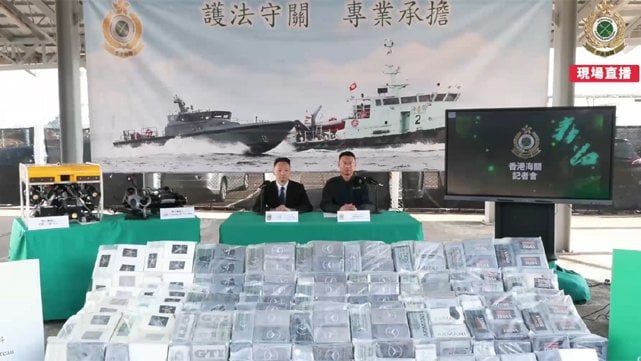
Hong Kong Customs is highlighting its first use of a new ROV for ship inspections and reports that last month it, for the first time, discovered a large stash of cocaine hidden in the sea chest of a containership. Speaking at a press event on December 16, the officials highlighted that the smugglers are using new techniques in an attempt to avoid detection.
The unnamed containership, only described as being 333 meters (1,092 feet) in length, was targeted using intelligence sharing and monitoring techniques, the customs officials said. The ship had sailed from Brazil and made stops in Singapore and China. They reported the vessel had been placed under 24-hour surveillance before it arrived in Hong Kong waters on November 3. The following day, it was moved to a designated anchorage for clearance and inspection.
A remotely operated vehicle was deployed for an underwater scan of the containership, which Customs said saves time and manpower for the initial search of ships. During the scan, they detected irregularities in one of the vessel’s sea chests located about 11 meters (36 feet) below the waterline. Customs divers were sent to investigate and discovered large packages that were retrieved and found to contain cocaine wrapped in waterproof materials.
“This drug concealment method is extremely rare,” said a HK Customs official during the briefing. “Given the sea chest lies roughly 11 meters beneath the hull, only professional divers could access this site.”
The officials described it as a “sophisticated maritime smuggling operation.” They recovered a total of 417 kg of cocaine in 11 bags hidden in the sea chest. It had an estimated value of HK$256 million (US$33 million).
During the subsequent investigation, the police said two individuals were arrested. Some reports are saying they were crew from the vessel.
The police said they had previously found drugs hidden in containers or concealed in other areas on arriving ships. They said this was the first recovery from a sea chest underneath a vessel.
This discovery followed another case in October, where Hong Kong police said they had arrested three men after discovering around 69 kg of suspected cocaine worth HK$42 million (US$5.4 million). The report said the police believed the traffickers had hired divers to retrieve the drugs from the near-shore waters. HK Police said it was the first time they had encountered this tactic, where they believe an arriving ship released the cocaine bundles offshore.
Globally, police have reported similar instances where cocaine is hidden in a vessel’s sea chest or released offshore. The HK police believe the smugglers are adopting these tactics in response to the increased surveillance and interdiction efforts.

No comments:
Post a Comment