
December 16, 2025
Source: Truthout

Screenshot from Firstpost, https://www.youtube.com/watch?v=P_4ZpMVqXAw
We have just seized a tanker on the coast of Venezuela — a large tanker, very large, the largest one ever seized actually,” Donald Trump told reporters on December 10, describing the escalation of his apparently impending illegal war and regime change in Venezuela. Attorney General Pam Bondi ceremoniously released a video clip of the U.S. Marines and National Guard rappelling down from two helicopters onto the tanker.
In seizing the “Skipper,” the Trump administration relied on sanctions the U.S. had imposed on the Venezuelan oil tanker. Bondi said a seizure warrant was executed by the U.S. Coast Guard, FBI, Pentagon, and Homeland Security Investigations. “For multiple years, the oil tanker has been sanctioned by the United States due to its involvement in an illicit oil shipping network supporting foreign terrorist organizations,” she stated.
But those sanctions are illegal and cannot provide a lawful basis for the U.S. to seize this vessel.
Only the Security Council Is Authorized to Impose Sanctions
Although claims in the corporate media that Venezuelan oil is subject to “international sanctions” are ubiquitous, nothing could be further from the truth.
When a country takes it upon itself to impose sanctions without Security Council approval, they are called unilateral coercive measures, which violate the UN Charter.
The U.S. government imposed unilateral coercive measures on the oil tanker in 2022 for its alleged ties to Iran. But the UN Charter empowers only the Security Council to impose and enforce sanctions. Article 41 specifies:
The Security Council may decide what measures not involving the use of armed force are to be employed to give effect to its decisions, and it may call upon the Members of the United Nations to apply such measures. These may include complete or partial interruption of economic relations and of rail, sea, air, postal, telegraphic, radio, and other means of communication, and the severance of diplomatic relations.
“Under international law, we cannot lawfully enforce U.S. domestic law in a foreign state’s territorial sea (12 nautical miles) or contiguous zone (next 12 miles out, to total 24) without the coastal state’s consent,” Jordan Paust, professor emeritus at University of Houston Law Center and former captain in the U.S. Army JAG Corps, told Truthout.
Francisco Rodriguez, senior research fellow at the Center for Economic and Policy Research, concurs. “The US has no jurisdiction to enforce unilateral sanctions on non-US persons outside its territory,” he posted on X. “The seizure of ships in international waters to extraterritorially enforce US sanctions is a dangerous precedent and a violation of international law.”
“Nor can we lawfully do so on a foreign flag vessel there or on the high seas without the flag state’s consent — all absent any international legal justification under the law of war during an actual ‘armed conflict’ or under Article 51 of the UN Charter in case of an actual ‘armed attack,’” Paust added.
Although there are allegations that the Skipper was operating under a false flag, Trump made clear in his December 10 statement that it was in Venezuela’s territorial sea or contiguous zone, not on “the high seas.” Moreover, a senior military official told CBS News that the tanker had just left a port in Venezuela when it was seized.
The Seizure Was an Illegal Act of Aggression
At first blush, it appears that the U.S. military committed piracy when it seized the Skipper. But piracy is defined by Article 101 of the UN Convention on the Law of the Sea as acts committed for private purposes by a private aircraft or ship. State-sponsored or military actions can constitute acts of war or violations of sovereignty, but not piracy.
The UN Charter prohibits the threat or use of force except in self-defense after an armed attack under Article 51 or when approved by the Security Council, neither of which was present before the seizure of the Skipper. Nor was the U.S. engaged in armed conflict with Venezuela.
General Assembly Resolution 3314 sets forth the definition of “aggression,” which has been adopted by the Rome Statute for the International Criminal Court: “Aggression is the use of armed force by a State against the sovereignty, territorial integrity or political independence of another State, or in any other manner inconsistent with the Charter of the United Nations.”
The seizure of the oil tanker by the U.S. armed forces constituted an unlawful use of force in violation of the UN Charter. It was therefore an act of aggression.
This aggression comes on the heels of the Trump administration’s extrajudicial executions (murders) of some 87 alleged drug traffickers on more than 20 small boats in the Caribbean and Eastern Pacific. In all likelihood, the administration doesn’t even know the identity of the victims, nor has it provided any evidence that they were trafficking in narcotics. Even if it had, due process requires arrest, not murder.
The U.S. has seized “sanctioned” oil in the past, during the first Trump administration and the Biden administration as well. But, according to The New York Times, it is not a common practice and “rarely becomes a public spectacle.”
Meanwhile, the administration is engaging in the largest military buildup of U.S. firepower in the Caribbean in decades, including the deployment of the USS Gerald R. Ford, the biggest aircraft carrier in the world. Trump declared a no-fly-zone over Venezuela. And the administration recently added significant combat equipment to that already present in the region.
On December 11, the U.S. Treasury Department imposed additional sanctions on the government of Venezuelan President Nicolás Maduro, targeting his relatives and six shipping companies operating in Venezuela’s oil sector.
If U.S. Regime Change Succeeds in Venezuela, Cuba May Be Next
Trump has clearly stated his intention to attack Venezuela, and his administration has signaled that it aims to change Venezuela’s regime, with opposition leader María Corina Machado waiting in the wings. Hours after it seized the Skipper, the U.S. helped Machado leave Venezuela and travel to Norway to receive the Nobel “Peace” Prize.
Maduro called the seizure of the tanker what it really is: “It has always been about our natural resources, our oil, our energy, the resources that belong exclusively to the Venezuelan people.” Venezuela has the largest proven oil reserves in the world.
This seizure could be the first act in the U.S. imposition of an oil blockade on Venezuela. Such a blockade “would shut down the entire economy,” former Biden administration Latin America adviser Juan González told the Guardian.
“Because Venezuela is so dependent on oil, they could not resist that very long,” retired U.S. Marine Corps Colonel and senior adviser at think tank Center for Strategic and International Studies Mark Cancian, told the BBC. It would be “an act of war.”
The oil tanker had offloaded a small amount of its oil to a smaller ship headed for Cuba and then proceeded east toward Asia before the tanker was seized by the U.S. That seizure “is part of the US escalation aimed at hampering Venezuela’s legitimate right to freely use and trade its natural resources with other nations, including the supplies of hydrocarbons to Cuba,” the Cuban Foreign Ministry said in a statement.
Secretary of State Marco Rubio, architect of Trump’s Venezuela regime change strategy, has long had the Cuban government in his sights. “Their theory of change involves cutting off all support to Cuba,” González told The New York Times. “Under this approach, once Venezuela goes, Cuba will follow.”
For decades, Cuba has suffered under unilateral coercive measures in the form of an economic blockade, which was also imposed by the U.S. in violation of the UN Charter.
Forcible regime change is illegal. The UN Charter prohibits the use of force against the territorial integrity or political independence of another state. Likewise, the Charter of the Organization of American States forbids any state from intervening in the internal or external affairs of another state. And the International Covenant on Civil and Political Rights guarantees the right to self-determination.
Trump’s new National Security Strategy contains the “Trump Corollary” to the Monroe Doctrine, signaling a return to U.S. military interventions in Latin America. The strategy states:
We want to ensure that the Western Hemisphere remains reasonably stable and well-governed enough to prevent and discourage mass migration to the United States; we want a Hemisphere whose governments cooperate with us against narco-terrorists, cartels, and other transnational criminal organizations; we want a Hemisphere that remains free of hostile foreign incursion or ownership of key assets, and that supports critical supply chains; and we want to ensure our continued access to key strategic locations.
Washington’s brutal anti-immigrant policies and false accusations that Venezuela is sending drugs to harm the U.S. are consistent with this strategy. And implicit in the strategy is the key goal of U.S. access to Venezuela’s rich oil deposits.

Marjorie Cohn
Marjorie Cohn is professor emerita at Thomas Jefferson School of Law, dean of the People's Academy of International Law, and former president of the National Lawyers Guild. She is a member of the national advisory boards of Veterans For Peace and Assange Defense, and is a member of the bureau of the International Association of Democratic Lawyers and the U.S. representative to the continental advisory council of the Association of American Jurists. Her books include Drones and Targeted Killing: Legal, Moral and Geopolitical Issues.
Murder on the High Seas?

Defense Secretary Pete Hegseth on Thursday, Nov. 6, 2025, announced in a post on X another deadly U.S. strike on a boat he said was trafficking narcotics in the Caribbean Sea. (Screengrab from a post on X)
Since Sept. 2, following the orders of President Donald Trump, U.S. armed forces have launched at least 22 airstrikes that we know of on alleged “narco-terrorist” vessels in the Caribbean Sea and Pacific Ocean killing 86 civilians. Thus far, there has been no congressional approval sought, nor thorough oversight provided.
There has been no complete factual information presented publicly that could provide sufficient proof of anything about the status of the people killed, nor the contents of those vessels, all of which appear to have been vaporized by precise and powerful munitions delivered by U S. armed forces.
The discussions concerning the airstrikes so far have been predominantly focused on the initial strike and a second strike on the same vessel 41 minutes later on Sept. 2. But, the paramount and transcendent questions to be answered with all due diligence and speed are: (1) whether any of the strikes were legal; and (2) whether the deaths of 86 people were justified?
A person who engages in hostilities against the United States during an “armed conflict,” on behalf of an opposing government, is an “enemy combatant.” Killing an enemy combatant engaged in an armed conflict can be a lawful act of war, but not if the target is a civilian or an enemy combatant who no longer poses an immediate threat of engaging in hostilities.
An “armed conflict” is defined as a “resort to armed force” between two or more countries or states. Whether there exists an armed conflict is determined by the facts, not by one country or state, and certainly not by a vigilante president and secretary of defense falsely and unilaterally declaring that their actions and orders are justified by the existence of an armed conflict.
As far as a vast number of Americans and members of Congress know, not one of the aforementioned attacks has produced a shred of verifiable evidence sufficient to justify the wholesale extrajudicial killing of 86 civilians. Unquestionably, stopping the overseas flow of illegal drugs into the United States is a matter of extraordinary importance, but that mission must be initiated and executed in conformance with the Uniform Code of Military Justice, international law and the Constitution — not by the president merely proclaiming the existence of an armed conflict where one does not legally or factually exist.
Likewise, there is no evidence that has been revealed of any “armed conflict” between two or more countries or states. In fact, the only known evidence of the use of “armed force” is that initiated by the United States.
In addition, there is no evidence proving that another state or country is involved in this debacle — much less that it has “resorted to armed force against the United States.” Likewise, there has also been no reported verification of hostilities against the United States initiated by enemy combatants on behalf of an opposing government. In fact, all the evidence reveals at this point is that only the United States has engaged in hostilities, and not against an opposing state or country, but instead against civilians, which, if true, raises issues of potential war crimes and charges under the UCMJ.
The UCMJ requires members of the armed forces to determine the legality of an order and to obey only those orders that are lawful. To put it simply, it is the mandatory duty of every member of the armed forces to determine whether an order is manifestly illegal and, if it is, to refuse to obey it.
Of grave concern for the members of U S. armed forces ordered to engage and carry out the orders of the president is the possibility that if, in fact, the orders of the president or secretary of defense are determined to be illegal, or unconstitutional, or in the alternative, there exists no evidence to prove the allegations upon which the orders to kill were based, then, in that case, there is the possibility of investigations for extrajudicial killings being initiated pursuant to Article 118 of the UCMJ involving those members of the armed forces in the chain of command who participated in executing civilians without justification or excuse.
If, in this instance, no other state or country has resorted to armed force or engaged in hostilities with enemy combatants against the United States, by definition and legally, there can be no armed conflict. Without the provision of evidence establishing justification to the contrary, the president or the secretary of defense, directing the U.S. military to act as judge, jury and executioner, poses grave risks to those members of the armed forces in the chain of command whose responsibility it is to assure the execution of only lawful orders.
Epilogue: The president has described six Democratic members of Congress — all former U.S. military officers or national security officials — as “traitors” for advising members of the armed forces that: “You can refuse illegal orders.” In actuality, there is no discretion — members of the armed forces must determine and refuse to follow a manifestly illegal order.
- First published at Stars and Stripes.
The Geopolitics of Trump’s Campaign Against Venezuela
Photograph Source: The White House – Public Domain
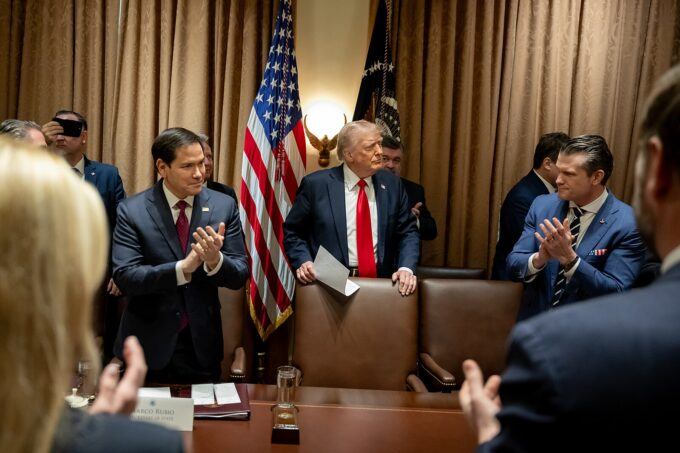
Donald Trump certainly has global ambitions. He is using tariffs to remake the global economy. He is withdrawing the United States from as many multinational organizations and agreements as possible in order to destroy the liberal international order. And he has alternated between confronting adversaries (like Iran) and brokering ceasefires (like the one in Gaza).
But he also has hemispheric aims—to consolidate U.S. hegemony in America’s “backyard” of Latin America and the Caribbean. In some ways, these aims are merely his global ambitions writ small. Here, too, he is slapping tariffs on allies and adversaries alike. He has threatened to withdraw the United States from multinational pacts like the Organization of American States. He has embraced autocratic friends—Nayib Bukele of El Salvador, Javier Milei of Argentina, Daniel Noboa of Ecuador—and sought to punish anyone who has stood up to him, including Lula in Brazil and Gustavo Petro in Colombia.
In this context, his policy toward Venezuela seems to be a departure from his usual approach to U.S. adversaries, which has usually involved transactional negotiations (as with North Korea and Belarus) or, more frequently, threats and non-military actions (as with China and Russia). In recent months, by contrast, the Trump administration has attacked nearly two dozen boats in the Caribbean and eastern Pacific Ocean, and killed more than 80 people, most of whom the administration has attempted to link to Venezuela. The United States has put a price ($50 million) on the head of Venezuelan leader Nicolas Maduro. It has sent considerable firepower to the region, including F-35 jets, eight Navy warships, a special operations vessel, a nuclear-powered attack submarine, and the aircraft carrier USS Gerald R. Ford, along with approximately 10,000 U.S. soldiers and 6,000 sailors. To top it off, the administration has also advertised its dispatch of a CIA mission to Venezuela.
This military force is sufficient to conduct a sustained air war against Venezuela. But an amphibious assault or ground invasion would require at least 50,000 troops, according to CSIS, so that doesn’t seem to be on the horizon yet. Trump has suggested that war is unlikely, but he rarely reveals his plans beforehand. For the time being, then, this show of force seems designed to scare Maduro into stepping down or embolden the opposition and/or elements of the military to seize power.
Elsewhere, the administration has not hesitated to threaten military action (as in Greenland) or even use force (as in Iran). But the campaign against Venezuela is of a much greater magnitude. The declaration of a “war” against “narco-terrorists” provides the administration with an almost unlimited justification for killing anyone deemed a threat to U.S. national interests. Trump has periodically criticized previous administrations for their involvement in “forever wars,” a populist message that struck a chord with many voters. Yet this new version of the forever war on drugs, with an ill-defined set of targets and no clear timeline, has not elicited much criticism from Trump’s Republican supporters. A vote in the Senate to invoke the War Powers Act failed by a slender margin, attracting only two Republican votes.
At first glance, Trump’s singling out of Venezuela seems more opportunistic than strategic. The Venezuelan government, particularly after the presidential elections in 2024 revealed widespread discontent with the regime, is relatively weak. The Venezuelan economy suffers from the highest inflation rate in the world and a serious erosion in living standards. Just as Trump bombed Iran only after Israel had made such a mission virtually risk-free, he is pressuring Venezuela because its modest size, military weakness, and unpopular government makes it an easy target.
But Cuba, too, is suffering from similar internal challenges, and it has not (yet) merited a full-scale U.S. pressure campaign. Venezuela has supplied Cuba with oil for the last two decades, keeping its economy from collapse. But that trade has declined substantially, from 56,000 barrels per day to only 8,000 in June 2025. Key actors in the Trump administration, particularly Secretary of State Marco Rubio, have long championed regime change in Cuba. So, one possible explanation for the campaign against Venezuela is its capacity to further isolate Cuba and possibly trigger regime change there as part of a new domino theory held by elements of the administration.
However, the Trump team is not entirely unified on its approach to Venezuela. A neo-isolationist wing has been lobbying against regime-change strategies. Until recently, Trump’s envoy to Venezuela Richard Grinnell was pushing this line, and Maduro was more than receptive to a diplomatic solution. According to The New York Times, Maduro “offered to open up all existing and future oil and gold projects to American companies, give preferential contracts to American businesses, reverse the flow of Venezuelan oil exports from China to the United States, and slash his country’s energy and mining contracts with Chinese, Iranian and Russian firms.” Even this generous offer, bordering on the sycophantic, failed to move Trump.
Opportunism doesn’t fully explain the magnitude of the Trump efforts in and around Venezuela. Nor does a well-known animus toward Maduro that dates back to Trump’s first term. Although Trump’s instincts are generally transactional, he does from time to time make geopolitical calculations. In this case, Venezuela attracts his attention because, unlike Cuba, it lies at the crossroads of several obsessions: immigration, drugs, fossil fuels, and China.
Pushing China Out of the Hemisphere
China is now South America’s leading trade partner and number two for Latin America as a whole. The region sends China raw materials such as soybeans, copper, and oil in exchange for manufactured goods. China’s Belt and Road Initiative has funneled considerable investments into mining, agriculture, and infrastructure projects throughout Latin America. Beijing has also opened up multiple lines of credit for countries in the region. Venezuela is the largest borrower, having taken on $60 billion in debt to China, twice the size of the next leading recipient, Brazil.
The Trump administration is focused on delinking the U.S. economy from China. Its greater ambition is to delink the entire hemisphere, beginning with North America. Its strategy so far in negotiations with Canada and Mexico, which will proceed either bilaterally or trilaterally through the renegotiation of the U.S.-Mexico-Canada Agreement, has been to close off Chinese access to North American markets by blocking the transshipment of Chinese finished products, reducing the quantity of Chinese parts and components in the supply chain, and restricting Chinese investment into manufacturing sites that then export to the United States. Trump is obsessed with Chinese attempts to enter the North American market through these backdoors, even though the Chinese use of these strategies is quite modest. U.S. trade negotiators have been pressuring their Mexican and Canadian counterparts to block these entry points into the U.S. market.
Trump is putting similar pressures on other Latin American leaders. He started by pushing Panama to withdraw from China’s Belt and Road Initiative. More recently, he has been focusing his attention on Argentina, which is China’s second largest trade partner in the region after Brazil. China has invested in several major infrastructure projects in Argentina, including two hydroelectric dams, a space observatory, and another planned nuclear power plant. Trump, meanwhile, has extended a $20 billion bailout package to Milei to forestall an economic crisis while making clear his preference to see Argentina downgrade its relationship with China.
There has been much talk of Trump falling back on a geopolitical strategy of “spheres of influence” by which China focuses on Asia, Russia on its “near abroad,” and the United States on the Americas. Such a division of the world perhaps appeals to Trump’s preference for looking at geopolitics as business by other means, with different regions functioning like corporate territory.
But Trump is not withdrawing the United States from the rest of the world. He has secured mineral rights in Ukraine, negotiated U.S. involvement in a transportation corridor between Armenia and Azerbaijan, and established agreements on minerals with the “club of nations” (Australia, Cambodia, Japan, Malaysia, Thailand). And his administration is doubling down on its containment of China—through alliances, expansion of Pacific bases, and increased Pentagon spending.
Meanwhile, Trump’s approach to the Americas is running up against considerable resistance. Mexico has asserted its sovereignty with respect to its economic relationship to China and its rejection of U.S. military intervention against narcotraffickers. The Brazilian government has refused to back down from its prosecution of former president Jair Bolsonaro in the face of higher U.S. tariffs. Even Ecuador, where President Daniel Noboa has a strong ideological affinity for Trump, can’t afford to jeopardize its relationship with China, which has involved considerable trade, investments into infrastructure, and $11 billion in loans.
Trump’s effort to reduce Chinese economic influence in the region has less to do with any “spheres of influence” geopolitical strategy and more to with the president’s desire to reduce U.S. dependency—and by extension, hemispheric dependency—on Beijing. He wants U.S. corporations, U.S. goods, and U.S. capital to occupy the first position in Latin America, not in the sense of globalized production but in a hub-and-spoke system where all key decisions and manufacturing takes place in the United States.
Other Drivers of Venezuela Policy
Donald Trump won reelection largely because of his focus on domestic issues, especially immigration, drugs, and energy policy. He deliberately downplayed international issues except to promise to end various wars that were costing the United States money and arms.
Venezuela, however, ticks off many boxes on Trump’s domestic to-do list. Even though the country is not the main source of either cocaine or fentanyl entering the United States, Trump has portrayed the Venezuelan criminal operation Tren de Aragua and the Maduro government as key perpetrators killing Americans with drugs. He has also used Tren de Aragua to vilify immigrants and made a big show of deporting Venezuelans allegedly connected to the gang to a highly dangerous prison in El Salvador (few if any of those deported had any such connections). The administration’s order terminating Temporary Protected Status for approximately 300,000 Venezuelans living in the United States made multiple mentions of Tren de Aragua.
Venezuela has the largest proven reserves of petroleum in the world—five times more than the United States. U.S. oil companies, primarily Chevron, have worked with Venezuela’s state-owned oil company to produce and ship petroleum. Trump initially severed that relationship, only to quietly reinstate it in July. At the same time, the Trump administration imposed an additional tariff on countries importing Venezuelan oil. Nevertheless, Venezuelan oil exports recently surged to a five-year high, led largely by sales to China and helped by Chevron’s involvement in production.
Trump, meanwhile, has pushed forward his own expansion of U.S. fossil fuel interests, opening up new areas of drilling, providing tax incentives to gas and oil companies, reducing regulatory oversight, and weakening clean energy competition. But any long-term reorientation of the U.S. economy back to oil will require access to other sources. Russia is out of the equation for the time being. The Middle East is unpredictable. Venezuela is problematic if the government there decides to restrict Chevron’s access or give preferential treatment to China or some other client. So, regardless of how conciliatory Maduro might be at the moment, the Trump administration wants to ensure secure access to Venezuela’s deposits well into the future.
The Trump administration has framed its rush to secure critical raw materials such as lithium, rare earth elements, and oil as part of its competition with China. But China has long anticipated the centrality of key minerals—for instance, taking over the processing of rare earth elements from the United States some decades ago—and is moving quickly away from its own dependency on fossil fuels. So, the Trump administration is both too late and too focused on the wrong target.
Nor is Venezuela China’s most important partner in Latin America. But the Trump administration might be going after Maduro as the weakest link. According to the Chinese adage, one must kill the chicken to warn the more powerful monkeys. The increasing pressure on Venezuela is a signal to China and other powerful actors to reduce their investments in the hemisphere and, even more so, a warning to other Latin American states that they’d better toe the Trump administration line—or else.
Originally published in Rosa Luxemburg Stiftung.
After U.S. Bust, Four Tankers Turn Around Instead of Calling in Venezuela
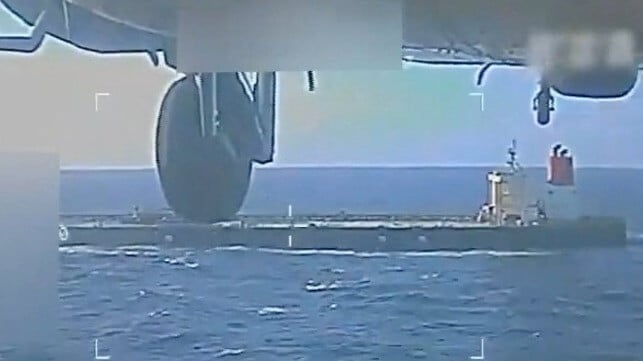
Venezuela's oil exports are coming under heavy pressure after the U.S. seized the VLCC Skipper off the country's shores last week. The boarding netted 1.85 million barrels of oil and one 20-year-old supertanker for the United States, satisfying a court-ordered arrest warrant and generating millions for the U.S. Treasury, but its more significant impact may be to deter other tanker operators from engaging in Venezuelan trade.
According to TankerTrackers.com, four "legitimate" tankers that were en route to Venezuela to lift crude have now turned around and headed back the way they came. This may be due to more than just the seizure of the supertanker Skipper: Venezuela may be unprepared to load newly-arrived tankers. On Monday, state oil firm PDVSA reported that its administrative computer systems had gone down due to a cyberattack, taking all of the tracking software for oil loadings offline. "There's no delivery [of cargoes]," one official with PDVSA told Reuters.
In an internal notice seen by Argus Media, PDVSA's managers told employees that the cyberattack centered on the Oriente Norte division, and the intruders had been deleting data on computer systems used for port and pipeline operations. Employees were instructed not to turn on their computers in order to contain the spread of the infection, the memo said.
Import cargoes may also be affected, though evidence is less clear. One tanker carrying Russian-origin naphtha for use as a diluent - needed to make Venezuela's extra-heavy crude liquid enough to pump and transport - may also have canceled an imminent offload and left Venezuelan waters, Reuters reported. The product tanker Boltaris, a stateless vessel falsely flagged in Benin, anchored just off Maracaibo on December 8; on December 10, the day Skipper was seized, Boltaris got under way again and headed out on her return voyage - without appearing to stop first to offload, according to AIS data provided by Pole Star Global.
AIS data can be falsified, and only imaging can definitively resolve tanker movements. Boltaris' previous visit to Venezuela (in January 2025) also ended in a "turnaround" without an AIS-visible port call alongside a pier.
Separately, Venezuela has laid blame on Trinidad and Tobago for allegedly supporting the seizure of the tanker Skipper. As the U.S. military ramps up its presence in the Caribbean, the island nation has allowed U.S. forces to set up ship-tracking radars on its shores and to use its airports for logistics, drawing Venezuela's ire. In a statement, the regime of Venezuelan dictator Nicolas Maduro said that in retaliation, it would immediately suspend joint agreements on offshore natural gas development that it had reached with the government of Trinidad.
Published Dec 16, 2025 12:57 AM by The Maritime Executive
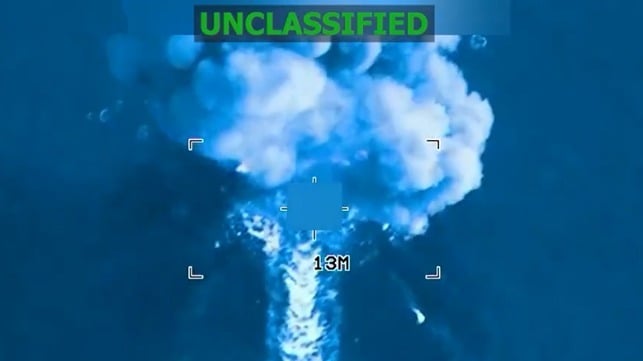
On Monday, U.S. Southern Command reported that its forces attached and destroyed three drug-smuggling boats in the Eastern Pacific, killing the occupants.
In a statement, Southern Command emphasized that it carried out the strikes at the direction of Secretary of War Pete Hegseth. Based on intelligence suggesting that the boats were engaged in narco-trafficking, including their presence in the known Eastern Pacific smuggling lanes, U.S. forces launched three aerial attacks.
Three suspected smugglers were killed in the first strike; two more in the second; and three more in the third and final attack, Southern Command said. The command released video footage documenting the events.
It is the first time since December 4 that the Pentagon has announced a round of attacks, and follows weeks of criticism from members of Congress over the department's methods. A "double-tap" follow-up strike that killed two survivors of an earlier Southern Command attack has attracted particular scrutiny, and Hegseth is scheduled to provide a rare briefing to the full House and full Senate tomorrow on the details of that engagement.
The Trump administration describes the targets of the strikes as "narco-terrorists" or "cartel terrorists," but reporting on the ground in South America suggests that most hired-on drug boat operators are fishermen, laborers, petty criminals and other low-income individuals with few economic options. The Pentagon has not disclosed the identities of those eliminated in the strikes, if any are known. The majority of the deceased remain unidentified, according to MSNBC.
The strikes have attracted criticism in legal circles over questions of compliance with the international law of war. The Trump administration maintains that the attacks are legally justified.

No comments:
Post a Comment