Monday, December 29, 2025

South Korea’s former first lady took bribes and meddled in state affairs, prosecutor says

Special prosecutor alleges Kim Keon Hee took advantage of her status as president's spouse ‘to receive money and expensive valuables’

Kim Keon Hee arrives for her first trial hearing on corruption charges at the Seoul Central District Court on 24 September 2025 (Getty)

Monday 29 December 2025 
The Independent

 South Korean prosecutor on Monday alleged that the wife of the impeached president Yoon Suk Yeol allegedly accepted bribes totalling over $200,000 and interfered in state affairs.

The special prosecutor's investigation into the former first lady, which wrapped up on Sunday, came amid a year-long probe into the disgraced president’s brief imposition of martial law last year and related scandals linked to the once-powerful couple.

Kim Keon Hee was arrested in August and placed under investigation for allegedly manipulating stocks and receiving gifts from the cult-like Unification Church. She is also accused of meddling in elections.

The prosecutor earlier this month sought a 15-year prison sentence for Ms Kim, who denied wrongdoing and, during a court hearing, apologised to the public for sparking concerns through her conduct.

Ms Kim “took advantage of the status of the president's spouse to receive money and expensive valuables, and has been widely involved in various personnel appointments and nominations," special prosecutor Min Joong Ki said at a news conference marking the end of his investigation.

She "illegally intervened in state affairs behind the scenes, beyond the public's view", the prosecutor said, adding that the bribes from businesses and politicians taken by her totalled up to $263,000.

Ms Kim previously said that the allegations were "deeply unjust". "Yet when I consider my role and the responsibilities entrusted to me, it seems clear that I have made many mistakes," she claimed.

A lower court’s ruling in Ms Kim’s case is expected on 28 January.

“Investigations do not end because one says so, but are eventually completed with evidence in court," Ms Kim's lawyers said in a statement on Monday, adding that they would work "to ensure that procedural legitimacy and defence rights are thoroughly guaranteed so that facts are not exaggerated or distorted into political framing”.


The prosecutors are also trying Unification Church leader Han Hak Ja as her group is suspected of giving Ms Kim valuables, including Chanel bags and a diamond necklace, as part of an effort to win influence.

Ms Kim allegedly also received a painting by famed South Korean minimalist painter Lee Ufan, a Dior handbag and a watch.

Ms Han denies directing her church to bribe the then first lady.

"Various people who did not have a common denominator with each other visited Kim Keon Hee, not the president, and asked for what they wanted, and gave money and goods," assistant special prosecutor Kim Hyeong Geun, alleged. "As a result, their request was realised."

Mr Yoon is on trial for masterminding an insurrection by imposing martial law late last year, a charge that could mean a life sentence or even a death penalty. He denies the charges.

A lower court ruling on Mr Yoon is expected early next year.

6.0-Magnitude Earthquake Injures at Least 25 in Northern Lima, Peru

Lima, Dec. 29 (SANA) At least 25 people were injured in a 6.0-magnitude earthquake that struck Peru’s Ancash region north of the capital, Lima, authorities reported.

Agence France-Presse (AFP) quoted local authorities as saying that the earthquake, which occurred Sunday near the coastal city of Chimbote, caused injuries to at least 25 people and inflicted damage to the main hospital, as well as numerous homes and schools in the city, which has a population of about half a million.

Peru, with a population of around 34 million, lies within the Pacific “Ring of Fire,” a zone of high seismic activity that extends along the western coast of the Americas. The country was previously hit by a devastating earthquake in 1970 in the Ancash region, which claimed approximately 67,000 lives.

India’s aviation meltdown exposes long-brewing pilot fatigue crisis

Aviation experts and pilot groups say IndiGo’s unprecedented scheduling crisis this month was due in part to an industry failure to address pilot fatigue.


December 29, 2025 
WASHINGTON POST


NEW DELHI — Every couple of weeks, the Indian pilot is required to make three short-haul night flights over two consecutive nights. As she tries to rest up before her next daytime flight, the 40-year-old says she often lies awake worrying about her health.

“I don’t think I will live long if I continue flying,” said the Delhi-based pilot for IndiGo, India’s largest airline. “My body, my brain — everything has just shut down. This is zombie work.”

She was hopeful when she learned the country’s aviation regulator was instituting new rules to combat pilot fatigue — eliminating the most punishing flight patterns, limiting night landings and mandating longer rest periods. But when the rules finally came into force in November, chaos followed.

It coincided with an expansion of flight schedules, in part to accommodate India’s largest-ever wedding season, and soon cancellations and delays were piling up. By early December, IndiGo faced a snowballing disaster, described by pilots and aviation experts as a crisis unique in Indian aviation history. Almost 1 million bookings were affected between Nov. 21 and Dec. 7, the Civil Aviation Ministry told local media.

During the worst week, Indigo said it canceled about 4,500 flights, including almost all of those in and out of the capital of New Delhi on Dec. 5. Across the country, airport departure boards glowed red. Passengers were left with little information. Bags piled up and went missing.

IndiGo staff members tag stranded bags and belongings after large-scale flight disruptions Dec. 8 at Indira Gandhi International Airport in New Delhi. (Bhawika Chhabra/Reuters)

“No airline, however large, will be permitted to cause such hardship to passengers,” Civil Aviation Minister Ram Mohan Naidu told Parliament on Dec. 9. But the ministry and its main regulator, the Directorate General of Civil Aviation (DGCA), temporarily exempted IndiGo from the new rules governing flight schedules to help stabilize the situation. The 40-year-old pilot and her colleagues felt like they were back where they began.

“In the crossfire, the people who are actually getting hammered here are the pilots,” said a senior Indian aviator with five decades of experience, who, like others in this story, spoke on the condition of anonymity for fear of professional retaliation.

Aviation experts and pilot groups say the scheduling crisis in early December was not an aberration, but a predictable outcome for an industry that has long resisted addressing pilot fatigue.Ask The Post AIDive deeper

“We always knew there would be a tipping point,” said an Indigo pilot based in southern India. “This wasn’t just cost optimization,” it was “cutting corners, pushing man and the machine to its absolute limits.”

In response to questions, IndiGo directed The Washington Post to public statements, including one from Dec. 3 that said “minor technology glitches, schedule changes linked to the winter season, adverse weather conditions, increased congestion in the aviation system and the implementation of updated crew rostering rules … had a negative compounding impact on our operations in a way that was not feasible to be anticipated.” On Dec. 8, the company said it had paid out about $100 million in passenger refunds.

The DGCA and the Civil Aviation Ministry did not respond to requests to comment.

An IndiGo aircraft prepares to land at the Mumbai airport on Dec. 6. (Punit Paranjpe/AFP/Getty Images)

An aviation boom in a shrinking field

Two decades ago, India had a plethora of domestic carriers. IndiGo, known for its lean staffing, punctual takeoffs and fast turnarounds, steadily rose to dominance, powering the world’s fastest-growing aviation industry.Ask The Post AIDive deeper

But that growth was accompanied by unprecedented consolidation. Since the early 2000s, at least three major Indian airlines have folded and at least five have been acquired or merged, leaving two major domestic players: IndiGo and Air India.

IndiGo has continued to outpace its older, more established rival, amassing more than 60 percent of the domestic market and more than $800 million in profits, according to the company’s latest annual report. For those looking to fly out of smaller airports or to less-frequented cities, IndiGo is often the only available option.

Underlying IndiGo’s ascent, pilots say, was a culture of intense pressure around work schedules that reshaped industry norms, particularly after the coronavirus pandemic. “I have often gone to the brink before I get rest,” the senior pilot told The Post.

Amit Singh, who has more than three decades of experience in the cockpit, said pilot rest standards in the United States and Europe are designed to protect sleep quality through circadian modeling and fatigue research, while India’s approach has largely been based on counting hours. U.S. airlines are required to guarantee pilots eight hours of uninterrupted sleep opportunity and adhere to cumulative limits that account for fatigue over time, he said.Ask The Post AIDive deeper

India’s rules, by contrast, have focused on how long a pilot is off duty — in some cases they provide more rest hours on paper, he said, but don’t account for whether that time allows for restorative sleep. The problem is exacerbated, Singh said, by “poor airline safety culture and regulatory oversight.”

After the chaos last month, IndiGo circulated an apology script for pilots to read from the cockpit. Two pilots told The Post they had refused to comply with the order.

“It is so infuriating that management … did not once apologize to us or sympathize with us,” said the Delhi-based pilot. “And I’m supposed to apologize on behalf of them?”

A digital departures board at Kempegowda International Airport. (Idrees Mohammed/AFP/Getty Images)

Flying on empty


The Delhi-based pilot said she now regrets the nearly $80,000 she spent on flight training. But her biggest mistake, she believes, was the contract she signed with IndiGo, which included clauses that require her to pay more than $50,000 to the company if she leaves before five years are up.

Pilots said such contracts are common at Indigo and Air India. The airlines say the financial penalties for opting out are necessary to help recoup training expenses.

Last year, the pilot in Delhi fell seriously ill. After she had exhausted her 12 days of sick leave, she said, the airline threatened to place her into a “dependability” program that freezes promotions, bonuses and travel benefits. She returned to work, she said, but her health has continued to suffer.

“If I keep working like this for 10 years, I will be completely useless to the company,” said the pilot. “It is plain cruelty.”

Singh recalled one former colleague from IndiGo who was fired for reporting fatigue. Another with a different airline, he said, received a warning letter for voluntarily reporting that he had briefly nodded off before a delayed flight.

Singh is now the head of the Safety Matters Foundation, a nonprofit organization focused on air safety. Of the 530 Indian pilots who filled out his organization’s online surveys last year, more than half said they suffer from excessive daytime sleepiness. Almost three-quarters of respondents said they had flown while knowing they were too tired to do so. A majority of the respondents worked for IndiGo, Singh said.

The issue extends across the industry, pilots and aviation experts said. An online survey conducted by the Airline Pilots’ Association of India in July and sent to DGCA found that almost half of 610 respondents had recently filed a fatigue report. Fewer than one-third of respondents flew for IndiGo.

Such reports sometimes lead to schedule changes, pilots told The Post, but the same demanding flight patterns often reappear.

C. S. Randhawa, head of the Federation of Indian Pilots, said airlines treat limits on pilots’ schedules as guidelines rather than hard caps.

“They want to squeeze everything out of us,” said the pilot in southern India.

Passengers gather at an Indigo reservation counter at Indira Gandhi International Airport on Dec. 5 after a mass cancellation of Indigo flights. (Ritesh Shukla/Getty Images)

Turbulence and resistance

In 2019, India’s pilot organizations took their concerns to court, demanding limits to nighttime flying, which eventually paved the way for the new regulations rolled out last month. Originally scheduled to take effect in June 2024, DGCA delayed the rules after resistance from airlines.

As the date of implementation approached, pilots say IndiGo failed to hire more staff to make up for the reduced duty hours. Even as DGCA approved an increase in IndiGo flights this year, the number of pilots employed by the airline decreased, from 5,463 in March to 5,085 in December, according to answers given by the Civil Aviation Ministry in Parliament.

In a Dec. 3 letter to the aviation minister, the Airline Pilots’ Association of India said the pilot shortage was probably due to a “failure in planning” and a “calculated strategy” to “arm-twist the regulator.”

Aviation expert Kapil Kaul dismissed the theory of a calculated strategy as “absurd.” But “you cannot overlook the responsibility of the regulator,” he said, which must “make sure this doesn’t happen again.”

India’s state competition commission announced Dec. 18 that it would launch an inquiry. The Aviation Ministry gave an initial clearance to two new airlines in the country in late December.

Transparency was key, said Randhawa, a former Air India executive and aviation regulator: IndiGo is “not coming out with the truth as to what happened, and that is causing a lot of speculation.”

The pilot based in the south said he is considering declining a promotion to avoid being locked into another multiyear contract.


“It’s a beautiful profession,” he said. “But if you suffocate us, we won’t want to fly anymore.”


By Karishma MehrotraKarishma Mehrotra is the South Asia correspondent for The Washington Post. She was previously a Fulbright fellow and has written or worked for Radiolab, the Wall Street Journal, CNN, the Indian Express, Scroll.in, and Bloomberg Businessweek.follow on Xkarishma__m__
Opinion...

Mr Trump, Gaza does not need your ballroom. It needs tents. It needs life.


December 29, 2025 
 Middle East Monitor


Israeli Prime Minister Benjamin Netanyahu and President Donald Trump depart the State Dining Room of the White House following a press conference in Washington, DC on September 29, 2025. [Stringer – Anadolu Agency]

by Jasim Al-Azzawi


Mr Trump,

You will meet Benjamin Netanyahu. Cameras will flash. Words will be exchanged in polished rooms, polished suits, polished lies. You will talk about “security,” “alliances,” “regional stability,” and all the hollow, sterile phrases that sanitize horror and suffocate truth.

But I want to talk to you about tents.

Not metaphorical tents. Not symbolic tents. Not poetic tents. Real tents. Fabric huts. Plastic roofs. Human shelters. The kind of tents that hang between life and death.

In Gaza, rain does not fall. It assaults. It slashes. It invades. It turns the ground into a grave of mud and disease. Children are sleeping in rags under tarps shredded by storms. Infants wake screaming, not from nightmares, but because their bodies are soaked in sewage. Mothers hold babies wrapped in blankets sodden with foul water and human waste. They whisper prayers into the night air that smells of death. Wind tears at canvas walls while hunger gnaws at their bones.

And the world shrugs.

We were told Palestinian families would receive tents and caravans with every agreement, every deal, every negotiation Israel struck with Hamas. Promised. Documented. Repeated. Lied about.

Those caravans are there. They exist. They stand mere kilometers away — pristine, dry, safe — imprisoned by checkpoints and political indifference. They are not being delivered because the suffering of Palestinians has become a bargaining chip. A tool. A punishment.

And while two million human beings live in filth, drowning in misery, freezing in cruel winter wind, you are planning to build a ballroom. Marble floors. Crystal chandeliers. Velvet drapes. A palace to ego while children cough blood in swamp water.

America — the nation that once claimed to be a moral compass — now walks willingly into contradiction so obscene it cannot stand upright.

Has the United States truly fallen this low? Has its heart calcified past redemption?
Has the “shining city on a hill” dimmed into a glittering tomb?

Mr Trump, Netanyahu promised 600 aid trucks per day. Not as generosity. As a necessity. As a minimum survival. Some days now, there are barely 120 trucks — if Israel allows them at all. Hunger swells. Hospitals collapse. Food rots behind borders while stomachs collapse inward.

You will sit across from Netanyahu. You will look him in the eye.

Will you speak? Or will you bow?

Are you afraid of angering him? To risk access? To disturb the sacrosanct theater of political allegiance? Is the relationship that fragile? Is your courage that conditional? Or is Palestinian suffering simply beneath the dignity of conversation?

History will remember the lie that civilization tells itself: that this is complicated. It is not. It is brutal. It is deliberate. It is man-made.

Do you know what the Greeks once called Arab desert tribes? Saracens — people of the tents.

Look at Gaza now. Zionism has not merely dispossessed Palestinians. It has hurled them two thousand years back into history, stripped them of walls, roofs, identity, security, dignity — and left them to rot in filth that only war and cowardice can create.

But do not romanticize these tents. These are not proud desert shelters. These tents are soaked in excrement. Their beds drip with disease. Their blankets stink of rot. This is not poverty.This is engineered humiliation. This is political cruelty masquerading as policy.

And so I ask you, not as a partisan, not as a critic, but as a man addressing another man whose decisions will echo long after his voice fades:

What are you going to do, Mr Trump?

You live in gilded spaces — towers, mansions, palaces of marble and polished gold. Your life is wrapped in velvet. Gaza is wrapped in sores. And yet, the lives trapped in those tents are no less human than the ones who dine in your ballrooms.

They are pleading for one million tents and 600 caravans. Not tomorrow. Not next month. Now. Their children do not have the luxury of political delay. Their lungs are drowning. Their bones are thinning. Their hope is cracking.

Will you order those caravans through? Will you pressure Netanyahu to open the gates? Will you let those shelters roll forward instead of rotting behind barriers of arrogance and calculation?

Or will you remain silent and let winter finish the work that bombs began?

You have been handed a moment history rarely grants: the power to choose compassion over alliance, humanity over political comfort, moral action over moral collapse.

Redeem something. Redeem anything. Redeem at least one shred of the idea that America can still mean something beyond brute power and selective grief.

Do not tell the world America is strong. Show it is capable of mercy. Do not boast of greatness.
Demonstrate decency.

Let the convoys through. Let the tents rise. Let children sleep dry for once. Let the name “American” mean rescue rather than ruin.

The Palestinians have screamed for decades into a deafening world. Today they scream again:

We need shelter. We need dignity. We need life.

History is watching, Mr. Trump. So are the dead.

OPINION: America’s double game with international justice: When power poses as principle

The views expressed in this article belong to the author and do not necessarily reflect the editorial policy of Middle East Monitor.


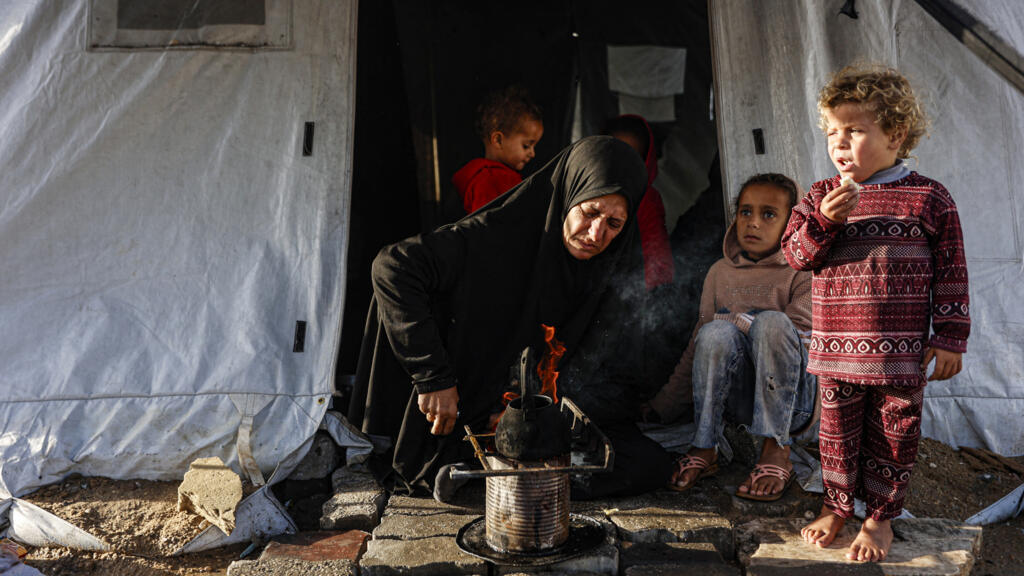
Winter rains flood camps, worsening living conditions for displaced Gazans

Issued on: 29/12/2025 - FRANCE24

Rain lashed the Gaza Strip, flooding makeshift encampments with ankle-deep puddles as Palestinians displaced by the two-year war attempted to stay dry in tents frayed by months of use. The flooding came as Israel Prime Minister Benjamin Netanyahu travelled to Florida to discuss the second phase of the ceasefire agreement with US President Donald Trump.


Ben-Gvir flees after being pelted with stones in Palestinian village in Negev

ISLAM HAS A TRADITION OF STONING IBLIS 
AT MECCA

December 29, 2025 


Israel’s National Security Minister Itamar Ben-Gvir on 10 September, 2023 [OHAD ZWIGENBERG/POOL/AFP via Getty Images]

Angry Palestinians from the Bedouin village of Tarabin, located in the occupied Negev region of southern Palestine, which has been under Israeli control since 1948, threw stones at Itamar Ben Gvir, the far-right extremist serving as the so-called Minister of National Security in the Israeli occupation government. The incident occurred on Sunday after Israeli occupation forces stormed the village and arrested several residents.

Channel 14 reported that Minister of National Security Itamar Ben-Gvir visited the village of Tarabin in the Negev on Sunday to oversee police operations. During his visit, dozens of villagers clashed with the police and threw stones at him.

Video clips shared on social media showed Ben-Gvir being hit with stones and leaving the area under heavy police protection. Israeli police responded by firing tear gas at the villagers.


Opinion...

A thesis confirmed: Epstein, Dershowitz and the Israel lobby


A billboard in Times Square calls for the release of the Epstein files on July 23, 2025 in New York City. [Photo by Adam Gray/Getty Images]

by Dr Binoy Kampmark

December 29, 2025 
Middle East Monitor.

Conman, convict, paedophile and a life terminated in circumstances of purported suicide. The list for Jeffrey E. Epstein, figure of cosmic social and political influence in the United States, is long. Trafficking in female flesh for his extensive client list, lubricated by his lover Ghislaine Maxwell, tends to be the crowning feature of most discussions about his sordid legacy. Another shrouded aspect has been neglected.

The fuss about releasing the Epstein files – the slowness with which the US Justice Department is undertaking that task, the erratic nature of its redactions, and what gold nuggets might be found – gives us a chance to examine the Israeli dimension in US politics. In November, Ryan Grim and Murtaza Hussain of Drop Site News showed the seedier side of that dimension in exposing Epstein’s role in what can be loosely termed the Israeli lobby. This involved a dedicated effort to discredit the work of two scholars, John Mearsheimer and Stephen Walt, who had done much to sketch the outlines of the very thing his own conduct affirmed.

Originally commissioned in late 2002 by The Atlantic, the article, written as a working paper, was simply entitled “The Israeli Lobby”. The subject, however, had become heated and worrying to the editors. When the article was ready for publication, the United States was involved in a futile, bloody conflict in Iraq that Mearsheimer and Walt argued was “motivated in good part by a desire to make Israel more secure.” The authors were offered a “kill fee” of $10,000 for their consent to pull the piece. “That’s the fastest $10,000 we ever made,” quipped Mearsheimer in an interview with Tucker Carlson.

The article eventually found a home at the London Review of Books, to be followed in book form, having an immediate, incendiary effect. It notes the Israeli Lobby as an extensive, fanning presence in the American political landscape, comprising think tanks, the muscular American Israel Public Affairs Committee, neoconservatives, Christian Zionists, and journalists with clout. Its aims are clear: “Maintaining US support for Israel’s policies against the Palestinians is essential in so far as the Lobby is concerned, but its ambitions do not stop there. It also wants America to help Israel remain the dominant regional power.” Hand in hand, Israel and pro-Israel groups in the US had “worked together to shape the administration’s policy toward Iraq, Syria and Iran, as well as its grand scheme for reordering the Middle East.”

Epstein proceeded to play a role in the campaign against Walt and Mearsheimer. His pro-Israel credentials were impeccable. He had a close relationship with former Israeli Prime Minister Ehud Barak. He aided the brokering of various deals for Israeli intelligence and security interests. These included oiling a security agreement between Israel and Mongolia; aiding the creation of a backchannel between Israel and Russia during the Syrian Civil War and facilitating a security agreement between Israel and the West African state of Côte d’Ivoire. He hosted an Israeli intelligence officer, Yoni Koren, on at least three occasions in Manhattan. “He was a dealmaker and a fixer at a very, very elite level,” says Hussain.

One need not bother about the accusation that Epstein might have been in the specific pay of the Israeli intelligence service to show where his allegiances lay. He was a dedicated spear carrier for Israeli interests. In the apoplexy that broke out among members of the lobby to the Walt and Mearsheimer paper, he featured prominently, as emails from his Yahoo! account reveal. Epstein’s specific role in targeting the two scholars came from correspondence obtained by the non-profit whistleblower entity Distributed Denial of Secrets and made available to Drop Site News.

Of interest here is the correspondence between Epstein and Harvard law professor Alan M. Dershowitz, himself a devoted apologist for Israeli causes. During the first week of April 2006 Dershowitz, who also acted for Epstein in criminal matters, passed on several drafts of his article “Debunking the Newest – and Oldest – Jewish Conspiracy” to the financier. That tatty, travesty of a piece accused Walt and Mearsheimer of putting together “little more than a compilation of old, false, and authoritatively discredited charges dressed up in academic garb”, incarnating in modern form the conspiratorial tract The Protocols of the Elders of Zion.

After Epstein’s warm congratulations for the libellous effort, the question of how best to distribute the piece comes to the fore. To a query from Dershowitz’s email address sent by an assistant regarding progress on the matter, Epstein replies: “yes I’ve started.” Here, the vital entrails of the Lobby become clear: Epstein’s relationship with Harvard (donor of sums over $9 million between 1998 and 2008); Epstein as trustee and president of the family financial office of retail mogul and philanthropist Leslie Wexner, himself a donor of almost $20 million to the Kennedy School between 2000 and 2006 via a foundation bearing his name and responsible for a scholar program for visiting Israeli government officials to study a one-year Master’s degree.

The effect of such strategizing was to curb the reach of Walt and Mearsheimer. Scheduled talks were cancelled or readjusted to include a pro-Israeli voice. Mearsheimer, in reacting to the emails, proved characteristically unflappable. “I’m not surprised to see these emails, because Dershowitz and Epstein were close and both have a passionate attachment to Israel.” It will be a frigid comfort for both he and Walt that their thesis on the bewitching influence of the Israeli lobby’s workings has been so profoundly vindicated.


The views expressed in this article belong to the author and do not necessarily reflect the editorial policy of Middle East Monitor.


Much Talk, Little Outcome: Peace Efforts Yield No Breakthrough on Ukraine

December 29, 2025
NOVITIATE


US President Donald Trump said that Russian President Vladimir Putin has not accepted the idea of a ceasefire during a possible Ukrainian referendum on a proposed peace plan. Trump made the comments at a joint press conference with Ukrainian President Volodymyr Zelensky following their meeting, after Trump had spoken by phone with Putin in advance.

Asked directly whether Putin had agreed to halt the fighting during a referendum, Trump replied that there was no such agreement. He explained that Putin’s position was based on concerns that stopping hostilities and then potentially resuming them could put Russia at a disadvantage. Trump said he understood that logic but added that discussions were ongoing on how to address the issue.

Trump also claimed that, if the war ends, Russia would take part in Ukraine’s reconstruction. He said Moscow supposedly wants to see Ukraine succeed, although he acknowledged that this might sound contradictory. At the same time, Trump complained that unnamed “bad people” had spread false narratives that, in his view, had obstructed efforts by Washington and Moscow to reach agreements.

Earlier, on 23 December, Zelensky said Ukraine was preparing a 20 point peace plan that could either be approved by parliament or put to a nationwide referendum. He noted that such a referendum would require at least 60 days and would only be possible under a full ceasefire during that period. On 28 December, Zelensky and Trump met in Florida and later held a video conference with European leaders. Trump said ahead of that meeting that he had a “good and very productive” conversation with Putin. Putin’s aide, Yuri Ushakov, later stated that both leaders had agreed a temporary ceasefire under the pretext of a referendum would only prolong the conflict.

European leaders responded positively to the Florida talks and the subsequent video call. According to statements cited by Interfax Ukraine, they stressed the importance of joint efforts to secure a just and lasting peace and to keep pressure on Russia. The video conference followed closed door talks between Ukrainian and US delegations at Trump’s Mar a Lago residence.

Finnish President Alexander Stubb confirmed that the call included French President Emmanuel Macron, Polish President Karol Nawrocki, UK Prime Minister Keir Starmer, Italian Prime Minister Giorgia Meloni, Norwegian Prime Minister Jonas Gahr Støre, German Chancellor Friedrich Merz, NATO Secretary General Mark Rutte and European Commission President Ursula von der Leyen. Stubb said the discussion lasted more than an hour and focused on concrete steps to end the war.

Polish President Nawrocki underlined strong US engagement in the peace process and highlighted Poland’s role, noting that Rzeszów Jasionka airport has handled more than 90 percent of aid deliveries to Ukraine since the start of Russia’s full scale invasion. He said Poland’s position would be crucial in any peace agreement and stressed that regional security decisions must involve all stakeholders. According to his statement, US determination combined with European unity offered a real chance to end the war.

Von der Leyen also described the talks as productive and said significant progress had been made. Irish Prime Minister Micheál Martin welcomed what he called progress in the peace discussions and said he hoped it would soon lead to a ceasefire. Dutch Prime Minister Dick Schoof said positive signals from Washington must now be matched by concrete steps from Moscow, adding that the Netherlands would continue supporting Ukraine.

European foreign ministers echoed these messages. Dutch Foreign Minister Wopke van der Linde spoke about next steps in the talks and stressed the need to further increase pressure on Russia. Czech Foreign Minister Jan Lipavský described the outcome of the Zelensky Trump meeting as optimistic, saying Ukraine wants peace and that Russia must be pushed towards it through sanctions and a strong Ukrainian defence.

In a separate statement, von der Leyen said a one hour call with Trump, Zelensky and several European leaders had produced “good progress”. She added that Europe was ready to continue working with Ukraine and the United States to build on these results, stressing that strong security guarantees from the very beginning were essential.

Trump and Zelensky also outlined how work on the peace plan would continue. Trump said the US working group would include Special Envoy Steve Witkoff, Jared Kushner, Secretary of State Marco Rubio, Defence Secretary Pete Hegseth and others. Zelensky said the Ukrainian team would involve National Security and Defence Council Secretary Rustem Umierov, First Deputy Foreign Minister Serhii Kyslytsia and General Staff Chief Andrii Hnatov. Zelensky said he hoped decisions on six key documents could be reached in January. Trump added that these groups would also engage with Russia, saying talks limited to one side would not solve the conflict.

When asked about timelines, Trump said a deal could take a few weeks if progress was smooth, but warned that talks could also collapse over unresolved issues. Zelensky said the teams would meet again in the coming weeks and that Trump had agreed to host further talks in Washington in January.

Trump also addressed the possibility of visiting Ukraine. He said there were no immediate plans but he would be willing to go if it helped secure peace. While he did not see such a visit as necessary at this stage, he said he would consider it if it could help save lives. Zelensky confirmed that Ukraine had invited Trump to address parliament.

The talks did not resolve the issue of Donbas. Trump said progress was being made but acknowledged it remained a major obstacle. He said Russia continued to demand the entire region and that this would need to be worked out, adding he believed the issue could be resolved in the coming months. Zelensky described Donbas as a very difficult matter, stressing Ukraine’s legal position and respect for the territory it controls. He said a referendum was one possible mechanism, alongside a parliamentary vote, depending on legal requirements.

Zelensky later said that Ukraine and the United States had finalised several documents within the broader peace package. He said the 20 point plan was about 90 percent agreed, US Ukraine security guarantees were fully agreed, US Europe Ukraine guarantees were close to completion, and the military dimension was settled. He added that work was continuing on a prosperity plan and on sequencing the next steps. Both leaders agreed that security guarantees were central to achieving lasting peace and confirmed that negotiations would continue.


Thorny questions remain despite positive meeting reports from Trump and Zelensky

Issued on: 29/12/2025 -FRANCE24


US President Donald Turmp and Ukraine President Volodymyr Zelensky both reported progress on two of the most contentious issues regarding a peace deal in Ukraine: security guarantees for the country and the division of the eastern Donbas region, which Russia is trying to capture. But thorny questions remain. David Smith, Washington Bureau Chief for The Guardian, told us more.

OPINION

John Simpson: "I've reported on 40 wars but I've never seen a year like 2025"

29 December 2025
John Simpson, BBC World Affairs Editor


John Simpson is the BBC's World Affairs editor, and one of its most experienced journalists. In this somber and candid article for BBC InDepth Simpson says "I've reported on 40 wars but I've never seen a year like 2025". commonspace.eu is republishing the article in full because of its importance:

I've reported on more than 40 wars around the world during my career, which goes back to the 1960s. I watched the Cold War reach its height, then simply evaporate. But I've never seen a year quite as worrying as 2025 has been - not just because several major conflicts are raging but because it is becoming clear that one of them has geopolitical implications of unparalleled importance.

Ukraine's President Volodymyr Zelensky has warned that the current conflict in his country could escalate into a world war. After nearly 60 years of observing conflict, I've got a nasty feeling he's right.

Ukraine's President has warned that the current conflict in Ukraine could escalate into a world war

Nato governments are on high alert for any signs that Russia is cutting the undersea cables that carry the electronic traffic that keeps Western society going. Their drones are accused of testing the defences of Nato countries. Their hackers develop ways of putting ministries, emergency services and huge corporations out of operation.

Authorities in the west are certain Russia's secret services murder and attempt to murder dissidents who have taken refuge in the West. An inquiry into the attempted murder in Salisbury of the former Russian intelligence agent Sergei Skrypal in 2018 (plus the actual fatal poisoning of a local woman, Dawn Sturgess) concluded that the attack had been agreed at the highest level in Russia. That means President Putin himself.
This time feels different

The year 2025 has been marked by three very different wars. There is Ukraine of course, where the UN says 14,000 civilians have died. In Gaza, where Israel's prime minister, Benjamin Netanyahu promised "mighty vengeance" after about 1,200 people were killed when Hamas attacked Israel on 7 October 2023 and 251 people were taken hostage.

Since then, more than 70,000 Palestinians have been killed by Israeli military action, including more than 30,000 women and children according to Gaza's Hamas-run health ministry – figures the UN considers reliable.

Meanwhile there has been a ferocious civil war between two military factions in Sudan. More than 150,000 people have been killed there over the past couple of years; around 12 million have been forced out of their homes.

Maybe, if this had been the only war in 2025, the outside world would have done more to stop it; but it wasn't.

"I'm good at solving wars," said US President Donald Trump, as his aircraft flew him to Israel after he had negotiated a ceasefire in the Gaza fighting. It's true that fewer people are dying in Gaza now. Despite the ceasefire, the Gaza war certainly doesn't feel as though it's been solved.

Given the appalling suffering in the Middle East it may sound strange to say the war in Ukraine is on a completely different level to this. But it is.

The Cold War aside, most of the conflicts I've covered over the years have been small-scale affairs: nasty and dangerous, certainly, but not serious enough to threaten the peace of the entire world. Some conflicts, such as Vietnam, the first Gulf War, and the war in Kosovo, did occasionally look as though they might tip over into something much worse, but they never did.

The great powers were too nervous about the dangers that a localised, conventional war might turn into a nuclear one.

"I'm not going to start the Third World War for you," the British Gen Sir Mike Jackson reportedly shouted over his radio in Kosovo in 1999, when his Nato superior ordered British and French forces to seize an airfield in Pristina after the Russian troops had got there first.

In the coming year, 2026, though, Russia, noting President Trump's apparent lack of interest in Europe, seems ready and willing to push for much greater dominance.

Earlier this month, Putin said Russia was not planning to go to war with Europe, but was ready "right now" if Europeans wanted to.

At a later televised event he said: "There won't be any operations if you treat us with respect, if you respect our interests just as we've always tried to respect yours".

Putin said Russia was not planning to go to war with Europe, but was ready "right now" if Europeans wanted to

But already Russia, a major world power, has invaded an independent European country, resulting in huge numbers of civilian and also military deaths. It is accused by Ukraine of kidnapping at least 20,000 children. The International Criminal Court (ICC) has issued an arrest warrant for Russian President Vladimir Putin for his involvement in this, something Russia has always denied.

Russia says it invaded in order to protect itself against Nato encroachment, but President Putin has indicated another motive: the desire to restore Russia's regional sphere of influence.
American disapproval

He is gratefully aware that this last year, 2025, has seen something most Western countries had regarded as unthinkable: the possibility that an American president might turn his back on the strategic system which has been in force ever since World War Two.

Not only is Washington now uncertain it wants to protect Europe, it disapproves of the direction it believes Europe is heading in. The Trump administration's new national security strategy report claims Europe now faces the "stark prospect of civilisational erasure".

The Kremlin welcomed the report, saying it is consistent with Russia's own vision. You bet it is.

Inside Russia, Putin has silenced most internal opposition to himself and to the Ukraine war, according to the UN special rapporteur focusing on human rights in Russia. He's got his own problems, though: the possibility of inflation rising again after a recent cooling, oil revenues falling, and his government having had to raise VAT to help pay for the war.

US President Donald Trump and Ukraine's President Volodymyr Zelensky clashed during a meeting at the White House in February 2025

The economies of the European Union are 10 times bigger than Russia's; even more than that if you add the UK. The combined European population of 450 million, is over three times Russia's 145 million. Still, Western Europe has seemed nervous of losing its creature comforts, and was until recently reluctant to pay for its own defence as long as America can be persuaded to protect it.

America, too, is different nowadays: less influential, more inward-looking, and increasingly different from the America I've reported on for my entire career. Now, very much as in the 1920s and 30s, it wants to concentrate on its own national interests.

Even if President Trump loses a lot of his political strength at next year's mid-term elections, he may have shifted the dial so far towards isolationism that even a more Nato-minded American president in 2028 might find it hard to come to Europe's aid.

Don't think Vladimir Putin hasn't noticed that.
The risk of escalation

The coming year, 2026, does look as though it'll be important. Zelensky may well feel obliged to agree to a peace deal, carving off a large part of Ukrainian territory. Will there be enough bankable guarantees to stop President Putin coming back for more in a few years' time?

For Ukraine and its European supporters, already feeling that they are at war with Russia, that's an important question. Europe will have to take over a far greater share of keeping Ukraine going, but if the United States turns its back on Ukraine, as it sometimes threatens to do, that will be a colossal burden.

If the United States turns its back on Ukraine, that will be a colossal burden for Europe

But could the war turn into a nuclear confrontation?

We know President Putin is a gambler; a more careful leader would have shied away from invading Ukraine in February 2022. His henchmen make bloodcurdling threats about wiping the UK and other European countries off the map with Russia's vaunted new weapons, but he's usually much more restrained himself.

While the Americans are still active members of Nato, the risk that they could respond with a devastating nuclear attack of their own is still too great. For now.
China's global role

As for China, President Xi Jinping has made few outright threats against the self-governed island of Taiwan recently. But two years ago the then director of the CIA William Burns said Xi Jinping had ordered the People's Liberation Army to be ready to invade Taiwan by 2027. If China doesn't take some sort of decisive action to claim Taiwan, Xi Jinping could consider this to look pretty feeble. He won't want that.

You might think that China is too strong and wealthy nowadays to worry about domestic public opinion. Not so. Ever since the uprising against Deng Xiaoping in 1989, which ended with the Tiananmen massacre, Chinese leaders have monitored the way the country reacts with obsessive care.

I watched the events unfold in Tiananmen myself, reporting and even sometimes living in the Square.

The story of 4 June 1989 wasn't as simple as we thought at the time: armed soldiers shooting down unarmed students. That certainly happened, but there was another battle going on in Beijing and many other Chinese cities. Thousands of ordinary working-class people came out onto the streets, determined to use the attack on the students as a chance to overthrow the control of the Chinese Communist Party altogether.

When I drove through the streets two days later, I saw at least five police stations and three local security police headquarters burned out. In one suburb the angry crowd had set fire to a policeman and propped up his charred body against a wall. A uniform cap was put at a jaunty angle on his head, and a cigarette had been stuck between his blackened lips.

It turns out the army wasn't just putting down a long-standing demonstration by students, it was stamping out a popular uprising by ordinary Chinese people.

China's political leadership, still unable to bury the memories of what happened 36 years ago, is constantly on the look-out for signs of opposition - whether from organised groups like Falun Gong or the independent Christian church or the democracy movement in Hong Kong, or just people demonstrating against local corruption. All are stamped on with great force.

I have spent a good deal of time reporting on China since 1989, watching its rise to economic and political dominance. I even came to know a top politician who was Xi Jinping's rival and competitor. His name was Bo Xilai, and he was an anglophile who spoke surprisingly openly about China's politics.

He once said to me, "You'll never understand how insecure a government feels when it knows it hasn't been elected."

As for Bo Xilai, he was jailed for life in 2013 after being found guilty of bribery, embezzlement and abuse of power.

John Simpson has spent a good deal of time reporting on China since 1989 (pictured in Tiananmen Square, 2016)

Altogether, then, 2026 looks like being an important year. China's strength will grow, and its strategy for taking over Taiwan - Xi Jinping's great ambition - will become clearer. It may be that the war in Ukraine will be settled, but on terms that are favourable to President Putin.

He may be free to come back for more Ukrainian territory when he's ready. And President Trump, even though his political wings could be clipped in November's mid-term elections, will distance the US from Europe even more.

From the European point of view, the outlook could scarcely be more gloomy.

If you thought World War Three would be a shooting-match with nuclear weapons, think again. It's much more likely to be a collection of diplomatic and military manoeuvres, which will see autocracy flourish. It could even threaten to break up the Western alliance.

And the process has already started.

source: commonspace.eu with BBC (London).

photo: John Simpson

The views expressed in opinion pieces and commentaries do not necessarily reflect the position of commonspace.eu or its partners
FREE SPEECH IS UNCOMFORTABLE

Activist Alaa Abd El-Fattah apologises for historic tweets - but says some were 'misunderstood'

The historic social media posts by Alaa Abd El-Fattah emerged after he returned to the UK on Boxing Day following several years of imprisonment in Egypt.


Monday 29 December 2025 
SKY NEWS


PM under pressure over activist


A British-Egyptian activist has apologised "unequivocally" for "shocking and hurtful" past social media posts in which he appears to call for violence against "Zionists" - but said some had been "completely twisted".

The historic tweets by Alaa Abd El-Fattah emerged after he returned to the UK on Boxing Day following several years of imprisonment in Egypt.

"I am shaken that, just as I am being reunited with my family for the first time in 12 years, several historic tweets of mine have been republished and used to question and attack my integrity and values, escalating to calls for the revocation of my citizenship," he said in a statement on Monday.

"Looking at the tweets now - the ones that were not completely twisted out of their meaning - I do understand how shocking and hurtful they are, and for that I unequivocally apologise."

Alaa Abd El-Fattah was pardoned in September 2025. Pic: AP

Mr Abd El-Fattah was a leading voice in Egypt's 2011 Arab Spring uprising and went on hunger strikes behind bars.


He was most recently detained in September 2019 and sentenced to five years in prison in December 2021, on charges of spreading false news.

UN investigators branded his imprisonment a breach of international law, and both Conservative and Labour governments lobbied for his release.

Egyptian president Abdel-Fattah el-Sisi pardoned the activist earlier this year and he flew to the UK to reunite with his young son, who lives in Brighton, last week.

He had been granted UK citizenship in December 2021 under Boris Johnson, reportedly through his UK-born mother.


Mr Abd El-Fattah with his sister after his release from prison. Pic: Twitter/@monasosh

'I take allegations of antisemitism very seriously'

After the historic social media posts came to light, Conservative leader Kemi Badenoch, shadow justice secretary Robert Jenrick and Reform UK leader Nigel Farage called for the home secretary to look into whether the activist can be stripped of his UK citizenship and deported.

In his statement, the activist highlighted that he is now a middle-aged father, but said the posts were "mostly expressions of a young man's anger and frustrations in a time of regional crises" and the "rise of police brutality against Egyptian youth".

He continued: "I particularly regret some that were written as part of online insult battles with the total disregard for how they read to other people. I should have known better."

Mr Abd El-Fattah said he took allegations of antisemitism "very seriously" and that some of the tweets had been "misunderstood, seemingly in bad faith".

A tweet being shared to allege homophobia was actually ridiculing homophobia, he said, while another had been "wrongly interpreted to suggest Holocaust denial - but in fact the exchange shows that I was clearly mocking Holocaust denial".

Mr Abd El-Fattah said he had been looking forward to celebrating his son's birthday with him for the first time since 2012, when he was just a year old.

He missed those birthdays because of his "consistent promotion of equality, justice and secular democracy", he said. This included "publicly rejecting anti-Jewish speech in Egypt, often at risk to myself, defence of LGBTQ rights, defence of Egyptian Christians, and campaigning against police torture and brutality - all at great risk".

Mr Abd El-Fattah said it had been "painful" to see some people who supported calls for his release now feeling regret.

"Whatever they feel now, they did the right thing," he continued. "Standing up for human rights and a citizen unjustly imprisoned is something honourable, and I will always be grateful for that solidarity."

He finished by saying he had "received huge empathy and solidarity from people across the UK, enough to win me my freedom, and I will be forever grateful for this".

A Foreign Office spokesperson said it had been a "long-standing priority under successive governments" to work for Mr Abd El-Fattah's release, "and to see him reunited with his family in the UK".

However, the government condemns the "abhorrent" historic tweets, the spokesperson added.

It is understood Prime Minister Keir Starmer was not aware of the social media posts when he celebrated Mr Abd El-Fattah's returned to the UK.


Myanmar pro-military party claims early wins in junta-run election


A senior figure in Myanmar’s dominant pro-military party says it is winning a majority of seats in the first phase of elections organised by the ruling junta, a vote widely condemned by democracy groups and Western governments.

Myanmar's dominant pro-military party is "winning a majority" in the first phase of junta-run elections, a party source told AFP on Monday, after democracy watchdogs warned the poll would entrench military rule.

The armed forces snatched power in a 2021 coup, but on Sunday opened voting in a phased, month-long election they pledged would return power to the people.

The massively popular but dissolved party of democratic figurehead Aung San Suu Kyi did not appear on ballots, and she has remained jailed since the military putsch, which triggered a civil war.

Campaigners, Western diplomats and the United Nations' rights chief have condemned the vote — citing a stark crackdown on dissent and a candidate list stacked with military allies.


Voters line up to cast their ballots at a polling station, in Naypyitaw, Myanmar, Sunday, December 28, 2025.

"The USDP is winning a majority of seats around the country according to different reports," said a party official in the capital Naypyidaw, requesting anonymity because they were not authorised to speak to the media.

Official results have yet to be posted by Myanmar's Union Election Commission and there are two more phases scheduled for January 11 and 25.

The military overturned the results of the last poll in 2020 after Suu Kyi's party, the National League for Democracy, trounced the Union Solidarity and Development Party.

RelatedTRT World - Myanmar to hold first election since coup as critics warn it will entrench military rule


The military and USDP then alleged massive voter fraud, claims which international monitors say were unfounded.

But on Sunday, military chief Min Aung Hlaing - who has ruled by diktat for the past five years - said the armed forces could be trusted to hand back power to a civilian-led government.

"We guarantee it to be a free and fair election," he told reporters after casting his vote in Naypyidaw. "It's organised by the military, we can't let our name be tarnished."

Officials of the Union Election Commission prepare to count votes at a polling station, in Naypyitaw, Myanmar, Sunday, December 28, 2025. / AP

The military coup triggered a civil war as pro-democracy activists formed guerrilla units, fighting alongside ethnic minority armies that had long resisted central rule.

Sunday's election was scheduled to take place in 102 of the country's 330 townships - the largest of the three rounds of voting.

But amid the war, the military has acknowledged that elections cannot happen in almost one in five lower house constituencies.
Top diplomats of China, Cambodia and Thailand meet as Beijing seeks to strengthen role in dispute

TRUMP WAS NOWHERE AROUND

By AP
Dec 29, 2025


In this photo released by Agence Kampuchea Press (AKP), Cambodia's Foreign Minister Prak Sokhonn, left, Thai counterpart Sihasak Phuangketkeow, right, and Chinese counterpart Wang Yi pose in Yunnan province, China, Dec. 29. AP-Yonhap

HONG KONG (AP) — Foreign ministers from Cambodia and Thailand convened with their Chinese counterpart on Monday as the Beijing government, building on its expanding presence in the world diplomatic arena, sought to play a stronger mediating role in the violent border dispute between the two Southeast Asian countries.

The trilateral meeting, held in a southwestern Chinese province north of the contested border, came two days after Thailand and Cambodia signed a fresh ceasefire agreement to end weeks of fighting that killed more than 100 people and forced hundreds of thousands to be evacuated on both sides of the border.

Chinese Foreign Minister Wang Yi called for joint efforts to promote regional peace, stability and development, which is language typical for China in such situations.


“Allowing the flames of war to be reignited is absolutely not what the people of the two countries want, and not what China, as your friend, wants to see. Therefore, we should resolutely look ahead and move forward,” Wang said during the meeting Monday in Yunnan province.

It was noteworthy that the meeting was held there, nearer to the dispute and to Southeast Asia, rather than in Beijing, the Chinese capital and seat of government about 1,300 miles (2,500 kilometers) northeast.

Cambodian Foreign Minister Prak Sokhonn said he believed the latest ceasefire would last and would create an environment for both countries to work on their relations and resume the previously agreed-upon ways to settle their differences, according to a Chinese interpreter.

Thai Foreign Minister Sihasak Phuangketkeow also expressed hopes for peace with neighboring countries, the interpreter said.

The Thai Foreign Ministry later said in a statement that China volunteered to be a platform to support peace between the two countries and Thailand reiterated that adjustments of ties should be conducted “on a step-by-step basis.”


“The Thai side will consider the release of 18 soldiers after the 72 hours ceasefire observation period and requests that Cambodia facilitate the return of Thais along the border,” the ministry said.


This handout photo taken and released by Agence Kampuchea Press (AKP) shows China's Foreign Minister Wang Yi, center, speaking as Cambodia's Deputy Prime Minister Prak Sokhonn, left, who is also the country's Foreign Minister, and Thailand's Foreign Minister Sihasak Phuangketkeow listen during a meeting in China's Yunnan province, Dec. 29. AFP-Yonhap

A day after the fresh pact was signed, Sihasak and Prak Sokhonn held separate meetings with Wang on Sunday, the first day of the two-day gathering.

The meetings represented China's latest efforts to strengthen its role as an international mediator and, in particular, its influence in Asian regional crises. As China grows and becomes more of an economic and political force regionally and globally, Beijing has spent the past decade and more working in various ways to increase its voice as a third party in diplomatic matters.

The two Southeast Asian countries originally reached a ceasefire in July. It was brokered by Malaysia and pushed through under pressure from U.S. President Donald Trump, who threatened to withhold trade privileges unless Thailand and Cambodia agreed. The preliminary pact was followed by a more detailed October agreement .

But Thailand and Cambodia carried on a bitter propaganda war, with minor, cross-border violence continuing. The tensions erupted into heavy fighting in early December.

The Saturday agreement calls for Thailand, after the ceasefire has held for 72 hours, to repatriate 18 Cambodian soldiers who have been held prisoner since the earlier fighting in July. Their release has been a major demand of the Cambodian side.

The agreement also calls on both sides to adhere to international agreements against deploying land mines , a major concern of Thailand.

Cambodian Prime Minister Hun Manet on Monday issued a statement to all Cambodian combatants along the border with Thailand.

“Even though we can still fight," he said, “as a small country we still have nothing to gain from prolonging the fighting for a long time.”
US pledges $2B for UN humanitarian aid amid sweeping foreign assistance cuts

Critics say the Western aid cutbacks have been shortsighted, driven millions toward hunger, displacement or disease, and harmed US soft power around the world.

T
he cuts have major implications for UN affiliates like the International Organization for Migration, the World Food Program and refugee agency UNHCR. / AP

The United States on Monday announced a $2 billion pledge for UN humanitarian aid as President Donald Trump’s administration continues to slash US foreign assistance and warns United Nations agencies to “adapt, shrink or die” in a time of new financial realities.

The money is a small fraction of what the US has contributed in the past but reflects what the administration believes is a generous amount that will maintain the United States’ status as the world’s largest humanitarian donor.

The pledge creates an umbrella fund from which money will be doled out to individual agencies and priorities, a key part of US demands for drastic changes across the world body that have alarmed many humanitarian workers and led to severe reductions in programs and services.

The $2 billion is only a sliver of traditional US humanitarian funding for UN-backed programs, which has run as high as $17 billion annually in recent years, according to UN data. US officials say only $8-$10 billion of that has been in voluntary contributions. The United States also pays billions in annual dues related to its UN membership.

Critics say the Western aid cutbacks have been shortsighted, driven millions toward hunger, displacement or disease, and harmed US soft power around the world.


RelatedTRT World - UN refugee agency hails record early donations amid US aid cuts


A year of crisis in aid

The move caps a crisis year for many UN organisations like its refugee, migration and food aid agencies. The Trump administration has already cut billions in US foreign aid, prompting them to slash spending, aid projects and thousands of jobs. Other traditional Western donors have reduced outlays, too.

The announced US pledge for aid programs of the United Nations, the world’s top provider of humanitarian assistance and biggest recipient of US humanitarian aid money, takes shape in a preliminary deal with the UN Office for the Coordination of Humanitarian Affairs, or OCHA, run by Tom Fletcher, a former British diplomat and government official.

Even as the US pulls back its aid, needs have ballooned across the world: Famine has been recorded this year in parts of conflict-ridden Sudan and Gaza, and floods, drought and natural disasters that many scientists attribute to climate change have taken many lives or driven thousands from their homes.

The cuts will have major implications for UN affiliates like the International Organization for Migration, the World Food Program and the refugee agency UNHCR. They have already received billions less from the US this year than under annual allocations from the previous Biden administration, or even during Trump’s first term.

Now, the idea is that Fletcher’s office, which last year set in motion a “humanitarian reset” to improve efficiency, accountability and effectiveness of money spent, will become a funnel for US and other aid money that can then be redirected to those agencies, rather than scattered US contributions to a variety of individual appeals for aid.

US seeks aid consolidation

The United States wants to see “more consolidated leadership authority” in UN aid delivery systems, said a senior State Department official, speaking on condition of anonymity to provide details before the announcement at the US diplomatic mission in Geneva.

Under the plan, Fletcher and his coordination office “are going to control the spigot” on how money is distributed to agencies, the official said.

“This humanitarian reset at the United Nations should deliver more aid with fewer tax dollars, providing more focused, results-driven assistance aligned with US foreign policy,” said US Ambassador to the United Nations Michael Waltz.

US officials say the $2 billion is just a first outlay to help fund OCHA’s annual appeal for money, announced earlier this month. Fletcher, noting the upended aid landscape, already slashed the request this year. Other traditional UN donors like Britain, France, Germany and Japan have reduced aid allocations and sought reforms this year.

“The agreement requires the UN to consolidate humanitarian functions to reduce bureaucratic overhead, unnecessary duplication, and ideological creep,” the State Department said in a statement. “Individual UN agencies will need to adapt, shrink, or die.”

“Nowhere is reform more important than the humanitarian agencies, which perform some of the UN’s most critical work,” the department added. “Today’s agreement is a critical step in those reform efforts, balancing President Trump’s commitment to remaining the world’s most generous nation, with the imperative to bring reform to the way we fund, oversee, and integrate with UN humanitarian efforts.”

At its core, the reform project will help establish pools of funding that can be directed either to specific crises or countries in need. A total of 17 countries will be targeted initially, including Bangladesh, Congo, Haiti, Syria and Ukraine.

One of the world’s most desperate countries, Afghanistan, is not included, nor are the Palestinian territories, which officials say will be covered by money stemming from Trump’s as-yet-incomplete Gaza peace plan.

The project, months in the making, stems from Trump’s longtime view that the world body has great promise, but has failed to live up to it, and has, in his eyes, drifted too far from its original mandate to save lives while undermining American interests, promoting radical ideologies and encouraging wasteful, unaccountable spending.

Fletcher praised the deal, saying in a statement, “At a moment of immense global strain, the United States is demonstrating that it is a humanitarian superpower, offering hope to people who have lost everything.”

SOURCE:AP

Unfounded theories blame Australia bushfires on smart meters and lasers

Bushfires destroyed more than a dozen houses along the Central Coast of Australia's New South Wales during a blistering December heatwave, prompting conspiracy theories online that the blazes were triggered by smart meters -- digital energy use meters -- or laser weapons, as nearby plants were "mostly untouched". However, a police investigation has not identified any evidence suggesting the fires were a deliberate act. Authorities also told AFP plenty of vegetation burned during the blaze and the flames torching the homes came from bushland embers.

"According to several firefighters and eyewitness accounts, the fires are reportedly leaping from house to house while leaving nearby trees and surrounding vegetation mostly untouched," reads a Facebook post from an Australia-based user on December 10.

It goes on to suggest that smart power meters -- an upgrade from older models that require manual readings -- or directed energy weapons, such as high-energy lasers, "could be the ignition source". It also adds that "the government will blame 'Climate Change' on the devastation". 

The post, which was shared more than 400 times, includes a picture of a house ablaze, with embedded text reading "NSW wildfires destroy homes, but skip vegetation?"

More than 50 bushfires burned in New South Wales on December 6, destroying a number of homes on the state's mid-north coast (archived link).

Bushfires are a common occurrence in Australia's summer months, and it is not unheard of for dozens of blazes to burn through sparsely populated areas on hot and windy days.

Image
Screenshot of the false Facebook post taken on December 29, 2025, with the red X added by AFP

The same image with the embedded text was shared in similar posts by several Australia-based users on Facebook and X, and also circulated widely in Canada and the United States

"The 'smart meters' are being ignited, making way for the 'smart cities'!" commented one user, while another said, "DEW weapon for sure, fire doesn't jump over dry grass and trees and burn houses". 

The claims repeat unfounded conspiracy theories blaming smart meters -- which are now being rolled out nationally in Australia -- and directed energy weapons for major wildfires (archived link). 

The New South Wales government says the meters meet strict health and safety standards set by the Australian Radiation Protection and Nuclear Safety Agency (ARPANSA). 

AFP has debunked similar false claims surrounding the Los Angeles fires in early 2025 and the Hawaii wildfires in August 2023. 

In a December 10 press release, NSW police said its investigators determined the fire was "likely to have originated in bushland on Nimbin Avenue", situated in the coastal Koolewong suburb (archived link). 

"Forensic examinations at the point of origin have not identified any evidence suggesting the use of ignitable liquids or a deliberate act," the police statement said.

Burned vegetation

A spokesperson for the New South Wales Rural Fire Service also told AFP on December 24 the claims that vegetation was "skipped" by the fires was "not correct" (archived link). 

"There was vegetation that did burn. The size of the fires was 129 hectares."

A spokesperson for the NSW Police also confirmed to AFP in a December 26 email: "There was considerable vegetation destroyed in the fire. It's clearly seen in the news vision."

reverse image search revealed that the circulating picture is similar to Sky News footage of the bushfires in Koolewong published on December 7, where the burning house is shown around the 15-second mark (archived link).

Image
Screenshot comparison between the false post (left) and Sky News footage on YouTube, with the red X added by AFP

Later in the Sky News video, there is footage of razed vegetation next to the house, leaving a blackened mass with nearby trees missing leaves. 

Image
Screenshot of the Sky News footage taken December 26, 2025, 
showing smouldering and burned trees on the bottom right side of the frame

Other photos and videos published by local media show burned bushland alongside affected homes in Koolewong (archived herehere and here).