Sunday, February 23, 2025


Michigan Governor Accused of 'Wage Theft' for Signing Tipped Minimum Wage Legislation

"Once again, Democrats have thrown working people under the bus, this time in Michigan," said one critic.
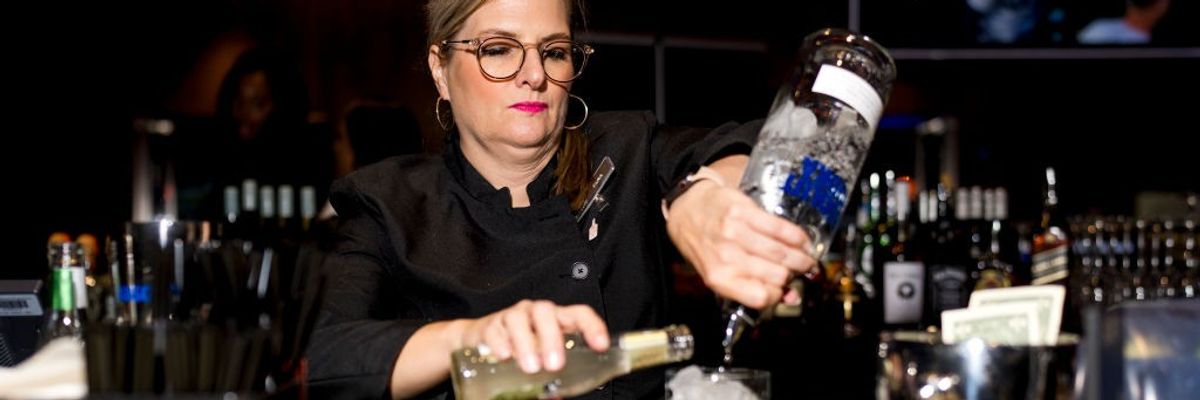


A bartender pours a cocktail at the MGM Grand in Detroit on July 28, 2024.
(Photo: Nic Antaya/Getty Images)

Brett Wilkins
Feb 21, 2025
 COMMON DREAMS

Economic justice advocates excoriated Michigan Gov. Gretchen Whitmer on Friday after the Democrat signed legislation that, while speeding up the state's increase to a $15 hour minimum wage, could leave tipped workers earning less than they would under a system imposed last year by the state Supreme Court, according to critics.

Whitmer signed a pair of bills changing the state's minimum wage, tip credit, and paid sick leave law following an eleventh-hour legislative compromise, explaining in a statement that "Michigan workers deserve fair wages and benefits so they can pay the bills and take care of their family, and small businesses need our support to keep creating good jobs."

Abigail Disney, a member of the group Patriotic Millionaires, said in a statement, "Once again, Democrats have thrown working people under the bus, this time in Michigan under the stewardship of Gov. Gretchen Whitmer."


"In its quest to rebrand itself and win back the working-class vote, Democrats needed to present a unified front in this pivotal moment in Michigan—and anything less than that, which this is, should be taken as an abysmal failure," Disney continued.

"This is the unfortunate but predictable outcome of a party that has proven itself over the years to be for sale to the highest bidder. Voters will definitely notice, and Democrats shouldn't expect them to forgive and forget at the polls in 2026 and beyond," she added.

In 2018, advocates drafted ballot initiatives aimed at expanding paid sick leave and raising the state minimum wage, which was then $9.25 an hour. But Republican state lawmakers moved to block the measures by maliciously adopting and then favorably amending them. Last July, Michigan's Supreme Court ruled this "adopt and amend" tactic unconstitutional and ordered the initial sick leave and minimum wage proposals to take affect at midnight on Friday.

By signing one of the bills, S.B. 8, Whitmer leaves in place a system in which tipped workers' minimum wage will be $4.74 instead of $6 under the court-ordered plan. Customer tips are counted upon to close the gap between the tipped and regular minimum wage of $12.48 per hour. Employers must pay the difference if workers don't reach that amount with tips.

While the Michigan Restaurant and Lodging Association welcomed Whitmer's move, John Driscoll, author of Pay the People! Why Fair Pay Is Good for Business and Great for America, said in a statement that "restaurant lobbyists in Michigan may say that they 'won' this battle in preserving the subminimum wage for tipped workers, but in the end, their efforts will only hurt themselves and their state's economy."

"I know from my own experience as the CEO and chair of businesses that pay people stable and fair wages that doing so is best for workers, businesses, and the broader economy," he continued. "When workers have economic security, they are more loyal and productive, which will help businesses and stimulate growth."

"Contrary to what restaurant associations may claim, everybody lost today when Gov. Whitmer signed S.B. 8 into law," Driscoll added. "Tipped workers lost. Businesses lost. And the Democrats lost too when they sacrificed the most vulnerable workers in Michigan to lobbyists."

The advocacy group One Fair Wage accused the governor of "stripping millions of dollars" from Michigan workers' paychecks.

"Michigan's highest court ruled that these wage increases should take effect," One Fair Wage president Saru Jayaraman said in a statement. "Michigan workers have already earned this raise, and taking it away is not a compromise—it is wage theft. We are mobilizing to ensure voters—not politicians—have the final say on whether these protections remain in place."

One Fair Wage said: "If enough valid signatures are collected, S.B. 8 will be blocked from implementation, and the 2024 Michigan Supreme Court decision requiring that all workers receive a raise to $15 an hour with tips on top will go into effect. The referendum will thus ensure that Michigan voters—not politicians—decide whether these wage increases stand."

One Fair Wage must gather 223,099 valid signatures to suspend S.B. 8 and leave the matter up to Michigan voters.

Meanwhile, the federal tipped minimum wage remains stuck at $2.13 an hour, where it's been since 1991. The federal minimum wage has been $7.25 since 2009.





Japan to release emergency rice reserves to fight runaway inflation

U$A HAS OIL RESERVES


By AFP
February 14, 2025

Japan enacted a law in 1995 for the government to stockpile rice 
- Copyright AFP Yuichi YAMAZAKI


Natsuko FUKUE, Tomohiro OSAKI

The Japanese government said Friday it will release a fifth of its emergency rice stockpile after hot weather, poor harvests and panic buying over a “megaquake” warning nearly doubled prices over a year.

Japan has previously tapped into its reserves to cope with disasters, but this marked the first time since the stockpile was built in 1995 that it was doing so because of supply chain problems.

Some supermarket shelves were emptied in August of rice following a week-long holiday, a series of typhoons and warnings of a looming major earthquake that has so far failed to materialise.

The government had initially hoped prices would stabilise late last year once newly harvested rice arrived in stores, but inflation continued unabated, this time because some distributors were hoarding for fear of running out.

Agriculture Minister Taku Eto told reporters on Friday the government will release 210,000 tonnes of rice from its stock of one million tonnes.

“I hope you will take this as our strong determination to improve at all costs the situation where distribution has been delayed and stuck,” he said.

Rice prices had already began to change consumption patterns for some like Tokyo resident Eriko Kato.

“I still do buy rice occasionally, but since it’s so expensive I sometimes give up on buying it once I see the price,” Kato, 41, told AFP.

A five-kilogramme (11-pound) bag was retailing at 3,688 yen ($24) in the last week of January, according to a government survey, up from 2,023 yen last year.


– Cashing in on crisis –


The law for the government to stockpile the grain was enacted in 1995 after a major rice crop failure two years earlier sent shoppers scrambling to buy the staple.

Masayuki Ogawa, assistant professor at Utsunomiya University, told AFP that a series of factors had contributed to the current crisis.

Among them is the tourism boom and shortage triggered by the extreme heat in 2023 — joint record hottest summer.

The crisis was exacerbated by distributors that were believed to be hoarding in hopes of cashing in later, he said.

“It’s suspected that some distributors are trying to make a profit, waiting for the price hike,” he explained.

But he estimates the price increase could stop if these distributors are forced to release their rice after the government’s move.

The reserve release is “a complicated operation,” as government intervention could impact the stability of rice production and producers’ earnings in the long term, he said.

To prevent the distorting effect, the government is required to buy back the same amount of rice it released within a year.

Rice consumption in Japan has more than halved in the past 60 years to about 50.9 kilogrammes (112 pounds) in 2022, but the grain remains deeply ingrained in Japanese culture and its harvesting has shaped the nation’s landscape — even being used in Shinto rituals.

Tokyo resident Kato says she “sometimes just switches to noodles like udon or soba instead” because rice is more expensive.

But “rice is food for our soul,” she said. “It is important.”

20 years on: Recent advances with graphene


By Dr. Tim Sandle
February 14, 2025
DIGITAL JOURNAL


A large sample of glassy carbon. Image by Alchemist-hp (Creative Commons 3.0)

Some 20 years have gone ever since the discovery of graphene as a single atom layer. Numerous papers have been published to demonstrate its high electron mobility, excellent thermal and mechanical as well as optical properties.

Graphene is an ultra- thin material (one atom thick) and is highly conducive at conducting electricity. The material is strong , very flexible and has been used from coating power plants, to making flexible computing screens to filtering out contaminants from water.

In this article, Digital Journal takes a brief look at five recent innovations with graphene that showcase continued developments. These are centred on different manufacturing and characterization techniques, especially in electronics and power modules.

Graphene enhanced concrete

A collaborative consortium, working within with Abu Dhabi government’s initiatives towards reducing carbon footprint and enhancing economies of construction materials, has undertaken work on boosting the properties of concrete in an environmentally friendly way.

When making cement, used to bind traditional concrete and mortar, limestone and other materials are heated to around 1,480 degrees Celsius. This process results in the release of large amounts of carbon dioxide into the atmosphere. By integrating graphene into concrete, engineers and architects can create structures that require less material, while still achieving the same structural performance as traditional concrete.

Graphene-enhanced concrete is 2.5 times stronger and 4 times less water permeable than standard concrete. It uses much less cement to deliver the desired strength. As a result, it is expected to reduce carbon dioxide emissions by 30 percent.

Graphene enhanced tires

The firm Perpetuus Advanced Materials has introduced the first in its range of proprietary nano engineered graphene-enhanced masterbatch compounds, including tires. The initial offerings include other polymer/elastomer masterbatches suitable for industries such as hoses, seals, gaskets, V-belts, and conveyor belts.

By using a plasma treatment process, Perpetuus graphene is integrated into the masterbatch, allowing tire manufacturers to integrate this breakthrough material into their existing production processes. The process eliminates the need for energy-intensive drying steps and the associated disposal of post-production toxic waste.

In terms of performance, road testing showing up to a 40 percent reduction in tire tread wear, together with improved overall handling and braking.

Cooling technologies

Many cooling solutions are contributing to warming the world. Worldwide, air conditioning accounts for 10 percent of current electricity consumption and associated greenhouse gas emissions. To tackle this, one Ontario company is working to redress this by commercializing advanced material manufacturing.

This is in the form of Evercloak’s technology which changes how buildings are cooled by improving indoor air control and comfort without further warming the planet. To develop refrigerant-free dehumidification systems the technology is powered by graphene oxide composite membrane technology. This can improve building cooling efficiency by up to 50 percent.

Graphene renewables

The firm First Graphene Limited has secured patents in Australia and Korea for its Kainos Technology, used to produce graphite, graphene, and hydrogen from petroleum waste streams.

Smartphone cooling

A limitation with smartphones is a tendency to over-heat. A new innovative cooling system is based on graphene film combined with a 3D VC heat spreader and Ultra-High Thermal Conductivity Graphene. Graphene has a very high thermal conductivity. The material’s large thermal conductivity enables passive cooling and a large thermoelectric power factor enables active cooling

The smartphone device that achieves this is the Huawei Mate X6. This continues Huawei’s use of graphene heat dissipation technology, which started with the use of graphene films in the Huawei Mate 20X and continued with later versions, as well as the Huawei MatePad Pro 5G tablet.


Cognac on the rocks: industry seeks French govt help from Chinese tariffs


By AFP
February 22, 2025


French cognac makers rely on exports for 98 percent of their sales with cognac making up the vast majority of EU brandy exports to China - Copyright AFP/File 

GEORGES GOBET

The French cognac industry said Friday it was losing 50 million euros ($50 million) per month since the imposition of antidumping duties by China and appealed for government help.

Since October 11, European exports of brandy to China have been hit with duties after the EU imposed tariffs of up to 35.3 percent on Chinese electric vehicles over claims of unfair competition.

The measure has been painful for French cognac makers who rely on exports for 98 percent of their sales with cognac making up the vast majority of EU brandy exports to China.

“These punitive measures have already caused a 50 percent drop in our monthly shipments,” the association of cognac and armagnac producers said in a statement.

“We’re starting to see an impact on jobs,” said Florent Morillon of the BNIC association of cognac producers and traders.

“We have an industry that functions very well, that supports more than 70,000 jobs and today it is weighed down by European political decisions,” he added.

The statement comes ahead of the opening Saturday of France’s annual agricultural fair in Paris, a key event for politicians and the industry to meet.

The BNIC called on French Prime Minister Francois Bayrou to travel to China to attempt to resolve the dispute.

“It’s an entirely political issue and it can only be resolved politically,” it added.

An executive of one cognac producer said they had been received by French government leaders but “we have the impression of being sacrificed”.

The executive said there was no possibility of replacing the lost business in China, the top market in terms of value and second in terms of volume behind the United States.

With the return to the White House of Donald Trump, who carried out an aggressive trade policy in his first term that included a stiff 25 percent tariff on cognac, the industry faces additional uncertainty.

“We hope we’ll be spared on that side,” BNIC’s Morillon said.


Bordeaux wine harvest drops to lowest level since 1991


By AFP
February 14, 2025


The Bordeaux region produces some of the world's most famous wines 
- Copyright AFP/File

 Philippe LOPEZ

Cold weather, disease and capacity cuts pushed wine production in France’s Bordeaux region last year to a low not seen in three-and-a-half decades, the local industry body said Friday.

Often called the world’s most famous wine country, Bordeaux — France’s biggest wine region — produces the iconic Medoc, Saint-Emilion, and Pomerol high-end wines, as well as larger quantities of lower-priced produce.

In total, Bordeaux winemakers produced 3.3 million hectolitres of wine last year, after 3.8 million in 2023, a drop of 14 percent.

Unfavourable weather, especially episodes of frost, weighed on production, while a high level of rainfall in the spring favoured the spread of disease, notably mildew.

Another major factor was a government-subsidised reduction in the size of vineyards amid efforts to curb over-production.

Just 95,000 hectares of Bordeaux wine country was cultivated in 2024, down from 103,000 the year before.

But wine professionals detected a silver lining. They say low output would cause prices to rise, and demand to soak up stocks built up in years of excess production.

“This will happen over the coming months or years,” said Christophe Chateau, a spokesman for the CIVB wine sector association, saying that wine sales had already outstripped current production last year.

“If you sell more than you produce, then you not only meet demand, you can dip into your stocks and, arithmetically, prices will rise,” he told AFP.

Meanwhile, Bordeaux winemakers are concerned about the impact of any new tariffs imposed by US President Donald Trump.

The United States is the Bordeaux region’s top export market with wine worth 340 million euros ($355 million) shipped to the US last year.

“We’re not sure what this will mean for sales,” said Chateau. “If Trump slaps a 25-percent tax on French wines in the US, sales there will fall and the imbalances will continue.”

Trump on Thursday unveiled a plan for “reciprocal tariffs” that could affect both allies and competitors, in an escalation of trade tensions since the start of his term.

burs/jh/sjw/jj

China’s EV maker XPeng eyes doubling global presence by year’s end


By AFP
February 22, 2025


XPENG, a Chinese-born global-orientated high-tech automotive company, announces its official entry to the UK — XPENG Visual Asset Library

One of China’s leading electric vehicle makers XPeng plans to double the number of countries in which the company operates by the end of this year, its CEO said Saturday.

Founded in 2014, XPeng is one of the Chinese firms in the sector with the strongest international ambitions, focusing in particular on cutting-edge technologies and design.

“We are going to accelerate from the 30 countries and regions where we were present in 2024,” XPeng founder and chief executive officer He Xiaopeng told a news conference in the southern Guangzhou city, overseeing a shipment of XPeng cars to Thailand.

“This year, we will increase to 60 and will have established more than 300 after-sales service points worldwide,” he said.

XPeng which designs high-end cars, already has stores in several European countries, including France, Germany, Sweden and Norway.

“Over the 10-year period from 2024 to 2033, we expect half of XPeng’s sales to come from outside China,” he said.


X9 electric vehicles by Chinese EV manufacturer XPeng, waiting to be loaded on a ship headed for Thailand – Copyright AFP Pedro Pardo

The ambitious plan comes despite the obstacles posed by the European Union, which has imposed extra import tariffs on China-made electric vehicles of up to 35.3 percent after concluding Beijing’s state support was unfairly undercutting European automakers.

XPeng is banking that its bespoke features — such as driving assistance, rapid recharging and modular interiors — would help it stand out from the crowd in the fiercely competitive Chinese market.

On Saturday, He forecast the possible demise of certain Chinese electric vehicle manufacturers when faced with intense rivalry over price, service and technological advances.

“This year marks the start of the elimination phase in China. I think it’s going to be extremely intense in 2025, 2026 and 2027,” He said.

A record 10.9 million hybrid and electric vehicles were sold in the country last year, up more than 40 percent from 2023, according to the China Passenger Car Association (CPCA).

The Chinese electric vehicle market has witnessed explosive growth in recent years, driven in part by generous subsidies from Beijing.

China’s government has supported the development and production of less polluting battery-powered vehicles, a field where Chinese manufacturers such as BYD and XPeng are leading the way.


Goodbye Tesla, hello Dacia Bigster: Most anticipated EVs revealed


By Dr. Tim Sandle
February 20, 2025
DIGITAL JOURNAL

The Dacia Bigster is a compact crossover SUV from the Romanian car manufacturer Dacia. Image by Ubi-testet CC3.0.

A recent study by Value My Car, conducted in January 2025, ranked the top ten most anticipated electric vehicles of 2025 based on the most recent search interest and market expectations.

The selection of vehicles was based on manufacturer announcements, industry reports, and news sources, covering a mix of compact cars, luxury SUVs, and electric pickups. Models were ranked according to their search volume, with approximate pricing included based on manufacturer estimates, comparable models, and market benchmarks.

This revealed, in perhaps a surprising shift in electric cars, that the Dacia Bigster has surpassed the new Tesla model as the most anticipated EV of 2025, breaking the trend seen in previous years.

The top ten most anticipated models, based on Google search data, are:Dacia Bigster
Tesla Model Q
Volkswagen ID.7
Jeep Wagoneer S
GMC Sierra EV Denali
Jeep Recon
Hyundai Ioniq 9
Renault 5 Turbo 3E
MINI Countryman SE
Mini Aceman

Dacia Bigster is a mid-sized SUV, also available as a hybrid option. With a $30,000 price tag, this vehicle provides a seemingly budget-friendly alternative in a competitive SUV market.

SUVs – or ‘Sports Utility Vehicle’ – are loosely defined, although the vehicle tends to refer to stylish, sleek looking vehicles that offer elegant city driving but also handle rugged terrain thanks to a typical 4×4 capability.

Of the cars bubbling below:

Tesla Model Q comes in second with 737K searches, less than half of Dacia Bigster’s searches. Tesla’s reputation for innovation usually places it at the top, but this year, the Model Q finds itself in second place. The excitement stems from its expected $18,000 price, which would make it one of the most affordable EVs available—nearly half the price of the Dacia Bigster.

Volkswagen ID.7 lands in third with 668K searches. As Volkswagen expands its ID lineup, the ID.7 has drawn considerable attention. Its price exceeds $64,000, and unlike the more budget-friendly models in the ranking, this electric sedan targets buyers looking for a high-end EV.

In fourth place, the Jeep Wagoneer S has captured 499K searches. This premium electric SUV is Jeep’s answer to the growing demand for off-road-capable EVs. It is also $8,000 more expensive than the Volkswagen ID.7, catering to those seeking a combination of rugged durability and electric efficiency.

The GMC Sierra EV Denali, ranking fifth with 428K searches, is the most expensive vehicle in the top 10. Despite its $85,000 price, interest in this electric pickup remains high. It costs nearly five times the price of Tesla’s Model Q, showing a strong market for both high-end and budget-friendly EVs.

Jeep Recon, ranking sixth, has generated 335K searches, nearly 100K fewer than the GMC Sierra EV Denali. This off-road EV, inspired by the Wrangler, is the second most expensive vehicle in the ranking at $79,000, only slightly cheaper than the GMC Sierra EV Denali.

Hyundai Ioniq 9, with 263K searches, takes seventh place. At $55,000, it is almost $24,000 cheaper than the Jeep Recon but still a pricier option compared to the Renault 5 Turbo 3E.

Renault 5 Turbo 3E ranks eighth with 251K searches. This hatchback revives the Renault 5 Turbo with an all-electric powertrain. Priced at $28,000, it is one of the most affordable EVs on the list. It costs nearly the same as the Tesla Model Q, making it an option for those looking for a compact, retro-styled electric vehicle.

In ninth place, the MINI Countryman SE attracted 231K searches. Designed for city drivers, this compact SUV offers electric mobility in an urban-friendly package. At $42,000, it sits between the more budget-friendly models among the high-end EVs.

Rounding out the top 10, the Mini Aceman has drawn 215K searches. This hatchback has both a familiar styling and an electric upgrade. Features like remote parking and a digital key make it a modern, practical choice for city dwellers. It costs just slightly more than the top-ranked Dacia Bigster, priced at $31,920.

After revolution, Bangladesh textbooks rewrite history


By AFP
February 19, 2025


Radical changes to the school curriculum are routine in Bangladesh - Copyright AFP Munir Uz Zaman

Sheikh Sabiha ALAM

Bangladeshi high schooler Laiba is being educated for the future, but what she learns has been determined by the latest chapter in her country’s battle over its past.

Last year, a student-led revolution overthrew the government of iron-fisted premier Sheikh Hasina when public anger over her increasingly autocratic rule boiled over.

Her ouster has prompted Bangladesh to do something that has followed every sudden change in national leadership: rewrite its history books to suit new orthodoxies.

“The tradition of altering history must stop at some point — the sooner, the better,” Laiba’s mother Suraiya Akhtar Jahan told AFP.

“Textbooks should not change every time a new government takes office.”

Radical changes to the school curriculum are routine in Bangladesh, where febrile political divisions dating back to its ruinous 1971 independence war against Pakistan have persisted.

Until this year, textbooks gave special exaltation to the country’s first president Sheikh Mujibur Rahman for spearheading that liberation struggle.

But Mujib, assassinated in 1975 in a military coup, is also Hasina’s father, and his daughter’s disgrace and exile has dented the late leader’s stature.

“The books had turned into one side’s political manifesto,” AKM Riazul Hassan, head of the national agency tasked with reforming the curriculum, told AFP.

“That does not conform to the purpose of textbooks. We tried to get them back on track.”

New history books have expunged dozens of poems, speeches and articles penned by Mujib, alongside images of his daughter.

They instead now valorise the hundreds of people killed in the protests that ultimately toppled Hasina last summer, while bringing back from exile other previously erased heroes of Bangladesh’s early history.

Among them is former army chief Ziaur Rahman — no relation to Mujib — credited with issuing the first public proclamation of Bangladesh’s independence during the 1971 war.

Zia had been left out of the curriculum during Hasina’s time because he founded the Bangladesh Nationalist Party (BNP), her chief opposition.

His return to the page augurs the resurgence of the political force he created, which is strongly favoured to win elections expected by next year.


– ‘Endless cycle’ –


While the overhaul of Bangladesh’s official history gives clues as to the country’s future direction, critics say the new curriculum has its own litany of omissions.

Of particular contention is one of the country’s darkest chapters — the murderous purge of its intellectual elite in the opening days of the 1971 war.

Bangladesh’s main Islamist party Jamaat-e-Islami, which at the time opposed the country’s independence, helped orchestrate these killings in concert with Pakistani forces.

Revised textbooks mention that militia groups were responsible for the murders, without mentioning that the militias were run by Jamaat.

The omission is significant because Jamaat — another party suppressed by Hasina’s government — is likely to be a major force in Bangladesh’s next parliament, and has governed in the past in coalition with the BNP.

Dhaka University professor Mujibur Rahman — no relation to the independence leader — told AFP that the apparently deliberate attempt to obscure details around the purge raised questions about the reasons behind the changes.

“The real question is whether this interim government wants students to learn the actual history,” he added.

Asked about the changes, Hassan said that the textbook commission he helms did not want to trap the nation’s youth “in an endless cycle of hatred”.

“At some point, we need to start reconciliation,” he added. “Should we make our textbooks flooded with hatred? How rational would it be?”


– ‘Minimise their anxiety’ –


Other signs suggest the new textbooks have conceded several changes to hardline religious sentiment in the Muslim-majority nation.

Hasina’s government, for all its other shortcomings on rights issues, was lauded for championing the rights of Bangladesh’s transgender community.

The new textbooks excise references to transgender Bangladeshis, a demand long held by Islamist groups.

Hassan acknowledged that the decision had been taken following objections from a Muslim group campaigning against representations of transgender issues in the curriculum.

“We took their concerns into account,” he said, “and made adjustments accordingly to minimise their anxiety.”


‘Queen of Pop’ Madonna lambasts ‘King’ Trump


By AFP
February 21, 2025


'Queen of Pop' Madonna performs during a Grammy Awards show in Los Angeles, California, on January 26, 2014 - Copyright AFP/File Pedro Pardo

Pop superstar Madonna has reignited her campaign against President Donald Trump, upbraiding the US leader for calling himself “the King.”

Trump declared “LONG LIVE THE KING” to end a social media message on Wednesday stating that he had killed a New York plan to impose a peak congestion charge of $9 for cars entering much of busy Manhattan.

The White House reposted the message on its social media with an illustration showing Trump wearing a diamond-studded crown.

“I thought this country was built by Europeans, escaping living under the rule of a King, to establish a New World governed by the people,” Madonna, widely known as “The Queen of Pop,” said late Thursday on the X platform.

“Currently we have a president who calls Himself Our King. If this is a joke, I’m not laughing,” added the 66-year-old singer.

Madonna had criticized Trump during his first term as president and she took part in a demonstration by Trump opponents after his January 20 inauguration. She has highlighted attacks on LGBTQ rights by the new administration.

Opponents frequently criticize Trump for adopting a regal tone. He said in his inaugural address that he was “saved by God to make America great again,” after surviving an assassination attempt in July.

The Republican leader campaigned against New York’s congestion charge, the first in the United States, during his presidential campaign.

The US Department of Transportation directed New York authorities this week to halt the charge.

New York Governor Kathy Hochul, a Democrat, said lawyers have initiated court action to halt the federal order.

But Trump triumphantly said on his Truth Social platform that “CONGESTION PRICING IS DEAD. Manhattan, and all of New York, is SAVED. LONG LIVE THE KING!”


TRUMP LIES

Unfair? Figures belie Trump’s claims on EU trade balance


By AFP
February 20, 2025


President Donald Trump claims the EU imposes higher tariffs on US cars than vice versa but experts say the reality is more complex 
- Copyright AFP/File Tolga Akmen

Daniel Aronssohn

President Donald Trump repeatedly claims that US-EU trade ties are unfair and that Europe is abusing the United States as justification for threatening tariffs.

But the figures paint a picture of a more balanced relationship than Trump describes, one that benefits both sides of the Atlantic.

– US services surplus

When Trump criticises the European Union’s trade surplus with the United States, he is only referring to trade in goods.

The EU is a major exporter of cars and industrial equipment to the United States and according to the European Commission, there was a goods trade surplus of 157 billion euros ($164 billion) for the 27-country bloc in 2023.

But this figure does not take into account services, which make up the largest part of economic activity.

American firms are very dominant in services, particularly in finance and digital.

Tech titans like Google or Meta don’t have any competitors in Europe. In fact, for services, the EU has a trade deficit of 109 billion euros with the United States.

This means the EU’s actual trade surplus is 48 billion euros, a negligible figure compared with EU-US trade worth 1.6 trillion euros.

– Tariffs barely higher in the EU

One of Trump’s bugbears with Europe is about car imports.

He slams the 10 percent customs duties in the EU on cars imported from the United States, comparing it to the 2.5 percent Washington imposes on Europe’s cars.

But the reality is more complex than Trump’s comments suggest.

The EU and the United States apply customs duties on different products. The EU estimates the “average tariff rate on both sides is approximately one percent”.

“We are at low levels even if the EU taxes a little more than the United States on average,” said Elvire Fabry, trade geopolitics expert at the Jacques Delors Institute.

The commission points out it is the United States that imposes a 25 percent tariff on pickup trucks from Europe — the most popular vehicle in the US market.

Some rates are restrictive, especially in the agricultural sector.

As examples, Fabry gave US taxes of 350 percent on tobacco imports, 164 percent on vegetable oils and 132 percent on fruits as well as 32 percent on clothing.

“Trump takes the numbers that suit him,” Fabry said.

– A win-win partnership

“Trade in goods only paints a part of the picture of the economic relationship between Europe and the US,” said Thibaut L’Ortye of the American Chamber of Commerce to the EU.

“Looking at other metrics, including trade in services, mutual investment and affiliate sales, offers a more complete understanding of the breadth and depth of the relationship,” he told AFP.

“Ultimately, both economies greatly benefit from the partnership,” he added.

The United States is Europe’s largest investor, and vice versa, with 5.3 trillion euros worth of investment in each others’ markets based on 2022 data, the commission said.

The American Chamber of Commerce to the EU does, however, say there are sectors, including digital, “where the success of American companies has made them more exposed and affected by the EU’s initiatives”.

From the US perspective, EU landmark digital rules including a mammoth data protection law as well as content moderation and competition laws constitute non-tariff barriers.

– A high-risk arm wrestling match

Brussels sees “no justification” for Trump’s extra tariffs, but is ready to respond “firmly and swiftly” if the United States goes ahead with extra duties, EU trade chief Maros Sefcovic said during his Washington visit this week.

Rising trade tensions have EU and US businesses worried.

“Tariffs are not the right economic tool. We are concerned about the broad scope of the measures under review, the uncertainty they create,” said L’Ortye.

“We must avoid a negative spiral of tit-for-tat tariffs that would only hurt both economies. The EU and the US should urgently seek a negotiated solution,” he urged.

Musk-Backed AfD Loses in Germany, But Party's Growth Seen as 'Warning' to West

"Worryingly and shockingly, they doubled their vote share, partly in thanks to a boost from U.S. special government employee/world's richest man Elon Musk."


A demonstrator poses for a photo during a protest against the rise of the conservative CDU and the far-right AfD parties in the German elections on February 23, 2025 in Dortmund, Germany.
(Photo: Hesham Elsherif/Getty Images)


Julia Conley
Feb 23, 2025
COMMON DREAMS


The conservative Christian Democrats party in Germany was the winner of the country's elections on Sunday, with leader Friedrich Merz expected to be the next chancellor, beating the far-right Alternative for Germany.

But with the latter group coming in second place and doubling its vote share—winning 20.6% of the vote in the latest exit polls that were out at 4:00 pm Eastern time—progressives in other Western countries suggested the election results should still serve as an urgent warning for political parties like the U.K. Labour Party and the Democrats in the United States.

"Working-class communities need tangible improvements and hope—not more austerity or pandering to Reform in a race-to-the-bottom on immigration," said British member of Parliament Zarah Sultana, referring to the right-wing British party that purports to be populist and prioritizes anti-immigration policies.


Progressives in the U.S. have pointed to the 2024 election, in which working-class voters from across racial demographics swung toward President Donald Trump, as evidence that Democrats must unequivocally support policies that benefit low- and middle-income people to win elections.

At Drop Site News, James Jackson wrote on Saturday about how Germany's embrace of Staatsräson, making the country's vehement support of Israel—and rejection of the push for Palestinian rights—a "reason of state," helped pave the way for AfD's rise:
Almost all German political parties, alongside local authorities and even cultural institutions have joined together in an alliance reaching from right and far-right through the center and even parts of the left to defend the "Reason of State" and crack down on migration from supposedly antisemitic countries, citizenship for foreigners, and civil liberties such as freedom of speech and assembly and academic freedom.

As a result, recent years have seen drastic repression against solidarity with Palestine in Germany, with criticism of Israel often portrayed as antisemitic. This has obviously only accelerated since Hamas' attack on Israel on October 7, 2023 and Israel's brutal war on Gaza.

[...]

"The nationalist party has questionable interest in protecting Israel, but doing so helps wave away Nazi allegations while also pushing the notion that Jewish life is at risk from imported antisemitism," say Chris Reiter and Will Wilkes in their forthcoming book about German decline, Broken Republik. The idea that antisemitism comes from abroad is "much easier for mainstream Germans to accept than the domestic variety. The assertion, which isn't backed up by official statistics, helps promote an agenda that seeks to clamp down on migration from Muslim countries," fitting right into the AfD's agenda.

In Germany, both the Christian Democrats and Alternative for Germany (AfD) pushed anti-immigration platforms ahead of the election. The issue is a top priority for AfD, which has been classified as a suspected extremist group by German intelligence agencies and which has platformed candidates who have minimized the Holocaust, used Nazi slogans, and been linked to plots to overthrow the government.

The far-right party campaigned largely on claims of threats posed by refugees who have arrived in Germany from the Middle East, Afghanistan, and other parts of the world in recent years.

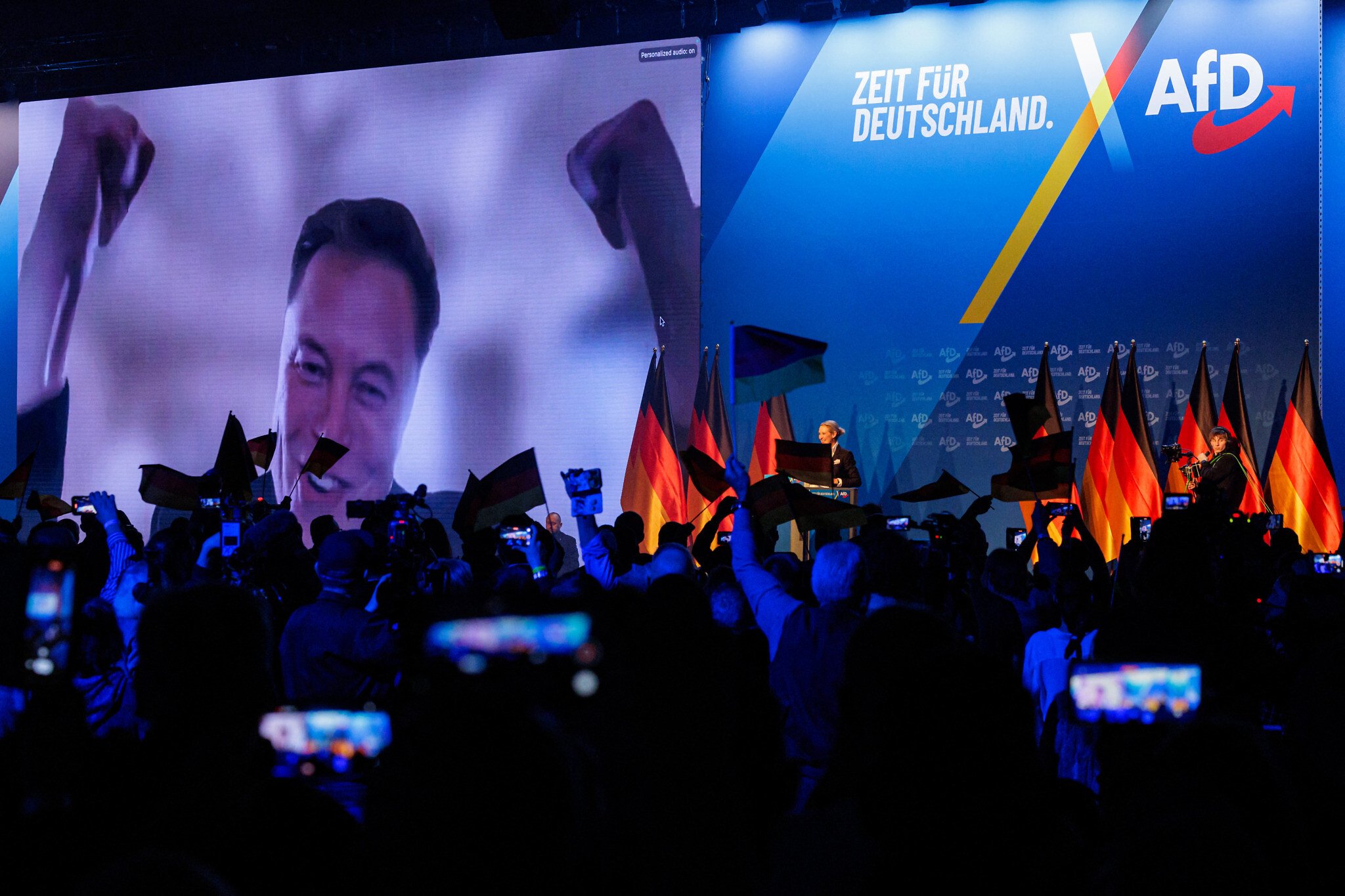
AfD garnered support from billionaire tech mogul Elon Musk, who addressed a rally held by the party days after displaying what appeared to be a Nazi salute at an event for U.S. President Donald Trump.

Trump's vice president, JD Vance, also signaled support for AfD this month when he met with its leader, Alice Weidel.

At the Munich Security Conference, Vance admonished German political parties for the "firewall" that prevents them from forming government coalitions with extremist, anti-democracy groups like AfD.

"I expressly reject what U.S. Vice President Vance said at the Munich Security Conference," said current Chancellor Olaf Scholz. "From the experience of National Socialism, the democratic parties in Germany have a common consensus: This is the firewall against extreme right-wing parties."

In the U.S., journalist Mehdi Hasan expressed relief that AfD lost the election.

"But, worryingly and shockingly, they doubled their vote share," he said, "partly in thanks to a boost from U.S. special government employee/world's richest man Elon Musk who has no objection to their far-right extremism."

Germany’s Merz vows ‘independence’ from Trump’s America, warning NATO may soon be dead

"I have absolutely no illusions about what is happening from America,"

Election winner likens the Trump administration to Putin’s Russia as he bids to take Europe in a new direction.


Friedrich Merz's comments mark a historic watershed: They reveal how deeply Trump has shaken the political foundations of Europe, which has depended on American security guarantees since 1945. | Odd Andersen/AFP via Getty Images\

February 23, 2025
By Tim Ross and Nette Nöstlinger
POITICO EU


BERLIN — Friedrich Merz did not even wait for the final results in Germany's election before delivering what could well be a defining verdict on U.S. President Donald Trump, consigning Europe's 80-year alliance with the United States to the past.

The Trump administration does not care about Europe and is aligning with Russia, said Merz, who is on course to become Germany's new leader. The continent, he warned, must urgently strengthen its defenses and potentially even find a replacement for NATO — within months.

Merz's comments mark a historic watershed: They reveal how deeply Trump has shaken the political foundations of Europe, which has depended on American security guarantees since 1945.

If he follows through on his rhetoric after assembling a new government in the coming weeks, Merz will steer Europe in a radical new direction at a critical time for the security of Ukraine and the wider region.

“My absolute priority will be to strengthen Europe as quickly as possible so that, step by step, we can really achieve independence from the USA,” Germany's chancellor-in-waiting said. “I never thought I would have to say something like this on a television program. But after Donald Trump's statements last week at the latest, it is clear that the Americans, at least this part of the Americans, this administration, are largely indifferent to the fate of Europe.”

Merz, a staunch Atlanticist who has spent much of his professional career as a lawyer working with and for American firms, didn't stop there. Later this year, a NATO summit will be held — but he suggested Europe may need to devise a new defense structure to replace it.

“I am very curious to see how we are heading toward the NATO summit at the end of June," he said. "Whether we will still be talking about NATO in its current form or whether we will have to establish an independent European defense capability much more quickly."
Europe, alone

Such extraordinary statements from the likely next leader of Europe’s biggest economy are stronger than any head of government has made in response to the U.S. president’s 10-day onslaught against Europe and Ukraine.

On Friday, Merz suggested it was time to explore nuclear cooperation between France, the U.K. and Germany (and others) to replace the American nuclear umbrella that has guaranteed European safety from Russian attack. His speculation was anything but idle.

Merz's conservative alliance is projected to win the most seats in the Bundestag but will need to stitch together a coalition with at least one center-left party over the coming weeks.

But he has clearly decided already that he needs to take up the mantle of European leadership, which Germany has been unable to provide in recent months due largely to the election campaign and the political crisis that preceded it.

Europe has also suffered from weakened leadership in France, where President Emmanuel Macron has been battling to keep any form of government together after his snap election gambit last year backfired.

Donald Trump has used his first month back in the White House to destroy the historic bonds between Europe and America that date back to the end of World War II. | Tierney L. Cross/Getty Images
Meanwhile, Trump has used his first month back in the White House to destroy the historic bonds between Europe and America that date back to the end of World War II.

In a series of highly critical interventions, Trump and his team branded Ukrainian President Volodymyr Zelenskyy "a dictator," unilaterally opened unconditional "peace" talks with Russian President Vladimir Putin, and put the region on notice that American troops may not stick around in Europe for much longer.

Another Russia

Merz even went as far as to liken the Trump administration's recent tactics to those of Russia. He was especially critical of tech billionaire Trump adviser Elon Musk for endorsing the far-right Alternative for Germany (AfD) party in the German election.

"I have absolutely no illusions about what is happening from America," Merz said during a televised debate on Sunday night. "Just look at the recent interventions in the German election campaign by Mr. Elon Musk — that is a unique event. The interventions from Washington were no less dramatic and drastic and ultimately outrageous than the interventions we have seen from Moscow. We are under such massive pressure from two sides that my absolute priority now really is to create unity in Europe."

Merz said he had some "residual" hope that the U.S. Congress and the White House would not completely cut Ukraine out of any peace negotiations, though he did not sound optimistic. "I am not sure what the American government's position on this war will be in the coming weeks and months. My impression over the last few days is that Russia and America are coming together here, over the heads of Ukraine and therefore also over the heads of Europe," he said.

His first task would be to put together a stable governing coalition, fast. "Everyone is now looking at Germany. How quickly will the Germans be able to form a government after this complicated election result? And that really is my first priority here."

Earlier, Trump appeared to offer something of an opening to Merz, in a characteristically bizarre manner. The president congratulated the election winners, without naming Merz, and also claimed the conservative victory was part of his own success, somehow.

But it seems that Germany's next leader has made up his own mind about the new American president, regardless.


Conservatives win German vote, far-right comes 2nd with strongest result since WWII

Likely chancellor Merz accuses Trump of being ‘largely indifferent to the fate of Europe’; AfD makes record gains but all other parties have vowed to keep it out of power

By Frank Zeller and Sebastien ASH
TIMES OF ISRAEL
Today


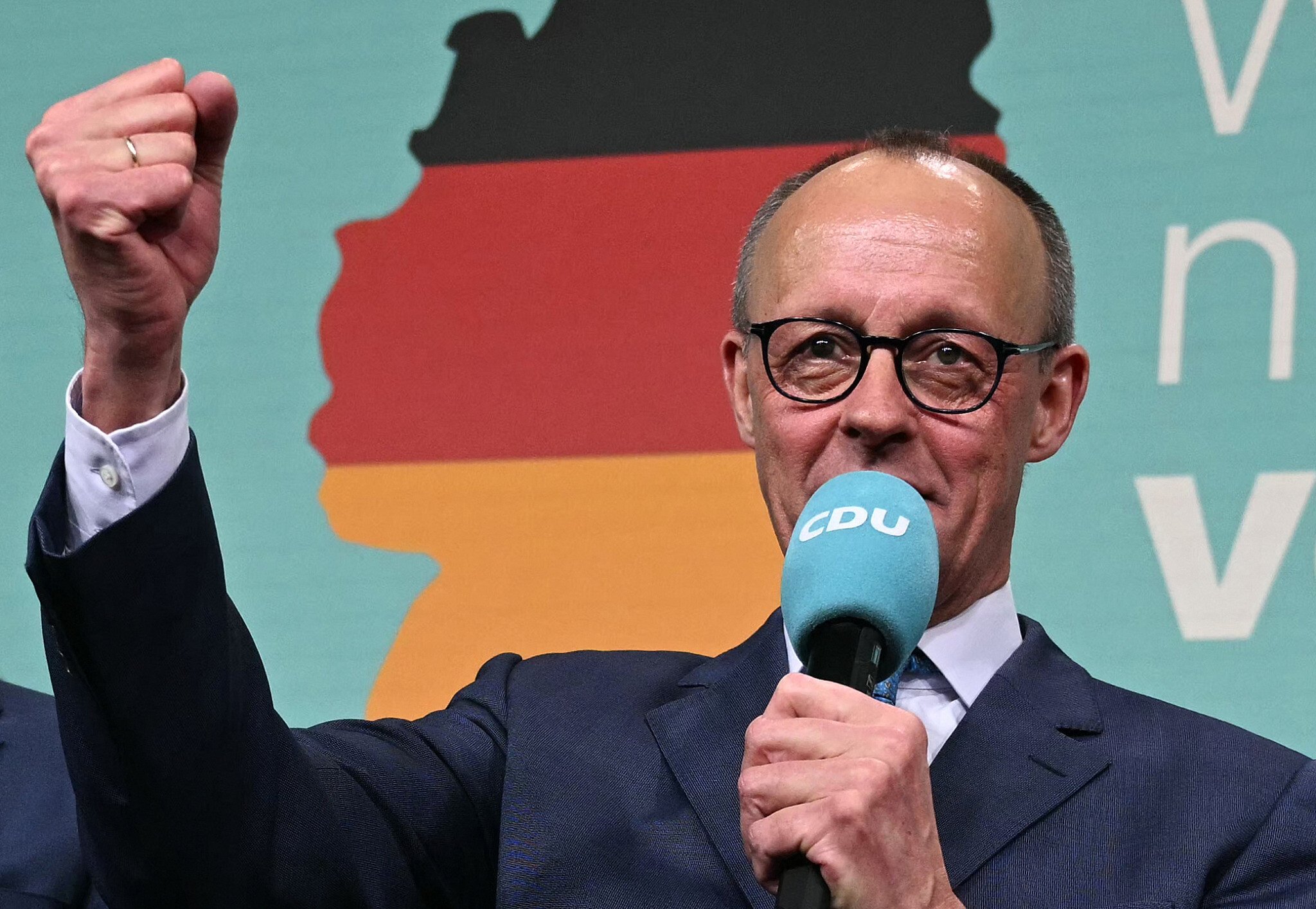
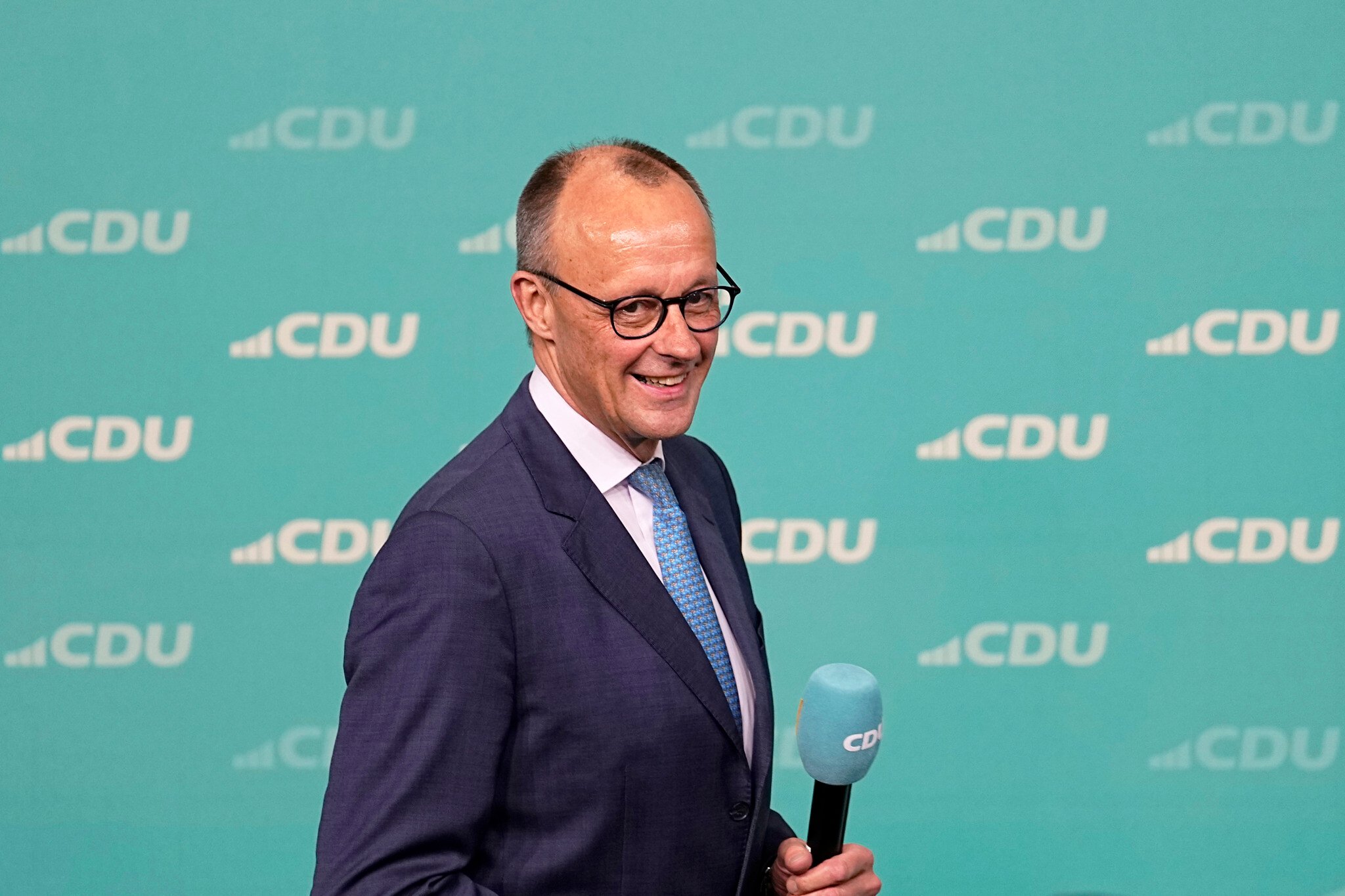
Friedrich Merz, leader of Germany's conservative Christian Democratic Union (CDU) and his party's main candidate for Chancellor addresses supporters after the first exit polls in the German general elections were announced on TV during the electoral evening in Berlin on February 23, 2025. (Ina Fassbender/AFP)


BERLIN, Germany (AFP) — Germany’s conservatives swept to victory in Sunday’s elections, with their leader Friedrich Merz set to become the next chancellor, followed by the far-right AfD in second place with record gains, in the strongest showing for a far-right party since World War II.

Merz urged the speedy formation of a new coalition government, warning that as US President Donald Trump is driving rapid and disruptive changes, “the world isn’t waiting for us.”

He stressed that — after Trump reached out to Russia and made comments fuelling doubts about the future strength of NATO — Europe must boost its defense capabilities and said that he has “no illusions at all about what is coming out of America.”

The far-right Alternative for Germany (AfD) almost doubled its score to over 20 percent, boosted by fears over immigration and security after a spate of deadly attacks blamed on asylum seekers.

Merz’s CDU/CSU alliance won more than 28 percent, according to projections in the early hours of Monday morning, crushing the Social Democrats (SPD) of outgoing Chancellor Olaf Scholz, which were looking at a historic low of 16 percent.

Merz — a long-time party rival of ex-chancellor Angela Merkel — has vowed a crackdown on irregular immigration. He hopes to win back votes from the AfD whose rise has stunned many in a country still seeking to atone for its dark Nazi history.


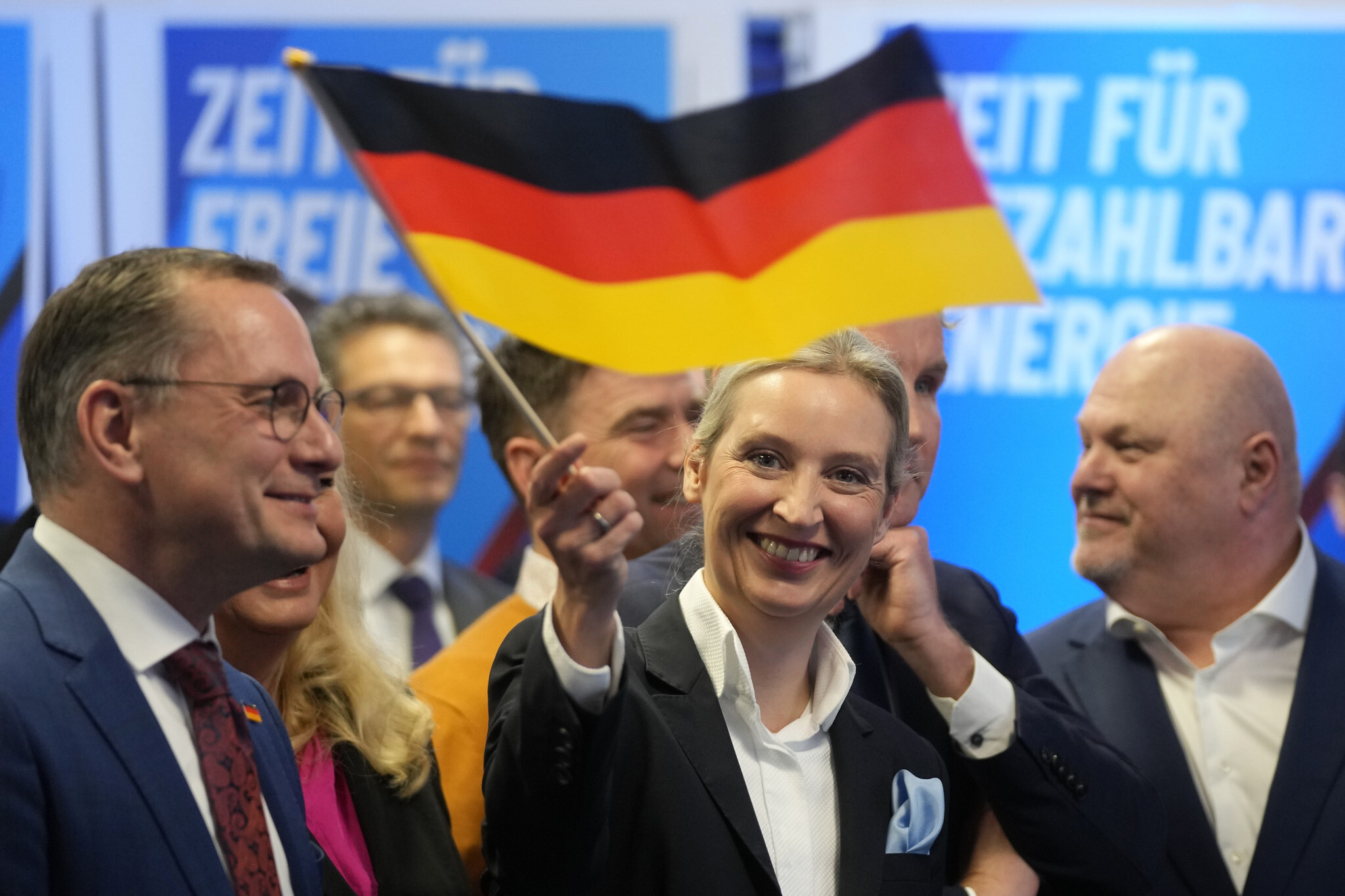
Leader of the far-right AfD Alice Weidel waves a German flag at the AfD party headquarters in Berlin, Germany, Sunday, Feb. 23, 2025, after the German national election. (AP Photo/Michael Probst)

For now, the AfD, basking in the vocal support of key Trump allies, is set to stay in opposition. All other parties have vowed to keep it out of power and behind a “firewall” of non-cooperation.

But its jubilant leader Alice Weidel hailed the “historic” result and again said her party was ready to govern with the CDU/CSU.

“Our hand remains outstretched to form a government,” Weidel told supporters, adding “next time we’ll come first.”

“I am very afraid of this shift to the right,” said retired teacher Hilke Reichersdorfer, 71, wearing a red scarf outside SPD headquarters. She voiced fears of a situation “like in other European countries or in America.”

‘Fate of Europe’

Before Merz, 69, takes over, he will have to forge a new coalition government in Europe’s top economy, an often drawn-out process he has vowed to complete by Easter.

This threatens to leave Berlin paralyzed for weeks to come as Trump has forced head-spinning change and rattled European allies, especially over the Ukraine war.

The German election came amid tectonic upheaval in US-Europe ties sparked by Trump going over the heads of European leaders to make a direct outreach to Russian President Vladimir Putin to end the three-year-old Ukraine war, which began with the February 2022 Russian invasion of Ukraine.

“After Donald Trump’s statements in the last week it is clear that the Americans are largely indifferent to the fate of Europe,” said Merz, hitherto seen as an Atlanticist, in a post-election TV debate.


Friedrich Merz, the candidate of the mainstream conservative Christian Democratic Union party, arrives on stage to address supporters at the party headquarters in Berlin, Germany, February 23, 2025, after the German national election. (AP Photo/Martin Meissner)

Merz’s broadside against the US came despite Trump welcoming the election outcome with a post on his Truth Social.

“Much like the USA, the people of Germany got tired of the no common sense agenda, especially on energy and immigration, that has prevailed for so many years,” Trump wrote.

Merz said his “absolute priority will be to strengthen Europe as quickly as possible so that, step by step, we can really achieve independence from the USA step by step.”

He even ventured to ask whether the next summit of the North Atlantic Treaty Organisation, which has underpinned Europe’s security for decades, would still see “NATO in its current form.”

To build a majority, Merz may first reach out to the SPD, though without Scholz, who apologized for his party’s “bitter” defeat.

Merz could also approach the Greens, who scored 12 percent, although the CDU’s Bavarian sister party the CSU has so far rejected this.

Another potential partner, the small FDP — which sparked the November breakup of Scholz’s government — stared down the barrel of narrowly missing the five-percent hurdle to return to parliament.

This would impact the complex parliamentary arithmetic, as would the fate of the far-left BSW, which was just below the threshold late Sunday, at 4.9 percent.

If the BSW eventually scrapes in, this will mean Merz needs two coalition allies — raising the specter of yet another ideologically diverse alliance, like the failed alliance that was led by Scholz.

‘Last chance’


In a strange twist to the polarised campaign, the AfD has basked in the support of Team Trump, which saw billionaire Elon Musk praising it as the only party that can “save Germany.”

Merz said “the interventions from Washington were no less dramatic and impertinent than the interventions we have seen from Moscow, so we are under massive pressure from two sides.”

US tech billionaire and businessman Elon Musk (L) is seen on a large screen as Alice Weidel, co-leader of Germany’s far-right Alternative for Germany (AfD) party, addresses an election campaign rally in Halle, eastern Germany on January 25, 2025. (AFP)

The AfD, strongest in the ex-communist east, also made gains in western states for its best-ever result after Germany was shocked by a series of deadly attacks blamed on migrants.

In December a car ramming through a Christmas market crowd killed six people and wounded hundreds.

A stabbing spree targeting kindergarten children followed, then another car-ramming attack, in Munich, and a knife attack at Berlin’s Holocaust memorial just last weekend.

Merz has argued that the next government must boldly address the AfD’s concerns on migration and also fix the ailing economy, warning that otherwise the far right might win next time around.

“The stakes could not be higher,” argued political analyst and author Michael Broening.

“Germany’s mainstream parties have consistently failed to convince voters to reject the far right, and this election could be their last chance to turn the tide.”

Democratic forces must find solutions to the country’s problems, he added. “If Germany’s ‘establishment’ parties fail to deliver this time, they may not be the establishment for much longer.”

Reuters contributed to this report.
R IS FOR RECESSION

'Domino effect' of Trump policies to spread pain nationwide: economists

Brad Reed
February 23, 2025 

Former President Donald Trump. (Jonah Elkowitz / Shutterstock)

CNBC is reporting that President Donald Trump and X owner Elon Musk's cuts to the federal workforce may amount to "the biggest job cut in U.S. history" that could also hurt the U.S. economy as a whole.

Depending on different variables, experts who spoke with CNBC estimate that hundreds of thousands of federal workers could soon be unemployed, which would be a significant negative economic shock felt throughout the entire country.

Callie Cox, the chief market strategist at Ritholtz Wealth Management, wrote last week that cuts of this magnitude would bring real economic pain, and not just to places like Washington D.C. but to communities throughout the United States where federal workers are located.

"We may soon find out the hard way that people drive the U.S. economy," she warned.

ALSO READ: 'Lies and distortions': New York Times offers unusually blunt assessment of Trump tactics

Erica Groshen, a senior economics advisor at Cornell University and former commissioner of the U.S. Bureau of Labor Statistics, similarly told CNBC that these job losses would ripple throughout the whole economy.

"There are economic impacts to [laid-off workers], their families, to the businesses they would have bought goods and services from," she said.

Ernie Tedeschi, director of economics at the Yale University Budget Lab, sounded a similarly pessimistic note.

“The economic consequences of layoffs are like a domino effect that spread across local economies to businesses that seem to have no connection whatsoever to the federal government," he said, although he also added that these layoffs in and of themselves would not be enough to push the economy into a recession.