Musk-Backed AfD Loses in Germany, But Party's Growth Seen as 'Warning' to West
"Worryingly and shockingly, they doubled their vote share, partly in thanks to a boost from U.S. special government employee/world's richest man Elon Musk."
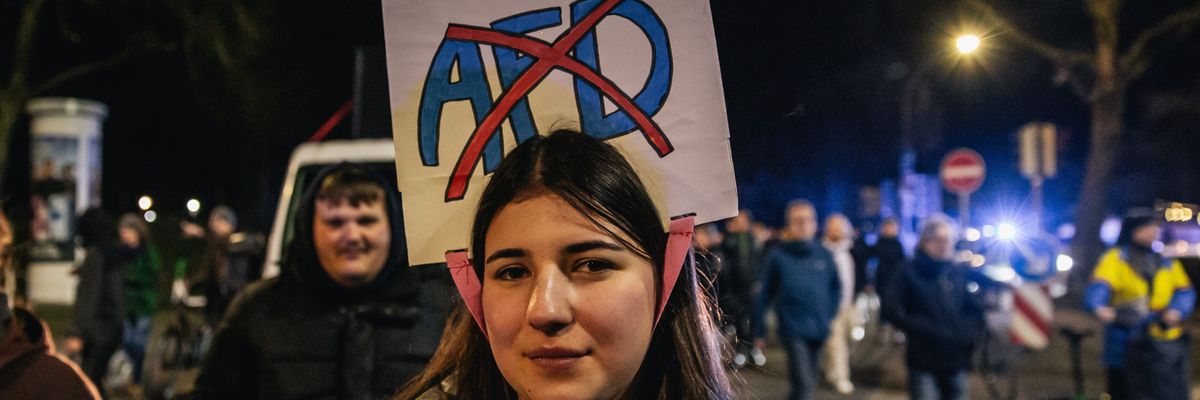
A demonstrator poses for a photo during a protest against the rise of the conservative CDU and the far-right AfD parties in the German elections on February 23, 2025 in Dortmund, Germany.
(Photo: Hesham Elsherif/Getty Images)
Julia Conley
Feb 23, 2025
"Worryingly and shockingly, they doubled their vote share, partly in thanks to a boost from U.S. special government employee/world's richest man Elon Musk."
A demonstrator poses for a photo during a protest against the rise of the conservative CDU and the far-right AfD parties in the German elections on February 23, 2025 in Dortmund, Germany.
(Photo: Hesham Elsherif/Getty Images)
Julia Conley
Feb 23, 2025
COMMON DREAMS
The conservative Christian Democrats party in Germany was the winner of the country's elections on Sunday, with leader Friedrich Merz expected to be the next chancellor, beating the far-right Alternative for Germany.
But with the latter group coming in second place and doubling its vote share—winning 20.6% of the vote in the latest exit polls that were out at 4:00 pm Eastern time—progressives in other Western countries suggested the election results should still serve as an urgent warning for political parties like the U.K. Labour Party and the Democrats in the United States.
"Working-class communities need tangible improvements and hope—not more austerity or pandering to Reform in a race-to-the-bottom on immigration," said British member of Parliament Zarah Sultana, referring to the right-wing British party that purports to be populist and prioritizes anti-immigration policies.
Progressives in the U.S. have pointed to the 2024 election, in which working-class voters from across racial demographics swung toward President Donald Trump, as evidence that Democrats must unequivocally support policies that benefit low- and middle-income people to win elections.
At Drop Site News, James Jackson wrote on Saturday about how Germany's embrace of Staatsräson, making the country's vehement support of Israel—and rejection of the push for Palestinian rights—a "reason of state," helped pave the way for AfD's rise:
Almost all German political parties, alongside local authorities and even cultural institutions have joined together in an alliance reaching from right and far-right through the center and even parts of the left to defend the "Reason of State" and crack down on migration from supposedly antisemitic countries, citizenship for foreigners, and civil liberties such as freedom of speech and assembly and academic freedom.
As a result, recent years have seen drastic repression against solidarity with Palestine in Germany, with criticism of Israel often portrayed as antisemitic. This has obviously only accelerated since Hamas' attack on Israel on October 7, 2023 and Israel's brutal war on Gaza.
[...]
"The nationalist party has questionable interest in protecting Israel, but doing so helps wave away Nazi allegations while also pushing the notion that Jewish life is at risk from imported antisemitism," say Chris Reiter and Will Wilkes in their forthcoming book about German decline, Broken Republik. The idea that antisemitism comes from abroad is "much easier for mainstream Germans to accept than the domestic variety. The assertion, which isn't backed up by official statistics, helps promote an agenda that seeks to clamp down on migration from Muslim countries," fitting right into the AfD's agenda.
In Germany, both the Christian Democrats and Alternative for Germany (AfD) pushed anti-immigration platforms ahead of the election. The issue is a top priority for AfD, which has been classified as a suspected extremist group by German intelligence agencies and which has platformed candidates who have minimized the Holocaust, used Nazi slogans, and been linked to plots to overthrow the government.
The far-right party campaigned largely on claims of threats posed by refugees who have arrived in Germany from the Middle East, Afghanistan, and other parts of the world in recent years.
AfD garnered support from billionaire tech mogul Elon Musk, who addressed a rally held by the party days after displaying what appeared to be a Nazi salute at an event for U.S. President Donald Trump.
Trump's vice president, JD Vance, also signaled support for AfD this month when he met with its leader, Alice Weidel.
At the Munich Security Conference, Vance admonished German political parties for the "firewall" that prevents them from forming government coalitions with extremist, anti-democracy groups like AfD.
"I expressly reject what U.S. Vice President Vance said at the Munich Security Conference," said current Chancellor Olaf Scholz. "From the experience of National Socialism, the democratic parties in Germany have a common consensus: This is the firewall against extreme right-wing parties."
In the U.S., journalist Mehdi Hasan expressed relief that AfD lost the election.
"But, worryingly and shockingly, they doubled their vote share," he said, "partly in thanks to a boost from U.S. special government employee/world's richest man Elon Musk who has no objection to their far-right extremism."
The conservative Christian Democrats party in Germany was the winner of the country's elections on Sunday, with leader Friedrich Merz expected to be the next chancellor, beating the far-right Alternative for Germany.
But with the latter group coming in second place and doubling its vote share—winning 20.6% of the vote in the latest exit polls that were out at 4:00 pm Eastern time—progressives in other Western countries suggested the election results should still serve as an urgent warning for political parties like the U.K. Labour Party and the Democrats in the United States.
"Working-class communities need tangible improvements and hope—not more austerity or pandering to Reform in a race-to-the-bottom on immigration," said British member of Parliament Zarah Sultana, referring to the right-wing British party that purports to be populist and prioritizes anti-immigration policies.
Progressives in the U.S. have pointed to the 2024 election, in which working-class voters from across racial demographics swung toward President Donald Trump, as evidence that Democrats must unequivocally support policies that benefit low- and middle-income people to win elections.
At Drop Site News, James Jackson wrote on Saturday about how Germany's embrace of Staatsräson, making the country's vehement support of Israel—and rejection of the push for Palestinian rights—a "reason of state," helped pave the way for AfD's rise:
Almost all German political parties, alongside local authorities and even cultural institutions have joined together in an alliance reaching from right and far-right through the center and even parts of the left to defend the "Reason of State" and crack down on migration from supposedly antisemitic countries, citizenship for foreigners, and civil liberties such as freedom of speech and assembly and academic freedom.
As a result, recent years have seen drastic repression against solidarity with Palestine in Germany, with criticism of Israel often portrayed as antisemitic. This has obviously only accelerated since Hamas' attack on Israel on October 7, 2023 and Israel's brutal war on Gaza.
[...]
"The nationalist party has questionable interest in protecting Israel, but doing so helps wave away Nazi allegations while also pushing the notion that Jewish life is at risk from imported antisemitism," say Chris Reiter and Will Wilkes in their forthcoming book about German decline, Broken Republik. The idea that antisemitism comes from abroad is "much easier for mainstream Germans to accept than the domestic variety. The assertion, which isn't backed up by official statistics, helps promote an agenda that seeks to clamp down on migration from Muslim countries," fitting right into the AfD's agenda.
In Germany, both the Christian Democrats and Alternative for Germany (AfD) pushed anti-immigration platforms ahead of the election. The issue is a top priority for AfD, which has been classified as a suspected extremist group by German intelligence agencies and which has platformed candidates who have minimized the Holocaust, used Nazi slogans, and been linked to plots to overthrow the government.
The far-right party campaigned largely on claims of threats posed by refugees who have arrived in Germany from the Middle East, Afghanistan, and other parts of the world in recent years.
AfD garnered support from billionaire tech mogul Elon Musk, who addressed a rally held by the party days after displaying what appeared to be a Nazi salute at an event for U.S. President Donald Trump.
Trump's vice president, JD Vance, also signaled support for AfD this month when he met with its leader, Alice Weidel.
At the Munich Security Conference, Vance admonished German political parties for the "firewall" that prevents them from forming government coalitions with extremist, anti-democracy groups like AfD.
"I expressly reject what U.S. Vice President Vance said at the Munich Security Conference," said current Chancellor Olaf Scholz. "From the experience of National Socialism, the democratic parties in Germany have a common consensus: This is the firewall against extreme right-wing parties."
In the U.S., journalist Mehdi Hasan expressed relief that AfD lost the election.
"But, worryingly and shockingly, they doubled their vote share," he said, "partly in thanks to a boost from U.S. special government employee/world's richest man Elon Musk who has no objection to their far-right extremism."
"I have absolutely no illusions about what is happening from America,"
Election winner likens the Trump administration to Putin’s Russia as he bids to take Europe in a new direction.

Friedrich Merz's comments mark a historic watershed: They reveal how deeply Trump has shaken the political foundations of Europe, which has depended on American security guarantees since 1945. | Odd Andersen/AFP via Getty Images\
February 23, 2025
By Tim Ross and Nette Nöstlinger
POITICO EU
BERLIN — Friedrich Merz did not even wait for the final results in Germany's election before delivering what could well be a defining verdict on U.S. President Donald Trump, consigning Europe's 80-year alliance with the United States to the past.
The Trump administration does not care about Europe and is aligning with Russia, said Merz, who is on course to become Germany's new leader. The continent, he warned, must urgently strengthen its defenses and potentially even find a replacement for NATO — within months.
Merz's comments mark a historic watershed: They reveal how deeply Trump has shaken the political foundations of Europe, which has depended on American security guarantees since 1945.
If he follows through on his rhetoric after assembling a new government in the coming weeks, Merz will steer Europe in a radical new direction at a critical time for the security of Ukraine and the wider region.
“My absolute priority will be to strengthen Europe as quickly as possible so that, step by step, we can really achieve independence from the USA,” Germany's chancellor-in-waiting said. “I never thought I would have to say something like this on a television program. But after Donald Trump's statements last week at the latest, it is clear that the Americans, at least this part of the Americans, this administration, are largely indifferent to the fate of Europe.”
Merz, a staunch Atlanticist who has spent much of his professional career as a lawyer working with and for American firms, didn't stop there. Later this year, a NATO summit will be held — but he suggested Europe may need to devise a new defense structure to replace it.
“I am very curious to see how we are heading toward the NATO summit at the end of June," he said. "Whether we will still be talking about NATO in its current form or whether we will have to establish an independent European defense capability much more quickly."
Europe, alone
Such extraordinary statements from the likely next leader of Europe’s biggest economy are stronger than any head of government has made in response to the U.S. president’s 10-day onslaught against Europe and Ukraine.
On Friday, Merz suggested it was time to explore nuclear cooperation between France, the U.K. and Germany (and others) to replace the American nuclear umbrella that has guaranteed European safety from Russian attack. His speculation was anything but idle.
Merz's conservative alliance is projected to win the most seats in the Bundestag but will need to stitch together a coalition with at least one center-left party over the coming weeks.
But he has clearly decided already that he needs to take up the mantle of European leadership, which Germany has been unable to provide in recent months due largely to the election campaign and the political crisis that preceded it.
Europe has also suffered from weakened leadership in France, where President Emmanuel Macron has been battling to keep any form of government together after his snap election gambit last year backfired.
BERLIN — Friedrich Merz did not even wait for the final results in Germany's election before delivering what could well be a defining verdict on U.S. President Donald Trump, consigning Europe's 80-year alliance with the United States to the past.
The Trump administration does not care about Europe and is aligning with Russia, said Merz, who is on course to become Germany's new leader. The continent, he warned, must urgently strengthen its defenses and potentially even find a replacement for NATO — within months.
Merz's comments mark a historic watershed: They reveal how deeply Trump has shaken the political foundations of Europe, which has depended on American security guarantees since 1945.
If he follows through on his rhetoric after assembling a new government in the coming weeks, Merz will steer Europe in a radical new direction at a critical time for the security of Ukraine and the wider region.
“My absolute priority will be to strengthen Europe as quickly as possible so that, step by step, we can really achieve independence from the USA,” Germany's chancellor-in-waiting said. “I never thought I would have to say something like this on a television program. But after Donald Trump's statements last week at the latest, it is clear that the Americans, at least this part of the Americans, this administration, are largely indifferent to the fate of Europe.”
Merz, a staunch Atlanticist who has spent much of his professional career as a lawyer working with and for American firms, didn't stop there. Later this year, a NATO summit will be held — but he suggested Europe may need to devise a new defense structure to replace it.
“I am very curious to see how we are heading toward the NATO summit at the end of June," he said. "Whether we will still be talking about NATO in its current form or whether we will have to establish an independent European defense capability much more quickly."
Europe, alone
Such extraordinary statements from the likely next leader of Europe’s biggest economy are stronger than any head of government has made in response to the U.S. president’s 10-day onslaught against Europe and Ukraine.
On Friday, Merz suggested it was time to explore nuclear cooperation between France, the U.K. and Germany (and others) to replace the American nuclear umbrella that has guaranteed European safety from Russian attack. His speculation was anything but idle.
Merz's conservative alliance is projected to win the most seats in the Bundestag but will need to stitch together a coalition with at least one center-left party over the coming weeks.
But he has clearly decided already that he needs to take up the mantle of European leadership, which Germany has been unable to provide in recent months due largely to the election campaign and the political crisis that preceded it.
Europe has also suffered from weakened leadership in France, where President Emmanuel Macron has been battling to keep any form of government together after his snap election gambit last year backfired.
 Donald Trump has used his first month back in the White House to destroy the historic bonds between Europe and America that date back to the end of World War II. | Tierney L. Cross/Getty Images
Meanwhile, Trump has used his first month back in the White House to destroy the historic bonds between Europe and America that date back to the end of World War II.
In a series of highly critical interventions, Trump and his team branded Ukrainian President Volodymyr Zelenskyy "a dictator," unilaterally opened unconditional "peace" talks with Russian President Vladimir Putin, and put the region on notice that American troops may not stick around in Europe for much longer.
Another Russia
Merz even went as far as to liken the Trump administration's recent tactics to those of Russia. He was especially critical of tech billionaire Trump adviser Elon Musk for endorsing the far-right Alternative for Germany (AfD) party in the German election.
"I have absolutely no illusions about what is happening from America," Merz said during a televised debate on Sunday night. "Just look at the recent interventions in the German election campaign by Mr. Elon Musk — that is a unique event. The interventions from Washington were no less dramatic and drastic and ultimately outrageous than the interventions we have seen from Moscow. We are under such massive pressure from two sides that my absolute priority now really is to create unity in Europe."
Merz said he had some "residual" hope that the U.S. Congress and the White House would not completely cut Ukraine out of any peace negotiations, though he did not sound optimistic. "I am not sure what the American government's position on this war will be in the coming weeks and months. My impression over the last few days is that Russia and America are coming together here, over the heads of Ukraine and therefore also over the heads of Europe," he said.
His first task would be to put together a stable governing coalition, fast. "Everyone is now looking at Germany. How quickly will the Germans be able to form a government after this complicated election result? And that really is my first priority here."
Earlier, Trump appeared to offer something of an opening to Merz, in a characteristically bizarre manner. The president congratulated the election winners, without naming Merz, and also claimed the conservative victory was part of his own success, somehow.
But it seems that Germany's next leader has made up his own mind about the new American president, regardless.
Conservatives win German vote, far-right comes 2nd with strongest result since WWII
Likely chancellor Merz accuses Trump of being ‘largely indifferent to the fate of Europe’; AfD makes record gains but all other parties have vowed to keep it out of power
By Frank Zeller and Sebastien ASH
Likely chancellor Merz accuses Trump of being ‘largely indifferent to the fate of Europe’; AfD makes record gains but all other parties have vowed to keep it out of power
By Frank Zeller and Sebastien ASH
TIMES OF ISRAEL
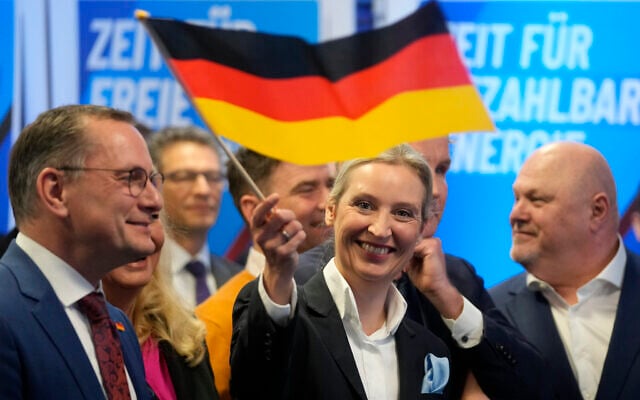
Leader of the far-right AfD Alice Weidel waves a German flag at the AfD party headquarters in Berlin, Germany, Sunday, Feb. 23, 2025, after the German national election. (AP Photo/Michael Probst)
For now, the AfD, basking in the vocal support of key Trump allies, is set to stay in opposition. All other parties have vowed to keep it out of power and behind a “firewall” of non-cooperation.
But its jubilant leader Alice Weidel hailed the “historic” result and again said her party was ready to govern with the CDU/CSU.
“Our hand remains outstretched to form a government,” Weidel told supporters, adding “next time we’ll come first.”
“I am very afraid of this shift to the right,” said retired teacher Hilke Reichersdorfer, 71, wearing a red scarf outside SPD headquarters. She voiced fears of a situation “like in other European countries or in America.”
‘Fate of Europe’
Before Merz, 69, takes over, he will have to forge a new coalition government in Europe’s top economy, an often drawn-out process he has vowed to complete by Easter.
This threatens to leave Berlin paralyzed for weeks to come as Trump has forced head-spinning change and rattled European allies, especially over the Ukraine war.
The German election came amid tectonic upheaval in US-Europe ties sparked by Trump going over the heads of European leaders to make a direct outreach to Russian President Vladimir Putin to end the three-year-old Ukraine war, which began with the February 2022 Russian invasion of Ukraine.
“After Donald Trump’s statements in the last week it is clear that the Americans are largely indifferent to the fate of Europe,” said Merz, hitherto seen as an Atlanticist, in a post-election TV debate.
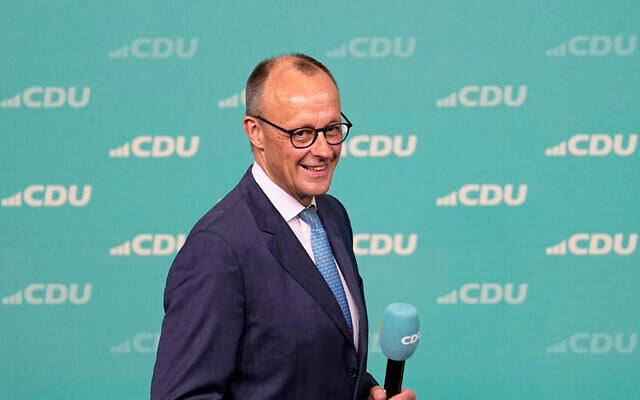
Friedrich Merz, the candidate of the mainstream conservative Christian Democratic Union party, arrives on stage to address supporters at the party headquarters in Berlin, Germany, February 23, 2025, after the German national election. (AP Photo/Martin Meissner)
Merz’s broadside against the US came despite Trump welcoming the election outcome with a post on his Truth Social.
“Much like the USA, the people of Germany got tired of the no common sense agenda, especially on energy and immigration, that has prevailed for so many years,” Trump wrote.
Merz said his “absolute priority will be to strengthen Europe as quickly as possible so that, step by step, we can really achieve independence from the USA step by step.”
He even ventured to ask whether the next summit of the North Atlantic Treaty Organisation, which has underpinned Europe’s security for decades, would still see “NATO in its current form.”
To build a majority, Merz may first reach out to the SPD, though without Scholz, who apologized for his party’s “bitter” defeat.
Merz could also approach the Greens, who scored 12 percent, although the CDU’s Bavarian sister party the CSU has so far rejected this.
Another potential partner, the small FDP — which sparked the November breakup of Scholz’s government — stared down the barrel of narrowly missing the five-percent hurdle to return to parliament.
This would impact the complex parliamentary arithmetic, as would the fate of the far-left BSW, which was just below the threshold late Sunday, at 4.9 percent.
If the BSW eventually scrapes in, this will mean Merz needs two coalition allies — raising the specter of yet another ideologically diverse alliance, like the failed alliance that was led by Scholz.
‘Last chance’
In a strange twist to the polarised campaign, the AfD has basked in the support of Team Trump, which saw billionaire Elon Musk praising it as the only party that can “save Germany.”
Merz said “the interventions from Washington were no less dramatic and impertinent than the interventions we have seen from Moscow, so we are under massive pressure from two sides.”
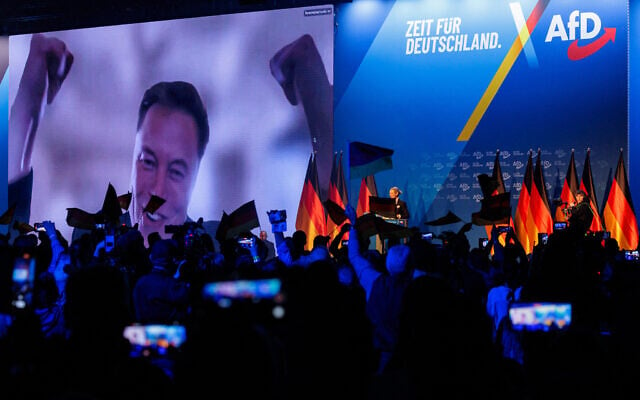
US tech billionaire and businessman Elon Musk (L) is seen on a large screen as Alice Weidel, co-leader of Germany’s far-right Alternative for Germany (AfD) party, addresses an election campaign rally in Halle, eastern Germany on January 25, 2025. (AFP)
The AfD, strongest in the ex-communist east, also made gains in western states for its best-ever result after Germany was shocked by a series of deadly attacks blamed on migrants.
In December a car ramming through a Christmas market crowd killed six people and wounded hundreds.
A stabbing spree targeting kindergarten children followed, then another car-ramming attack, in Munich, and a knife attack at Berlin’s Holocaust memorial just last weekend.
Merz has argued that the next government must boldly address the AfD’s concerns on migration and also fix the ailing economy, warning that otherwise the far right might win next time around.
“The stakes could not be higher,” argued political analyst and author Michael Broening.
“Germany’s mainstream parties have consistently failed to convince voters to reject the far right, and this election could be their last chance to turn the tide.”
Democratic forces must find solutions to the country’s problems, he added. “If Germany’s ‘establishment’ parties fail to deliver this time, they may not be the establishment for much longer.”
Reuters contributed to this report.
Today
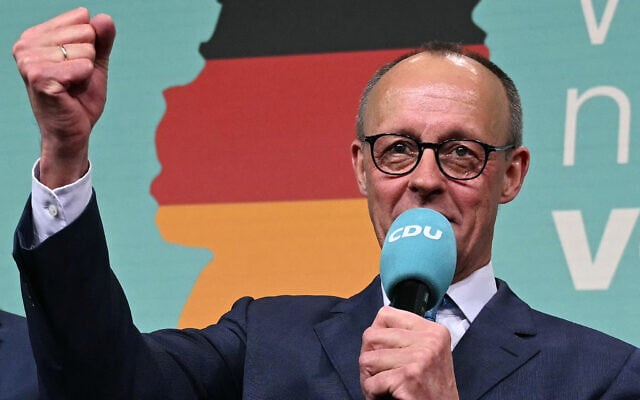
Friedrich Merz, leader of Germany's conservative Christian Democratic Union (CDU) and his party's main candidate for Chancellor addresses supporters after the first exit polls in the German general elections were announced on TV during the electoral evening in Berlin on February 23, 2025. (Ina Fassbender/AFP)
BERLIN, Germany (AFP) — Germany’s conservatives swept to victory in Sunday’s elections, with their leader Friedrich Merz set to become the next chancellor, followed by the far-right AfD in second place with record gains, in the strongest showing for a far-right party since World War II.
Merz urged the speedy formation of a new coalition government, warning that as US President Donald Trump is driving rapid and disruptive changes, “the world isn’t waiting for us.”
He stressed that — after Trump reached out to Russia and made comments fuelling doubts about the future strength of NATO — Europe must boost its defense capabilities and said that he has “no illusions at all about what is coming out of America.”
The far-right Alternative for Germany (AfD) almost doubled its score to over 20 percent, boosted by fears over immigration and security after a spate of deadly attacks blamed on asylum seekers.
Merz’s CDU/CSU alliance won more than 28 percent, according to projections in the early hours of Monday morning, crushing the Social Democrats (SPD) of outgoing Chancellor Olaf Scholz, which were looking at a historic low of 16 percent.
Merz — a long-time party rival of ex-chancellor Angela Merkel — has vowed a crackdown on irregular immigration. He hopes to win back votes from the AfD whose rise has stunned many in a country still seeking to atone for its dark Nazi history.
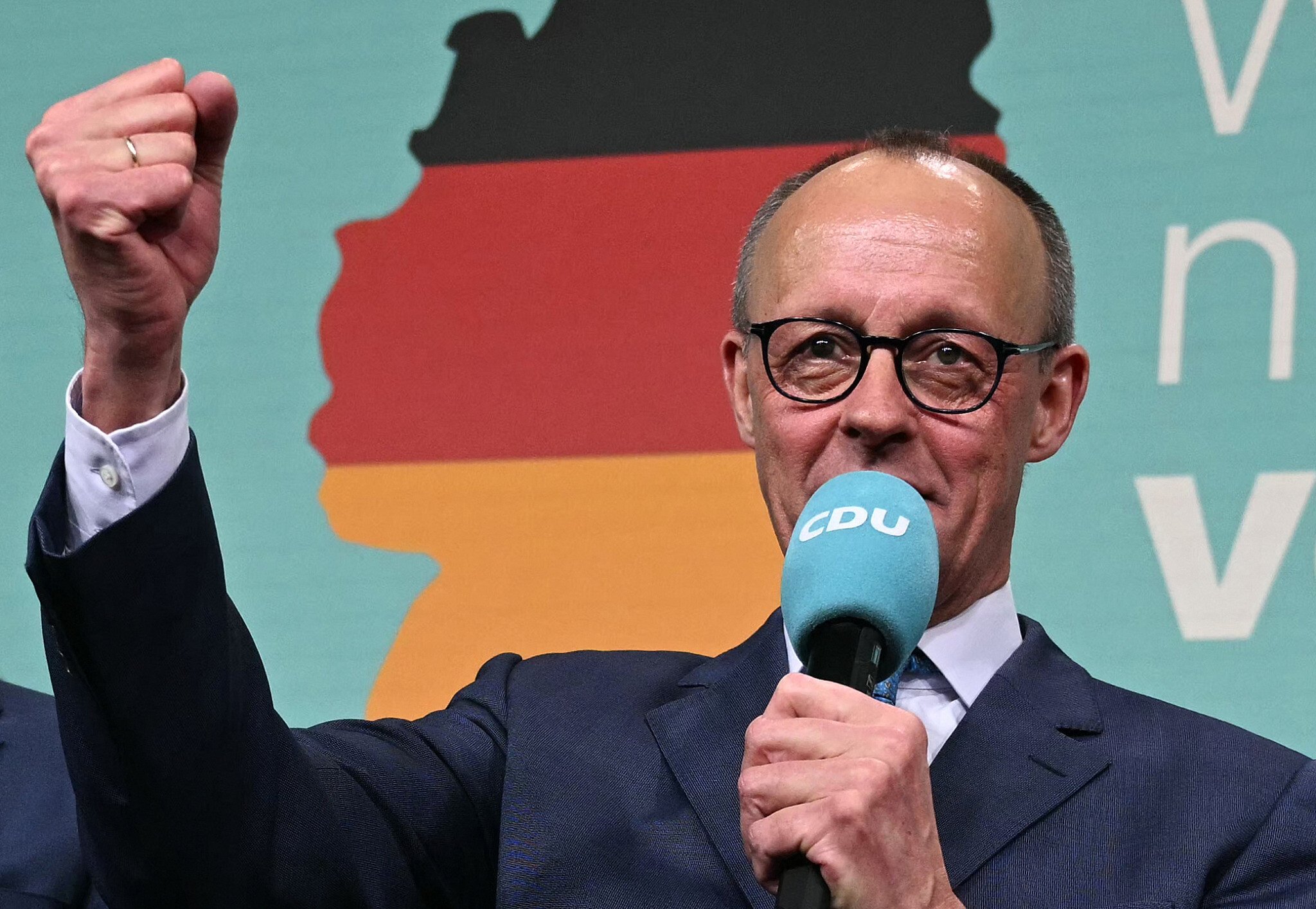
Friedrich Merz, leader of Germany's conservative Christian Democratic Union (CDU) and his party's main candidate for Chancellor addresses supporters after the first exit polls in the German general elections were announced on TV during the electoral evening in Berlin on February 23, 2025. (Ina Fassbender/AFP)
BERLIN, Germany (AFP) — Germany’s conservatives swept to victory in Sunday’s elections, with their leader Friedrich Merz set to become the next chancellor, followed by the far-right AfD in second place with record gains, in the strongest showing for a far-right party since World War II.
Merz urged the speedy formation of a new coalition government, warning that as US President Donald Trump is driving rapid and disruptive changes, “the world isn’t waiting for us.”
He stressed that — after Trump reached out to Russia and made comments fuelling doubts about the future strength of NATO — Europe must boost its defense capabilities and said that he has “no illusions at all about what is coming out of America.”
The far-right Alternative for Germany (AfD) almost doubled its score to over 20 percent, boosted by fears over immigration and security after a spate of deadly attacks blamed on asylum seekers.
Merz’s CDU/CSU alliance won more than 28 percent, according to projections in the early hours of Monday morning, crushing the Social Democrats (SPD) of outgoing Chancellor Olaf Scholz, which were looking at a historic low of 16 percent.
Merz — a long-time party rival of ex-chancellor Angela Merkel — has vowed a crackdown on irregular immigration. He hopes to win back votes from the AfD whose rise has stunned many in a country still seeking to atone for its dark Nazi history.
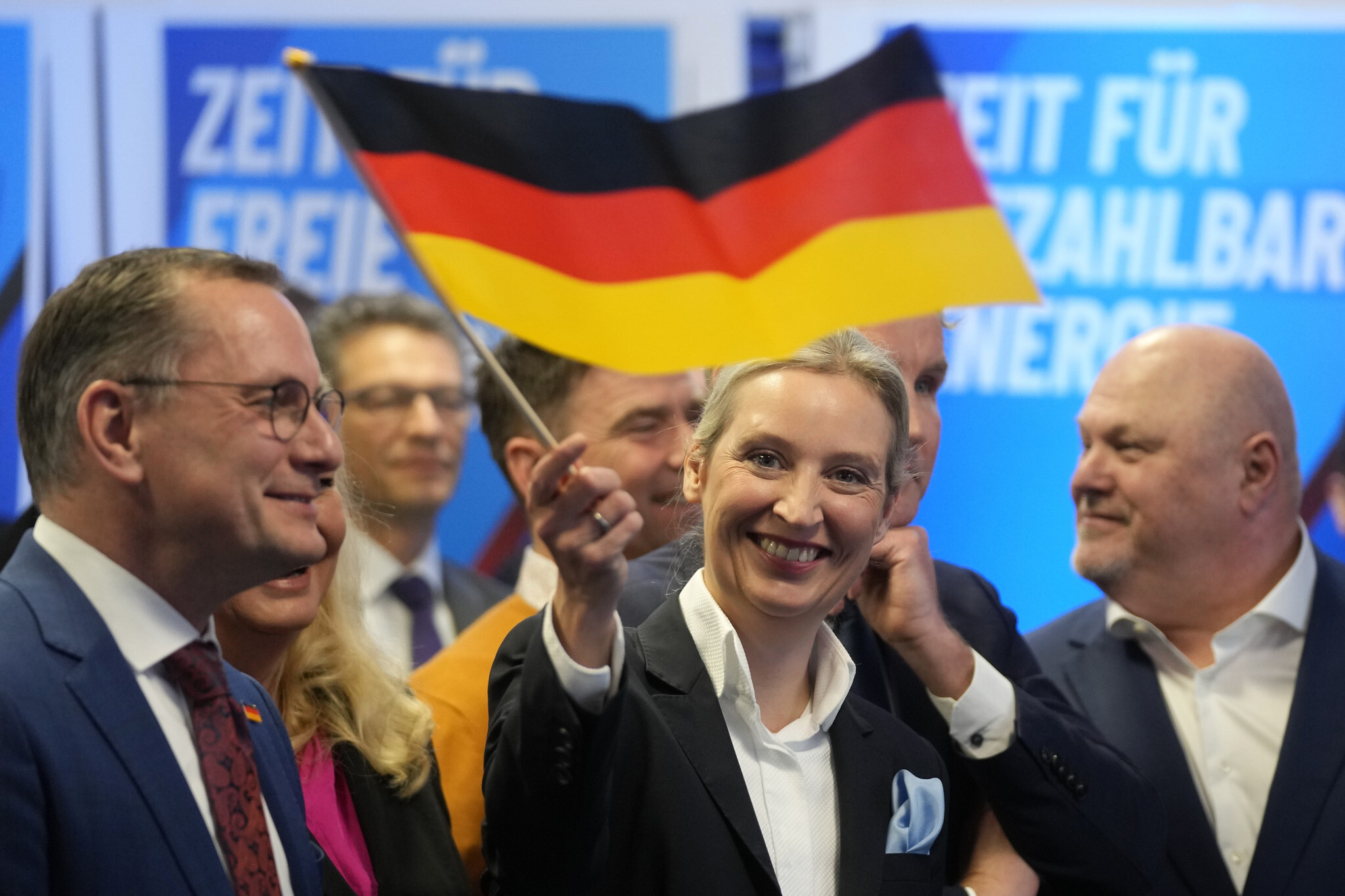
Leader of the far-right AfD Alice Weidel waves a German flag at the AfD party headquarters in Berlin, Germany, Sunday, Feb. 23, 2025, after the German national election. (AP Photo/Michael Probst)
For now, the AfD, basking in the vocal support of key Trump allies, is set to stay in opposition. All other parties have vowed to keep it out of power and behind a “firewall” of non-cooperation.
But its jubilant leader Alice Weidel hailed the “historic” result and again said her party was ready to govern with the CDU/CSU.
“Our hand remains outstretched to form a government,” Weidel told supporters, adding “next time we’ll come first.”
“I am very afraid of this shift to the right,” said retired teacher Hilke Reichersdorfer, 71, wearing a red scarf outside SPD headquarters. She voiced fears of a situation “like in other European countries or in America.”
‘Fate of Europe’
Before Merz, 69, takes over, he will have to forge a new coalition government in Europe’s top economy, an often drawn-out process he has vowed to complete by Easter.
This threatens to leave Berlin paralyzed for weeks to come as Trump has forced head-spinning change and rattled European allies, especially over the Ukraine war.
The German election came amid tectonic upheaval in US-Europe ties sparked by Trump going over the heads of European leaders to make a direct outreach to Russian President Vladimir Putin to end the three-year-old Ukraine war, which began with the February 2022 Russian invasion of Ukraine.
“After Donald Trump’s statements in the last week it is clear that the Americans are largely indifferent to the fate of Europe,” said Merz, hitherto seen as an Atlanticist, in a post-election TV debate.
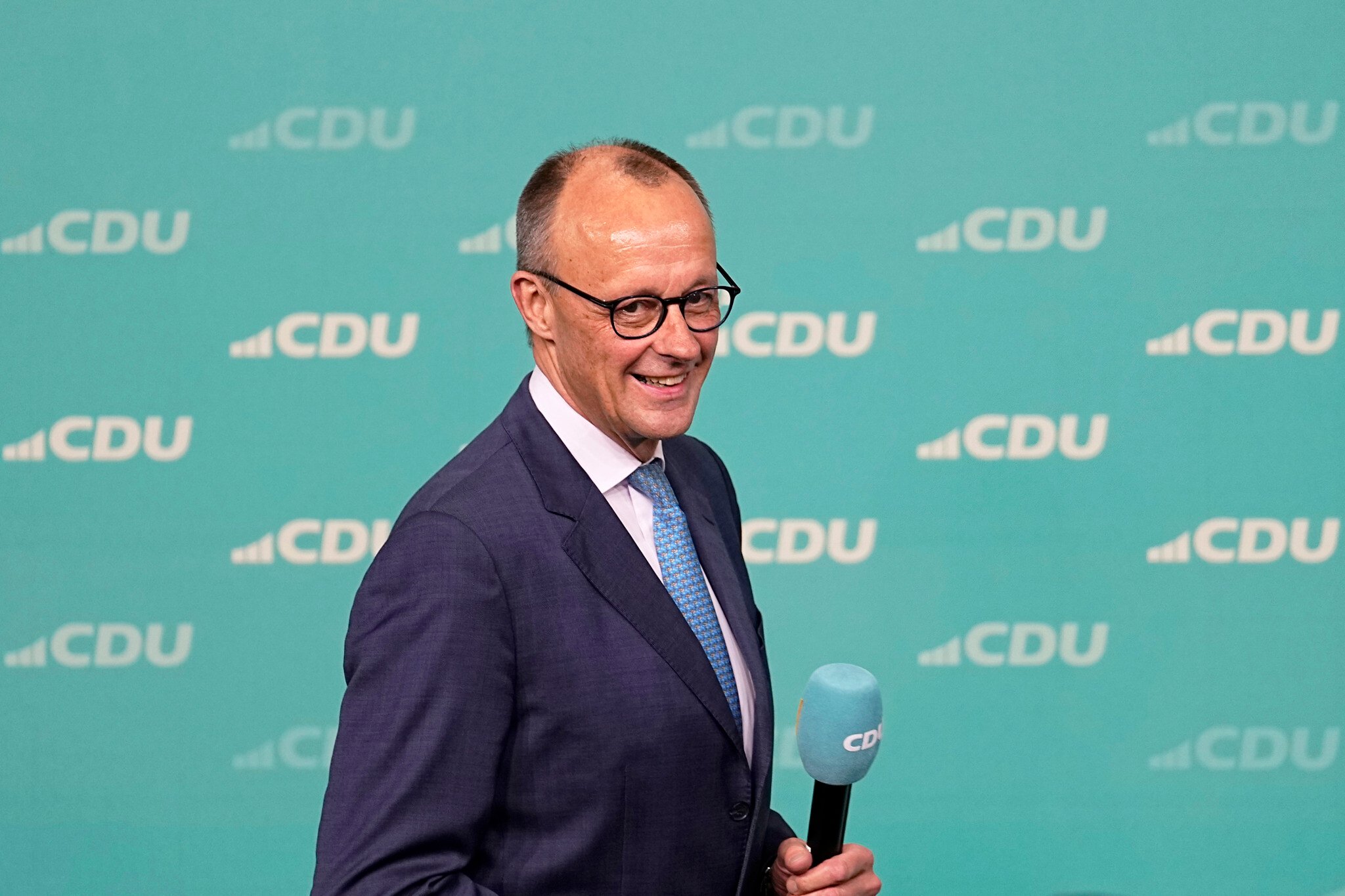
Friedrich Merz, the candidate of the mainstream conservative Christian Democratic Union party, arrives on stage to address supporters at the party headquarters in Berlin, Germany, February 23, 2025, after the German national election. (AP Photo/Martin Meissner)
Merz’s broadside against the US came despite Trump welcoming the election outcome with a post on his Truth Social.
“Much like the USA, the people of Germany got tired of the no common sense agenda, especially on energy and immigration, that has prevailed for so many years,” Trump wrote.
Merz said his “absolute priority will be to strengthen Europe as quickly as possible so that, step by step, we can really achieve independence from the USA step by step.”
He even ventured to ask whether the next summit of the North Atlantic Treaty Organisation, which has underpinned Europe’s security for decades, would still see “NATO in its current form.”
To build a majority, Merz may first reach out to the SPD, though without Scholz, who apologized for his party’s “bitter” defeat.
Merz could also approach the Greens, who scored 12 percent, although the CDU’s Bavarian sister party the CSU has so far rejected this.
Another potential partner, the small FDP — which sparked the November breakup of Scholz’s government — stared down the barrel of narrowly missing the five-percent hurdle to return to parliament.
This would impact the complex parliamentary arithmetic, as would the fate of the far-left BSW, which was just below the threshold late Sunday, at 4.9 percent.
If the BSW eventually scrapes in, this will mean Merz needs two coalition allies — raising the specter of yet another ideologically diverse alliance, like the failed alliance that was led by Scholz.
‘Last chance’
In a strange twist to the polarised campaign, the AfD has basked in the support of Team Trump, which saw billionaire Elon Musk praising it as the only party that can “save Germany.”
Merz said “the interventions from Washington were no less dramatic and impertinent than the interventions we have seen from Moscow, so we are under massive pressure from two sides.”
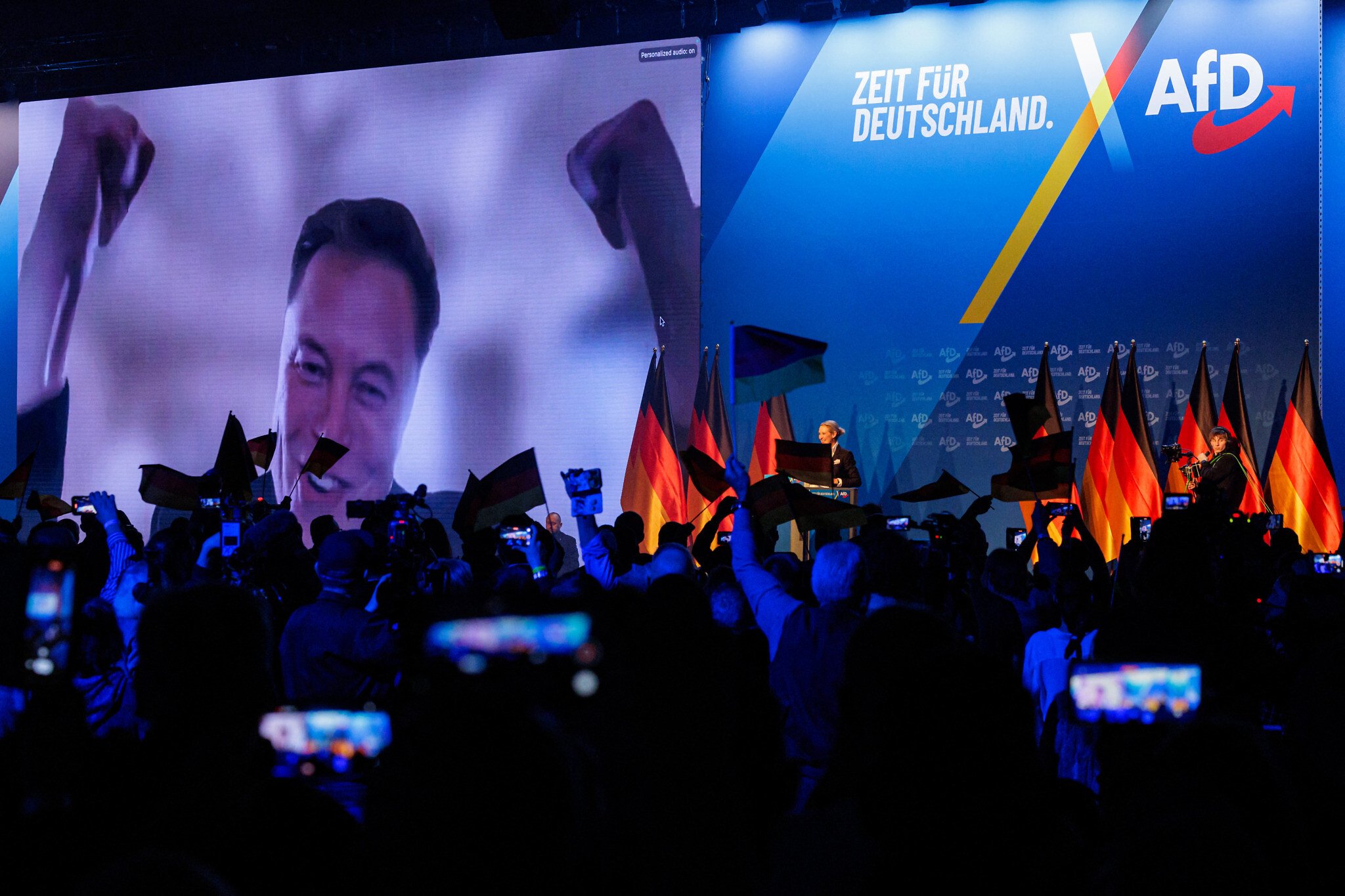
US tech billionaire and businessman Elon Musk (L) is seen on a large screen as Alice Weidel, co-leader of Germany’s far-right Alternative for Germany (AfD) party, addresses an election campaign rally in Halle, eastern Germany on January 25, 2025. (AFP)
The AfD, strongest in the ex-communist east, also made gains in western states for its best-ever result after Germany was shocked by a series of deadly attacks blamed on migrants.
In December a car ramming through a Christmas market crowd killed six people and wounded hundreds.
A stabbing spree targeting kindergarten children followed, then another car-ramming attack, in Munich, and a knife attack at Berlin’s Holocaust memorial just last weekend.
Merz has argued that the next government must boldly address the AfD’s concerns on migration and also fix the ailing economy, warning that otherwise the far right might win next time around.
“The stakes could not be higher,” argued political analyst and author Michael Broening.
“Germany’s mainstream parties have consistently failed to convince voters to reject the far right, and this election could be their last chance to turn the tide.”
Democratic forces must find solutions to the country’s problems, he added. “If Germany’s ‘establishment’ parties fail to deliver this time, they may not be the establishment for much longer.”
Reuters contributed to this report.

No comments:
Post a Comment