Syria: Dangling Between the Past, Present and the Future
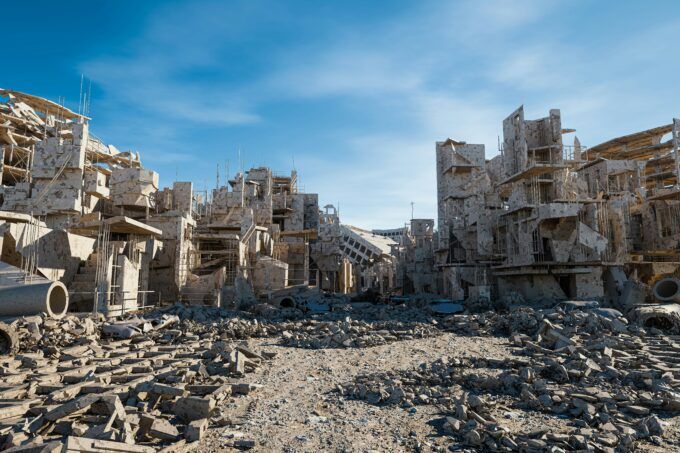
Image by Alex Shuper.
Following the collapse of the Assad regime, I ended my article last December with the following paragraph: “The new government must represent all Syrians, regardless of religion or ethnicity, ensuring justice and equality for all, while upholding Syria’s historic role at the forefront of resistance against Israel and its local agents.”
I etched those words while sharing the hopes of all Syrians for a better future following the downfall of one of the most corrupt Arab dictatorships. As I elaborated further, history teaches us that the removal of a dictator does not necessarily usher peace and democracy. The tragic examples of Iraq, Egypt, and Libya serve as stark reminders of the dangers of post-revolution instability, where the euphoria of change quickly gave way to chaos, repression, and bloodshed.
In Syria, the emergence of a new government has not ended the cycle of violence. The news of last week in the Sahel (shoreline) region of mass killings, targeted assassinations, and civilian massacres by the new ruling forces have raised alarming questions about the true nature of this so-called “liberation.” The promise of justice and democracy is fading as brutality against ordinary Syrians continues under a different guise.
The incoherent militants who stormed the Sahel following an ambush on the new government forces—allegedly orchestrated by ex-regime military officers—do not represent those who genuinely care for Syria. While those responsible for the killing of government soldiers must be held accountable, so too must those who exacted revenge on defenseless Syrian Alawite civilians. The central government must conduct transparent investigations not only into these atrocities but also into the leaders who recklessly mobilized disparate military factions into an already inflamed, sectarian-charged region. If these militants had true national integrity, they would have directed their efforts south of Damascus to confront Israeli incursions into Syria.
The lessons of Iraq and Libya cannot be ignored. The removal of Saddam Hussein and Muammar Gaddafi did not result in flourishing democracies but instead led to power struggles, sectarian violence, and foreign interventions that tore these nations apart. Egypt’s brief experiment with democracy fell into the hand of a military dictator, reinforcing the notion that revolutionary change without institutional stability breeds further authoritarianism. Syria must avoid these pitfalls to ensure that its people do not suffer the same fate.
One of the key failures in these nations was the exclusion and persecution of political opponents following the collapse of the old regimes. In Syria, if the new government pursues a similar path of vengeance and repression, it risks alienating significant portions of the population, igniting further resistance, and prolonging the cycle of violence. National unity can only be achieved through reconciliation, inclusion, and a commitment to justice that transcends sectarian and ethnic lines.
The new Syrian government falls into the trap of division by blaming outside agitators (Iran and Hezbollah) before conducting thorough investigations into recent massacres against the Alawite community. Such actions only serve to foment sectarian hatred and deflect from the government’s own responsibilities to protect its people. While external forces may have played a role in supporting remnants of the Assad regime, this does not excuse sectarian slaughter or the indiscriminate killing of civilians. If Syria is to emerge as a just and stable state, it must hold those responsible for these atrocities accountable, ensuring that justice is served without bias or political manipulation.
The new leadership must send a clear message that Syria is a nation for all its people. The government must set an example by prosecuting murderers, regardless of their affiliations, to prove its commitment to justice and national unity. Only by demonstrating fairness and accountability can Syria begin to heal from decades of division and bloodshed.
At the same time, Syria’s new leadership must engage in meaningful dialogue with key regional actors, particularly Iran and the Lebanese resistance. Blaming these forces for internal instability will only exacerbate the divide. Instead, the government should engage with the Resistance in Lebanon and Iran to consolidate Arab and Islamic unity against the occupier of Syrian land. Maintaining strong ties with Resistance movements in Lebanon, rather than alienating them, is crucial for Syria’s geopolitical positioning. Political and economic cooperation with Iran, and Iraq rather than confrontation, offer a great opportunity for the rebuilding of the new Syria.
The new government cannot claim to represent all Syrians in words alone when, like the previous regime, its power structure remains sectarian and continues to exclude the majority of Syrians. For Syria to move forward, its new leadership must embrace governance that is inclusive of all Syrians—regardless of religion, ethnicity, or political affiliation. Marginalizing any group will only sow the seeds of future unrest. Ensuring justice for past atrocities must not come at the expense of indiscriminate revenge, but rather through fair trials and a transparent legal system.
Furthermore, Syria’s historical role as a leader in regional resistance against Israeli aggression must not be compromised. Any government that seeks to align itself with foreign powers at the expense of Syria’s sovereignty and national dignity will lose legitimacy in the eyes of its people. Stability and justice must go hand in hand with an unwavering commitment to the nation’s independence and its role in the broader geopolitical landscape.
The reconciliation efforts with the Kurdish-led movement in North and Eastern Syria mark a significant step forward. However, it’s incomplete until all Syrians feel a genuine sense of belonging to a shared nation, transcending sectarian or ethnic divisions. Achieving this requires fostering a collective national identity that prioritizes unity, and inclusivity among all communities. Only then can Syria move toward lasting stability.
Syria’s future remains uncertain, but the path it chooses now will determine whether it slips into perpetual conflict or rises to its leadership role in the Arab world. Syrians must hold their leaders accountable for human rights violations and demand transparency in governance. At the same time, they must stay vigilant, ensuring that their hard-fought revolution does not replace one form of oppression with another.
Ultimately, true liberation is not simply about removing a dictator; it is about building a system that values human rights, justice, and equality for all. The killings of civilians under Syria’s new government serve as a grim warning—unless decisive steps are taken to protect all citizens and uphold the rule of law, history may repeat itself, with tragic consequences for generations to come.
MSM’s Contradictions Regarding the New Syrian Government
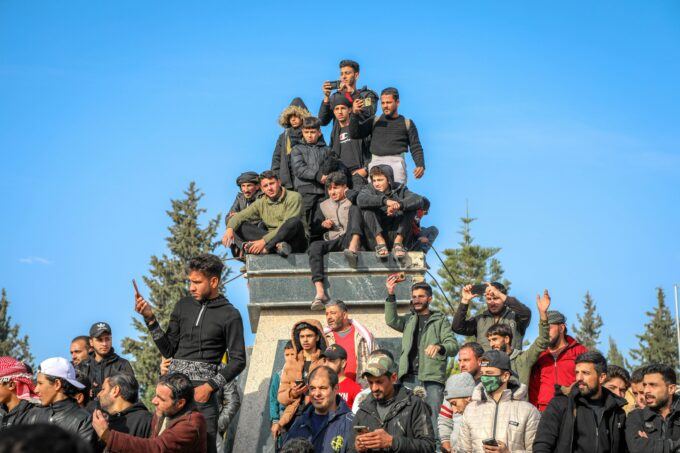
Image by Mahmoud Sulaiman.
The American mainstream media may have some ability to get away from government policy talking points when covering domestic news. But when it covers international news, it strictly toes the line of US foreign policy.
Nowhere in the contemporary world has this led to more layers of contradiction than in Syria, following the fall of Bashar al-Assad.
After 13 years of civil war and, in recent years, relatively diminished fighting, Syrian President Bashar al-Assad was deposed in December 2024. Thanks in large part to Turkish backing, the former Salafist group Hayat Tahrir al-Sham (HTS), an anti-Shia, former Al Qaeda affiliate, descended south at lightning speed and took over Damascus.
Because Israel has been a longtime Assad enemy and Assad helped transfer weapons from Iran to Hizbollah, the US MSM celebrated the US-designated terrorist organization HTS coming to power. Within days, Israel bombed hundreds of Syrian military installations in the country, moved into the Syrian Golan Heights and began creeping closer to the Damascus suburbs.
The glaring contradiction is that since the US MSM celebrated the new Syrian government’s rise to power and if the main elements within it – HTS – have truly “reformed” and shed its jihadist elements, why not call out Israel for bombing the Syrian military and invading its sovereign territory? It would seem such actions would be rather detrimental to a new government.
The answer is simple.
As seen in Gaza, the West Bank, southern Lebanon, Israel can do whatever it likes. This is despite the fact that it has its most extremist government in history and has arguably acted more aggressively than throughout its settler-imperialist history. Now, although the Assad regime has fallen, Israel has taken full advantage of the new Syrian government – which, by the way, seems to hate Shias, Alawites and other minorities more than incursions into its sovereign land or attacks on its own military. The goal of Israel is to ensure that Syria is feeble, in case Assad returns to power or if the former terrorist government starts growing a spine and stops attacking minorities and begins defending its territory from external aggressors.
As alluded to more recently, there have been clashes between government security forces and minority groups. Over the past week or so, this has been a developing situation, so it is hard to know the entire picture. However, initially in the south, there were skirmishes between government forces and Druzes. Later, over the past week, former regime supporters allegedly attacked government security forces in the Alawite northwest, causing severe retaliation by security forces and vigilantes. The dead are mostly Alawites in what has been considered the largest massacre since Assad used chemical weapons in 2013. There are some outlets, such as the Grayzone alleging that this attack on Alawites was unprovoked and a reflection of the former terrorist government’s anti-Shia (anti-“apostate”) stand, which harkens back to HTS’s and ISIS’s actions during the Syrian Civil War.
In response to the skirmishes between Druze and Syrian government forces, Netanyahu said Israeli forces were prepared to protect Druze in southern Damascus suburbs.
There are a few major contradictions here.
Again, this new celebrated Syrian government’s targeting of minorities, which Assad had protected, reflects HTS’s behavior during the civil war. Yet the MSM has celebrated this new government and the fall of Assad in depicting the “cautious optimism” and “hope” of the Syrian people. What gives?
The other contradiction is that the US MSM is taking Israel’s claim of preparing for military intervention near Damascus to protect Druzes at face value, as if Israel were a country acting only on universal human rights and international law, rather than a country that has trammeled such universal human rights in its Gaza genocide and in its attack on the West Bank and Lebanon. As if Israel’s imperial goal were anything other than ingesting territory to build a Greater Israel and keeping Syria weak, as stated. Furthermore, the US MSM ignores calls by Druzes of Syria for Israel not to interfere.
The situation in Syria over the past week or so and even, perhaps, the past 13 years has been a little muddled. Bashar al-Assad was a brutal ruler who killed thousands of his own people and had opponents tortured in secret prisons. Yet, ISIS, al-Nusra and HTS were engaged in torture, mass murder, and extreme human rights abuses. Now HTS has taken over what was a secular Syria. The US MSM celebrated because this was in Israel’s interest and, therefore America’s. Yet if one is celebrating the new government, why not call out Israel’s taking over its sovereign territory, its bombing of Syria’s military and threats to demilitarize its southern provinces, swallowing up its entire south? The American MSM’s answer is simple: Israel can do whatever the hell it wants. In the American MSM acting as cheerleaders for a “former” terrorist group taking power in Syria because it suits Israel is particularly hypocritical and contradictory. Even for them.
As a prolific author from the Boston area, Peter F. Crowley writes in various forms, including short fiction, op-eds, poetry and academic essays. In 2020, his poetry book Those Who Hold Up the Earth was published by Kelsay Books and received impressive reviews by Kirkus Review, the Bangladeshi New Age and two local Boston-area newspapers. His writing can be found in Middle East Monitor, Znet, 34th Parallel, Pif Magazine, Galway Review, Digging the Fat, Adelaide’s Short Story and Poetry Award anthologies (finalist in both) and The Opiate.
His forthcoming books, due out later in 2023, are That Night and Other Stories (CAAB Publishing) and Empire’s End (Alien Buddha Press)
No comments:
Post a Comment