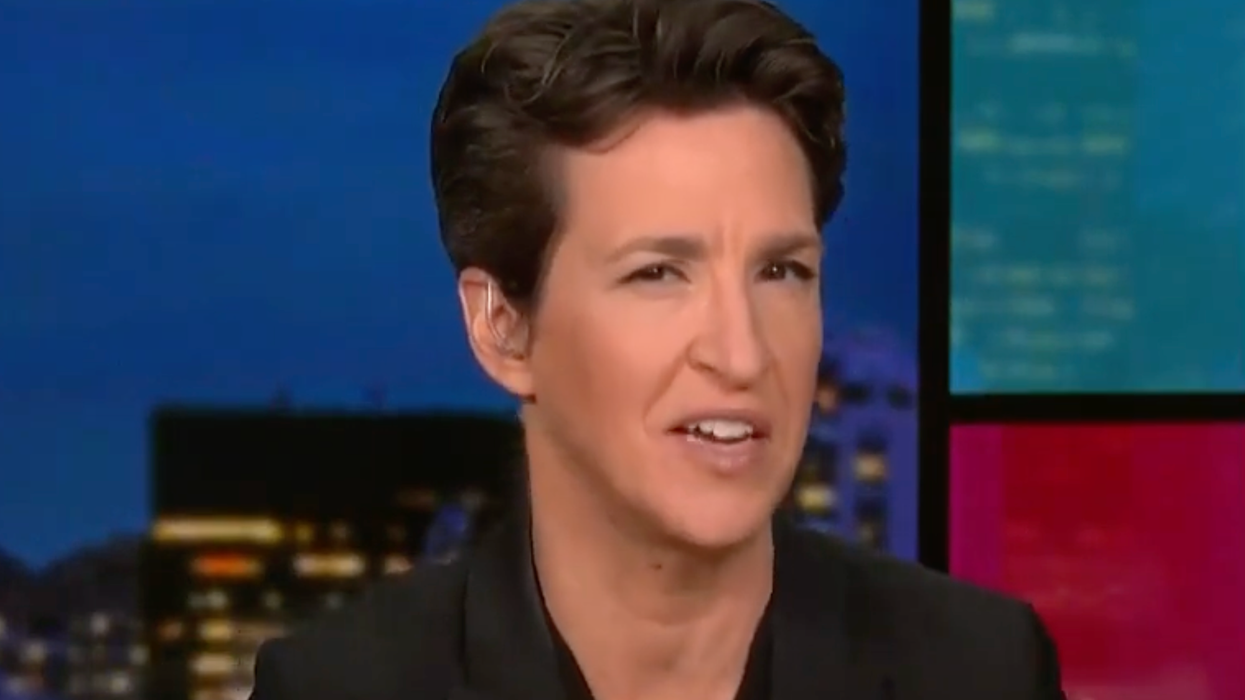
MSNBC host Rachel Maddow on April 4, 2025
April 05, 2025
ALTERNET
Financial markets have been taking a nosedive since President Donald Trump announced double-digit tariffs on every country and territory in the world this week. But on Friday, the trading floor of the New York Stock Exchange (NYSE) almost got so calamitous that an emergency measure nearly kicked in.
During her monologue on Friday night, MSNBC host Rachel Maddow showed two metrics that illustrated how volatile the stock market became on the second day of post-tariff chaos. She explained that the NYSE's "trading curbs" — which she characterized as "circuit breakers" were nearly activated due to the rapid decline in the S&P 500 Index.
"The markets have circuit breakers that kick in when things go off a cliff," Maddow explained. "They're these shut-offs that kick in automatically and basically stop the market. They stop people from trading for 15 minutes when things have gone unbelievably wrong. And where those circuit breakers kick in — like the threshold of how bad it has to be before the circuit breakers kick in, is when the S&P drops 7% from the previous day's close."
"Today, the S&P dropped 6%. Had we got to seven, we would have hit the circuit breaker," she continued. "They would have turned the lights out on the market to try to save us from ourselves. That's one way to understand the severity of what's happened here.
Maddow also illustrated the precipitous nature of the stock market by referencing Friday's spike in the VIX volatility index, which is run by the Chicago Board Options Exchange. The MSNBC host described VIX as a ticker in which a sharp increase can often precede a major financial disaster. She showed a graph that with three distinct jumps — one at the onset of the 2008 financial crisis, one as the Covid-19 pandemic shut down the global economy and one that is now jumping in response to the panic triggered by Trump's tariffs.
"That [spike] not caused by the biggest financial catastrophe since the great depression or a global pandemic that's killing millions of people, that one caused simply by Donald Trump being president. Again. With his great ideas," she said.
Major bank now predicting Trump policies will drive US into a recession by end of 2025
Financial markets have been taking a nosedive since President Donald Trump announced double-digit tariffs on every country and territory in the world this week. But on Friday, the trading floor of the New York Stock Exchange (NYSE) almost got so calamitous that an emergency measure nearly kicked in.
During her monologue on Friday night, MSNBC host Rachel Maddow showed two metrics that illustrated how volatile the stock market became on the second day of post-tariff chaos. She explained that the NYSE's "trading curbs" — which she characterized as "circuit breakers" were nearly activated due to the rapid decline in the S&P 500 Index.
"The markets have circuit breakers that kick in when things go off a cliff," Maddow explained. "They're these shut-offs that kick in automatically and basically stop the market. They stop people from trading for 15 minutes when things have gone unbelievably wrong. And where those circuit breakers kick in — like the threshold of how bad it has to be before the circuit breakers kick in, is when the S&P drops 7% from the previous day's close."
"Today, the S&P dropped 6%. Had we got to seven, we would have hit the circuit breaker," she continued. "They would have turned the lights out on the market to try to save us from ourselves. That's one way to understand the severity of what's happened here.
Maddow also illustrated the precipitous nature of the stock market by referencing Friday's spike in the VIX volatility index, which is run by the Chicago Board Options Exchange. The MSNBC host described VIX as a ticker in which a sharp increase can often precede a major financial disaster. She showed a graph that with three distinct jumps — one at the onset of the 2008 financial crisis, one as the Covid-19 pandemic shut down the global economy and one that is now jumping in response to the panic triggered by Trump's tariffs.
"That [spike] not caused by the biggest financial catastrophe since the great depression or a global pandemic that's killing millions of people, that one caused simply by Donald Trump being president. Again. With his great ideas," she said.
Major bank now predicting Trump policies will drive US into a recession by end of 2025
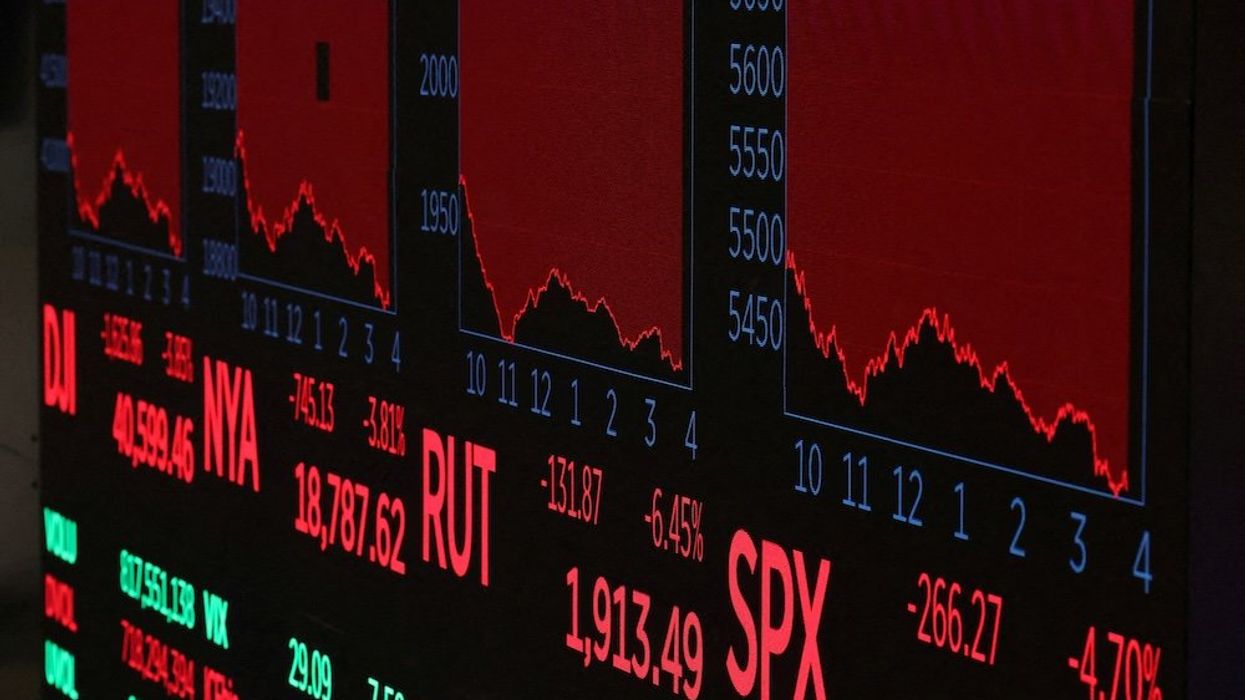
A screen shows trading indexes at the New York Stock Exchange (NYSE) in New York City, U.S., April 3, 2025. REUTERS/Brendan McDermid
Carl Gibson
April 04, 2025
ALTERNET
One leading American bank has now adjusted its economic forecast for the remainder of 2025 to be far more bearish following President Donald Trump's new tariffs.
On Friday, Bloomberg reported that JPMorgan Chase chief economist Michael Feroli told the bank's clients that real GDP growth is now likely to contract by the fourth quarter of the year "under the weight of the tariffs," and that this would likely impact Americans' jobs and personal finances. He estimated that rather than the previous forecast of 1.3% GDP growth this year, the U.S. economy would now shrink by a third of a point.
"The forecasted contraction in economic activity is expected to depress hiring and over time to lift the unemployment rate to 5.3%," he wrote.
JPMorgan isn't the only bank forecasting a recession. According to Bloomberg, Barclays Plc also projected this week that the U.S. economy could soon take a dive, with GDP contracting "consistent with a recession." And while Citigroup stopped short of predicting a U.S. recession, it did adjust total GDP growth expectations this year to just 0.1%.
Most economists generally agree a recession has begun once there are two consecutive quarters of negative GDP growth. This week, the Federal Reserve Bank of Atlanta forecasted that GDP may contract for the first quarter of 2025 by anywhere from 0.8% points to 2.8% Should this trend continue this summer, the U.S. economy may officially be in recession territory by the fall.
Financial markets have been reeling since Trump's tariff announcement on Wednesday in which he imposed double-digit tariff duties on all countries, with higher import fees that will particularly impact certain products like cars manufactured overseas and foreign-made apparel. The Dow Jones Industrial Average closed roughly 2,200 points lower than it did yesterday, for a nearly 5% drop in 24 hours. This week has been the worst for stocks since the Covid-19 pandemic hit in 2020.
Trump has called on Federal Reserve Chair Jerome Powell to lower interest rates, though Powell responded to Friday's jobs report by saying "it feels like we don’t need to be in a hurry" to adjust interest rates. The Bureau of Labor Statistics found that while more than 220,000 jobs were added to the economy last month, the unemployment rate rose slightly to 4.2%, with public sector job cuts as a result of the Trump administration's slashing of the federal workforce serving as a major contributor to the jobless rate.
Click here to read Bloomberg's report in full (subscription required).
One leading American bank has now adjusted its economic forecast for the remainder of 2025 to be far more bearish following President Donald Trump's new tariffs.
On Friday, Bloomberg reported that JPMorgan Chase chief economist Michael Feroli told the bank's clients that real GDP growth is now likely to contract by the fourth quarter of the year "under the weight of the tariffs," and that this would likely impact Americans' jobs and personal finances. He estimated that rather than the previous forecast of 1.3% GDP growth this year, the U.S. economy would now shrink by a third of a point.
"The forecasted contraction in economic activity is expected to depress hiring and over time to lift the unemployment rate to 5.3%," he wrote.
JPMorgan isn't the only bank forecasting a recession. According to Bloomberg, Barclays Plc also projected this week that the U.S. economy could soon take a dive, with GDP contracting "consistent with a recession." And while Citigroup stopped short of predicting a U.S. recession, it did adjust total GDP growth expectations this year to just 0.1%.
Most economists generally agree a recession has begun once there are two consecutive quarters of negative GDP growth. This week, the Federal Reserve Bank of Atlanta forecasted that GDP may contract for the first quarter of 2025 by anywhere from 0.8% points to 2.8% Should this trend continue this summer, the U.S. economy may officially be in recession territory by the fall.
Financial markets have been reeling since Trump's tariff announcement on Wednesday in which he imposed double-digit tariff duties on all countries, with higher import fees that will particularly impact certain products like cars manufactured overseas and foreign-made apparel. The Dow Jones Industrial Average closed roughly 2,200 points lower than it did yesterday, for a nearly 5% drop in 24 hours. This week has been the worst for stocks since the Covid-19 pandemic hit in 2020.
Trump has called on Federal Reserve Chair Jerome Powell to lower interest rates, though Powell responded to Friday's jobs report by saying "it feels like we don’t need to be in a hurry" to adjust interest rates. The Bureau of Labor Statistics found that while more than 220,000 jobs were added to the economy last month, the unemployment rate rose slightly to 4.2%, with public sector job cuts as a result of the Trump administration's slashing of the federal workforce serving as a major contributor to the jobless rate.
Click here to read Bloomberg's report in full (subscription required).
'This. Will. Not. End. Well': George Will slams Trump’s 'fanciful assumptions' on economy
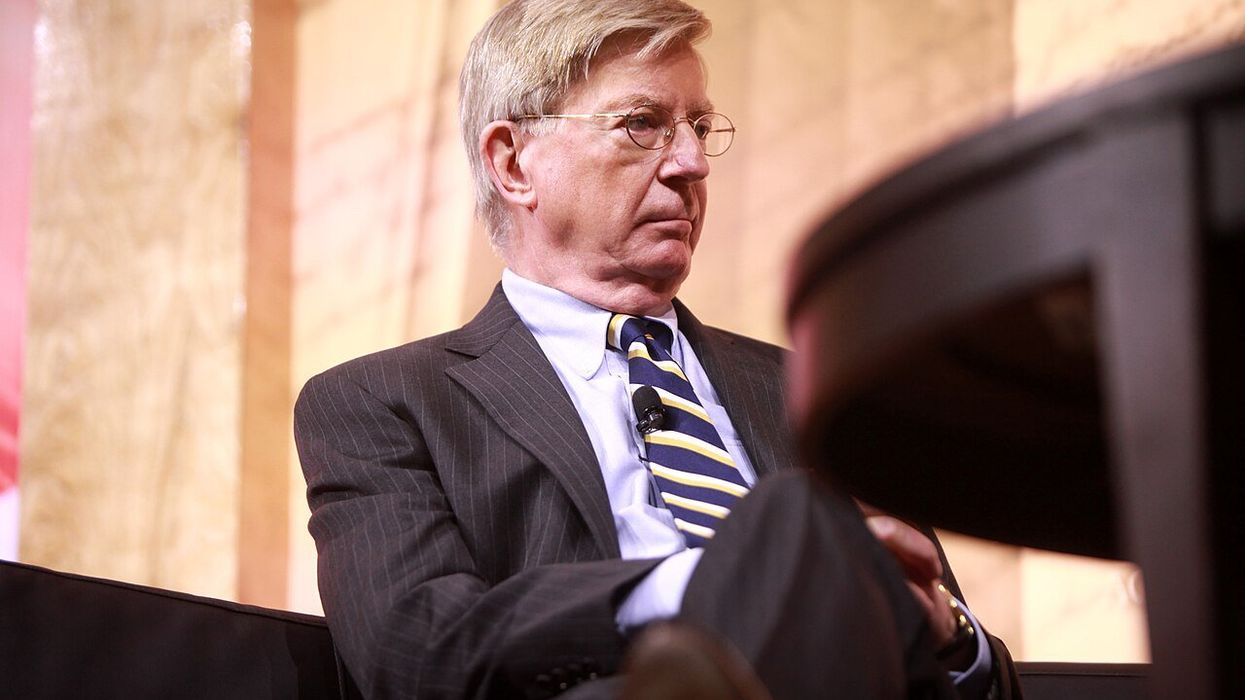
George Will speaking at the 2014 Conservative Political Action Conference (CPAC) in National Harbor, Maryland on March 6, 2014 (Gage Skidmore/Flickr)
Alex Henderson
April 04, 2025
ALTERNET
ALTERNET
When President Donald Trump detailed his far-reaching tariff plans on Wednesday, April 2 — the day he touted as "Libertarian Day" — much of the criticism came from Democrats. But some Never Trump conservatives are speaking out as well, from MSNBC host Joe Scarborough to former GOP strategist/consultant Stuart Stevens. And Trump critics on both the left and the right are warning that his new tariffs will make a variety of goods much more expensive without yielding the economic boom that Trump is promising.
Another Never Trumper who is vehemently critical of Trump's tariffs is veteran Washington Post columnist George F. Will. In his April 4 column, however, Will emphasizes that tariffs are only one of the reasons why Trump is problematic on the economy.
"Donald Trump's economic agenda, from taxes to tariffs — which are themselves taxes — is variable because he believes in the immediate translation of whims into policy proposals, without an intervening pause for study," the 83-year-old Will argues. "His conversation with a Las Vegas waitress quickly became his proposal to end taxation on tips. Commerce Secretary Howard Lutnick says Trump suddenly favors eliminating 'taxes' on people making less than $150,000 a year — in 2022, about 93 percent of Americans 15 and over."
Will adds, "Progressives want income taxation to be more progressive so the wealthy will pay 'their fair share.' Trump is more progressive still, wanting the wealthy to pay everyone else's share, too."
Trump's economic agenda, according to Will, fails to take into account the size of the United States' federal deficit.
"As, second by second, the government borrows substantial sums to pay interest on the money it has borrowed, remember: The national debt was $20 trillion when Donald Trump began his first administration, having vowed to eliminate the debt in eight years," Will writes. "It was $28 trillion when Joe Biden's presidency began. As Maya MacGuineas at the Committee for a Responsible Federal Budget notes, it reached $32 trillion on June 15, 2023; $33 trillion 92 days later; $34 trillion 105 days after that; $35 trillion in another 210 days; and $36 trillion in another 118. It will reach $37 trillion after Congress raises the debt ceiling sometime this summer."
The longtime Post columnist adds, "All of these numbers reflect the optimistic, perhaps fanciful assumptions that the post-'Liberation Day' economy does not sag into a recession. In any case: This. Will. Not. End. Well."
George Will's full column is available at this link (subscription required).

No comments:
Post a Comment