
People attend the funerals of Sayfollah Kamel Musallet, a Palestinian-American man who was beaten to death by settlers, and Mohammad Al-Shalabi, a man who was shot dead by Israeli forces, according to the Palestinian Health Ministry, near Ramallah, in the Israel-occupied West Bank July 13, 2025.
PHOTO: Reuters
July 13, 2025
AL-MAZRA'A ASH-SHARQIYA, West Bank — Frustration among Palestinians grew towards the United States on Sunday (July 13) as mourners packed the roads to a cemetery in the Israeli-occupied West Bank town of Al-Mazr'a Ash-Sharqiya for the burial of two men, one of them a Palestinian American, killed by settlers.
Palestinian health authorities and witnesses said Sayfollah Musallet, 21, was beaten to death, and Hussein Al-Shalabi, 23, was shot in the chest by settlers during a confrontation on Friday night.
Most of the small town's roughly 3,000 residents share family ties to the United States and many hold citizenship, including Musallet, who was killed weeks after flying to visit his mother in Al-Mazr'a Ash-Sharqiya, where he travelled most summers from Tampa, Florida.
"There's no accountability," said his father Kamel Musallet, who flew from the United States to bury his son.
"We demand the United States government do something about it... I don't want his death to go in vain."
Israeli killings of US citizens in the West Bank in recent years include those of Palestinian American journalist Shireen Abu Akleh, Palestinian American teenager Omar Mohammad Rabea and Turkish American activist Aysenur Ezgi Eygi.
A US State Department spokesperson said on Friday it was aware of the latest death, but that the department had no further comment "out of respect for the privacy of the family and loved ones" of the victim.
Many family and community members said they expected more, including that the United States would spearhead an investigation into who was responsible.
A US State Department spokesperson on Sunday referred questions on an investigation to the Israeli government and said it "has no higher priority than the safety and security of US citizens overseas."
Read Also

US citizen killed in West Bank settler attack
The Israeli military had earlier said Israel was probing the incident. It said confrontations between Palestinians and settlers broke out after Palestinians threw rocks at Israelis, lightly injuring them.
'Betrayal'
Musallet's family said medics tried to reach him for three hours before his brother managed to carry him to an ambulance, but he died before reaching the hospital.
Local resident Domi, 18, who has lived in Al-Mazr'a Ash-Sharqiya for the last four years after moving back from the United States, said fears had spread in the community since Friday and his parents had discussed sending him to the United States.
"If people have sons like this they are going to want to send them back to America because it's just not safe for them," he said.
He had mixed feelings about returning, saying he wanted to stay near his family's land, which they had farmed for generations, and that Washington should do more to protect Palestinians in the West Bank.
"It's a kind of betrayal," he said.
Settler violence in the West Bank has risen since the start of Israel's war against Palestinian militant group Hamas in Gaza in late 2023, according to rights groups.
Dozens of Israelis have also been killed in Palestinian street attacks in recent years and the Israeli military has intensified raids across the West Bank.
Around 700,000 Israeli settlers live among 2.7 million Palestinians in the West Bank and East Jerusalem, territories Israel captured from Jordan in the 1967 war.
US President Donald Trump in January rescinded sanctions imposed by the former Biden administration on Israeli settler groups and individuals accused of being involved in violence against Palestinians in the West Bank.
Malik, 18, who used to visit Musallet's ice-cream shop in Tampa and had returned to the West Bank for a few months' vacation, said his friend's death had made him question his sense of belonging.
"I was born and raised in America, I only come here two months of a 12-month year, if I die like that nobody's going to be charged for my murder," he said, standing in the cemetery shortly before his friend was buried. "No one's going to be held accountable."
'So much hatred in their hearts': Family of US-born Palestinian killed by Israeli settlers tell of pain
Sayfollah Musallat was beaten to death in the town of Sinjil, north-east of Ramallah
THE NATIONAL
Updated: July 13, 2025,
Mourners gathered in the town of Turmus Aya in the occupied West Bank to receive the body of Sayafollah Musallat, a Palestinian-American man who was beaten to death by Israeli settlers in a violent attack near the town of Sinjil, north-east of Ramallah.
Mr Musallat, originally from Tampa, Florida, had travelled to the West Bank to visit family and help protect their land from increasing settler incursions.
He is the latest Palestinian-American to be killed in the territory, only weeks after the death of an American teenager left the community reeling.
At his family home, dozens of women lined the driveway early in the day, awaiting the arrival of the body. As the morning progressed, men gathered outside under the blazing sun, offering condolences. An ambulance arrived playing verses from the Quran, and when Mr Musallat’s body was finally brought out, mourners erupted in religious and political chants.
The presence of many American voices in the crowd was striking. Friends and relatives had flown in from Tampa, where Mr Musallat was born and raised. Among the mourners was a teenage boy who wept continuously, from the family home to the local cemetery. After a mass prayer held at a nearby school, the boy was heard crying into a friend’s shoulder, whispering, “I can’t breathe.
Kamal Abdel Jalil Al Hijaz, a senior member of the Musallat family, stood outside the house, welcoming mourners. Dressed in a traditional keffiyeh and leaning on a walking stick, he directed younger relatives to fetch water for the guests.
“The whole town feels the pain,” he said, his voice breaking. “I’m crying in front of you so that God hears us.”
He recalled that Mr Musallat had gone with a group of people, many of them US passport holders, to prevent settlers from encroaching on Palestinian land. “They thought the American passport might offer some protection,” he said. “But they attacked him. Now he’s a martyr.”
Jama’a Hijaz, 23, a close friend of Mr Musallat from Tampa, spoke of their years growing up together. “We used to hang out every day. He loved going to the shooting range. He ran an ice cream shop, and that’s where we’d always meet – he couldn’t leave because he worked so hard.”
Mr Hijaz described his friend as devout, kind, and committed to his faith. “He never missed a prayer. He was on the right path.”
He said the attack happened after Friday prayers, when news spread that settlers were targeting nearby land. “At first they said someone died. Then they said no. Then they said Saif was passing out. I texted him to ask if he was OK. Everyone said he was fine. Two hours later, we found out he died on the way to the hospital.”
According to Mr Hijaz, Mr Musallat was left injured in the sun for three hours before help arrived. Another man, Hussein Al Shalabi, was also killed – first beaten, then shot by the settlers as they left. Others were reportedly tied up and had their limbs broken.
“The settlers have so much hatred in their hearts,” Mr Hijaz said. “Humans don’t do this. They have compassion. They get scared when they see a dead body. I don’t know what we’re dealing with – these are evil people.”
He added that the shock of Mr Musallat’s death reached far beyond the West Bank. “Everyone I know in the US is devastated. A friend of mine from high school met Saif only once – he still cried when he heard the news. That’s the kind of person Saif was.”
“I’m still in shock. I didn’t believe it until I saw the picture,” Hijaz said. “But we’re going to keep coming back. This is our land. This is our home. Saif died for it.”
Palestinian American Death Under Investigation, Police Spokesperson’s Unit Says: ‘No Complaint, No Autopsy, No Evidence’
GABRIEL COLODRO
07/14/2025

GABRIEL COLODRO
07/14/2025
THE MEDIALINE

Masked Israeli settlers hurl rocks at Palestinians from a hilltop near the village of Sinjil, in the West Bank, on July 4, 2025. (JOHN WESSELS/AFP via Getty Images)
The killing near Sinjil has intensified debate over West Bank clashes, competing claims of aggression, and the limits of accountability
A young Palestinian American was killed on Friday near the West Bank village of Sinjil, triggering renewed scrutiny of Israeli conduct in the territory and prompting calls for a US-led investigation. Israeli officials say the fatal incident occurred during a violent confrontation between civilians, but they are investigating without a formal complaint, autopsy, or access to the body.
The victim, Saif al-Din Kamil Abdul Karim Musalat, was a Florida-born US citizen in his early 20s visiting family in the West Bank. According to relatives, Musalat was attempting to protect family land from Israeli civilians trying to set up an unauthorized outpost when he was reportedly beaten for hours and died en route to the hospital. The family claims Israeli attackers blocked emergency responders and have called on Washington to investigate.
“This is an unimaginable nightmare and injustice that no family should ever have to face,” the Musalat family said in a statement. “We demand the US State Department lead an immediate investigation and hold the Israeli settlers who killed Saif accountable for their crimes. We demand justice.”
The US State Department confirmed Musalat’s death and said it is providing consular support to his family. “The US Department of State has no higher priority than the safety and security of US citizens overseas,” a spokesperson said, declining to comment further out of respect for the family’s privacy.
The incident unfolded around 3 p.m., when Israeli authorities say Palestinians began throwing rocks at Israeli civilians near Sinjil, approximately 10 miles north of Ramallah. Security forces from the Israel Police and the IDF were dispatched to the scene. According to a police spokesperson, “Following reports of a physical confrontation between civilians in the area of Judea and Samaria, Israel Police and Border Police forces were deployed to the scene alongside the IDF to disperse the unrest and restore order.”
Israeli authorities say the confrontation included property vandalism, arson, and rock throwing. Several individuals were detained: two Israeli civilians, two left-wing activists, one Palestinian, and one Israeli military reservist, who was later released after questioning. “An observation post was set up to document the events and gather evidence. The area was stabilized and the units withdrew,” the spokesperson told The Media Line.
We want to hold people accountable, but right now, we’re investigating a murder claim without evidence
The Israel Police and IDF Military Police have opened a joint investigation. But the lack of a formal complaint, autopsy, or access to Musalat’s body has left police relying solely on media reports. “If you’re investigating a murder, you need to examine the body,” the police spokesperson said. “We want to hold people accountable, but right now, we’re investigating a murder claim without evidence. All we have are media reports.”
A video released by the Israeli Ministry of Foreign Affairs shows Palestinians hurling stones at what appear to be Israeli civilians and vehicles. Israeli officials say this supports their version of events, in which Palestinian residents initiated the clash.
The Binyamin Regional Council released an unusual statement on Shabbat, calling the incident a premeditated terror attack. According to the council, dozens of “terrorists and Arab rioters,” accompanied by anarchist activists, attacked Jewish shepherds with stones and slingshots, burned equipment, and injured two people. The IDF reportedly uncovered several explosive devices concealed in stone barriers, allegedly meant to target Israeli soldiers. The council demanded that the army investigate the use of live fire and described the incident as a deliberate effort to displace Jews from the area.
Despite the absence of formal evidence, headlines around the world reported that Musalat had been “beaten to death by Israeli settlers.” No charges have been filed to support that claim.
Hamas has claimed Musalat as a fighter. The group frequently issues such declarations posthumously for symbolic or propaganda purposes, often without presenting evidence of an operational affiliation. No information has been made public that links Musalat to Hamas in any verifiable way.
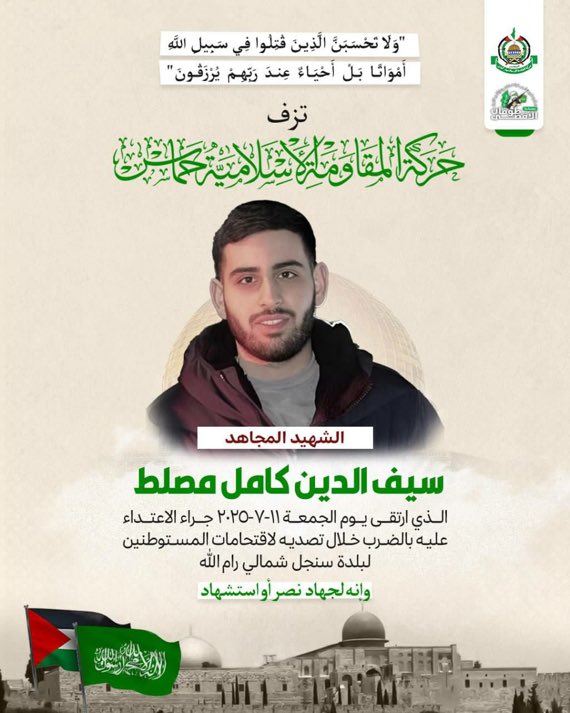
Hamas posted on social media an image of Saif al-Din Musalat, claiming he is one of the terrorist group’s fighters. (Screenshot: X)
Brig. Gen. (res.) Amir Avivi, founder of the Israel Defense and Security Forum and former IDF deputy comptroller, told The Media Line the case reflects a broader issue of narrative distortion. “You’re labeling an entire population, 150,000 normative Israeli citizens in Judea and Samaria, based on the actions of a tiny fringe,” he said. “To talk about ‘settler violence’ is almost a racist concept.”
To talk about ‘settler violence’ is almost a racist concept
While acknowledging “there are small groups who may act outside the law,” Avivi said Israel’s institutions remain fully capable of handling such violations. “These individuals should be prosecuted accordingly. Israel is a state of law, and law is law.”
He added: “If it’s classified as terrorism, the Shin Bet handles it. If it’s criminal, the police handle it. People are investigated. People are brought to justice.”
Avivi rejected claims of systemic aggression from Israeli civilians, stating, “There’s no more violence in Judea and Samaria than in Tel Aviv.” He believes the international attention on West Bank clashes is part of an effort to delegitimize the Jewish right to live in the area.
Member of Knesset Zvi Sukkot, of the Religious Zionism party and a longtime resident of Judea and Samaria, also spoke to The Media Line. He described the reaction to the Sinjil incident as disproportionate. “We didn’t attack anyone. We didn’t expel anyone. We bought land and live here,” he said. “But the Arabs attack us because they refuse to accept even a single Jew in this land.”
Sukkot acknowledged isolated cases of violence by Jews but framed the broader dynamic differently: “In some specific cases, it’s possible a Jew attacked, but as a general rule, Arabs attack Jews, not the other way around.” Asked how civilian clashes emerge, he added: “People fight everywhere. It’s like asking how violence starts in Buenos Aires or New York. It happens.”
Palestinian human rights advocate Issa Amro, founder of Youth Against Settlements, also spoke to The Media Line and described Musalat’s death as part of a broader strategy of forced displacement. “It’s not settler violence, it’s settler terror now,” he said. According to Amro, Israeli civilians and armed personnel cooperate to make life unbearable for Palestinians, driving them from Area C. “Itamar Ben-Gvir gave out 150,000 rifles in the last 20 months. The majority of the weapons were given to settlers,” he claimed.
Avivi dismissed such accusations but said there is a broader philosophical gap. “For the Palestinian extremist worldview, there’s no difference between an Israeli living in Tel Aviv and one living in Judea and Samaria. To them, all Israelis are ‘settlers.’”
Amro, offering his own perspective, said: “First settlers came to the West Bank, not the Palestinians going to Israeli cities. The settlers are occupying land which is Palestine. According to international law, the settlers are war criminals.”
Avivi contended that the conflict was not only about territory but about narratives and legitimacy. “The entire Palestinian system, from the PA to Hamas and Islamic Jihad, is designed to produce violence and terror,” he said. “Yes, there is a fringe on the Israeli side that acts illegally, and they should be prosecuted. But on the Palestinian side, the whole system is built for confrontation.”
He opposed the idea of physical separation of populations. “This isn’t about building walls to stop all contact,” he said. “No country eliminates all violence. What matters is the trend, and the general trend is that things are improving.”
Amro disputed that assertion. “Even nonviolent resistance is illegal,” he said. “I was arrested, beaten, and convicted in military court for using a video camera.” On Musalat’s death, he said: “I think he was kidnapped while trying to defend a house or land, and beaten until he was dead,” though he admitted he did not witness the incident.
Palestinians die in silence. The international media is not telling the truth.
“Palestinians die in silence,” Amro added. “The international media is not telling the truth. And without concrete action, this will continue. There will be no peace.”
A second Palestinian, 23-year-old Mohammed Rizq Hussein al-Shalabi, was also killed during the incident. His body was found hours later with signs of severe bruising. It remains unclear whether he was shot by Israeli civilians or security personnel. Israeli police say they are attempting to coordinate with the Palestinian Authority to obtain access to both bodies for forensic examination.
As the Israeli investigation continues without a formal complaint, physical evidence, or autopsy results, both sides remain locked in a broader struggle over facts and legitimacy. In a region defined by disputed boundaries and deep mistrust, truth remains entangled in the space between what is seen, what is claimed, and what can be proved.
Felice Friedson and Giorgia Valente contributed to this report.
The killing near Sinjil has intensified debate over West Bank clashes, competing claims of aggression, and the limits of accountability
A young Palestinian American was killed on Friday near the West Bank village of Sinjil, triggering renewed scrutiny of Israeli conduct in the territory and prompting calls for a US-led investigation. Israeli officials say the fatal incident occurred during a violent confrontation between civilians, but they are investigating without a formal complaint, autopsy, or access to the body.
The victim, Saif al-Din Kamil Abdul Karim Musalat, was a Florida-born US citizen in his early 20s visiting family in the West Bank. According to relatives, Musalat was attempting to protect family land from Israeli civilians trying to set up an unauthorized outpost when he was reportedly beaten for hours and died en route to the hospital. The family claims Israeli attackers blocked emergency responders and have called on Washington to investigate.
“This is an unimaginable nightmare and injustice that no family should ever have to face,” the Musalat family said in a statement. “We demand the US State Department lead an immediate investigation and hold the Israeli settlers who killed Saif accountable for their crimes. We demand justice.”
The US State Department confirmed Musalat’s death and said it is providing consular support to his family. “The US Department of State has no higher priority than the safety and security of US citizens overseas,” a spokesperson said, declining to comment further out of respect for the family’s privacy.
The incident unfolded around 3 p.m., when Israeli authorities say Palestinians began throwing rocks at Israeli civilians near Sinjil, approximately 10 miles north of Ramallah. Security forces from the Israel Police and the IDF were dispatched to the scene. According to a police spokesperson, “Following reports of a physical confrontation between civilians in the area of Judea and Samaria, Israel Police and Border Police forces were deployed to the scene alongside the IDF to disperse the unrest and restore order.”
Israeli authorities say the confrontation included property vandalism, arson, and rock throwing. Several individuals were detained: two Israeli civilians, two left-wing activists, one Palestinian, and one Israeli military reservist, who was later released after questioning. “An observation post was set up to document the events and gather evidence. The area was stabilized and the units withdrew,” the spokesperson told The Media Line.
We want to hold people accountable, but right now, we’re investigating a murder claim without evidence
The Israel Police and IDF Military Police have opened a joint investigation. But the lack of a formal complaint, autopsy, or access to Musalat’s body has left police relying solely on media reports. “If you’re investigating a murder, you need to examine the body,” the police spokesperson said. “We want to hold people accountable, but right now, we’re investigating a murder claim without evidence. All we have are media reports.”
A video released by the Israeli Ministry of Foreign Affairs shows Palestinians hurling stones at what appear to be Israeli civilians and vehicles. Israeli officials say this supports their version of events, in which Palestinian residents initiated the clash.
The Binyamin Regional Council released an unusual statement on Shabbat, calling the incident a premeditated terror attack. According to the council, dozens of “terrorists and Arab rioters,” accompanied by anarchist activists, attacked Jewish shepherds with stones and slingshots, burned equipment, and injured two people. The IDF reportedly uncovered several explosive devices concealed in stone barriers, allegedly meant to target Israeli soldiers. The council demanded that the army investigate the use of live fire and described the incident as a deliberate effort to displace Jews from the area.
Despite the absence of formal evidence, headlines around the world reported that Musalat had been “beaten to death by Israeli settlers.” No charges have been filed to support that claim.
Hamas has claimed Musalat as a fighter. The group frequently issues such declarations posthumously for symbolic or propaganda purposes, often without presenting evidence of an operational affiliation. No information has been made public that links Musalat to Hamas in any verifiable way.
Hamas posted on social media an image of Saif al-Din Musalat, claiming he is one of the terrorist group’s fighters. (Screenshot: X)
Brig. Gen. (res.) Amir Avivi, founder of the Israel Defense and Security Forum and former IDF deputy comptroller, told The Media Line the case reflects a broader issue of narrative distortion. “You’re labeling an entire population, 150,000 normative Israeli citizens in Judea and Samaria, based on the actions of a tiny fringe,” he said. “To talk about ‘settler violence’ is almost a racist concept.”
To talk about ‘settler violence’ is almost a racist concept
While acknowledging “there are small groups who may act outside the law,” Avivi said Israel’s institutions remain fully capable of handling such violations. “These individuals should be prosecuted accordingly. Israel is a state of law, and law is law.”
He added: “If it’s classified as terrorism, the Shin Bet handles it. If it’s criminal, the police handle it. People are investigated. People are brought to justice.”
Avivi rejected claims of systemic aggression from Israeli civilians, stating, “There’s no more violence in Judea and Samaria than in Tel Aviv.” He believes the international attention on West Bank clashes is part of an effort to delegitimize the Jewish right to live in the area.
Member of Knesset Zvi Sukkot, of the Religious Zionism party and a longtime resident of Judea and Samaria, also spoke to The Media Line. He described the reaction to the Sinjil incident as disproportionate. “We didn’t attack anyone. We didn’t expel anyone. We bought land and live here,” he said. “But the Arabs attack us because they refuse to accept even a single Jew in this land.”
Sukkot acknowledged isolated cases of violence by Jews but framed the broader dynamic differently: “In some specific cases, it’s possible a Jew attacked, but as a general rule, Arabs attack Jews, not the other way around.” Asked how civilian clashes emerge, he added: “People fight everywhere. It’s like asking how violence starts in Buenos Aires or New York. It happens.”
Palestinian human rights advocate Issa Amro, founder of Youth Against Settlements, also spoke to The Media Line and described Musalat’s death as part of a broader strategy of forced displacement. “It’s not settler violence, it’s settler terror now,” he said. According to Amro, Israeli civilians and armed personnel cooperate to make life unbearable for Palestinians, driving them from Area C. “Itamar Ben-Gvir gave out 150,000 rifles in the last 20 months. The majority of the weapons were given to settlers,” he claimed.
Avivi dismissed such accusations but said there is a broader philosophical gap. “For the Palestinian extremist worldview, there’s no difference between an Israeli living in Tel Aviv and one living in Judea and Samaria. To them, all Israelis are ‘settlers.’”
Amro, offering his own perspective, said: “First settlers came to the West Bank, not the Palestinians going to Israeli cities. The settlers are occupying land which is Palestine. According to international law, the settlers are war criminals.”
Avivi contended that the conflict was not only about territory but about narratives and legitimacy. “The entire Palestinian system, from the PA to Hamas and Islamic Jihad, is designed to produce violence and terror,” he said. “Yes, there is a fringe on the Israeli side that acts illegally, and they should be prosecuted. But on the Palestinian side, the whole system is built for confrontation.”
He opposed the idea of physical separation of populations. “This isn’t about building walls to stop all contact,” he said. “No country eliminates all violence. What matters is the trend, and the general trend is that things are improving.”
Amro disputed that assertion. “Even nonviolent resistance is illegal,” he said. “I was arrested, beaten, and convicted in military court for using a video camera.” On Musalat’s death, he said: “I think he was kidnapped while trying to defend a house or land, and beaten until he was dead,” though he admitted he did not witness the incident.
Palestinians die in silence. The international media is not telling the truth.
“Palestinians die in silence,” Amro added. “The international media is not telling the truth. And without concrete action, this will continue. There will be no peace.”
A second Palestinian, 23-year-old Mohammed Rizq Hussein al-Shalabi, was also killed during the incident. His body was found hours later with signs of severe bruising. It remains unclear whether he was shot by Israeli civilians or security personnel. Israeli police say they are attempting to coordinate with the Palestinian Authority to obtain access to both bodies for forensic examination.
As the Israeli investigation continues without a formal complaint, physical evidence, or autopsy results, both sides remain locked in a broader struggle over facts and legitimacy. In a region defined by disputed boundaries and deep mistrust, truth remains entangled in the space between what is seen, what is claimed, and what can be proved.
Felice Friedson and Giorgia Valente contributed to this report.
Family of Palestinian-American allegedly beaten to death by settlers in the West Bank calls for US investigation
The liberal Israel lobby J Street also called for a US-led investigation into the death.
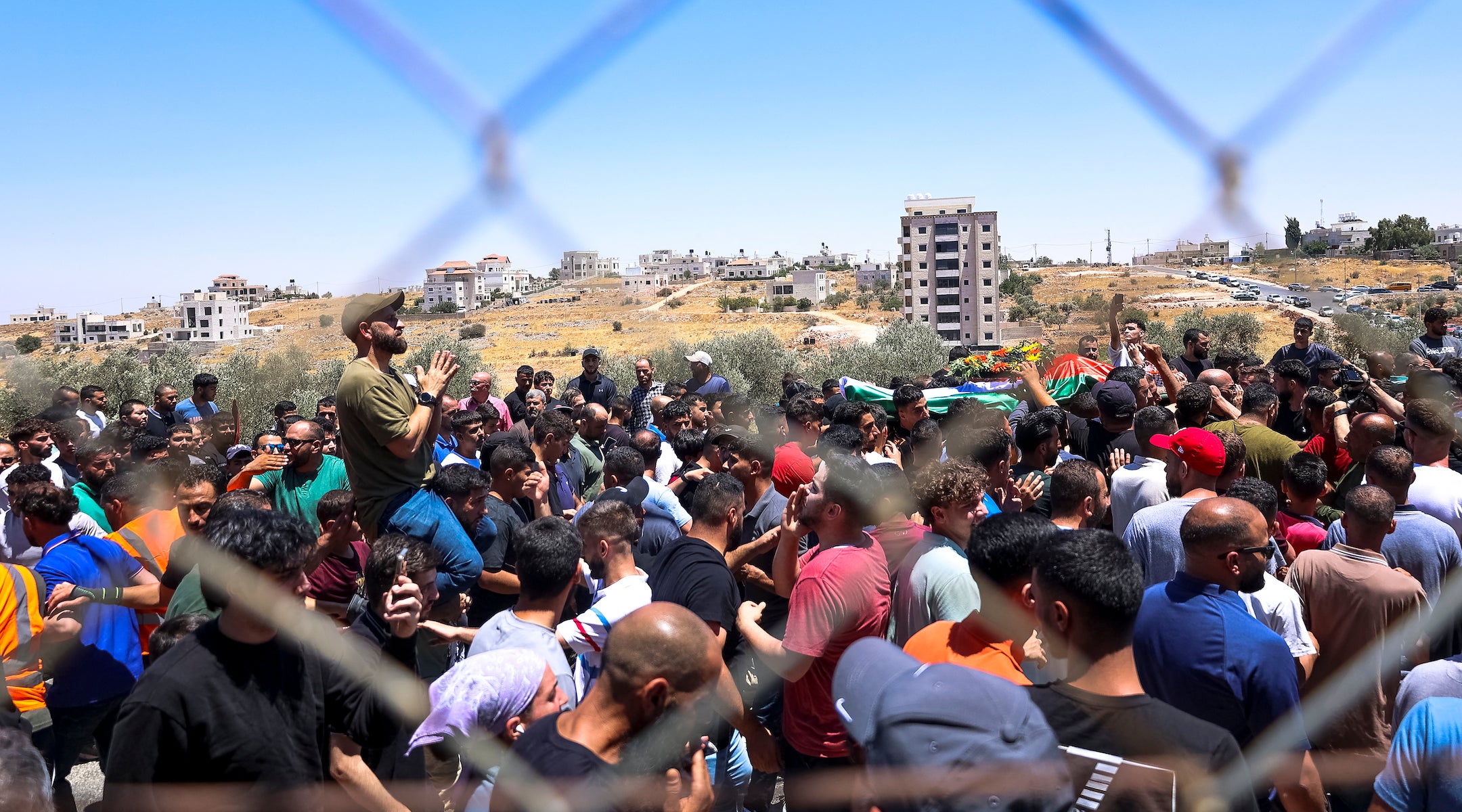
Mourners carry the bodies of Mohammad al-Shalabi, 23, and Sayafollah Musallet, 20, during their funeral on July 13, 2025, in Al-Mazra'a ash-Sharqiya, east of Ramallah in the occupied West Bank. (Mohammad Nazal / Middle East Images via AFP)
Advertisement
By Grace Gilson
The liberal Israel lobby J Street also called for a US-led investigation into the death.
Mourners carry the bodies of Mohammad al-Shalabi, 23, and Sayafollah Musallet, 20, during their funeral on July 13, 2025, in Al-Mazra'a ash-Sharqiya, east of Ramallah in the occupied West Bank. (Mohammad Nazal / Middle East Images via AFP)
Advertisement
By Grace Gilson
JEWISH TELEGRAPH NEWS
July 14, 2025
The family of a 20-year-old Palestinian-American man they say was beaten to death Friday by Israeli settlers in the West Bank has called on the U.S. State Department to investigate the incident.
“This is an unimaginable nightmare and injustice that no family should ever have to face,” the family of Sayafollah Musallet, also known as Saif, said in a statement. “We demand the U.S. State Department lead an immediate investigation and hold the Israeli settlers who killed Saif accountable for their crimes.”
According to his family and the Palestinian Health Ministry, Musallet had come from his home in Florida to the town of al-Mazra’a ash-Sharqiya to visit relatives, was severely beaten while protecting his family’s land in the town of Sinjil, north of Ramallah. Another man, Hussein Al-Shalabi, 23, was fatally shot in the chest.
A State Department spokesperson confirmed in a statement that a U.S. citizen died in the West Bank on Friday but referred questions about any investigation into the incident to Israel’s government.
The killings come as tensions among Israeli settlers, Palestinians and the Israeli Defense Forces in the West Bank have escalated in recent weeks. Last month, far-right settler groups violently attacked two Palestinian villages in the West Bank and rioted outside of a major Israeli security facility.
Many extremist settlers are seen as emboldened following the Trump administration’s decision to cancel sanctions targeting dozens of far-right Israeli individuals and settler organizations accused by the Biden administration of violent extremism against Palestinians.
Following the confrontation on Friday, settlers allegedly blocked an ambulance and paramedics from reaching Musallet for three hours. Once the mob cleared, Mussallet’s younger brother carried him to an ambulance, but he died before reaching the hospital, according to a statement from the family.
The U.S. Embassy in Jerusalem asked Israeli authorities for further details of Friday’s incident and is providing consular assistance to the family, an embassy spokesperson told CBS News.
“We are aware of reports regarding a Palestinian civilian killed and a number of injured Palestinians as a result of the confrontation, and they are being looked into by the ISA and Israel Police,” a statement on Friday from the Israel Defense Forces read.
Musallet was born and grew up in Port Charlotte, Florida, his father, Kamel Musallet, told the Washington Post. The pair were working together at an ice cream and dessert shop they opened recently in Tampa.
“He worked at his family’s ice cream shop in Tampa and was loved by so many people there. He was always kind and compassionate,” Musallet’s cousin Fatmah Muhammad told CBS News.
The town he was visiting, Al-Mazra’a ash-Sharqiya, has been dubbed the “Miami of the West Bank” for its large population of Palestinian expats that return to the town each summer, bringing wealth with them.
Following the killings, the liberal Israel lobby J Street called for “an independent, US-led investigation into the incident and its aftermath” in a statement.
“The unimaginable nightmare these families are enduring must not be compounded by injustice, inaction and a lack of accountability,” J Street President Jeremy Ben-Ami said in the statement. “As Jewish and pro‑Israel Americans, we have an obligation to demand better.”
The family of a 20-year-old Palestinian-American man they say was beaten to death Friday by Israeli settlers in the West Bank has called on the U.S. State Department to investigate the incident.
“This is an unimaginable nightmare and injustice that no family should ever have to face,” the family of Sayafollah Musallet, also known as Saif, said in a statement. “We demand the U.S. State Department lead an immediate investigation and hold the Israeli settlers who killed Saif accountable for their crimes.”
According to his family and the Palestinian Health Ministry, Musallet had come from his home in Florida to the town of al-Mazra’a ash-Sharqiya to visit relatives, was severely beaten while protecting his family’s land in the town of Sinjil, north of Ramallah. Another man, Hussein Al-Shalabi, 23, was fatally shot in the chest.
A State Department spokesperson confirmed in a statement that a U.S. citizen died in the West Bank on Friday but referred questions about any investigation into the incident to Israel’s government.
The killings come as tensions among Israeli settlers, Palestinians and the Israeli Defense Forces in the West Bank have escalated in recent weeks. Last month, far-right settler groups violently attacked two Palestinian villages in the West Bank and rioted outside of a major Israeli security facility.
Many extremist settlers are seen as emboldened following the Trump administration’s decision to cancel sanctions targeting dozens of far-right Israeli individuals and settler organizations accused by the Biden administration of violent extremism against Palestinians.
Following the confrontation on Friday, settlers allegedly blocked an ambulance and paramedics from reaching Musallet for three hours. Once the mob cleared, Mussallet’s younger brother carried him to an ambulance, but he died before reaching the hospital, according to a statement from the family.
The U.S. Embassy in Jerusalem asked Israeli authorities for further details of Friday’s incident and is providing consular assistance to the family, an embassy spokesperson told CBS News.
“We are aware of reports regarding a Palestinian civilian killed and a number of injured Palestinians as a result of the confrontation, and they are being looked into by the ISA and Israel Police,” a statement on Friday from the Israel Defense Forces read.
Musallet was born and grew up in Port Charlotte, Florida, his father, Kamel Musallet, told the Washington Post. The pair were working together at an ice cream and dessert shop they opened recently in Tampa.
“He worked at his family’s ice cream shop in Tampa and was loved by so many people there. He was always kind and compassionate,” Musallet’s cousin Fatmah Muhammad told CBS News.
The town he was visiting, Al-Mazra’a ash-Sharqiya, has been dubbed the “Miami of the West Bank” for its large population of Palestinian expats that return to the town each summer, bringing wealth with them.
Following the killings, the liberal Israel lobby J Street called for “an independent, US-led investigation into the incident and its aftermath” in a statement.
“The unimaginable nightmare these families are enduring must not be compounded by injustice, inaction and a lack of accountability,” J Street President Jeremy Ben-Ami said in the statement. “As Jewish and pro‑Israel Americans, we have an obligation to demand better.”

No comments:
Post a Comment