Despite clear evidence of the harms of industrial livestock, new research showed that in 2024, 11 leading international finance institutions invested $1.23 billion in factory farming and wider industrial animal agriculture supply chains.
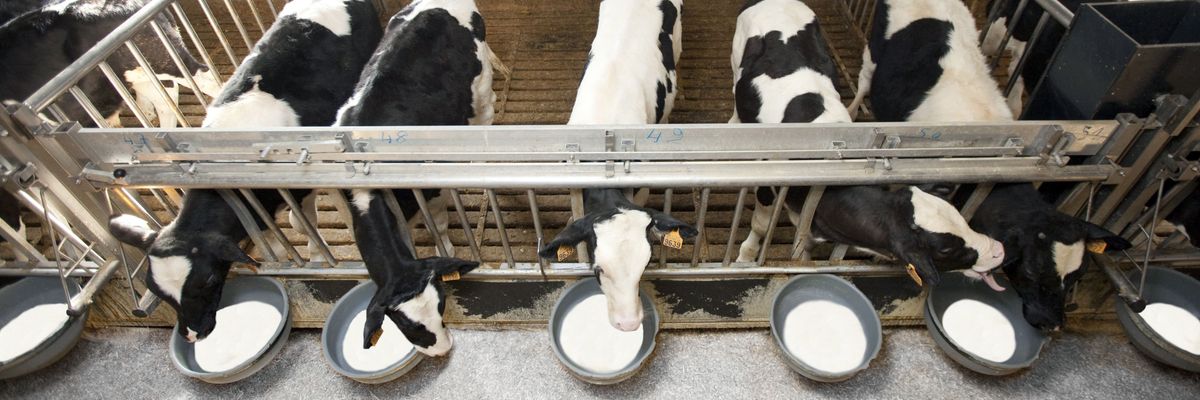
Calves drinking milk in a factory farm.
(Photo: Andia/Universal Images Group via Getty Images)
Alessandro Ramazzotti
Jul 06, 2025
Common Dreams
The World Bank’s mission is to “create a world free of poverty on a livable planet.” However, the institution, along with its peer development partners, pumps billions of dollars into factory farming, appearing to turn a blind eye to the significant harm it causes.
We cannot meet the 1.5°C Paris agreement goal without reducing emissions from livestock. Animal agriculture is a leading cause of climate breakdown; already responsible for around 16% of global greenhouse gas emissions and set to rise.
Factory farming is also tearing apart our thriving ecosystems. In Latin America, high demand for industrial grazing pasture and land for growing animal feed has fueled devastating deforestation: 84% of all Latin America’s forest loss in the last 50 years can be attributed to land claimed for livestock farming. Factory farming also pollutes soils and freshwater sources that wild animals and rural communities rely on.
Development banks tasked with tackling poverty and climate change owe it to current and future generations to use their investments to help spur the transition toward more sustainable diets and forms of food production.
Yet despite clear evidence of the harms of industrial livestock, new research I conducted for the Stop Financing Factory Farming Coalition (S3F), based on data from the Early Warning System, showed that in 2024, 11 leading international finance institutions (IFI) invested $1.23 billion in factory farming and wider industrial animal agriculture supply chains. This is five times more than what they spend on more sustainable non-industrial animal agriculture projects. The World Bank and its private sector arm, the International Finance Corporation (IFC), were together responsible for over half the funding for industrial animal agriculture.
One of the investments IFC made last year was a $40 million loan to build a soybean crushing plant in Bangladesh, used to mass-produce animal feed. The soybeans will require an estimated 354,000 hectares of land annually to be grown, and will be sourced from Brazil and Argentina where soy production is associated with destruction of sensitive ecosystems. Communities living near the plant have documented the existing and potential impacts such as the contamination of coastal waters and freshwater sources, which would consequently lead to a reduction in the local fish stocks that local communities rely on to guarantee their livelihoods, and brought their concerns in front of representatives of the U.S. government.
Over the last 20 years, IFC has also made a number of investments in Pronaca, the largest food producer in Ecuador, to expand its factory farm operations. The company has built pig and poultry farms in Santo Domingo de los Tsáchilas, a region home to natural forest and Indigenous Peoples. Local Indigenous communities documented how the farms have polluted water resources that are traditionally used to sustain their livelihoods, forcing community members to migrate to preserve their traditional cultures.
Other IFIs have also made harmful investments. The European Bank for Reconstruction and Development (EBRD) boldly claims all its investments have been Paris-aligned since January 2023; however, recent spending to expand multinational fast food chains in Eastern Europe seem to show a different scenario. During the first half of 2025, the EBRD has provided $10 million for the expansion of KFC and Taco Bell restaurants in the Western Balkans, and proposed an equity investment of $46 million for the expansion of Burger King and Louisiana Popeyes in Poland, Romania, and Czech Republic.
The latter investment would have led to the opening of 600 restaurants in the region, with large adverse impacts in terms of public health and emissions of greenhouse gases. Restaurant Brands International, which owns Burger King and Popeyes, reportedapproximately 29 million metric tons of carbon dioxide-equivalent emissions along its value chain in 2024, more than the entire emissions of Northern Ireland. Thankfully, following civil society pressure, the investment was not approved by the EBRD’s Board of Directors.
While the overall picture is bleak, there is real room for hope. Between 2023 and 2024, IFI investments in factory farming nearly halved, and investments in more sustainable approaches tripled, from $77 million to US$244 million. Examples of promising investments include the Multilateral Investment Guarantee Agency and the Inter-American Development Bank providing support to smallholder farmers using climate-friendly techniques.
This is clearly good news; however, it remains too early to tell if these figures are a one-off blip, or part of a longer-term trend. My hope is that the next round of investment data will show that harmful investments have dropped further—if not stopped completely—and more sustainable ones additionally increased.
Development banks tasked with tackling poverty and climate change owe it to current and future generations to use their investments to help spur the transition toward more sustainable diets and forms of food production, rather than replicating and expanding the broken systems that are wrecking our planet. By only investing in animal agriculture projects that are sustainable—following agroecological principles such as promoting species diversity and using nature’s resources efficiently—banks can help move us closer toward “a world free of poverty on a livable planet.”
Our work is licensed under Creative Commons (CC BY-NC-ND 3.0). Feel free to republish and share widely.
Alessandro Ramazzotti is a researcher at International Accountability Project.
Full Bio >
The World Bank’s mission is to “create a world free of poverty on a livable planet.” However, the institution, along with its peer development partners, pumps billions of dollars into factory farming, appearing to turn a blind eye to the significant harm it causes.
We cannot meet the 1.5°C Paris agreement goal without reducing emissions from livestock. Animal agriculture is a leading cause of climate breakdown; already responsible for around 16% of global greenhouse gas emissions and set to rise.
Factory farming is also tearing apart our thriving ecosystems. In Latin America, high demand for industrial grazing pasture and land for growing animal feed has fueled devastating deforestation: 84% of all Latin America’s forest loss in the last 50 years can be attributed to land claimed for livestock farming. Factory farming also pollutes soils and freshwater sources that wild animals and rural communities rely on.
Development banks tasked with tackling poverty and climate change owe it to current and future generations to use their investments to help spur the transition toward more sustainable diets and forms of food production.
Yet despite clear evidence of the harms of industrial livestock, new research I conducted for the Stop Financing Factory Farming Coalition (S3F), based on data from the Early Warning System, showed that in 2024, 11 leading international finance institutions (IFI) invested $1.23 billion in factory farming and wider industrial animal agriculture supply chains. This is five times more than what they spend on more sustainable non-industrial animal agriculture projects. The World Bank and its private sector arm, the International Finance Corporation (IFC), were together responsible for over half the funding for industrial animal agriculture.
One of the investments IFC made last year was a $40 million loan to build a soybean crushing plant in Bangladesh, used to mass-produce animal feed. The soybeans will require an estimated 354,000 hectares of land annually to be grown, and will be sourced from Brazil and Argentina where soy production is associated with destruction of sensitive ecosystems. Communities living near the plant have documented the existing and potential impacts such as the contamination of coastal waters and freshwater sources, which would consequently lead to a reduction in the local fish stocks that local communities rely on to guarantee their livelihoods, and brought their concerns in front of representatives of the U.S. government.
Over the last 20 years, IFC has also made a number of investments in Pronaca, the largest food producer in Ecuador, to expand its factory farm operations. The company has built pig and poultry farms in Santo Domingo de los Tsáchilas, a region home to natural forest and Indigenous Peoples. Local Indigenous communities documented how the farms have polluted water resources that are traditionally used to sustain their livelihoods, forcing community members to migrate to preserve their traditional cultures.
Other IFIs have also made harmful investments. The European Bank for Reconstruction and Development (EBRD) boldly claims all its investments have been Paris-aligned since January 2023; however, recent spending to expand multinational fast food chains in Eastern Europe seem to show a different scenario. During the first half of 2025, the EBRD has provided $10 million for the expansion of KFC and Taco Bell restaurants in the Western Balkans, and proposed an equity investment of $46 million for the expansion of Burger King and Louisiana Popeyes in Poland, Romania, and Czech Republic.
The latter investment would have led to the opening of 600 restaurants in the region, with large adverse impacts in terms of public health and emissions of greenhouse gases. Restaurant Brands International, which owns Burger King and Popeyes, reportedapproximately 29 million metric tons of carbon dioxide-equivalent emissions along its value chain in 2024, more than the entire emissions of Northern Ireland. Thankfully, following civil society pressure, the investment was not approved by the EBRD’s Board of Directors.
While the overall picture is bleak, there is real room for hope. Between 2023 and 2024, IFI investments in factory farming nearly halved, and investments in more sustainable approaches tripled, from $77 million to US$244 million. Examples of promising investments include the Multilateral Investment Guarantee Agency and the Inter-American Development Bank providing support to smallholder farmers using climate-friendly techniques.
This is clearly good news; however, it remains too early to tell if these figures are a one-off blip, or part of a longer-term trend. My hope is that the next round of investment data will show that harmful investments have dropped further—if not stopped completely—and more sustainable ones additionally increased.
Development banks tasked with tackling poverty and climate change owe it to current and future generations to use their investments to help spur the transition toward more sustainable diets and forms of food production, rather than replicating and expanding the broken systems that are wrecking our planet. By only investing in animal agriculture projects that are sustainable—following agroecological principles such as promoting species diversity and using nature’s resources efficiently—banks can help move us closer toward “a world free of poverty on a livable planet.”
Our work is licensed under Creative Commons (CC BY-NC-ND 3.0). Feel free to republish and share widely.
Alessandro Ramazzotti is a researcher at International Accountability Project.
Full Bio >


No comments:
Post a Comment