Offshore Wind Projects Continue to Add to U.S.-Flagged Fleet
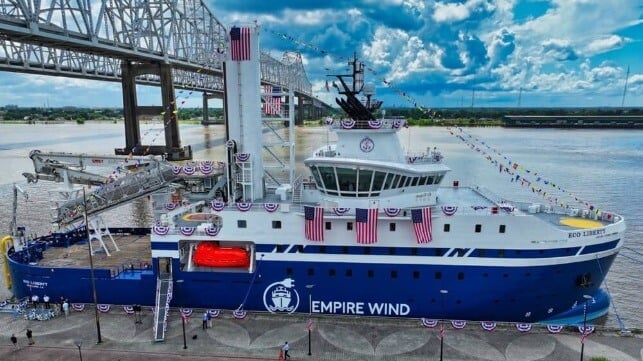
The next offshore service operation vessel (SOV), ECO Liberty, was christened to officially enter the U.S. fleet in support of the offshore wind sector. The vessel, which was completed in May, has been in jeopardy after the Trump administration suspended work on the Empire Wind project, but with work back underway, the vessel was named in New Orleans, Louisiana on June 28 by Louisiana’s First Lady Sharon Landry.
The 262-foot (80-meter) hybrid-powered ECO Liberty will be homeported at New York’s South Brooklyn Marine Terminal, where more than 2,000 workers are constructing the staging facility, O&M base, and control center for Empire Wind. The ECO Liberty will be deployed to support ongoing marine construction in the lease area and eventually serve as the floating home for Empire Wind’s skilled workers when stationed offshore.
The vessel is 5,700 GT. It provides accommodations for up to 60 workers and is designed to remain offshore at the site to support the construction and later maintenance operations.
The vessel was built by Edison Chouset Offshore, which continues to own the vessel through its offshore division. It will be operating on a long-term charter to Empire Wind, which is being developed by Equinor. Empire Wind is located 15 to 30 miles southeast of New York’s Long Island and spans 80,000 acres, with water depths of between approximately 75 and 135 feet. Offshore work started this spring for the project, which will have a capacity for 810 MW when completed.
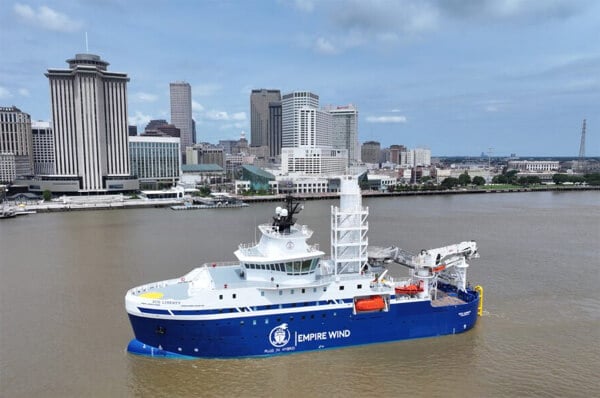
ECO Liberty is the seventh U.S. registered vessel built for the Empire Wind project (Empire Wind)
The project had been placed in jeopardy when the Trump administration suspended its permits just as offshore work was due to begin. There was more than a month of political jockeying which included New York’s government Kathy Hochul and Norwegian government officials. The permit was restored after an agreement with New York for a new onshore energy pipeline.
Empire Wind highlights that the ECO Liberty is the seventh new US-flagged vessel added to the U.S. Jones Act-compliant fleet, because of the wind project. She has a sister ship, ECO Edison, which was completed a year ago and is operating under a long-term charter to Ørsted to play an integral part in the operation and maintenance of the South Fork Wind, Revolution Wind, and Sunrise Wind projects.
In 2023, President Joe Biden attended the first steel cutting at the Philly Shipyard for a future rock installation vessel to support the offshore wind industry. At the time, the president highlighted that companies had announced 18 offshore wind shipbuilding projects as well as investments of nearly $3.5 billion across 12 manufacturing facilities and 13 ports to strengthen the American offshore wind supply chain. The vessels ranged from the first Jones Act-compliant installation vessels to SOVs and crew transfer vessels. They are being built at shipyards ranging from Florida to Louisiana, New York, Massachusetts, Michigan, Rhode Island, Wisconsin, and Pennsylvania.
In addition to the SOVs at Edison Chouset, Fincantieri Bay in Wisconsin is building an SOV that will support Dominion's offshore wind farm in Virginia. Dominion is also preparing for the delivery of Charybdis, the massive turbine installation vessel being built by Seatrium AmFELS shipyard in Brownsville, Texas. The vessel began sea trials and jack up testing in early 2025. It will be used to install the turbines at the Coastal Virginia Offshore Wind (CVOW) project, which began offshore installation in 2024.
Denmark Grants Life Extension for Two Pioneering Wind Farms
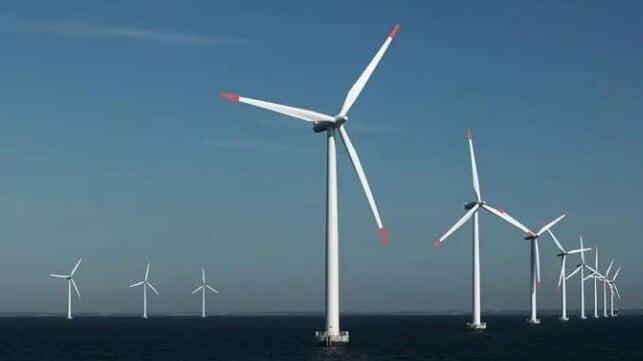
Two of the pioneering offshore wind farms, which at the time were also the largest in the world, have been granted life extensions by the Danish Energy Agency. This marks the third offshore wind farm that Demarn was licensed for continued operations and represents a critical step for the industry, changing the economics of the properties and the sustainability of the industry.
The Danish Energy Agency has notified the owners of Nysted Offshore Wind Farm south of Lolland and Middelgrunden Offshore Wind Farm in Øresund that they will have their permit for electricity production extended. The owners of the properties had applied for the extensions, and after a review that required an impartial analysis of the remaining service life to be obtained. In addition, the owners are required, as part of the extension, to carry out an extended service inspection annually.
"It is positive that offshore wind turbines that are over 20 years old will have the opportunity to continue producing green electricity for many years to come," said Stig Uffe Pedersen, Deputy Director General of the Danish Energy Agency. “It is also sustainable from a resource perspective that the plant can continue to operate safely and responsibly for a longer period of time.”
These wind farms are seen as pioneering in the industry. They are considered to have laid the foundation for the development of the modern industry with its much larger capacity.
The Middelgrunden Offshore Wind Farm, owned by HOFOR and the Middelgrundens Vindmøllelaug, has, according to the agency, become a permanent part of the view for Copenhageners. Launched in 2000, just nine years after the first offshore wind farm was started by Ørsted, Middlegrundens at the time was the largest offshore wind farm with a location just 3.5 km off the coast of Copenhagen.
The owners applied for and have received a 25-year extension of the permit. The park's 20 turbines, each just 2 MW, supply a total of 40 MW.
It was surpassed three years later by the Nysted Offshore Wind Farm. It is 10 km south of?Nysted and has a total of 72 wind turbines. Nysted’s turbines are each 2.3 MW with a total output of approximately 166 MW. Nysted offshore wind farm is owned by Ørsted, PensionDanmark, and Stadtwerke Lübeck, which had applied for a 10-year life extension.
The Danish Energy Agency marks these steps as another advancement in the maturation of the industry and expanding its contributions. Earlier in June, the Danish Energy Agency approved the first-ever extension granted to the Samsø Offshore Wind Farm. This extension is valid for ten years.
When the Samsø Offshore Wind Farm was established in 2002, the industry standard for the electricity production permit was limited to 25 years. The ten-turbine park has a total capacity of 23 MW and was granted an extension to operate until 2037.
At the beginning of June, the Agency said it had also received applications from Rønland offshore wind farm (17.2 MW) and Horns Rev 1 offshore wind farm for life extensions. Horns Rev 1 was expanded in three phases to become one of the largest offshore wind farms, and together, all these farms still play a key role in energy generation for Denmark. Today, the country has 2.7 GW of installed offshore wind power generation and an ambitious goal to reach 14 GW by 2030.

No comments:
Post a Comment