SPACE/COSMOS
Possible interstellar object spotted zooming through Solar System
By AFP
July 2, 2025
An image of the second interstellar object, 2I/Borisov, taken in 2019. Astronomers have now spotted a third - Copyright EUROPEAN SOUTHERN OBSERVATORY/AFP/File O. HAINAUT
Daniel Lawler
An object that appears to be from beyond our Solar System has been spotted hurtling towards the Sun, which if confirmed would be the third visitor from the stars ever detected, the European Space Agency said Wednesday.
The object, which is currently being referred to as A11pl3Z, poses no threat to Earth, the ESA’s planetary defence head Richard Moissl told AFP.
“It will fly deep through the Solar System, passing just inside the orbit of Mars,” but will not hit our neighbouring planet, he said.
Excited astronomers are still refining their calculations, but the object appears to be zooming more than 60 kilometres (37 miles) a second.
This would mean it is not bound by the Sun’s orbit, unlike comets and asteroids, which all originate from within the Solar System.
Its trajectory also “means it’s not orbiting our star, but coming from interstellar space and flying off to there again,” Moissl said.
“We are not 100 percent certain at the moment, but anything else would be a surprise,” he added.
Official confirmation is expected to come from the International Astronomical Union’s Minor Planet Center, which has recorded more than 100 observations of the object so far.
The NASA-funded ATLAS survey in Hawaii first discovered the object on Tuesday, US astronomer David Rankin wrote on the social media platform Bluesky.
Professional and amateur astronomers across the world then searched through past telescope data, tracing its trajectory back to at least June 14.
The object is currently estimated to be roughly 10-20 kilometres wide, Moissl said. But the object could be smaller if it is made out of ice, which reflects more light.
“It will get brighter and closer to the Sun until late October and then still be observable (by telescope) until next year,” Moissl said.
– Our third visitor –
It would be the third time humanity has detected something coming from the stars.
The first, ‘Oumuamua, was discovered in 2017. It was so strange that at least one prominent scientist became convinced it was an alien vessel — though this has since been dismissed by further research.
Our second interstellar visitor, 2I/Borisov, was spotted in 2019.
Mark Norris, an astronomer at the UK’s University of Central Lancashire, told AFP that the new object appears to be “moving considerably faster than the other two extra-solar objects that we previously discovered.”
The object is currently roughly around the distance from Jupiter away from Earth, Norris said.
He lamented that he would not be able to observe the object on his telescope on Wednesday night, because it is currently only visible in the Southern Hemisphere.
Norris pointed to modelling estimating that there could be as many 10,000 interstellar objects drifting through the Solar System at any given time, though most would be smaller than the newly discovered object.
If true, this suggests that the newly online Vera C. Rubin Observatory in Chile could soon be finding these dim interstellar visitors every month, Norris said.
Moissl said it is not feasible to send a mission into space to intercept the new object.
Still, these visitors offer scientists a rare chance to study something outside of our Solar System.
For example, if we detected precursors of life such as amino acids on such an object, it would give us “a lot more confidence that the conditions for life exist in other star systems,” Norris said.
Double detonation: New image shows remains of star destroyed by pair of explosions
image:
This image, taken with ESO’s Very Large Telescope (VLT), shows the supernova remnant SNR 0509-67.5. These are the expanding remains of a star that exploded hundreds of years ago in a double-detonation – the first photographic evidence that stars can die with two blasts.
The data were captured with the Multi-Unit Spectroscopic Explorer (MUSE) instrument at the VLT. MUSE allows astronomers to map the distribution of different chemical elements, displayed here in different colours. Calcium is shown in blue, and it is arranged in two concentric shells. These two layers indicate that the now-dead star exploded with a double-detonation.
view moreCredit: ESO/P. Das et al. Background stars (Hubble): K. Noll et al.
For the first time, astronomers have obtained visual evidence that a star met its end by detonating twice. By studying the centuries-old remains of supernova SNR 0509-67.5 with the European Southern Observatory’s Very Large Telescope (ESO’s VLT), they have found patterns that confirm its star suffered a pair of explosive blasts. Published today, this discovery shows some of the most important explosions in the Universe in a new light.
Most supernovae are the explosive deaths of massive stars, but one important variety comes from an unassuming source. White dwarfs, the small, inactive cores left over after stars like our Sun burn out their nuclear fuel, can produce what astronomers call a Type Ia supernova.
"The explosions of white dwarfs play a crucial role in astronomy,” says Priyam Das, a PhD student at the University of New South Wales Canberra, Australia, who led the study on SNR 0509-67.5 published today in Nature Astronomy. Much of our knowledge of how the Universe expands rests on Type Ia supernovae, and they are also the primary source of iron on our planet, including the iron in our blood. “Yet, despite their importance, the long-standing puzzle of the exact mechanism triggering their explosion remains unsolved," he adds.
All models that explain Type Ia supernovae begin with a white dwarf in a pair of stars. If it orbits close enough to the other star in this pair, the dwarf can steal material from its partner. In the most established theory behind Type Ia supernovae, the white dwarf accumulates matter from its companion until it reaches a critical mass, at which point it undergoes a single explosion. However, recent studies have hinted that at least some Type Ia supernovae could be better explained by a double explosion triggered before the star reached this critical mass.
Now, astronomers have captured a new image that proves their hunch was right: at least some Type Ia supernovae explode through a ‘double-detonation’ mechanism instead. In this alternative model, the white dwarf forms a blanket of stolen helium around itself, which can become unstable and ignite. This first explosion generates a shockwave that travels around the white dwarf and inwards, triggering a second detonation in the core of the star — ultimately creating the supernova.
Until now, there had been no clear, visual evidence of a white dwarf undergoing a double detonation. Recently, astronomers have predicted that this process would create a distinctive pattern or fingerprint in the supernova’s still-glowing remains, visible long after the initial explosion. Research suggests that remnants of such a supernova would contain two separate shells of calcium.
Astronomers have now found this fingerprint in a supernova’s remains. Ivo Seitenzahl, who led the observations and was at Germany’s Heidelberg Institute for Theoretical Studies when the study was conducted, says these results show “a clear indication that white dwarfs can explode well before they reach the famous Chandrasekhar mass limit, and that the ‘double-detonation’ mechanism does indeed occur in nature.” The team were able to detect these calcium layers (in blue in the image) in the supernova remnant SNR 0509-67.5 by observing it with the Multi Unit Spectroscopic Explorer (MUSE) on ESO’s VLT. This provides strong evidence that a Type Ia supernova can occur before its parent white dwarf reaches a critical mass.
Type Ia supernovae are key to our understanding of the Universe. They behave in very consistent ways, and their predictable brightness — no matter how far away they are — helps astronomers to measure distances in space. Using them as a cosmic measuring tape, astronomers discovered the accelerating expansion of the Universe, a discovery that won the Physics Nobel Prize in 2011. Studying how they explode helps us to understand why they have such a predictable brightness.
Das also has another motivation to study these explosions. “This tangible evidence of a double-detonation not only contributes towards solving a long-standing mystery, but also offers a visual spectacle,” he says, describing the “beautifully layered structure” that a supernova creates. For him, “revealing the inner workings of such a spectacular cosmic explosion is incredibly rewarding.”
More information
This research was presented in a paper to appear in Nature Astronomy titled “Calcium in a supernova remnant shows the fingerprint of a sub-Chandrasekhar mass explosion”.
The team is composed of P. Das (University of New South Wales, Australia [UNSW] & Heidelberger Institut für Theoretische Studien, Heidelberg, Germany [HITS]), I. R. Seitenzahl (HITS), A. J. Ruiter (UNSW & HITS & OzGrav: The ARC Centre of Excellence for Gravitational Wave Discovery, Hawthorn, Australia & ARC Centre of Excellence for All-Sky Astrophysics in 3 Dimensions), F. K. Röpke (HITS & Institut für Theoretische Astrophysik, Heidelberg, Germany & Astronomisches Recheninstitut, Heidelberg, Germany), R. Pakmor (Max-Planck-Institut für Astrophysik, Garching, Germany [MPA]), F. P. A. Vogt (Federal Office of Meteorology and Climatology – MeteoSwiss, Payerne, Switzerland), C. E. Collins (The University of Dublin, Dublin, Ireland & GSI Helmholtzzentrum für Schwerionenforschung, Darmstadt, Germany), P. Ghavamian (Towson University, Towson, USA), S. A. Sim (Queen’s University Belfast, Belfast, UK), B. J. Williams (X-ray Astrophysics Laboratory NASA/GSFC, Greenbelt, USA), S. Taubenberger (MPA & Technical University Munich, Garching, Germany), J. M. Laming (Naval Research Laboratory, Washington, USA), J. Suherli (University of Manitoba, Winnipeg, Canada), R. Sutherland (Australian National University, Weston Creek, Australia), and N. Rodríguez-Segovia (UNSW).
The European Southern Observatory (ESO) enables scientists worldwide to discover the secrets of the Universe for the benefit of all. We design, build and operate world-class observatories on the ground — which astronomers use to tackle exciting questions and spread the fascination of astronomy — and promote international collaboration for astronomy. Established as an intergovernmental organisation in 1962, today ESO is supported by 16 Member States (Austria, Belgium, Czechia, Denmark, France, Finland, Germany, Ireland, Italy, the Netherlands, Poland, Portugal, Spain, Sweden, Switzerland and the United Kingdom), along with the host state of Chile and with Australia as a Strategic Partner. ESO’s headquarters and its visitor centre and planetarium, the ESO Supernova, are located close to Munich in Germany, while the Chilean Atacama Desert, a marvellous place with unique conditions to observe the sky, hosts our telescopes. ESO operates three observing sites: La Silla, Paranal and Chajnantor. At Paranal, ESO operates the Very Large Telescope and its Very Large Telescope Interferometer, as well as survey telescopes such as VISTA. Also at Paranal ESO will host and operate the Cherenkov Telescope Array South, the world’s largest and most sensitive gamma-ray observatory. Together with international partners, ESO operates ALMA on Chajnantor, a facility that observes the skies in the millimetre and submillimetre range. At Cerro Armazones, near Paranal, we are building “the world’s biggest eye on the sky” — ESO’s Extremely Large Telescope. From our offices in Santiago, Chile we support our operations in the country and engage with Chilean partners and society.
Links
- Research paper
- Photos of the VLT
- For journalists: subscribe to receive our releases under embargo in your language
- For scientists: got a story? Pitch your research to ESO’s Department of Communication
- New ESO analysis confirms severe damage from industrial complex planned near Paranal
Journal
Nature Astronomy
Public Take The Lead In Discovery Of New Exploding Star
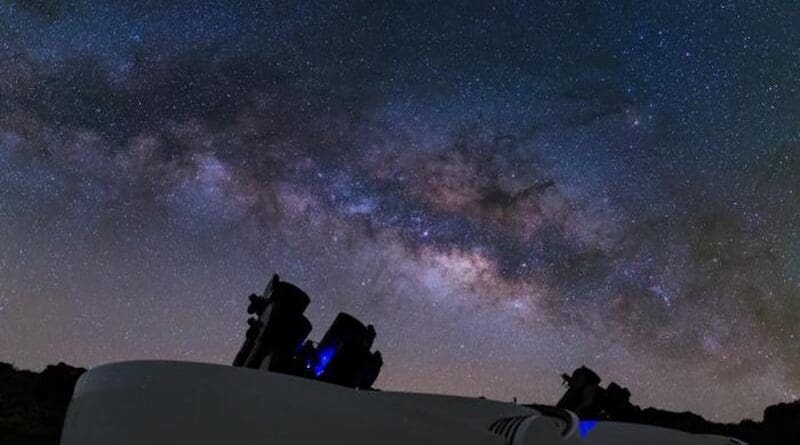
Full GOTO-North node under the skies of La Palma CREDIT: K. Ulaczyk (2024)
Previously described as playing astronomical ‘spot the difference,’ Kilonova Seekers asks the public to compare the latest images of a section of night sky to an image of the same section of space taken on previous nights. Their goal – to spot new stars or significant changes in light intensity that may indicate that something remarkable has happened in space.
Published today in Astronomy & Astrophysics, the project has announced its first published major discovery – a bright exploding star.
The object underwent an extreme brightening (increasing by 2500 times) that was not seen when compared to the image taken 2 days earlier. The quick response and diligent work of the public allowed the object to be studied and classified early in its evolution, identifying it as a cataclysmic variable star, and given the name GOTO0650.
Co-lead of Kilonova Seekers, Dr. Tom Killestein, Warwick Prize Fellow in the Astronomy and Astrophysics group, University of Warwick said: “Kilonova Seekers is a unique opportunity for members of the public to take part in true real-time astrophysics. Remarkably, public volunteers identified this star as an object of interest within 3 1/2 hours of the image being taken by the GOTO telescopes – this discovery could have been missed among many other objects without their efforts.
“The involvement of the volunteers didn’t stop there, as there was a huge follow-up response from the public. It was flagged for further observations from the Swift and Einstein Probe space observatories, and GOTO0650 was bright enough for amateur astronomers to take impressively high-quality observations of with their own equipment, which formed a key part of the paper and really helping us understand the object.”
Cataclysmic variable stars sporadically increase in brightness by large amounts before dropping back to normal levels. They are compact binary star systems, consisting of a white dwarf star stealing matter from its companion donor star. Periodically, material from the donor star hits a critical density and temperature within the disc of gas that surrounds the white dwarf, which causes an explosive outburst and bright flashes of light.
The fast response of the public enabled the team to get an unusually highly complete dataset on the star, including spectroscopy, X-ray, and UV measurements, supplemented by the impressively high-quality observations of the amateur astronomers. These observations suggest it is a period bouncer, the final state of a cataclysmic variable star, and a rare object to find even in the age of widespread wide-field imaging surveys.
Co-lead of Kilonova Seekers, Dr Lisa Kelsey, Leverhulme Early Career Fellow, Institute of Astronomy and Kavli Institute for Cosmology, Cambridge said: “Citizen science is a powerful way to make novel serendipitous discoveries in vast datasets that would normally need to be analysed in depth by scientists.
“With over 2.8 million classifications so far, the discovery of GOTO0650 is really the pinnacle of 2 years of consistent hard work from our volunteers. Without the Kilonova Seekers volunteers flagging this object, rapid follow-up would not have been possible, and this object may have been missed entirely.”
The Kilonova Seekers Project is approaching its two-year anniversary of inviting members of the public to analyse near real-time data collected from the Warwick-led Gravitational-wave Optical Transient Observer (GOTO) project. This project takes all-sky survey images of space from two arrays of telescopes located on opposite sides of the planet – in Spain and Australia.
The vast numbers of observations taken in these imaging surveys will soon be beyond the capacity of individual and small teams of scientists to label and validate. Citizen Science is a viable, mutually beneficial solution to avoid objects like GOTO0650 being missed.
As a shining example of such efforts, Kilonova Seekers has provided over 3,500 members of the public with the opportunity to discover supernovae and variable stars using real data. With volunteers from around the world, there is almost always someone online looking at the data in real-time.
Svetoslav Alexandrov, Kilonova Seekers Volunteer based in Bulgaria said: “Traffic in Sofia, Bulgaria, is always awful during the mornings so I have to pass time on the bus somehow, and contributing to citizen science is an excellent way to do that! Kilonova Seekers is on the top of my list, because it’s mobile-friendly and most importantly, it offers us fresh imagery almost every single day.
“I literally screamed with joy when I saw that I was going to be a co-author of the research paper. I’m certain that people on the street raised their eyebrows when they saw me screaming and dancing, but I didn’t care. I knew I am a co-discoverer of something significant, and this was all that mattered”

No comments:
Post a Comment