Rights Defenders Denounce Trump-DeSantis Alligator Alcatraz as 'Direct Assault on Humanity'
"This facility echoes some of our nation's darkest history," said a civil liberties advocate.
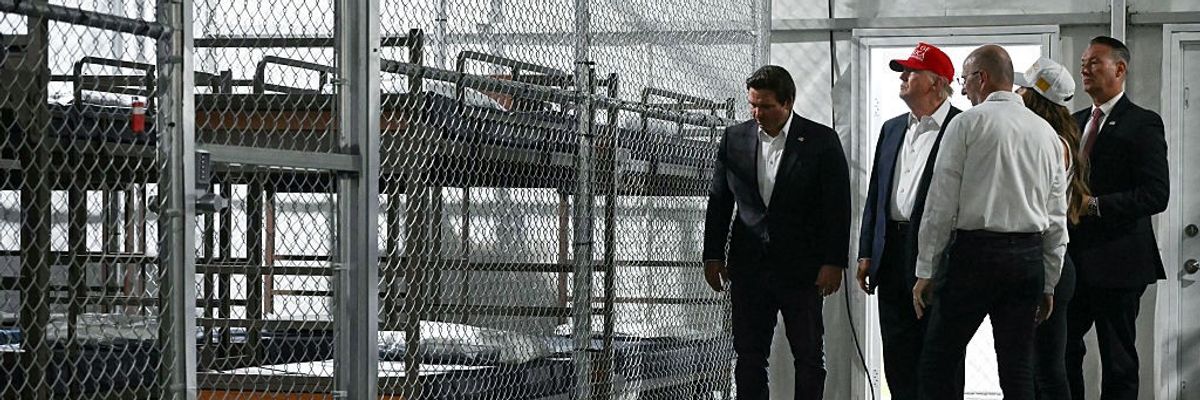
U.S. President Donald Trump and Florida Gov. Ron DeSantis tour a migrant detention center dubbed “Alligator Alcatraz” in Ochopee, Florida on July 1, 2025. (Photo: Andrew Caballero-Reynolds/AFP via Getty Images)
Brad Reed
Jul 02, 2025
"This facility echoes some of our nation's darkest history," said a civil liberties advocate.
U.S. President Donald Trump and Florida Gov. Ron DeSantis tour a migrant detention center dubbed “Alligator Alcatraz” in Ochopee, Florida on July 1, 2025. (Photo: Andrew Caballero-Reynolds/AFP via Getty Images)
Brad Reed
Jul 02, 2025
COMMON DREAMS
Civil liberties advocates expressed horror on Tuesday after President Donald Trump and Florida Gov. Ron DeSantis held a joint press event at a massive new detention facility in the Florida Everglades known as "Alligator Alcatraz."
The facility was first announced last month when Republican Florida Attorney General James Uthmeier unveiled a plan to renovate the Dade-Collier Training and Transition Airport and transform it into a mass detention center for immigrants. During a press event touting the new facility, DeSantis boasted that detainees being held at the facility had little hope of ever escaping given that it was surrounded by miles of alligator-infested swamps.
"What'll happen is you'll bring people in there, they ain't going anywhere once they're there unless you want them to go somewhere, because, good luck getting to civilization," he explained. "So the security is amazing—natural and otherwise."
Civil liberties advocates were appalled by the new facility, which is lined with razor-wire fence and is projected at least initially to house 5,000 beds for immigrants awaiting deportation. Bacardi Jackson, the executive director of the American Civil Liberties Union of Florida, accused Trump and DeSantis of engaging in wanton cruelty with their touting of the new facility and said it harkened back to dark chapters in American history.
"Building a prison-like facility on sacred indigenous land in the middle of the Everglades is a direct assault on humanity, dignity, indigenous sovereignty, and the constitutional protections we all share," she said. “Our laws—both U.S. and Florida—prohibit cruel and unusual punishment. Yet, this facility echoes some of our nation's darkest history, all while trampling the very land that indigenous communities have long fought to protect."
She added that "the facility's opening also comes as Congress is poised to authorize $45 billion in funding to expand the harmful mass immigration detention machine, right on the heels of multiple deaths in detention facilities" and further said that the project "dehumanizes people, strips them of their rights, and diverts public dollars from the services our communities need."
Guardian correspondent Robert Tait, meanwhile, described the press event surrounding the facility's opening as a "calculatedly provocative celebration of the dystopian" in a place that was designed to be "a location of dread to those lacking documentary proof of their right to be in the U.S."
Former CNN anchor Jim Acosta delivered an even more scathing denunciation of the facility on his Substack page, labeling it a "gulag in the swamp" that was intended to distract Trump supporters from the Republican Party's efforts to take an axe to Medicaid spending in their budget bill.
"Trump knows he can salvage a bad news cycle in conservative media if he can find new and, in this case, medieval ways to torment immigrants," Acosta explained. "Distract the base from Medicaid coverage they're going to lose or the skyrocketing deficits plaguing future generations by conjuring up the fantasy of terrified migrants being eaten by alligators—a prospect that seemed to delight Trump when speaking with reporters Tuesday morning."
Amid growing condemnation of the facility, Trump adviser Stephen Miller encouraged other states to pitch their own ideas for migrant detention facilities during a Tuesday night Fox News appearance. What's more, Miller said that accepted proposals from states would receive funding from the very same GOP budget bill that is projected to slash Medicaid spending by over $1 trillion over a 10-year period.
Civil liberties advocates expressed horror on Tuesday after President Donald Trump and Florida Gov. Ron DeSantis held a joint press event at a massive new detention facility in the Florida Everglades known as "Alligator Alcatraz."
The facility was first announced last month when Republican Florida Attorney General James Uthmeier unveiled a plan to renovate the Dade-Collier Training and Transition Airport and transform it into a mass detention center for immigrants. During a press event touting the new facility, DeSantis boasted that detainees being held at the facility had little hope of ever escaping given that it was surrounded by miles of alligator-infested swamps.
"What'll happen is you'll bring people in there, they ain't going anywhere once they're there unless you want them to go somewhere, because, good luck getting to civilization," he explained. "So the security is amazing—natural and otherwise."
Civil liberties advocates were appalled by the new facility, which is lined with razor-wire fence and is projected at least initially to house 5,000 beds for immigrants awaiting deportation. Bacardi Jackson, the executive director of the American Civil Liberties Union of Florida, accused Trump and DeSantis of engaging in wanton cruelty with their touting of the new facility and said it harkened back to dark chapters in American history.
"Building a prison-like facility on sacred indigenous land in the middle of the Everglades is a direct assault on humanity, dignity, indigenous sovereignty, and the constitutional protections we all share," she said. “Our laws—both U.S. and Florida—prohibit cruel and unusual punishment. Yet, this facility echoes some of our nation's darkest history, all while trampling the very land that indigenous communities have long fought to protect."
She added that "the facility's opening also comes as Congress is poised to authorize $45 billion in funding to expand the harmful mass immigration detention machine, right on the heels of multiple deaths in detention facilities" and further said that the project "dehumanizes people, strips them of their rights, and diverts public dollars from the services our communities need."
Guardian correspondent Robert Tait, meanwhile, described the press event surrounding the facility's opening as a "calculatedly provocative celebration of the dystopian" in a place that was designed to be "a location of dread to those lacking documentary proof of their right to be in the U.S."
Former CNN anchor Jim Acosta delivered an even more scathing denunciation of the facility on his Substack page, labeling it a "gulag in the swamp" that was intended to distract Trump supporters from the Republican Party's efforts to take an axe to Medicaid spending in their budget bill.
"Trump knows he can salvage a bad news cycle in conservative media if he can find new and, in this case, medieval ways to torment immigrants," Acosta explained. "Distract the base from Medicaid coverage they're going to lose or the skyrocketing deficits plaguing future generations by conjuring up the fantasy of terrified migrants being eaten by alligators—a prospect that seemed to delight Trump when speaking with reporters Tuesday morning."
Amid growing condemnation of the facility, Trump adviser Stephen Miller encouraged other states to pitch their own ideas for migrant detention facilities during a Tuesday night Fox News appearance. What's more, Miller said that accepted proposals from states would receive funding from the very same GOP budget bill that is projected to slash Medicaid spending by over $1 trillion over a 10-year period.
Stop Alligator Alcatraz Now, Before They Build Another in a Remote Area Near You
America stands at a crossroads. Down one road lies the fragile promise of democracy: messy, imperfect, but built on the belief in human dignity and the rule of law. Down the other lies the swamp—where cruelty is policy, and fear is law.
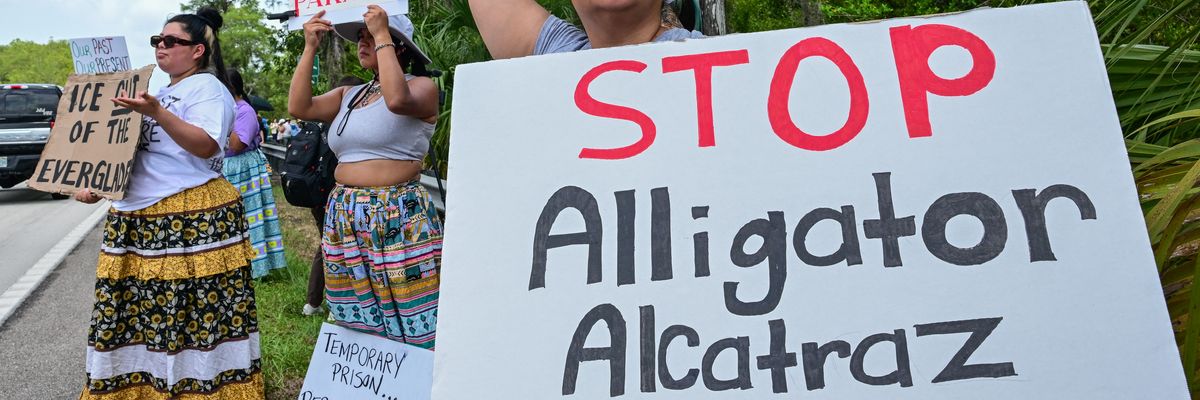
Demonstrators protest the construction of an immigrant detention center, dubbed "Alligator Alcatraz," in the Everglades near Ochopee, Florida, on June 28, 2025.
(Photo: Giorgio Viera/AFP via Getty Images)
Thom Hartmann
Jul 02, 2025
America stands at a crossroads. Down one road lies the fragile promise of democracy: messy, imperfect, but built on the belief in human dignity and the rule of law. Down the other lies the swamp—where cruelty is policy, and fear is law.
Demonstrators protest the construction of an immigrant detention center, dubbed "Alligator Alcatraz," in the Everglades near Ochopee, Florida, on June 28, 2025.
(Photo: Giorgio Viera/AFP via Getty Images)
Thom Hartmann
Jul 02, 2025
Common Dreams
When Louise and I lived in Germany in 1986-87, we visited Dachau with our family. The crematoriums shocked our children, but even more so because this was simply a “detention facility” and not one of Hitler’s death camps. The ovens were for those who had been worked to death or killed by cholera.
The death camps, it turns out, were all located outside of Germany so Dear Leader could deny responsibility for them. You know, like Gitmo.
Trump’s “Big Beautiful Bill” (aka the “GOP Donor Fellatio Act”) contains a 13-fold increase in Immigration and Custom Enforcement’s budget, turning it into the largest single (secret, masked) police force in America, along with, in aggregate, close to $100 billion to build a new series of “detention facilities” all across America.
The most dangerous thing about Alligator Alcatraz isn’t the alligators. It’s the message.
If this passes, soon the country will pockmarked by concentration camps. As Trump said yesterday:
Well, I think we'd like to see them in many states, really, many states. This one, I know Ron’s doing a second one, at least a second one, and probably a couple of more. And, you know, at some point, they might morph into a system where you’re going to keep it for a long time.
Let’s stop pretending. Let’s stop dancing around the language, around the morality, and around the history.
What’s being built in the Florida Everglades, for example—what they’re calling “Alligator Alcatraz”—is not just another immigration facility. It’s a political prison engineered not merely to detain, but to humiliate, dehumanize, and broadcast terror.
It’s America’s first open-air symbol that our democracy is not just dying: it is being dissected publicly, cruelly, and with calculation.
Donald Trump is back in the White House. The Republican Party controls Congress. And with a permanent “immigration emergency” in place, Florida Gov. Ron DeSantis is running point on an experiment in authoritarian governance.
Alligator Alcatraz is the proof-of-concept.
Rising in a remote wildlife preserve in Big Cypress National Preserve—Indigenous land, no less—Alligator Alcatraz is expected to hold thousands of undocumented migrants. Some reports say 1,000 at launch; others say 5,000. Either way, it is the largest civilian detention project built on U.S. soil in a generation.
It’s surrounded by dense marshland, home to pythons and alligators.
“Let them try to escape,” Trump smirked at a recent rally. “They better know how to run from an alligator.”
This isn’t just cruelty. It’s performance. It’s state-sponsored sadism, broadcast as patriotism. DeSantis and Trump are now competing in a bizarre effort to show who can be more cruel.
But it’s not unprecedented. If you want to understand what’s happening in Florida, you have to travel back to 1933, to a small, remote town in Bavaria.
When Adolf Hitler seized power in Germany, the first thing he built wasn’t a tank or a warship. It was a “detention facility.”
The Dachau concentration camp, opened in March 1933 just three months after he became Chancellor, was described at the time as “the first concentration camp for political prisoners.” As the Dachau memorial site explains,
From the very beginning, the camp was a place of brutality. During the first years, most prisoners were political opponents of the Nazi regime.
They weren’t criminals. They weren’t traitors. They were “undesirable immigrants.” Trade unionists. Communists. Jews. Catholics. Writers. Teachers. Students. They were anyone the regime considered a threat or a convenient enemy.
The Nazis didn’t hide Dachau. They advertised it. It was a warning. A message. Step out of line, and this is where you go.
Sound familiar?
Alligator Alcatraz is not Dachau. It’s not exterminating people. Yet. But Dachau didn’t begin as a death camp either. It began as a “protective custody” facility, built on the idea that “certain people” posed a threat to the national body simply by existing.
That’s what Florida’s new facility represents. Not immigration enforcement. Not public safety. Protective custody for political purposes.
Under Trump’s new national emergency framework, virtually anyone deemed “unlawfully present” can be detained indefinitely without trial.
That means asylum-seekers. Victims of trafficking. Children.
And if you believe this won’t expand—if you believe this power will remain solely focused on brown-skinned migrants fleeing violence in Central America—then you haven’t read a history book lately.
Stripping people of their citizenship is called denaturalization, and it was one of Hitler’s favorite tools against his enemies and Jews, who were referred to as “undesirable foreign elements” and denaturalized en masse in 1935.
Trump’s DOJ just updated their guidelines relating to the 25 million American citizens who first came to this country as immigrants and then obtained citizenship through the naturalization process. It used to be that you could only lose your citizenship if you committed a serious enough crime.
And, yesterday, Trump said:
Many of them were born in our country. I think we ought to get them the hell out of here, too, if you want to know the truth. So maybe that'll be the next job that we'll work on together.
So now, the DOJ says, Trump can choose to denaturalize anybody and then immediately send them to Alligator Alcatraz:
“Any other cases referred to the Civil Division that the Division determines to be sufficiently important to pursue [may be stripped of citizenship]. These categories are intended to guide the Civil Division in prioritizing which cases to pursue; however, these categories do not limit the Civil Division from pursuing any particular case, nor are they listed in a particular order of importance. Further, the Civil Division retains the discretion to pursue cases outside of these categories as it determines appropriate. The assignment of denaturalization cases may be made across sections or units based on experience, subject-matter expertise, and the overall needs of the Civil Division.” (emphasis added)
And as a special bonus, the memo notes that stripping American citizens of their citizenship is a civil, not criminal, process so you are not entitled to have a lawyer or any of the other normal aspects of legal procedure like a trial that we generally think of as our rights. Franz Kafka would be proud.
Dachau didn’t just hold communists. Over time, it expanded to include denaturalized Jews, homosexuals, Jehovah’s Witnesses, Roma, and anyone who opposed Nazi policy. It became a national crucible of cruelty. It normalized the idea that “certain people do not deserve legal protections.”
That is the fire that Alligator Alcatraz is stoking today.
How is this being done? Through a cunning abuse of emergency powers.
Florida has been under a rolling immigration “state of emergency” since 2023, a legal status that allows the governor to bypass environmental protections, override public procurement processes, and redirect funds without oversight.
Sound familiar? It should. The Nazis used the 1933 Reichstag Fire Decree to grant themselves emergency powers in perpetuity. One crisis, one convenient boogeyman, and suddenly all democratic guardrails are removed.
Today, DeSantis is using Federal Emergency Management Agency funds intended for hurricane victims to build migrant cages. Tomorrow, it could be protesters. Journalists. Teachers. You.
This isn’t alarmism. It’s precedent.
Let’s talk about the location, because it matters.
Big Cypress is a remote and largely inaccessible swamp, home to endangered species, sacred Indigenous land, and—now—a prison surrounded by natural predators.
Human rights lawyers and journalists will find it hard to access. Escapes will be all but impossible. Oversight will be nonexistent. That’s by design.
Dachau, too, was deliberately chosen for its isolation. As the memorial website explains:
The camp was constantly expanded and served as the prototype and model for all later concentration camps.
It became a template. A blueprint. And its very existence reshaped what the German public considered “normal.”
Alligator Alcatraz is the same. A testing ground. If it succeeds—not as a legal institution, but as a political spectacle—there will be more. One in Texas. One in Arizona. One in Arkansas. Maybe even one in your backyard.
The most dangerous thing about Alligator Alcatraz isn’t the alligators. It’s the message.
The message that some people are less than human. That caging them is acceptable. That they deserve no rights, no hearing, no compassion. Just mud and barbed wire.
That was the logic behind Dachau.
And it’s becoming the logic behind Trump’s America.
This facility is being built not to solve a problem, but to create one. To manufacture outrage. To train the public to see brown-skinned immigrants not as workers or families or survivors but as invaders. Intruders. Animals.
And that’s when the door opens for something far worse.
We cannot afford to wait. We cannot afford to be polite. The time for half-measures and technocratic rebuttals and “strongly worded letters” is over.
America stands at a crossroads. Down one road lies the fragile promise of democracy: messy, imperfect, but built on the belief in human dignity and the rule of law. Down the other lies the swamp—literal and figurative—where cruelty is policy, and fear is law.
Alligator Alcatraz isn’t just a prison. It’s a mirror. And it’s asking us: Who are we, really?
The answer, as always, is up to us.
We must engage:Lawsuits: Civil liberties groups and Indigenous tribes must continue challenging this facility in court. Environmental statutes, tribal treaties, and international human rights laws can still be leveraged.
Documentation: Journalists must risk everything to document the construction, conditions, and policies of Alligator Alcatraz. We need eyes in the swamp, or darkness will reign.
Direct Action: Peaceful protest, civil disobedience, and national mobilization must become central. This is a fight for the moral compass of our country.
Language: Stop calling this a “detention center.” Call it what it is: a political prison. A migrant concentration camp. Words matter.
History: Teach your neighbors about Dachau. Show them how it started. Not with mass extermination, but with silence. With a single camp, surrounded by a fence, where people were put “for their own protection.”
Democracy doesn’t fall all at once. It decays from the inside. It erodes at the margins. It disappears not with a bang, but with a shrug.
The United States of America has reached a threshold. We can step back and reaffirm our commitment to human dignity, to due process, to liberty and justice for all.
Or we can cross into the swamp. And never come back.
Dachau was the beginning of something monstrous. Let Alligator Alcatraz be the end of something: the end of our innocence, the end of our complacency, and the start of a renewed resistance.
Because if we wait too long, we may wake up one day and discover we are no longer the land of the free, but only the home of the caged.
Our work is licensed under Creative Commons (CC BY-NC-ND 3.0). Feel free to republish and share widely.
Thom Hartmann
is a talk-show host and the author of "The Hidden History of Monopolies: How Big Business Destroyed the American Dream" (2020); "The Hidden History of the Supreme Court and the Betrayal of America" (2019); and more than 25 other books in print.
Full Bio >
When Louise and I lived in Germany in 1986-87, we visited Dachau with our family. The crematoriums shocked our children, but even more so because this was simply a “detention facility” and not one of Hitler’s death camps. The ovens were for those who had been worked to death or killed by cholera.
The death camps, it turns out, were all located outside of Germany so Dear Leader could deny responsibility for them. You know, like Gitmo.
Trump’s “Big Beautiful Bill” (aka the “GOP Donor Fellatio Act”) contains a 13-fold increase in Immigration and Custom Enforcement’s budget, turning it into the largest single (secret, masked) police force in America, along with, in aggregate, close to $100 billion to build a new series of “detention facilities” all across America.
The most dangerous thing about Alligator Alcatraz isn’t the alligators. It’s the message.
If this passes, soon the country will pockmarked by concentration camps. As Trump said yesterday:
Well, I think we'd like to see them in many states, really, many states. This one, I know Ron’s doing a second one, at least a second one, and probably a couple of more. And, you know, at some point, they might morph into a system where you’re going to keep it for a long time.
Let’s stop pretending. Let’s stop dancing around the language, around the morality, and around the history.
What’s being built in the Florida Everglades, for example—what they’re calling “Alligator Alcatraz”—is not just another immigration facility. It’s a political prison engineered not merely to detain, but to humiliate, dehumanize, and broadcast terror.
It’s America’s first open-air symbol that our democracy is not just dying: it is being dissected publicly, cruelly, and with calculation.
Donald Trump is back in the White House. The Republican Party controls Congress. And with a permanent “immigration emergency” in place, Florida Gov. Ron DeSantis is running point on an experiment in authoritarian governance.
Alligator Alcatraz is the proof-of-concept.
Rising in a remote wildlife preserve in Big Cypress National Preserve—Indigenous land, no less—Alligator Alcatraz is expected to hold thousands of undocumented migrants. Some reports say 1,000 at launch; others say 5,000. Either way, it is the largest civilian detention project built on U.S. soil in a generation.
It’s surrounded by dense marshland, home to pythons and alligators.
“Let them try to escape,” Trump smirked at a recent rally. “They better know how to run from an alligator.”
This isn’t just cruelty. It’s performance. It’s state-sponsored sadism, broadcast as patriotism. DeSantis and Trump are now competing in a bizarre effort to show who can be more cruel.
But it’s not unprecedented. If you want to understand what’s happening in Florida, you have to travel back to 1933, to a small, remote town in Bavaria.
When Adolf Hitler seized power in Germany, the first thing he built wasn’t a tank or a warship. It was a “detention facility.”
The Dachau concentration camp, opened in March 1933 just three months after he became Chancellor, was described at the time as “the first concentration camp for political prisoners.” As the Dachau memorial site explains,
From the very beginning, the camp was a place of brutality. During the first years, most prisoners were political opponents of the Nazi regime.
They weren’t criminals. They weren’t traitors. They were “undesirable immigrants.” Trade unionists. Communists. Jews. Catholics. Writers. Teachers. Students. They were anyone the regime considered a threat or a convenient enemy.
The Nazis didn’t hide Dachau. They advertised it. It was a warning. A message. Step out of line, and this is where you go.
Sound familiar?
Alligator Alcatraz is not Dachau. It’s not exterminating people. Yet. But Dachau didn’t begin as a death camp either. It began as a “protective custody” facility, built on the idea that “certain people” posed a threat to the national body simply by existing.
That’s what Florida’s new facility represents. Not immigration enforcement. Not public safety. Protective custody for political purposes.
Under Trump’s new national emergency framework, virtually anyone deemed “unlawfully present” can be detained indefinitely without trial.
That means asylum-seekers. Victims of trafficking. Children.
And if you believe this won’t expand—if you believe this power will remain solely focused on brown-skinned migrants fleeing violence in Central America—then you haven’t read a history book lately.
Stripping people of their citizenship is called denaturalization, and it was one of Hitler’s favorite tools against his enemies and Jews, who were referred to as “undesirable foreign elements” and denaturalized en masse in 1935.
Trump’s DOJ just updated their guidelines relating to the 25 million American citizens who first came to this country as immigrants and then obtained citizenship through the naturalization process. It used to be that you could only lose your citizenship if you committed a serious enough crime.
And, yesterday, Trump said:
Many of them were born in our country. I think we ought to get them the hell out of here, too, if you want to know the truth. So maybe that'll be the next job that we'll work on together.
So now, the DOJ says, Trump can choose to denaturalize anybody and then immediately send them to Alligator Alcatraz:
“Any other cases referred to the Civil Division that the Division determines to be sufficiently important to pursue [may be stripped of citizenship]. These categories are intended to guide the Civil Division in prioritizing which cases to pursue; however, these categories do not limit the Civil Division from pursuing any particular case, nor are they listed in a particular order of importance. Further, the Civil Division retains the discretion to pursue cases outside of these categories as it determines appropriate. The assignment of denaturalization cases may be made across sections or units based on experience, subject-matter expertise, and the overall needs of the Civil Division.” (emphasis added)
And as a special bonus, the memo notes that stripping American citizens of their citizenship is a civil, not criminal, process so you are not entitled to have a lawyer or any of the other normal aspects of legal procedure like a trial that we generally think of as our rights. Franz Kafka would be proud.
Dachau didn’t just hold communists. Over time, it expanded to include denaturalized Jews, homosexuals, Jehovah’s Witnesses, Roma, and anyone who opposed Nazi policy. It became a national crucible of cruelty. It normalized the idea that “certain people do not deserve legal protections.”
That is the fire that Alligator Alcatraz is stoking today.
How is this being done? Through a cunning abuse of emergency powers.
Florida has been under a rolling immigration “state of emergency” since 2023, a legal status that allows the governor to bypass environmental protections, override public procurement processes, and redirect funds without oversight.
Sound familiar? It should. The Nazis used the 1933 Reichstag Fire Decree to grant themselves emergency powers in perpetuity. One crisis, one convenient boogeyman, and suddenly all democratic guardrails are removed.
Today, DeSantis is using Federal Emergency Management Agency funds intended for hurricane victims to build migrant cages. Tomorrow, it could be protesters. Journalists. Teachers. You.
This isn’t alarmism. It’s precedent.
Let’s talk about the location, because it matters.
Big Cypress is a remote and largely inaccessible swamp, home to endangered species, sacred Indigenous land, and—now—a prison surrounded by natural predators.
Human rights lawyers and journalists will find it hard to access. Escapes will be all but impossible. Oversight will be nonexistent. That’s by design.
Dachau, too, was deliberately chosen for its isolation. As the memorial website explains:
The camp was constantly expanded and served as the prototype and model for all later concentration camps.
It became a template. A blueprint. And its very existence reshaped what the German public considered “normal.”
Alligator Alcatraz is the same. A testing ground. If it succeeds—not as a legal institution, but as a political spectacle—there will be more. One in Texas. One in Arizona. One in Arkansas. Maybe even one in your backyard.
The most dangerous thing about Alligator Alcatraz isn’t the alligators. It’s the message.
The message that some people are less than human. That caging them is acceptable. That they deserve no rights, no hearing, no compassion. Just mud and barbed wire.
That was the logic behind Dachau.
And it’s becoming the logic behind Trump’s America.
This facility is being built not to solve a problem, but to create one. To manufacture outrage. To train the public to see brown-skinned immigrants not as workers or families or survivors but as invaders. Intruders. Animals.
And that’s when the door opens for something far worse.
We cannot afford to wait. We cannot afford to be polite. The time for half-measures and technocratic rebuttals and “strongly worded letters” is over.
America stands at a crossroads. Down one road lies the fragile promise of democracy: messy, imperfect, but built on the belief in human dignity and the rule of law. Down the other lies the swamp—literal and figurative—where cruelty is policy, and fear is law.
Alligator Alcatraz isn’t just a prison. It’s a mirror. And it’s asking us: Who are we, really?
The answer, as always, is up to us.
We must engage:Lawsuits: Civil liberties groups and Indigenous tribes must continue challenging this facility in court. Environmental statutes, tribal treaties, and international human rights laws can still be leveraged.
Documentation: Journalists must risk everything to document the construction, conditions, and policies of Alligator Alcatraz. We need eyes in the swamp, or darkness will reign.
Direct Action: Peaceful protest, civil disobedience, and national mobilization must become central. This is a fight for the moral compass of our country.
Language: Stop calling this a “detention center.” Call it what it is: a political prison. A migrant concentration camp. Words matter.
History: Teach your neighbors about Dachau. Show them how it started. Not with mass extermination, but with silence. With a single camp, surrounded by a fence, where people were put “for their own protection.”
Democracy doesn’t fall all at once. It decays from the inside. It erodes at the margins. It disappears not with a bang, but with a shrug.
The United States of America has reached a threshold. We can step back and reaffirm our commitment to human dignity, to due process, to liberty and justice for all.
Or we can cross into the swamp. And never come back.
Dachau was the beginning of something monstrous. Let Alligator Alcatraz be the end of something: the end of our innocence, the end of our complacency, and the start of a renewed resistance.
Because if we wait too long, we may wake up one day and discover we are no longer the land of the free, but only the home of the caged.
Our work is licensed under Creative Commons (CC BY-NC-ND 3.0). Feel free to republish and share widely.
Thom Hartmann
is a talk-show host and the author of "The Hidden History of Monopolies: How Big Business Destroyed the American Dream" (2020); "The Hidden History of the Supreme Court and the Betrayal of America" (2019); and more than 25 other books in print.
Full Bio >
Jennifer Bowers Bahney
July 2, 2025
RAW STORY
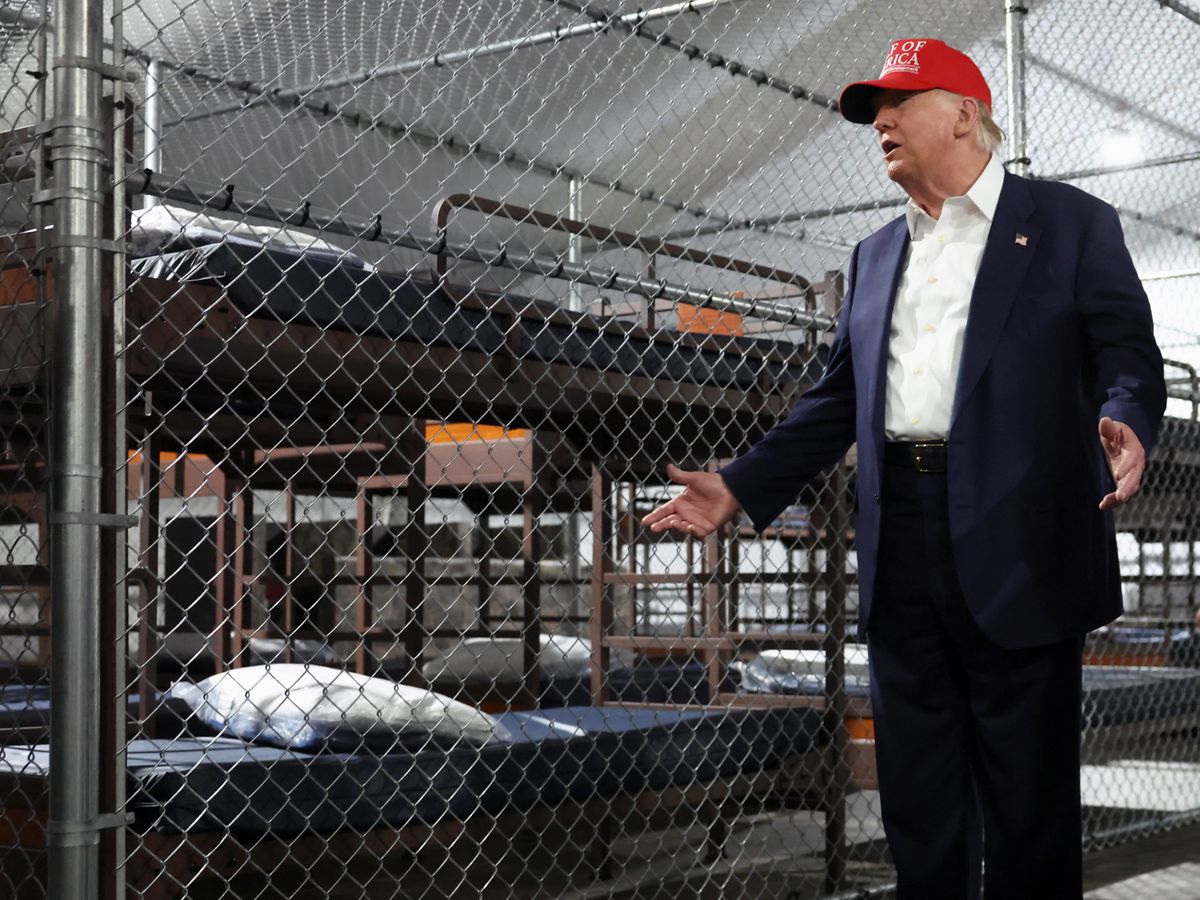
U.S. President Donald Trump visits a temporary migrant detention center informally known as "Alligator Alcatraz" in Ochopee, Florida, U.S., July 1, 2025. REUTERS/Evelyn Hockstein
New video showed a "garden-variety South Florida summer rainstorm" flooding tents and drowning out Gov. Ron DeSantis (R) as he touted the "Alligator Alcatrez" detention facility he claimed was ready to house deportees, according to The Miami Herald.
Rain began shortly after President Donald Trump finished up his tour of the Everglades facility that the White House claimed needed little security due to pythons and alligators surrounding it, the report said.
"The water seeped into the site — the one that earlier in day the state’s top emergency chief had boasted was ready to withstand the winds of a 'high-end' Category 2 hurricane — and streamed all over electrical cables on the floor," wrote reporters Syra Ortiz Blanes, Ana Ceballos, and Alex Harris.
U.S. President Donald Trump visits a temporary migrant detention center informally known as "Alligator Alcatraz" in Ochopee, Florida, U.S., July 1, 2025. REUTERS/Evelyn Hockstein
New video showed a "garden-variety South Florida summer rainstorm" flooding tents and drowning out Gov. Ron DeSantis (R) as he touted the "Alligator Alcatrez" detention facility he claimed was ready to house deportees, according to The Miami Herald.
Rain began shortly after President Donald Trump finished up his tour of the Everglades facility that the White House claimed needed little security due to pythons and alligators surrounding it, the report said.
"The water seeped into the site — the one that earlier in day the state’s top emergency chief had boasted was ready to withstand the winds of a 'high-end' Category 2 hurricane — and streamed all over electrical cables on the floor," wrote reporters Syra Ortiz Blanes, Ana Ceballos, and Alex Harris.

They quoted Kevin Guthrie, executive director of the Florida Division of Emergency Management, as saying, “For those people that don’t think we’re taking that into consideration. This is Florida, by the way. We have a hurricane plan.”
But The Herald reported "that at one point the roof was shaking as the rain pounded down, drowning out Gov. Ron DeSantis’ voice as he spoke to reporters."
Spectrum News reporter Jason Delgado posted video of the flooding, and of DeSantis trying to talk over the cacophony.

"A good lil storm passed over us here at 'Alligator Alcatraz,’" Delgado posted. "Here's what it looks & sounds like inside one of these tents. The state says the sites here are rated to withstand a category two hurricane (~120mph winds)."
Liberal commentator Christopher Webb also posted video of the flooding, writing, "It’s costing taxpayers $450 million annually and Alligator Alcatraz concentration camp is already flooding. Imagine a hurricane. People are going to die. There’s always enough money to hurt folks, but when it comes to public transit, low-income housing, schools, or public healthcare, 'Sorry, we’re broke.'”
In a follow-up post, Delgado included a statement by the Florida Division of Emergency Management, saying "they’ve taken action to address the water leaks that happened Tuesday during a thunderstorm at ‘Alligator Alcatraz.’"
The statement read, “Overnight, the vendors went back and tightened any seams at the base of the structures that allowed water intrusion during the heavy storm, which was minimal.”

No comments:
Post a Comment