
'Brutal' job report leaves experts reeling: 'Hard to overstate how bad'
Common Dreams
August 1, 2025
The latest jobs report from the Bureau of Labor Statistics released on Friday showed a significant slowdown in hiring across the economy.
In total, the BLS estimated that a mere 73,000 jobs were added to the U.S. economy in July, which was well below economists' consensus estimate of 117,500 net job gains.
What really made the latest jobs report concerning, however, was the downward revision of previous months' gains, which the BLS described as "larger than normal." The number of jobs added in May was revised downward from 144,000 to 19,000, while the number of jobs added in June was revised downward from 147,000 to 14,000. Taken together, this means that the economy has added an average of just 35,000 jobs per month over the last three months.
New York Times chief economics correspondent Ben Casselman described the downward revisions as "a very significant sign of weakening" and he noted that healthcare and social assistance jobs accounted for nearly all of last month's gains.
"If it hadn't been for that sector, employment would have fallen slightly," he observed on Bluesky.
Economic analyst Joe Weisenthal, cohost of the Bloomberg podcast "Odd Lots," also zeroed in on the fact that healthcare and social assistance were now carrying the weight for the entire U.S. labor market.
"Brutal," he wrote on X. "If you exclude these two categories, job growth has been running negative for three straight months."
Heather Long, the chief economist at Navy Federal Credit Union, described the July jobs report as a "game changer," and not in a good way.
"The labor market now looks a lot weaker than expected," Long wrote on X. "This puts a September rate cut from the Federal Reserve back on the table."
Market analyst Adam Crisafulli, the founder of Vital Knowledge Media, shared Long's view that the Federal Reserve would likely start cutting rates soon and he even believed that the Fed would have cut rates starting this week had it known about the weakness of the labor market.
"Hard to overstate how bad this jobs report was," he commented on X.
Daniel Hornung, a senior fellow at MIT and former deputy director of the National Economic Council, said that the weak jobs report will only make the Federal Reserve's decisions more perilous in the coming months.
"A turbulent week in markets and the economy is coming to a close with inflation moving higher, while economic and payroll growth are moving lower," he said. "It's a precarious position for the Fed and the economy, largely the result of the [Trump] administration's stagflationary tariff policies, which are set to move even higher beginning next week."
Jessica Fulton, a senior fellow at the Joint Center for Political and Economic Studies, argued that the slowdown in hiring, combined with the increased costs consumers are facing thanks to U.S. President Donald Trump's tariffs, are putting American workers in a very tight squeeze.
"The economy continues to show signs of weakening even as the White House pushes policies that will raise costs and make it harder for families to make ends meet," she said. "Labor market cracks that showed up for Black women earlier this year are beginning to expand, with Black male unemployment reaching 7% this month. Black workers are often laid off first when the economy slows down."
Rep. Brendan Boyle (D-Pa.), the top Democrat on the House Budget Committee, delivered a blistering statement about the jobs report and pointed the finger directly at Trump and Republicans in Congress.
"Under President Trump, job growth is slowing, costs keep rising, and the Big Ugly Law is stripping health care from millions," he said. "While he hands out tax breaks to billionaires and stokes reckless trade wars, middle-class families are left paying the price."
August 1, 2025
The latest jobs report from the Bureau of Labor Statistics released on Friday showed a significant slowdown in hiring across the economy.
In total, the BLS estimated that a mere 73,000 jobs were added to the U.S. economy in July, which was well below economists' consensus estimate of 117,500 net job gains.
What really made the latest jobs report concerning, however, was the downward revision of previous months' gains, which the BLS described as "larger than normal." The number of jobs added in May was revised downward from 144,000 to 19,000, while the number of jobs added in June was revised downward from 147,000 to 14,000. Taken together, this means that the economy has added an average of just 35,000 jobs per month over the last three months.
New York Times chief economics correspondent Ben Casselman described the downward revisions as "a very significant sign of weakening" and he noted that healthcare and social assistance jobs accounted for nearly all of last month's gains.
"If it hadn't been for that sector, employment would have fallen slightly," he observed on Bluesky.
Economic analyst Joe Weisenthal, cohost of the Bloomberg podcast "Odd Lots," also zeroed in on the fact that healthcare and social assistance were now carrying the weight for the entire U.S. labor market.
"Brutal," he wrote on X. "If you exclude these two categories, job growth has been running negative for three straight months."
Heather Long, the chief economist at Navy Federal Credit Union, described the July jobs report as a "game changer," and not in a good way.
"The labor market now looks a lot weaker than expected," Long wrote on X. "This puts a September rate cut from the Federal Reserve back on the table."
Market analyst Adam Crisafulli, the founder of Vital Knowledge Media, shared Long's view that the Federal Reserve would likely start cutting rates soon and he even believed that the Fed would have cut rates starting this week had it known about the weakness of the labor market.
"Hard to overstate how bad this jobs report was," he commented on X.
Daniel Hornung, a senior fellow at MIT and former deputy director of the National Economic Council, said that the weak jobs report will only make the Federal Reserve's decisions more perilous in the coming months.
"A turbulent week in markets and the economy is coming to a close with inflation moving higher, while economic and payroll growth are moving lower," he said. "It's a precarious position for the Fed and the economy, largely the result of the [Trump] administration's stagflationary tariff policies, which are set to move even higher beginning next week."
Jessica Fulton, a senior fellow at the Joint Center for Political and Economic Studies, argued that the slowdown in hiring, combined with the increased costs consumers are facing thanks to U.S. President Donald Trump's tariffs, are putting American workers in a very tight squeeze.
"The economy continues to show signs of weakening even as the White House pushes policies that will raise costs and make it harder for families to make ends meet," she said. "Labor market cracks that showed up for Black women earlier this year are beginning to expand, with Black male unemployment reaching 7% this month. Black workers are often laid off first when the economy slows down."
Rep. Brendan Boyle (D-Pa.), the top Democrat on the House Budget Committee, delivered a blistering statement about the jobs report and pointed the finger directly at Trump and Republicans in Congress.
"Under President Trump, job growth is slowing, costs keep rising, and the Big Ugly Law is stripping health care from millions," he said. "While he hands out tax breaks to billionaires and stokes reckless trade wars, middle-class families are left paying the price."
Trump’s sabotage of jobs report exposed by conservative after meltdown
Matthew Chapman
August 1, 2025

U.S. President Donald Trump speaks alongside Howard Lutnick in the Oval Office of the White House on the day Lutnick is sworn in as U.S. Commerce Secretary by Vice President JD Vance, in Washington, DC, U.S., February 21, 2025. REUTERS/Nathan Howard
President Donald Trump reacted to Friday's disastrous jobs report by firing the director of the Bureau of Labor Statistics, baselessly claiming this data had been fabricated by anti-MAGA forces to make him look bad.
But this freakout is even more embarrassing given that a task force had been working to improve BLS data accuracy, and the Trump administration disbanded it, conservative National Review writer Dominic Pino explained in a lengthy thread posted to X.
"Mad about jobs report inaccuracy?" wrote Pino. "One reason it has gotten harder in recent years is declining survey response rates. There was an unpaid advisory group of statistical experts that was working on solving that problem at its last meeting... before Howard Lutnick disbanded it."
This group, known as the Federal Economic Statistics Advisory Committee, "was established in 1999 to advise the Bureau of Labor Statistics, Bureau of Economic Analysis, and the Census Bureau, on technical methodology issues," and consisted of 15 unpaid volunteer experts from think tanks and academic institutions.
The committee held two in-person meetings each year, the last of which occurred Dec. 13, 2024, where they talked about how to improve survey response rates, wrote Pino. Falling rates on the BLS establishment survey, which asks employers how many people they employ and is used for the jobs report, has been a "major impediment to achieving greater accuracy," he said, as the response rate has plunged since the COVID-19 pandemic and no one knows how to reverse it.
"FESAC members at the December meeting heard from officials at statistical agencies in the U.K., Canada, and Germany who had all tried different things to improve response rates, with varying levels of success," wrote Pino. "In other words, this advisory group was doing exactly what one should want the government to do to improve its service to the public: Asking questions about what works based on experience and trying to formulate a better process."
Lutnick, he noted, ended the program in February, stating that "the purposes for which FESAC was established has been fulfilled" and provided no further reason.
"Was FESAC going to completely solve the long-running problem of lower response rates? No. But having it is better than not having it, and at little to no cost to the taxpayer, Lutnick did not need to disband it," Pino concluded. "Now, the Trump administration is mad about the exact thing FESAC was working on during its final meeting."
Matthew Chapman
August 1, 2025
RAW STORY
U.S. President Donald Trump speaks alongside Howard Lutnick in the Oval Office of the White House on the day Lutnick is sworn in as U.S. Commerce Secretary by Vice President JD Vance, in Washington, DC, U.S., February 21, 2025. REUTERS/Nathan Howard
President Donald Trump reacted to Friday's disastrous jobs report by firing the director of the Bureau of Labor Statistics, baselessly claiming this data had been fabricated by anti-MAGA forces to make him look bad.
But this freakout is even more embarrassing given that a task force had been working to improve BLS data accuracy, and the Trump administration disbanded it, conservative National Review writer Dominic Pino explained in a lengthy thread posted to X.
"Mad about jobs report inaccuracy?" wrote Pino. "One reason it has gotten harder in recent years is declining survey response rates. There was an unpaid advisory group of statistical experts that was working on solving that problem at its last meeting... before Howard Lutnick disbanded it."
This group, known as the Federal Economic Statistics Advisory Committee, "was established in 1999 to advise the Bureau of Labor Statistics, Bureau of Economic Analysis, and the Census Bureau, on technical methodology issues," and consisted of 15 unpaid volunteer experts from think tanks and academic institutions.
The committee held two in-person meetings each year, the last of which occurred Dec. 13, 2024, where they talked about how to improve survey response rates, wrote Pino. Falling rates on the BLS establishment survey, which asks employers how many people they employ and is used for the jobs report, has been a "major impediment to achieving greater accuracy," he said, as the response rate has plunged since the COVID-19 pandemic and no one knows how to reverse it.
"FESAC members at the December meeting heard from officials at statistical agencies in the U.K., Canada, and Germany who had all tried different things to improve response rates, with varying levels of success," wrote Pino. "In other words, this advisory group was doing exactly what one should want the government to do to improve its service to the public: Asking questions about what works based on experience and trying to formulate a better process."
Lutnick, he noted, ended the program in February, stating that "the purposes for which FESAC was established has been fulfilled" and provided no further reason.
"Was FESAC going to completely solve the long-running problem of lower response rates? No. But having it is better than not having it, and at little to no cost to the taxpayer, Lutnick did not need to disband it," Pino concluded. "Now, the Trump administration is mad about the exact thing FESAC was working on during its final meeting."
Data on jobs were ‘rigged,’ Trump claims
'In my opinion, today’s Jobs Numbers were RIGGED in order to make the Republicans, and ME, look bad,' says US president
Diyar Güldoğan |01.08.2025 - TRT/AA
WASHINGTON
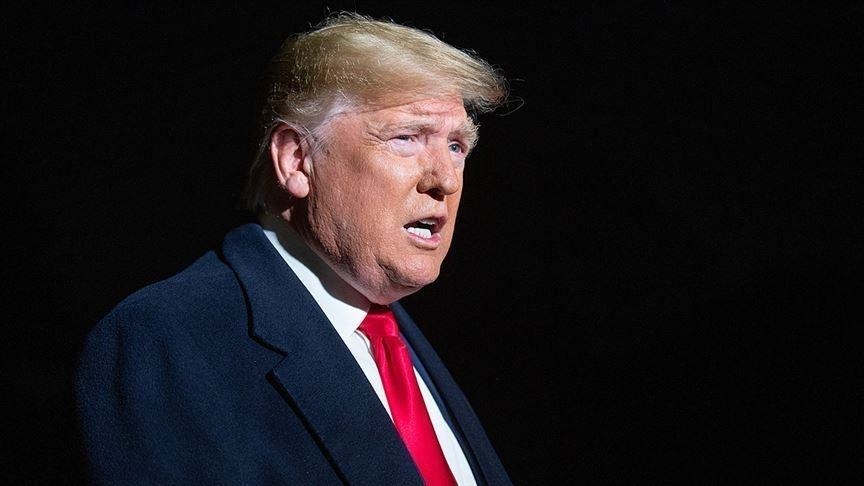
US President Donald Trump on Friday said he believed the most recent job figures released by the Bureau of Labor Statistics were "rigged" and politically motivated.
"In my opinion, today’s Jobs Numbers were RIGGED in order to make the Republicans, and ME, look bad — Just like when they had three great days around the 2024 Presidential Election," Trump wrote on Truth Social.
He added, "the figures were 'taken away' on November 15, 2024, right after the Election, when the Jobs Numbers were massively revised DOWNWARD, making a correction of over 818,000 Jobs — A TOTAL SCAM."
Earlier, Trump said that he has ordered the dismissal of the expert in charge of the Labor Department's statistics division after the agency's data showed that job growth fell short of expectations.
Trump accused Erika McEntarfer, the commissioner of labor statistics, of being a political appointee of former President Joe Biden who "faked" the numbers.
The Labor Department on Friday reported that the US economy added 73,000 jobs in July, significantly less than expectations of 106,000. It further downgraded estimates for the past two months, cutting a combined 258,000 estimated jobs.
'In my opinion, today’s Jobs Numbers were RIGGED in order to make the Republicans, and ME, look bad,' says US president
Diyar Güldoğan |01.08.2025 - TRT/AA
WASHINGTON
US President Donald Trump on Friday said he believed the most recent job figures released by the Bureau of Labor Statistics were "rigged" and politically motivated.
"In my opinion, today’s Jobs Numbers were RIGGED in order to make the Republicans, and ME, look bad — Just like when they had three great days around the 2024 Presidential Election," Trump wrote on Truth Social.
He added, "the figures were 'taken away' on November 15, 2024, right after the Election, when the Jobs Numbers were massively revised DOWNWARD, making a correction of over 818,000 Jobs — A TOTAL SCAM."
Earlier, Trump said that he has ordered the dismissal of the expert in charge of the Labor Department's statistics division after the agency's data showed that job growth fell short of expectations.
Trump accused Erika McEntarfer, the commissioner of labor statistics, of being a political appointee of former President Joe Biden who "faked" the numbers.
The Labor Department on Friday reported that the US economy added 73,000 jobs in July, significantly less than expectations of 106,000. It further downgraded estimates for the past two months, cutting a combined 258,000 estimated jobs.
Trump directs firing of expert in charge of US jobs figures after records show hiring slowed
President claims US economy is 'booming' while accusing head of Labor Department's statistics department of having 'faked' job numbers
Michael Gabriel Hernandez |01.08.2025 - TRT/AA
WASHINGTON
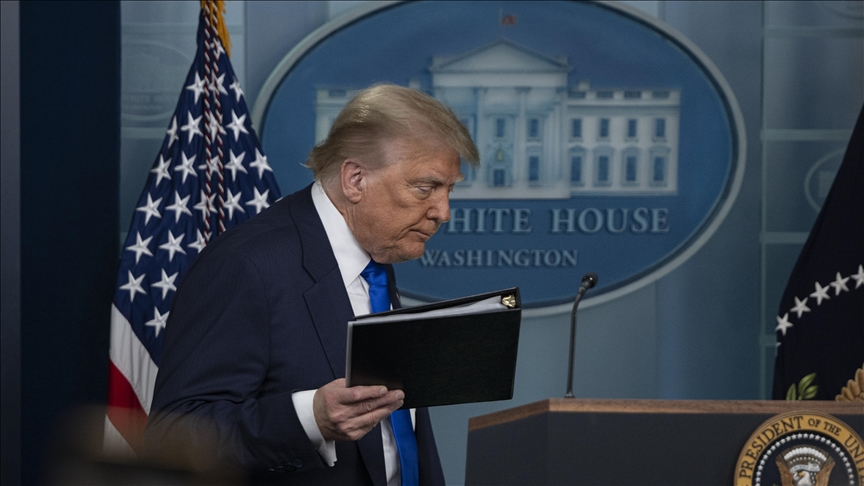
US President Donald Trump said Friday that he has ordered the dismissal of the expert in charge of the Labor Department's statistics division after the agency's data showed that job growth has been reduced to a crawl.
Trump accused Dr. Erika McEntarfer, the commissioner of labor statistics, of being a political appointee of former President Joe Biden who "faked" the numbers.
"She will be replaced with someone much more competent and qualified. Important numbers like this must be fair and accurate, they can’t be manipulated for political purposes," Trump said on social media.
"The Economy is BOOMING under “TRUMP” despite a Fed that also plays games, this time with Interest Rates, where they lowered them twice, and substantially, just before the Presidential Election, I assume in the hopes of getting “Kamala” elected – How did that work out? Jerome “Too Late” Powell should also be put 'out to pasture,'" he added.
The Labor Department earlier Friday reported that the US economy added a far less than expected 73,000 jobs in July, significantly less than expectations of 106,000. It further significantly downgraded estimates for the past two months, cutting a combined 258,000 estimated jobs.
Unemployment rose to 4.2%.
The announcement, coupled with Trump's decision to escalate tariffs on dozens of countries amid his ongoing trade war, sent markets sharply lower.
The Dow shed over 1%, and the tech-heavy Nasdaq dipped more than 2.1% in late-day trading.
President claims US economy is 'booming' while accusing head of Labor Department's statistics department of having 'faked' job numbers
Michael Gabriel Hernandez |01.08.2025 - TRT/AA
WASHINGTON
US President Donald Trump said Friday that he has ordered the dismissal of the expert in charge of the Labor Department's statistics division after the agency's data showed that job growth has been reduced to a crawl.
Trump accused Dr. Erika McEntarfer, the commissioner of labor statistics, of being a political appointee of former President Joe Biden who "faked" the numbers.
"She will be replaced with someone much more competent and qualified. Important numbers like this must be fair and accurate, they can’t be manipulated for political purposes," Trump said on social media.
"The Economy is BOOMING under “TRUMP” despite a Fed that also plays games, this time with Interest Rates, where they lowered them twice, and substantially, just before the Presidential Election, I assume in the hopes of getting “Kamala” elected – How did that work out? Jerome “Too Late” Powell should also be put 'out to pasture,'" he added.
The Labor Department earlier Friday reported that the US economy added a far less than expected 73,000 jobs in July, significantly less than expectations of 106,000. It further significantly downgraded estimates for the past two months, cutting a combined 258,000 estimated jobs.
Unemployment rose to 4.2%.
The announcement, coupled with Trump's decision to escalate tariffs on dozens of countries amid his ongoing trade war, sent markets sharply lower.
The Dow shed over 1%, and the tech-heavy Nasdaq dipped more than 2.1% in late-day trading.
Trump fires labour statistics chief Erika McEntarfer after weak July jobs report
President Trump accused BLS Commissioner Erika McEntarfer, a Biden appointee, of manipulating employment data and fired her after weak July jobs numbers and major revisions.
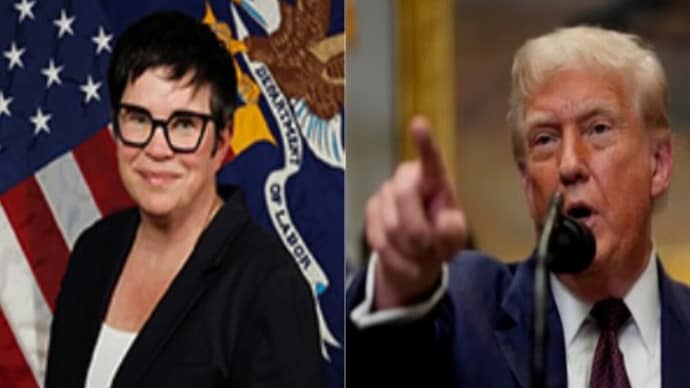
Donald Trump fires Bureau of Labour Statistics Comissioner Erika McEntrafer. (Photo: Reuters)
India Today World Desk
UPDATED: Aug 2, 2025
In Short
Experts warn politicisation threatens credibility of US economic data
Job growth slowed sharply in July, attributed to Trump's policies
US President Donald Trump on Friday (local time) ordered that the commissioner of the Labour Department's Bureau of Labour Statistics Erika McEntarfer be fired after data showed weaker-than-expected employment growth in July and massive downward revisions to the prior two months' job counts.
McEntarfer was nominated by former President Joe Biden to serve in the role in 2023 and was confirmed by the US Senate the following year. It was not immediately clear whether McEntarfer, whom Trump accused of faking the jobs numbers, had been fired.
advertisement
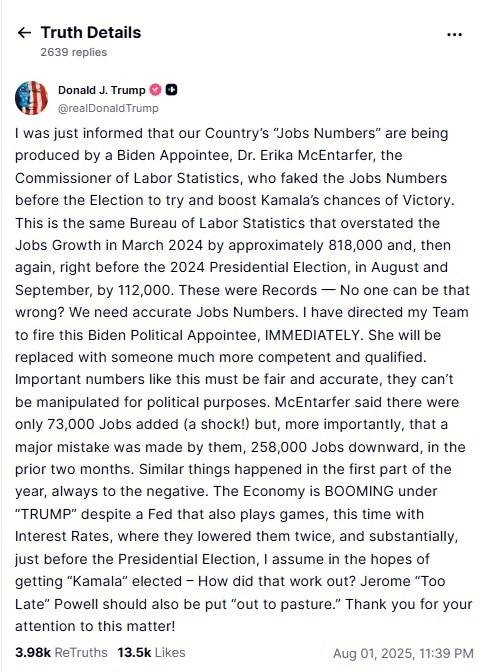
Trump took to his Truth Social account to inform about McEntarfer's firing.
With inputs from agencies.
President Trump accused BLS Commissioner Erika McEntarfer, a Biden appointee, of manipulating employment data and fired her after weak July jobs numbers and major revisions.
Donald Trump fires Bureau of Labour Statistics Comissioner Erika McEntrafer. (Photo: Reuters)
India Today World Desk
UPDATED: Aug 2, 2025
In Short
McEntarfer accused by Trump of faking job numbers, no proof found
Experts warn politicisation threatens credibility of US economic data
Job growth slowed sharply in July, attributed to Trump's policies
US President Donald Trump on Friday (local time) ordered that the commissioner of the Labour Department's Bureau of Labour Statistics Erika McEntarfer be fired after data showed weaker-than-expected employment growth in July and massive downward revisions to the prior two months' job counts.
McEntarfer was nominated by former President Joe Biden to serve in the role in 2023 and was confirmed by the US Senate the following year. It was not immediately clear whether McEntarfer, whom Trump accused of faking the jobs numbers, had been fired.
advertisement
Trump took to his Truth Social account to inform about McEntarfer's firing.
Trump announced the firing of McEntarfer over his Truth Social account
Trump lambasted McEntarfer and accused her of producing fake job numbers. "We need accurate Jobs Numbers. I have directed my Team to fire this Biden Political Appointee, IMMEDIATELY. She will be replaced with someone much more competent and qualified," Trump said.
There is no proof that supports Trump's accusations about the BLS tampering with data. The BLS is the statistical agency responsible for creating the employment report, which is closely followed, as well as data on consumer and producer prices.
The White House did not respond immediately to questions about Trump’s post.
ACCUSATIONS
According to Reuters, Trump acccused McEntarfer of putting out the job numbers before the elections to help Democrats.
The order to dismiss McEntarfer comes at a time when the Trump administration's mass layoffs of federal government workers have raised concerns about the quality of US economic data, long seen as the gold standard.
Trump later posted: “In my opinion, today’s Jobs Numbers were RIGGED in order to make the Republicans, and ME, look bad.”
After his initial post, Labour Secretary Lori Chavez-DeRemer said on X that McEntarfer was no longer leading the bureau and that William Wiatrowski, the deputy commissioner, would serve as the acting director.
“I support the President’s decision to replace Biden’s Commissioner and ensure the American People can trust the important and influential data coming from BLS,” Chavez-DeRemer said.
Earlier this year, Commerce Secretary Howard Lutnick disbanded two expert committees that worked with the government to produce economic statistics. Lutnick has also floated the idea of stripping out government spending from the gross domestic product report, claiming "governments historically have messed with GDP."
CONCERNS OVER DATA INTEGRITY
The recent dismissal of a senior Bureau of Labour Statistics official has triggered a wave of concern among economists, public sector unions, and data transparency advocates, as Trump-aligned Republicans label the official a “Biden holdover.”
American Federation of Government Employees national president Everett Kelley defended the integrity of the agency and its personnel. "The civil servants at BLS are not political actors. They are professionals committed to producing accurate, independent data, regardless of who is in power," said Kelley, noting that the ousted official, McEntarfer, had served across multiple administrations over more than two decades.
While the Trump administration has not detailed the rationale behind the firing, allies have publicly supported the move, casting it as part of an effort to purge lingering Biden-era personnel.The incident has prompted broader warnings about the politicisation of economic statistics.
"Politicizing economic statistics is a self-defeating act," said Michael Madowitz, principal economist at the Roosevelt Institute’s Roosevelt Forward.
"Credibility is far easier to lose than rebuild, and the credibility of America's economic data is the foundation on which we've built the strongest economy in the world. Blinding the public about the state of the economy has a long track record, and it never ends well."
Earlier this year, Commerce Secretary Howard Lutnick disbanded two advisory committees tasked with helping ensure the reliability of US economic statistics. He has also floated controversial changes to the calculation of GDP, suggesting that government spending should be excluded on the grounds that “governments historically have messed with GDP.”
Meanwhile, the BLS has scaled back data collection efforts for key reports, citing budget limitations. Sample sizes have been reduced for both consumer and producer price indexes. The monthly employment survey—which typically includes data from around 121,000 businesses and agencies covering more than 600,000 worksites—has seen its response rate fall from 80.3% in October 2020 to just 67.1% in July.
With multiple shifts in data practices underway and political tensions escalating, experts warn that the perceived impartiality of US economic data could be at risk.
ECONOMISTS' OVERVIEW
The BLS has already reduced data collection for the consumer price data as well as the producer price report.
Economists attributed the sharply slower job growth to Trump's trade and immigration policies. The economy created only 73,000 jobs in July. Data for May and June were revised sharply down to show 258,000 fewer jobs created than had been previously reported. As per a report by CNBC, Laura Ulrich, director of economic research for North America at job site Indeed said that the July figure suggests the job market isn’t keeping pace with population growth, and is therefore contracting.
- Ends
Trump lambasted McEntarfer and accused her of producing fake job numbers. "We need accurate Jobs Numbers. I have directed my Team to fire this Biden Political Appointee, IMMEDIATELY. She will be replaced with someone much more competent and qualified," Trump said.
There is no proof that supports Trump's accusations about the BLS tampering with data. The BLS is the statistical agency responsible for creating the employment report, which is closely followed, as well as data on consumer and producer prices.
The White House did not respond immediately to questions about Trump’s post.
ACCUSATIONS
According to Reuters, Trump acccused McEntarfer of putting out the job numbers before the elections to help Democrats.
The order to dismiss McEntarfer comes at a time when the Trump administration's mass layoffs of federal government workers have raised concerns about the quality of US economic data, long seen as the gold standard.
Trump later posted: “In my opinion, today’s Jobs Numbers were RIGGED in order to make the Republicans, and ME, look bad.”
After his initial post, Labour Secretary Lori Chavez-DeRemer said on X that McEntarfer was no longer leading the bureau and that William Wiatrowski, the deputy commissioner, would serve as the acting director.
“I support the President’s decision to replace Biden’s Commissioner and ensure the American People can trust the important and influential data coming from BLS,” Chavez-DeRemer said.
Earlier this year, Commerce Secretary Howard Lutnick disbanded two expert committees that worked with the government to produce economic statistics. Lutnick has also floated the idea of stripping out government spending from the gross domestic product report, claiming "governments historically have messed with GDP."
CONCERNS OVER DATA INTEGRITY
The recent dismissal of a senior Bureau of Labour Statistics official has triggered a wave of concern among economists, public sector unions, and data transparency advocates, as Trump-aligned Republicans label the official a “Biden holdover.”
American Federation of Government Employees national president Everett Kelley defended the integrity of the agency and its personnel. "The civil servants at BLS are not political actors. They are professionals committed to producing accurate, independent data, regardless of who is in power," said Kelley, noting that the ousted official, McEntarfer, had served across multiple administrations over more than two decades.
While the Trump administration has not detailed the rationale behind the firing, allies have publicly supported the move, casting it as part of an effort to purge lingering Biden-era personnel.The incident has prompted broader warnings about the politicisation of economic statistics.
"Politicizing economic statistics is a self-defeating act," said Michael Madowitz, principal economist at the Roosevelt Institute’s Roosevelt Forward.
"Credibility is far easier to lose than rebuild, and the credibility of America's economic data is the foundation on which we've built the strongest economy in the world. Blinding the public about the state of the economy has a long track record, and it never ends well."
Earlier this year, Commerce Secretary Howard Lutnick disbanded two advisory committees tasked with helping ensure the reliability of US economic statistics. He has also floated controversial changes to the calculation of GDP, suggesting that government spending should be excluded on the grounds that “governments historically have messed with GDP.”
Meanwhile, the BLS has scaled back data collection efforts for key reports, citing budget limitations. Sample sizes have been reduced for both consumer and producer price indexes. The monthly employment survey—which typically includes data from around 121,000 businesses and agencies covering more than 600,000 worksites—has seen its response rate fall from 80.3% in October 2020 to just 67.1% in July.
With multiple shifts in data practices underway and political tensions escalating, experts warn that the perceived impartiality of US economic data could be at risk.
ECONOMISTS' OVERVIEW
The BLS has already reduced data collection for the consumer price data as well as the producer price report.
Economists attributed the sharply slower job growth to Trump's trade and immigration policies. The economy created only 73,000 jobs in July. Data for May and June were revised sharply down to show 258,000 fewer jobs created than had been previously reported. As per a report by CNBC, Laura Ulrich, director of economic research for North America at job site Indeed said that the July figure suggests the job market isn’t keeping pace with population growth, and is therefore contracting.
- Ends
With inputs from agencies.
US job growth slowed sharply in July 2025, with unemployment rising to 4.2 per cent and past job gains revised down, fuelling recession fears and pressuring the Fed to consider cutting interest rates.

A tractor trailer advertising job opportunities in the trucking industry drives south on Interstate 81 near Staunton, Virginia. (Reuters Photo)
India Today World Desk
UPDATED: Aug 2, 2025
In Short
May and June job gains were drastically revised down by 258,000
Unemployment rate rose to 4.2 per cent
Trump's tariffs raised costs, pressuring hiring and wages
US job growth in July 2025 fell short of expectations, delivering a sharp blow to economists and unsettling financial markets. According to a closely watched Labor Department report released on Friday and cited by Reuters, nonfarm payrolls added just 73,000 jobs last month, well below expectations, while employment gains from May and June were revised downward by a staggering 258,000.
The unemployment rate also ticked up to 4.2 per cent from 4.1 per cent, signalling that the once-resilient labor market may finally be cracking under pressure.
Labor market strength had been a main support for the U.S. economy, helping it hold up against high inflation and tough policies from the Trump administration, such as new tariffs and strict immigration measures.
But the latest Bureau of Labor Statistics (BLS) data paints a troubling picture of a cooling job market, raising the specter of a looming recession.
Perhaps the most startling revelation in the report wasn't July's weak job creation alone, but the massive downward revisions to previous months.
May's job gains were cut from 144,000 to just 19,000, and June's numbers were slashed from 147,000 to a paltry 14,000.
HIRING FREEZE SIGNALS BROADER SLOWDOWN
The three-month average for job gains has now dropped to just 35,000, a sharp drop from monthly averages exceeding 240,000 in 2024.
Sectors like retail, tech, and manufacturing are reporting either stagnant hiring or outright layoffs. Wage growth is also slowing, job openings are declining, and the unemployment uptick marks a critical turning point for analysts who had seen labor data as a key measure of economic resilience.
“This is the slowdown we’ve been bracing for,” said Luke Tilley, chief economist at Wilmington Trust. “Firms are adjusting to a very different cost structure and holding off on hiring.”
TRUMP'S TARIFFS: MAJOR OBSTACLE FOR GROWTH
President Donald Trump's sweeping 2025 tariff agenda is emerging as a key factor weighing down job creation. The average US tariff rate has surged to between 18 per cent and 21per cent, the highest in over a century.
According to the Penn Wharton Budget Model, the long-run effect could be a 6 per cen reduction in GDP and a 5 per cen decline in real wages. Middle-income households may lose an estimated USD 22,000 in lifetime earnings.
The Tax Foundation compares the tariffs to a stealth tax hike, estimating they could shrink 2025 GDP by 0.8% and cost households between $1,200 and $1,600 this year alone. Higher input costs—up 2% to 4.5% in some sectors—are pressuring businesses to scale back hiring or cut jobs entirely.
FED UNDER PRESSURE TO PIVOT
With inflation still stuck between 2.6 per cent and 2.8 per cent, the Federal Reserve has been trying to strike a careful balance. But the sudden slowdown in the job market may push it to act.
According to CME Group data, investors now see a 75.5 per cent chance the Fed will cut interest rates in September—up from just 40 per cent the day before the jobs report came out.
The central bank had been using strong employment numbers to justify holding rates steady. Now, the dramatic slowdown in hiring may compel policymakers to act to prevent a deeper economic contraction.
Not all sectors fared equally. Healthcare, construction, and government continued to post modest job gains, but at a slower pace. Meanwhile, tech, retail, and manufacturing either stagnated or saw declines in hiring.
A TURNING POINT FOR US ECONOMY?
The July jobs report may mark the moment when a soft landing slipped out of reach. With hiring slowing, jobless claims ticking upward, and consumer spending dampened by inflation and higher costs due to tariffs, many economists believe the second half of 2025 could see the US slipping closer to, or even into a recession.
“This report is a gamechanger,” said Heather Long, chief economist at Navy Federal Credit Union, via CNBC. “The labor market is deteriorating quickly.”

No comments:
Post a Comment