Product Tanker Causes Protest in Australia as it Likely has Russian Oil
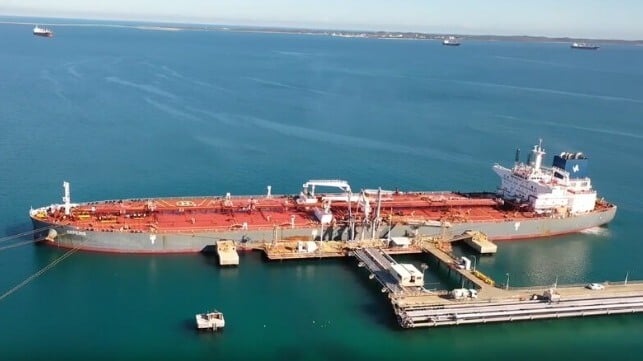
The issue of intermediaries in the oil supply chain surfaced in Australia this week as a tanker arrived from India, likely with Russian oil. It is leading to calls to close loopholes in the sanctions, which so far have focused on direct Russia trade but have not extended to products made from Russian crude in intermediary countries.
The European Union recently focused on this same issue, imposing sanctions on a refinery in India in which Russia’s Rosneft is an investor. Donald Trump also continues to threaten secondary sanctions on the buyers of Russian oil, including India, unless Russia moves forward with peace talks and a ceasefire in Ukraine.
The issue emerged in Australia as the Greek-owned tanker Seferis (113,839 dwt) approached Western Australia. The vessel is reported to have departed India’s Jamnagar refinery on July 11, loaded with gasoline likely refined from Russian stock.
Protestors called for the vessel to be turned away, but it was pointed out that the vessel was not in violation of the sanctions. It provided legitimate documentation that it had been loaded in India, and even the critics had to admit it is nearly impossible to determine the source of the stock. The vessel docked at Kwinana terminal, approximately 25 miles south of Perth, early on Wednesday, July 30, to offload.
Australia has imposed broad sanctions on Russia since the start of the war in Ukraine. For the first time, it also recently imposed sanctions on shadow fleet tankers.
The protestors pounced on reports that nearly half of the feedstock going into Jamnagar is coming from Russia. Calling the fuel “blood money,” they said Australia must move immediately to stop these imports.
Australia, according to data from the Centre for Research on Energy and Clean Air, imported approximately US$650 million of oil products from India in the first four months of 2025. Most of it was likely made from Russian stock. About 90 percent of Australia’s imports from India come from the Jamnagar refinery.
Western Australia’s Defense Industries Minister, Paul Papalia, speaking to the media on Tuesday, highlighted the prospect of “Russia getting around sanctions and getting its oil to market… by sneaky means.”
There are indications that the pressure building on intermediaries may be working. Reuters is reporting that India’s state refineries have all suspended purchases of Russian oil this week. They are said to be scrambling to find alternative sources, primarily in the Middle East. However, the report notes that the state refineries are not the largest buyers, which remain the private companies in India, including Reliance Industries and Nayara Energy.
After the EU sanctions against Nayara, there have been multiple reports of tankers diverting. Reuters reports that companies are demanding that their contracts be canceled due to the sanctions.
Protestors Square Off with Police and Block Cruise Ship in Amsterdam
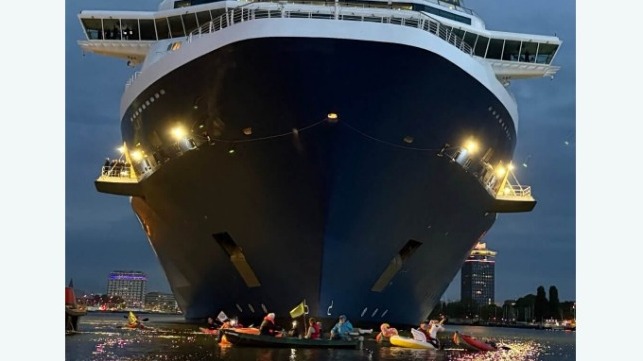
The environmental group Extinction Rebellion renewed its protests against cruise ships docking in the Netherlands during an incident that resulted in a confrontation and arrests in Amsterdam. Last year, the same group staged several protests blocking one of the locks to enter the port, but this year they took to small boats and proudly said they were able to delay the cruise ship Celebrity Eclipse from docking.
Approximately 30 individuals positioned themselves in canoes, boats, and inflatables between the cruise ship and the dock in the heart of Amsterdam. Pictures showed some of the small boats surrounding the bow of the large cruise ship, while others were between the ship and the dock.
“They should not be allowed in Dutch waters,” the group said in a statement on social media. “We will continue the actions like this until this harmful tourist industry is banned from Amsterdam and the rest of the Netherlands.” The group cites the environmental impact of the cruise industry on “humans, nature, and the climate.”
The 121,878 gross ton cruise ship was completing an 11-day trip and was docking at the Passenger Terminal Amsterdam. According to reports, there were 2,850 passengers and approximately 1,200 crewmembers aboard.
The protestor began at approximately 4:30 a.m. local time before the cruise ship arrived, and police responded by sending launches to clear the waterway. The protestors are contending that the police ran over their inflatable boats. The incident is reported to have lasted about two hours on July 26.
The police said that five people were arrested for assault, blocking the cruise ship, and refusing to show identification. Newspaper reports said two of the individuals were quickly released.
A spokesperson for the port authority cited the dangers of this type of protest. They said these types of small boats should not have approached the 1,040-foot (315-meter) cruise ship. They cited the dangers as well as the potential that the vessel’s propellers or bow thrusters could have created dangerous conditions for the small boats.
Last year, the group was successful in getting several cruise ships to turn around or reschedule their port stops, docking outside the heart of the city, and busing passengers to Amsterdam. City officials responded by putting a limit on the number of cruise ships permitted to come to the port and said their longer-term plan is to move the cruise ship terminal outside the center of the city.

No comments:
Post a Comment