South Korea Wins Trade Deal With $150 Billion U.S. Shipbuilding Pledge
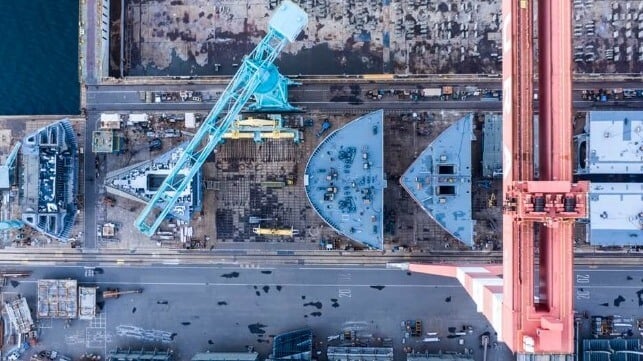
The government of South Korea has secured a favorable 15 percent U.S. tariff rate by pledging a $350 billion investment package in American industry, including a $150 billion "Make American Shipbuilding Great Again" investment in U.S. shipyard capacity.
The idea of a very large Korean shipbuilding investment has been actively discussed for months as a possible bargaining chip in trade negotiations, and the rumors picked up after Japan made a $400 billion industrial investment commitment of its own. Unlike Japan's proposal, Korea's pledge has a specific carve-out for shipyards.
The objective of the fund is to provide loans, guarantees and investments that will help Korean shipbuilders to expand into the U.S. market, industry insiders told Korea Herald. President Donald Trump broadcast a different interpretation, suggesting in a social media post that "South Korea will give to the United States $350 Billion Dollars for Investments owned and controlled by the United States, and selected by myself" (caps original).
U.S. shipbuilding is largely conducted for defense purposes, and the sector has been a top expansion target for Korean yards for years. Korea's "Big Three" have a high degree of skill in complex shipbuilding but a declining market share in the commercial space, handicapped by a domestic labor shortage and fierce Chinese competition. With yards in the U.S., they could market their capabilities to the biggest shipowning enterprise in the world - the United States Navy, which has more employees, more capex resources and a more valuable fleet than any other entity. The Navy's annual expenditure on new ship construction comes to about $30 billion, equal to about 15 percent of all merchant ship orders worldwide in 2024.
"The US market is about warships rather than commercial vessels," one Korean shipbuilding executive told Korea Herald. "The warship market is huge."
Korean shipbuilder Hanwha has already begun testing the waters with overseas ship repair services for Military Sealift Command, and has received positive reviews for its work. Hanwha's business plan for its newly-acquired Philly Shipyard also proposes some amount of military sales.
Like the earlier Japanese deal, Korea's investment pledge is a handshake commitment, and does not yet include specific projects or an investment timeline. The overall $350 billion fund would amount to 70 percent of annual Korean government spending, so less costly ways of achieving the total (like loan guarantees) and an investment spread out over time may be part of the proposal.
For Korea, the short-term gains from the deal are essential. Without an agreement, U.S. tariffs on Korean autos and other exports would have risen to 25 percent, undercutting their competitiveness in the lucrative American consumer market. “We just overcame a big challenge,” South Korea’s President Lee Jae Myung said. “Today’s deal eliminated uncertainty in the export environment.”
An additional Korean pledge of $100 billion in purchases of U.S. LNG and other energy products over the remainder of Trump's current term will support energy trade volumes. The EU has previously pledged to buy $250 billion in American energy products annually over the same period, an amount that many independent analysts suggest is unlikely to be achieved.
Electrical Fire Knocks Out Power at Hyundai Samho Shipyard
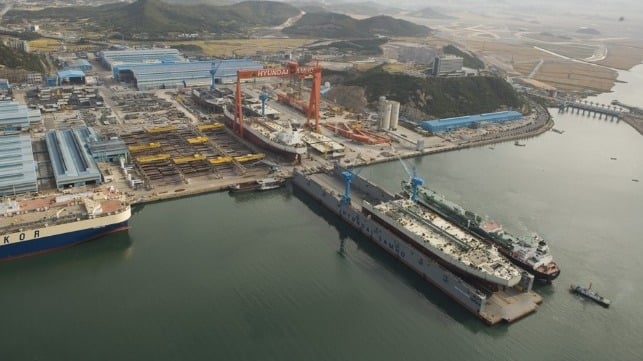
A major electrical fire that burned for nearly nine hours has caused significant damage at the HD Hyundai Samho shipyard in South Korea. Officials are reporting that all of the power has been turned off to the yard, but fortunately, the fire struck just hours after workers went on summer vacation.
The fire started around 11:20 p.m. local time on July 28 in an underground tunnel that houses a power substation for the yard and connects to key areas of the yard. The substation is located approximately 5 to 6.5 feet underground and was very difficult to reach due to the intense heat and toxic smoke.
The local fire department reports that the shipyard initially tried to fight the fire with internal resources, but it quickly spread. The fire department reports it was on scene overnight and finally declared the fire extinguished around 8:30 a.m. on July 29. They report there is extensive damage to the wiring and substation, but the transformer appears undamaged. They were speculating that the yard would not be able to reuse the existing wiring.
All power has been turned off to the shipyard facilities while they work to recover and assess the level of damage. Workers, however, had gone on summer leave starting July 28, which helped to ensure there were no casualties. Work is suspended as planned for the vacation period.
Work is scheduled to resume from the vacation period on August 8. Yard officials said it was too early to tell when work would resume as they continue to explore the level of damage and needed repairs.
The Samho yard is one of the large facilities in the HD Hyundai shipbuilding operation, with reports that it accounts for 13 percent of the company’s assets. The companies are all running at near capacity based on the strong order flow and tight production schedules.
The yard is one of the large facilities for building LNG carriers. Among the projects that were reported to be underway is construction of the first of two 174,000 cbm LNG carriers for Nakilat as part of the massive QatarEnergy shipbuilding program. Work has also just commenced for eight new container cranes being built got the Gwangyang Port in South Korea.
HD Korea Shipbuilding & Offshore Engineering, the holding company for all the shipbuilding operations, reported on July 24 that it has received so far in 2025 orders for 82 ships worth $11.22 billion, marking 62 percent of its annual target for new orders. Earlier in 2025, it was reported that the company had a nearly three-year backlog. As of the first quarter of the year, the company valued its backlog at over $74 billion.

No comments:
Post a Comment