Babis’s Czech Election Victory Poses Potential Headache For Brussels, Kyiv – Analysis
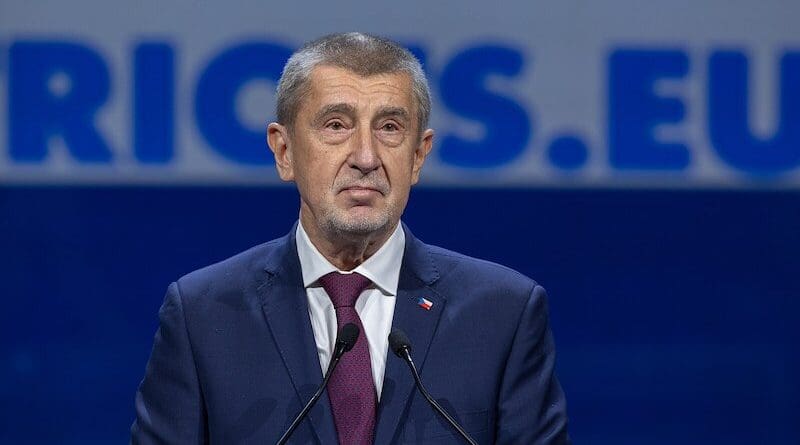
File photo of Czech Republic’s Andrej Babiš. Photo Credit: Vox España, Wikimedia Commons
October 6, 2025
By RFE RL
By Rikard Jozwiak
The election victory this weekend of right-wing populist Andrej Babis risks turning the Czech Republic into another Central European problem child for Brussels after he campaigned on vows to slash support for Ukraine and confront the EU over immigration and environmental policies.
Babis, a former prime minister and billionaire sometimes referred to in the media as the Czech Donald Trump, easily took the most votes with his ANO (YES) party garnering 35 percent.
A triumphant Babis said after the results came in that he would seek a one-party minority government, though he would hold talks with two small parties including the far-right SPD that could give him a majority in parliament.
There is no panic yet in the corridors of power in Brussels with some officials assessing that Babis is “no Robert Fico or Viktor Orban.”
That’s a reference to the leaders of Slovakia and Hungary, who in recent years have caused the bloc all sorts of headaches by watering down or holding up sanctions on Russia, pausing both military aid, economic support, and EU accession negotiations for Ukraine and undermining the rule of law in the club in general.
Still, Orban was the first leader in Europe to congratulate Babis, who was Czech prime minister from December 2017 to December 2021.
Filip Nerad, who has followed Czech-EU politics for the think-tank Globsec, told RFE/RL that the Babis government will be more critical toward big EU initiatives such as the “Green deal” that aims to make the bloc climate neutral by 2050.
He also said Babis opposes the migration pact, which enters into force next year and is aimed to create a common EU asylum system.
Still, the 71-year-old leader may not totally align with Budapest and Bratislava, giving some hope Brussels may be able to work with Prague on some level.
“Overall the Czech Republic will be less in the mainstream in Brussels and cooperate more with Hungary and Slovakia, but don’t expect that Prague will follow Budapest and Bratislava on everything,” Nerad said.
The assumption, speaking to both European and Czech officials, that Babis indeed is different from his two Visegrad peers is based on three observations.
Firstly, the nature of his election win.
While his ANO party clearly came out on top, the three other populist parties — the SPD, Motoriste sobe (Motorists for Themselves) and Stacilo (Enough) — fared poorer than expected.
Stacilo failed to clear the 5 percent threshold to gain seats in parliament, removing a potential coalition partner for Babis.
While the Slovak-born Babis may aim to form a minority government of just ANO ministers with the political backing of the Motorists and SPD, analysts said talks between the parties are likely to prove difficult.
And his government might end up wobbly and weak. He might even eventually turn to the more mainstream parties in the outgoing government.
Second, while his rhetoric on the campaign trail often was anti-EU, he may be forced to move toward the middle to work along side pro-West President Petr Pavel, who is popular among Czechs and a likely counterbalance to Babis.
Pavel doesn’t have many levers of power, but one he does possess is approving cabinet ministers. And he’s already said he won’t accept any “anti-systemic” candidates if he is to sign-off on Babis’s government.
It is also worth noting that many other senior ANO officials such as Karel Havlicek and Adam Vojtech are considered moderate and even were well-regarded in Brussels during their previous stints as government ministers.
Finally, there is Babis himself, who despite having sharpened his criticism of the European Union in recent years and is in the same European political group that has challenged the mainstream direction of Europe’s policies, has practical reasons to remain Western-oriented.
His business interests in agriculture and media are linked to both Austria and Germany and dependent on generous EU funds.
He has sought close political ties with Italian Prime Minister Giorgia Meloni and with France. On top of that, he has promised to honor the Czech Republic’s commitment to NATO.
“We want to save Europe…and we are clearly pro-European and pro-NATO,” Babis told reporters after his election win.
Pavel Havlicek, who follows Czech-EU relations for the think tank AMO, notes that “Brussels most likely is looking at the Czech vote with skepticism and worry.”
But, he adds, “it will be important for Brussels to stay merit-based and judge Babis on his deeds and not necessarily his rhetoric” as he could prove to be “more pragmatic and willing to negotiate than Fico and Orban.”
One EU official, speaking to RFE/RL on condition of anonymity, said Babis’s election is likely to remove the Czechs from their leadership role in some parts of the bloc.
Concretely, the Czechs have spearheaded an “ammunition initiative” that has been key in getting millions of rounds of mainly desperately needed ammunition to Kyiv as it fights to repel invading Russian forces.
Babis has been a sharp critic of the initiative, though he has left the door open for it to fall under NATO auspices.
Czech soldiers in any possible future peace-keeping mission in Ukraine can likely be ruled out and weapons might not be transferred to the war as readily as before.
There are other projects driven by the Czechs that may quietly might die out too.
The country has been pushing Brussels for over a year to limit the movement of Russian diplomats in EU countries and to impose EU-wide sanctions on the current ruling regime in Georgia as it backslides on democratic reforms and veers toward Moscow.
Prague was also instrumental in creating a new sanctions framework for Russian hybrid action around the globe and encouraging Kosovo to apply for EU membership.Rikard Jozwiak is the Europe editor for RFE/RL in Prague, focusing on coverage of the European Union and NATO. He previously worked as RFE/RL’s Brussels correspondent, covering numerous international summits, European elections, and international court rulings. He has reported from most European capitals, as well as Central Asia.

RFE RL
RFE/RL journalists report the news in 21 countries where a free press is banned by the government or not fully established.
Babiš pledges loyalty to Europe as Czech coalition talks begin
Billionaire former prime minister Andrej Babiš won the Czech Republic's parliamentary elections according to partial results on Saturday.
Leader of the ANO movement and former Czech Prime Minister Andrej Babiš vowed loyalty to Europe as talks to form a coalition government began.
"We were very reliable partner. And we are patriots for Europe. And we want to win next elections because Europe is suffering," Babiš said in response to questions from reporters on Sunday.
On Saturday, Babiš' ANO party won parliamentary elections with 34.5% of the vote and 80 seats in a 200-member parliament. He soundly beat the Together conservative coalition of Prime Minister Petr Fiala, who received 23.2%
The major anti-migrant force, the Freedom and Direct Democracy party, got 7.9% while a right-wing group calling itself the Motorists collected 6.8%.
Babiš has said his aim was to form a one-party government and he will have to seek tolerance from the two groups. Electoral math dictates he will have to join forces with additional parties in order to reach a majority.
If he wants to govern alone, his minority Cabinet would need at least tacit support from the Freedom party and the Motorists to win a mandatory parliamentary confidence vote to rule.
Babiš joined forces with his friend, Hungary's Viktor Orbán, last year to create a new alliance in the European Parliament, the “Patriots for Europe,” to represent hard-right groups, a significant shift from the liberal Renew group that Babiš previously belonged to.
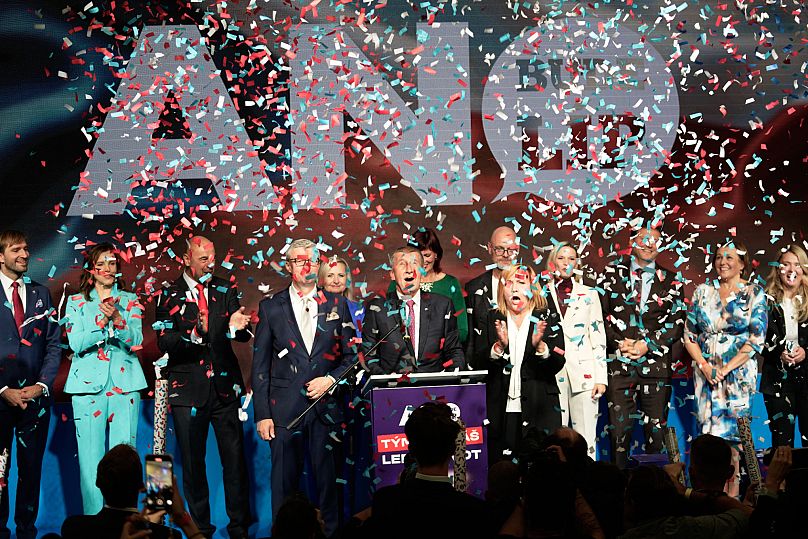
The Patriots are united by anti-migrant rhetoric, a critical stance toward EU policies tackling climate change, and the protection of national sovereignty.
The Motorists, who are backed by former EU-skeptic President Václav Klaus, share these views while the Freedom party wants to lead the country out of the EU and NATO and plans to expel almost all of some 380,000 Ukrainian refugees from the country.
Babiš declared his party "clearly pro-European and pro-NATO" after his victory. At a press conference on Sunday, he said that "negative information is constantly being spread abroad, which I think is unfair."
"After all, I was prime minister, and our orientation was clear. I am simply concerned that Europe should function, because its economic development is not going in the right direction."
The billionaire campaigned on a platform of prioritising domestic issues over international ones such as Russia's war in Ukraine.
Babiš said he was planning to abandon an internationally recognised Czech initiative that acquires artillery shells for Ukraine on markets outside the EU.
“We don't like it,” Babiš said about that initiative. “We have a different view of it,” he added.
He also said he opposed a NATO commitment to significantly increase defence spending and criticised a deal to purchase 24 US F-35 fighter jets.
President Petr Pavel is scheduled to meet with Babiš and other party leaders on Sunday. The head of the strongest political force usually gets a chance from the president to form a new government.

No comments:
Post a Comment