The Conversation
October 25, 2025
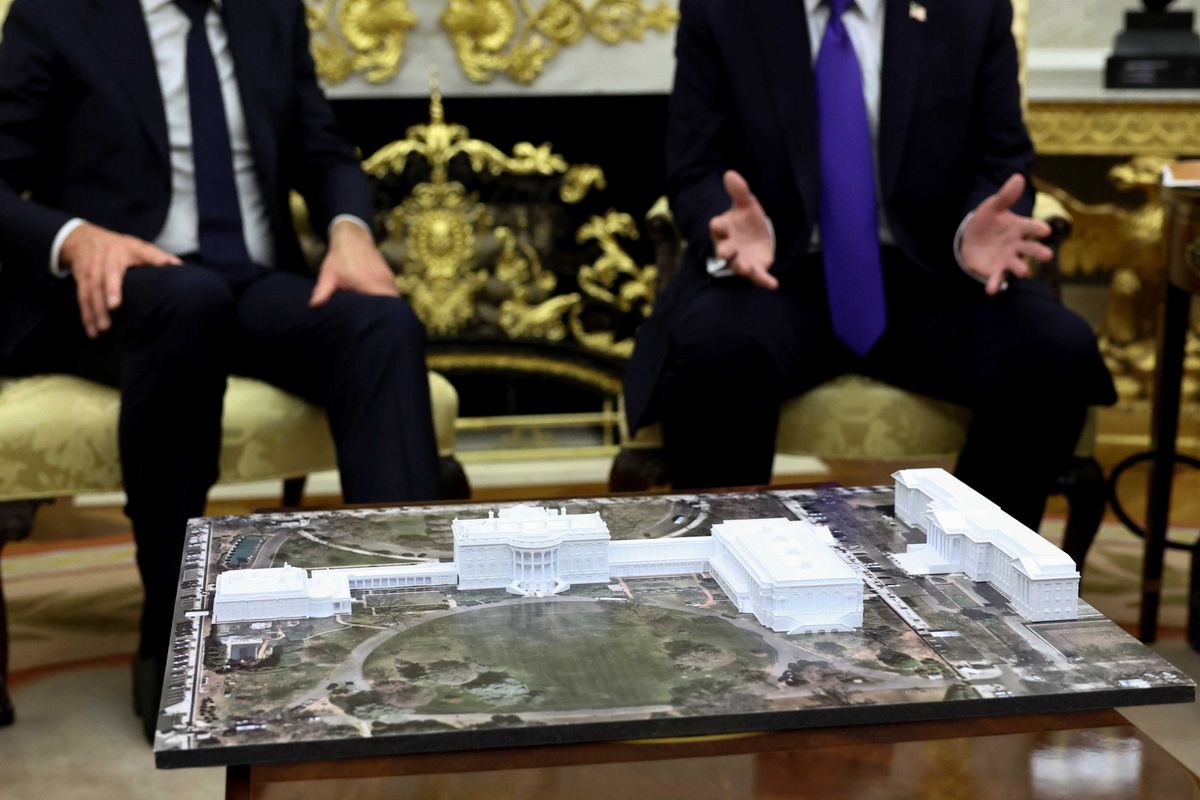
Donald Trump speaks near a model of the new White House ballroom.
REUTERS/Kevin Lamarque
By R. Grant Gilmore III, Director,
By R. Grant Gilmore III, Director,
Historic Preservation and Community Planning Program, College of Charleston
From ancient Egypt to Washington, D.C., rulers have long used architecture and associated stories to project power, control memory and shape national identity. As 17th-century French statesman Jean-Baptiste Colbert observed:
“In the absence of brilliant deeds of war, nothing proclaims the greatness and spirit of princes more than building works.”
Today, the Trump administration is mobilizing heritage and architecture as tools of ideology and control. In U.S. historic preservation, “heritage” is the shared, living inheritance of places, objects, practices and stories — often plural and contested — that communities value and preserve. America’s architectural heritage is as diverse as the people who created, inhabited and continue to care for it.
As an archaeologist with three decades of practice, I read environments designed by humans. Enduring modifications to these places, especially to buildings and monuments, carry power and speak across generations.
In his first term as president, and even more so today, Donald Trump has pushed to an extreme legacy-building through architecture and heritage policy. He is remaking the White House physically and metaphorically in his image, consistent with his long record of putting his name on buildings as a developer.
In December 2020, Trump issued an executive order declaring classical and traditional architectural styles the “preferred” design for new federal buildings. The order derided Brutalist and modernist structures as inconsistent with national values.
Now, Trump is seeking to roll back inclusive historical narratives at U.S. parks and monuments. And he is reviving sanitized myths about America’s history of slavery, misogyny and Manifest Destiny, for use in museums, textbooks and public schools.
Yet artifacts don’t lie. And it is the archaeologist’s task to recover these legacies as truthfully as possible, since how the past is remembered shapes the choices a nation makes about its future.
From ancient Egypt to Washington, D.C., rulers have long used architecture and associated stories to project power, control memory and shape national identity. As 17th-century French statesman Jean-Baptiste Colbert observed:
“In the absence of brilliant deeds of war, nothing proclaims the greatness and spirit of princes more than building works.”
Today, the Trump administration is mobilizing heritage and architecture as tools of ideology and control. In U.S. historic preservation, “heritage” is the shared, living inheritance of places, objects, practices and stories — often plural and contested — that communities value and preserve. America’s architectural heritage is as diverse as the people who created, inhabited and continue to care for it.
As an archaeologist with three decades of practice, I read environments designed by humans. Enduring modifications to these places, especially to buildings and monuments, carry power and speak across generations.
In his first term as president, and even more so today, Donald Trump has pushed to an extreme legacy-building through architecture and heritage policy. He is remaking the White House physically and metaphorically in his image, consistent with his long record of putting his name on buildings as a developer.
In December 2020, Trump issued an executive order declaring classical and traditional architectural styles the “preferred” design for new federal buildings. The order derided Brutalist and modernist structures as inconsistent with national values.
Now, Trump is seeking to roll back inclusive historical narratives at U.S. parks and monuments. And he is reviving sanitized myths about America’s history of slavery, misogyny and Manifest Destiny, for use in museums, textbooks and public schools.
Yet artifacts don’t lie. And it is the archaeologist’s task to recover these legacies as truthfully as possible, since how the past is remembered shapes the choices a nation makes about its future.
Architecture as political power and legacy
Dictators, tyrants and kings build monumental architecture to buttress their own egos, which is called authoritarian monumentalism. They also seek to build the national ego — another word for nationalism.
Social psychologists have found that the awe we experience when we encounter something vast diminishes the “individual self,” making viewers feel respect and attachment to creators of awesome architecture. Authoritarian monumentalism often exploits this phenomenon. For example, in France, King Louis XIV expanded the Palace of Versailles and renovated its gardens in the mid-1600s to evoke perceptions of royal grandeur and territorial power in visitors.
Many leaders throughout history have built “temples to power” while erasing or overshadowing the memory of their predecessors — a practice known as damnatio memoriae, or condemnation to oblivion.
In the ancient world, the Sumerians, Babylonians, Egyptians, Romans, Chinese dynasties, Mayans and Incas all left behind architecture that still commands awe in the form of monuments to gods, rulers and communities. These monuments conveyed power and often served as instruments of physical and psychological control.
In the 19th century, Napoleon fused conquest with heritage. Expeditions to Egypt and Rome, and the building of Parisian monuments — the Arc de Triomphe and the Vendôme Column, both modeled on Roman precedents — reinforced his legitimacy.
Albert Speer’s and Hermann Giesler’s monumental neoclassical designs in Nazi Germany, such as the party rally grounds in Nuremberg, were intended to overwhelm the individual and glorify the regime. And Josef Stalin’s Soviet Union suppressed avant-garde experimentation in favor of monumental “socialist realist” architecture, projecting permanence and centralized power.
Now, Trump has proposed building his own triumphal arch in Arlington, Virginia, just across the Potomac River from the Lincoln Memorial, as a symbol to mark the 250th anniversary of the Declaration of Independence.
Dictators, tyrants and kings build monumental architecture to buttress their own egos, which is called authoritarian monumentalism. They also seek to build the national ego — another word for nationalism.
Social psychologists have found that the awe we experience when we encounter something vast diminishes the “individual self,” making viewers feel respect and attachment to creators of awesome architecture. Authoritarian monumentalism often exploits this phenomenon. For example, in France, King Louis XIV expanded the Palace of Versailles and renovated its gardens in the mid-1600s to evoke perceptions of royal grandeur and territorial power in visitors.
Many leaders throughout history have built “temples to power” while erasing or overshadowing the memory of their predecessors — a practice known as damnatio memoriae, or condemnation to oblivion.
In the ancient world, the Sumerians, Babylonians, Egyptians, Romans, Chinese dynasties, Mayans and Incas all left behind architecture that still commands awe in the form of monuments to gods, rulers and communities. These monuments conveyed power and often served as instruments of physical and psychological control.
In the 19th century, Napoleon fused conquest with heritage. Expeditions to Egypt and Rome, and the building of Parisian monuments — the Arc de Triomphe and the Vendôme Column, both modeled on Roman precedents — reinforced his legitimacy.
Albert Speer’s and Hermann Giesler’s monumental neoclassical designs in Nazi Germany, such as the party rally grounds in Nuremberg, were intended to overwhelm the individual and glorify the regime. And Josef Stalin’s Soviet Union suppressed avant-garde experimentation in favor of monumental “socialist realist” architecture, projecting permanence and centralized power.
Now, Trump has proposed building his own triumphal arch in Arlington, Virginia, just across the Potomac River from the Lincoln Memorial, as a symbol to mark the 250th anniversary of the Declaration of Independence.
An American alternative
Born of Enlightenment ideals of John Locke, Voltaire and Adam Smith, the American Revolution rejected the European idea of monarchs as semi-divine rulers. Instead, leaders were expected to serve the citizenry.
That philosophy took architectural form in the Federal style, which was dominant from about 1785 to 1830. This clear, democratic architectural language was distinct from Europe’s ornate traditions, and recognizably American.
Its key features were Palladian proportions — measurements rooted in classical Roman architecture — and an emphasis on balance, simplicity and patriotic motifs.
James Hoban’s White House and Thomas Jefferson’s Monticello embodied this style. Interiors featured lighter construction, symmetrical lines, and motifs such as eagles, urns and bellflowers. They rejected the opulent rococo styles associated with monarchy.
Americans also recognized preservation’s political force. In 1816, the city of Philadelphia bought Independence Hall, which was constructed in 1753 and was where the Declaration of Independence and the Constitution were debated and signed, to keep it from being demolished. Today the building is a U.S. National Park and a UNESCO World Heritage Site.
Early preservationists saved George Washington’s home, Mount Vernon, Jefferson’s Monticello, and other landmarks, tying democracy’s endurance to the built environment.
Architecture, memory and Trump
In remaking the White House and prescribing the style and content of many federal sites, Trump is targeting not just buildings but the stories they tell.
By challenging narratives that depart from white, Anglo-Saxon origin myths, Trump is using his power to roll back decades of work toward creating a more inclusive national history.
These actions ignore the fact that America’s strength lies in its identity as a nation of immigrants. The Trump administration has singled out the Smithsonian Institution — the world’s largest museum, founded “for the increase and diffusion of knowledge — for ideological reshaping. Trump also is pushing to restore recently removed Confederate monuments, helping to revive "Lost Cause” mythology about the Civil War.
Trump’s 2020 order declaring classical and traditional architectural styles the preferred design for government buildings echoed authoritarian leaders like Adolf Hitler and Stalin, whose governments sought to dictate aesthetics as expressions of ideology. The American Institute of Architects publicly opposed the order, warning that it imposed ideological restrictions on design.
Trump’s second administration has advanced this agenda by adopting many recommendations in the Heritage Foundation’s Project 2025 blueprint. Notably, Project 2025 calls for repealing the 1906 Antiquities Act — which empowers presidents to quickly designate national monuments on federal land — and for shrinking many existing monuments. Such rollbacks would undercut the framework that has safeguarded places like Devils Tower in Wyoming and Muir Woods in California for over a century.
Trump’s new ballroom is a distinct departure from the core values embodied in the White House’s Federal style. Although many commentators have described it as rococo, it is more aligned with the overwrought and opulent styles of the Gilded Age — a time in American history, from about 1875 through 1895, with many parallels to the present.
In ordering its construction, Trump has ignored long-standing consultation and review procedures that are central to historic preservation. The demolition of the East Wing may have ignored processes required by law at one of the most important U.S. historic sites. It’s the latest illustration of his unilateral and unaccountable methods for getting what he wants.
In remaking the White House and prescribing the style and content of many federal sites, Trump is targeting not just buildings but the stories they tell.
By challenging narratives that depart from white, Anglo-Saxon origin myths, Trump is using his power to roll back decades of work toward creating a more inclusive national history.
These actions ignore the fact that America’s strength lies in its identity as a nation of immigrants. The Trump administration has singled out the Smithsonian Institution — the world’s largest museum, founded “for the increase and diffusion of knowledge — for ideological reshaping. Trump also is pushing to restore recently removed Confederate monuments, helping to revive "Lost Cause” mythology about the Civil War.
Trump’s 2020 order declaring classical and traditional architectural styles the preferred design for government buildings echoed authoritarian leaders like Adolf Hitler and Stalin, whose governments sought to dictate aesthetics as expressions of ideology. The American Institute of Architects publicly opposed the order, warning that it imposed ideological restrictions on design.
Trump’s second administration has advanced this agenda by adopting many recommendations in the Heritage Foundation’s Project 2025 blueprint. Notably, Project 2025 calls for repealing the 1906 Antiquities Act — which empowers presidents to quickly designate national monuments on federal land — and for shrinking many existing monuments. Such rollbacks would undercut the framework that has safeguarded places like Devils Tower in Wyoming and Muir Woods in California for over a century.
Trump’s new ballroom is a distinct departure from the core values embodied in the White House’s Federal style. Although many commentators have described it as rococo, it is more aligned with the overwrought and opulent styles of the Gilded Age — a time in American history, from about 1875 through 1895, with many parallels to the present.
In ordering its construction, Trump has ignored long-standing consultation and review procedures that are central to historic preservation. The demolition of the East Wing may have ignored processes required by law at one of the most important U.S. historic sites. It’s the latest illustration of his unilateral and unaccountable methods for getting what he wants.
Instruments of memory and identity
When leaders push selective histories and undercut inclusive ones, they turn heritage into a tool for controlling public memory. This collective understanding and interpretation of the past underpins a healthy democracy. It sustains a shared civic identity, ensures accountability for past wrongs and supports rights and participation.
Heritage politics in the Trump era seeks to redefine America’s story and determine who gets to speak. Attacks on so-called “woke” history seek to erase complex truths about slavery, inequality and exclusion that are essential to democratic accountability.
Architecture and heritage are never just bricks and mortar. They are instruments of memory, identity and power.
When leaders push selective histories and undercut inclusive ones, they turn heritage into a tool for controlling public memory. This collective understanding and interpretation of the past underpins a healthy democracy. It sustains a shared civic identity, ensures accountability for past wrongs and supports rights and participation.
Heritage politics in the Trump era seeks to redefine America’s story and determine who gets to speak. Attacks on so-called “woke” history seek to erase complex truths about slavery, inequality and exclusion that are essential to democratic accountability.
Architecture and heritage are never just bricks and mortar. They are instruments of memory, identity and power.
'So little respect': Trump 'pillages' as he turns the White House into a 'shipwreck'
October 25, 2025 | ALTERNET
The White House East Wing existed, in different forms, for 123 years. The East Wing was unveiled in its original form under Republican President Teddy Roosevelt in 1902 before undergoing a major expansion and renovation under Democratic President Franklin Delano Roosevelt 40 years later. But in late October, the East Wing was demolished altogether on orders from President Donald Trump — who is planning to replace it with a massive ballroom.
In her October 25 opinion column, the New York Times' Maureen Dowd points to the demolition of the East Wing as symbolic of a broader problem: Trump, during his second presidency, is "governing" by "whims" and has tossed aside the United States' long "We the People" tradition.
"Trump has so little respect for this 123-year-old symbol of American history that he didn't check with federal planning officials or Congress before he obliterated one side of the White House," Dowd argues. "As if he's tearing down a gas station. When I visited the White House with my mom as a kid, we loved overhearing foreign tourists ooh and ahh about how relatively small and modest the house was. Its simplicity was part of its charm…. Trump does not do small or modest. He does big, flashy odes to self."
The demolition of the East Wing, Dowd adds, is only one example of Trump's indifference to the views of others.
"It's a slam-dance presidency that delights in transgressing and provoking," Dowd laments. "Build a $300 million, 90,000-square-foot gilt ballroom — which will overshadow the central edifice — while the government is shut and people have been thrown out of work; plaster tacky gold all over the Oval; sue everyone willy-nilly; put foes through legal torture; send troops to American cities; shrug off due process and blow alleged drug runners out of the water…. After turning the Justice Department into his own vigilante posse, Trump now wants to warp the once-esteemed department even more…. Trump once thought nothing of aiming to overthrow the government he ran. Now, he thinks nothing of threatening to sue the government he runs if he isn't allowed to pay himself a quarter-billion dollars."
Dowd continues, "'We the People' is quaint. Now, we are governed by the whims of one person."
Trump, the New York Times columnist emphasizes, "can indulge any crazy impulse, and nobody is able to check him."
"Congress is adrift," Dowd writes. "The White House is a shipwreck. Trump is marauding in the Caribbean. (Former FBI Director) James Comey and (New York State Attorney General) Letitia James are being forced to walk the plank, and next up could be (former special counsel) Jack Smith and (Sen.) Adam Schiff. We are awash in nautical metaphors as the president plunders and pillages. He’s a pirate — and not the fun Halloween kind."
Maureen Dowd's full New York Times column is available at this link (subscription required).
October 25, 2025 | ALTERNET
The White House East Wing existed, in different forms, for 123 years. The East Wing was unveiled in its original form under Republican President Teddy Roosevelt in 1902 before undergoing a major expansion and renovation under Democratic President Franklin Delano Roosevelt 40 years later. But in late October, the East Wing was demolished altogether on orders from President Donald Trump — who is planning to replace it with a massive ballroom.
In her October 25 opinion column, the New York Times' Maureen Dowd points to the demolition of the East Wing as symbolic of a broader problem: Trump, during his second presidency, is "governing" by "whims" and has tossed aside the United States' long "We the People" tradition.
"Trump has so little respect for this 123-year-old symbol of American history that he didn't check with federal planning officials or Congress before he obliterated one side of the White House," Dowd argues. "As if he's tearing down a gas station. When I visited the White House with my mom as a kid, we loved overhearing foreign tourists ooh and ahh about how relatively small and modest the house was. Its simplicity was part of its charm…. Trump does not do small or modest. He does big, flashy odes to self."
The demolition of the East Wing, Dowd adds, is only one example of Trump's indifference to the views of others.
"It's a slam-dance presidency that delights in transgressing and provoking," Dowd laments. "Build a $300 million, 90,000-square-foot gilt ballroom — which will overshadow the central edifice — while the government is shut and people have been thrown out of work; plaster tacky gold all over the Oval; sue everyone willy-nilly; put foes through legal torture; send troops to American cities; shrug off due process and blow alleged drug runners out of the water…. After turning the Justice Department into his own vigilante posse, Trump now wants to warp the once-esteemed department even more…. Trump once thought nothing of aiming to overthrow the government he ran. Now, he thinks nothing of threatening to sue the government he runs if he isn't allowed to pay himself a quarter-billion dollars."
Dowd continues, "'We the People' is quaint. Now, we are governed by the whims of one person."
Trump, the New York Times columnist emphasizes, "can indulge any crazy impulse, and nobody is able to check him."
"Congress is adrift," Dowd writes. "The White House is a shipwreck. Trump is marauding in the Caribbean. (Former FBI Director) James Comey and (New York State Attorney General) Letitia James are being forced to walk the plank, and next up could be (former special counsel) Jack Smith and (Sen.) Adam Schiff. We are awash in nautical metaphors as the president plunders and pillages. He’s a pirate — and not the fun Halloween kind."
Maureen Dowd's full New York Times column is available at this link (subscription required).
Why Trump is really tearing down the White House
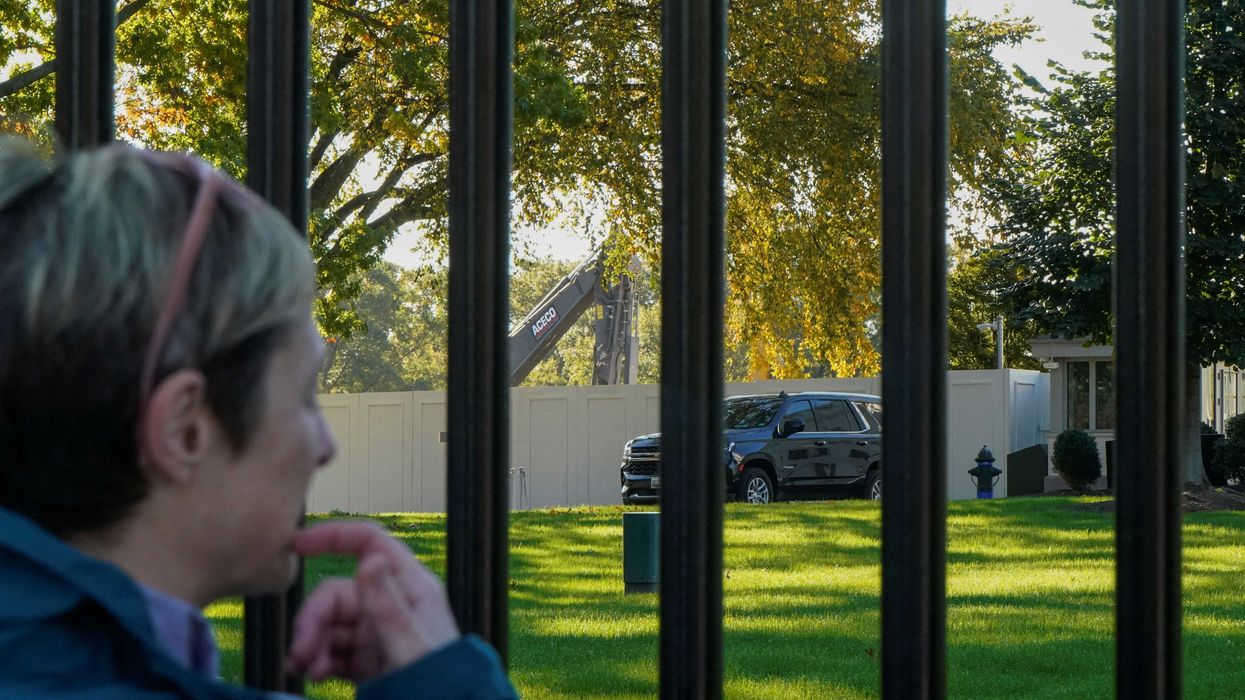
A person looks through the fence at Pennsylvania Avenue, as demolition work continues at the East Wing of the White House, where U.S. President Donald Trump's proposed ballroom is being built, in Washington, D.C., U.S., October 24, 2025.
REUTERS/Elizabeth Frantz
Adam Gopnik tells the New Yorker that Trump destroying the White House is a performance display broadcasting his unbroken power over the presidency.
“After months marked by corruption, violence, and the open perversion of law, to gasp in outrage at the loss of a few tons of masonry and mortar might seem oddly misjudged,” said Gopnik. “And yet it isn’t. We are creatures of symbols, and our architecture tells us who we are.”
A nation writes its history in books, but its buildings is a kind of enduring book itself. The Eiffel Tower is an expression of a nation’s history, as is the Lincoln Memorial. The White House’s East Wing, however, was a place of accomplishment. Franklin Roosevelt created room for staff and military protection. Eleanor Roosevelt hosted women journalists. It was there that Jacqueline Kennedy presided founded the White House Historical Association. Rosalynn Carter established an office there and used it for a host of benevolent endeavors, including mental health advocacy and humanitarian work, including helping pass the Mental Health Systems Act of 1980 and global human rights initiatives.
“All of that is now gone,” said Gopnik. “The act of destruction is precisely the point: a kind of performance piece meant to display Trump’s arbitrary power over the Presidency, including its physical seat. He asks permission of no one, destroys what he wants, when he wants. As many have noted, one of Trump’s earliest public acts, having promised the Metropolitan Museum of Art the beautiful limestone reliefs from the façade of the old Bonwit Teller building, was to jackhammer them to dust in a fit of impatience.”
Trump apologists argue that Jimmy Carter installed solar panels and Barack Obama put in a basketball court, but that’s “mismatched matching,” said Gopnik.
“[These] … earlier alterations were made incrementally, and only after much deliberation,” Gopnik said. “When Harry Truman added a not very grand balcony to the Executive Residence, the move was controversial, but the construction was overseen by a bipartisan commission. By contrast, [Trump’s] project — bankrolled by Big Tech firms and crypto moguls — is one of excess and self-advertisement. The difference between the Truman balcony and the Trump ballroom is all the difference in the world. It is a difference of process and procedure — two words so essential to the rule of law and equality, yet doomed always to seem feeble beside the orgiastic showcase of power.”
Architecture embodies values, argued Gopnik.
“The shock that images of the destruction provoke — the grief so many have felt — is not an overreaction to the loss of a beloved building. It is a recognition of something deeper: the central values of democracy being demolished before our eyes. Now we do not only sense it. We see it,” Gopnik said.
Read the New Yorker report at this link.
October 25, 2025
ALTERNET
Adam Gopnik tells the New Yorker that Trump destroying the White House is a performance display broadcasting his unbroken power over the presidency.
“After months marked by corruption, violence, and the open perversion of law, to gasp in outrage at the loss of a few tons of masonry and mortar might seem oddly misjudged,” said Gopnik. “And yet it isn’t. We are creatures of symbols, and our architecture tells us who we are.”
A nation writes its history in books, but its buildings is a kind of enduring book itself. The Eiffel Tower is an expression of a nation’s history, as is the Lincoln Memorial. The White House’s East Wing, however, was a place of accomplishment. Franklin Roosevelt created room for staff and military protection. Eleanor Roosevelt hosted women journalists. It was there that Jacqueline Kennedy presided founded the White House Historical Association. Rosalynn Carter established an office there and used it for a host of benevolent endeavors, including mental health advocacy and humanitarian work, including helping pass the Mental Health Systems Act of 1980 and global human rights initiatives.
“All of that is now gone,” said Gopnik. “The act of destruction is precisely the point: a kind of performance piece meant to display Trump’s arbitrary power over the Presidency, including its physical seat. He asks permission of no one, destroys what he wants, when he wants. As many have noted, one of Trump’s earliest public acts, having promised the Metropolitan Museum of Art the beautiful limestone reliefs from the façade of the old Bonwit Teller building, was to jackhammer them to dust in a fit of impatience.”
Trump apologists argue that Jimmy Carter installed solar panels and Barack Obama put in a basketball court, but that’s “mismatched matching,” said Gopnik.
“[These] … earlier alterations were made incrementally, and only after much deliberation,” Gopnik said. “When Harry Truman added a not very grand balcony to the Executive Residence, the move was controversial, but the construction was overseen by a bipartisan commission. By contrast, [Trump’s] project — bankrolled by Big Tech firms and crypto moguls — is one of excess and self-advertisement. The difference between the Truman balcony and the Trump ballroom is all the difference in the world. It is a difference of process and procedure — two words so essential to the rule of law and equality, yet doomed always to seem feeble beside the orgiastic showcase of power.”
Architecture embodies values, argued Gopnik.
“The shock that images of the destruction provoke — the grief so many have felt — is not an overreaction to the loss of a beloved building. It is a recognition of something deeper: the central values of democracy being demolished before our eyes. Now we do not only sense it. We see it,” Gopnik said.
Read the New Yorker report at this link.
OPINION
Trump's new gilded ballroom is perfect
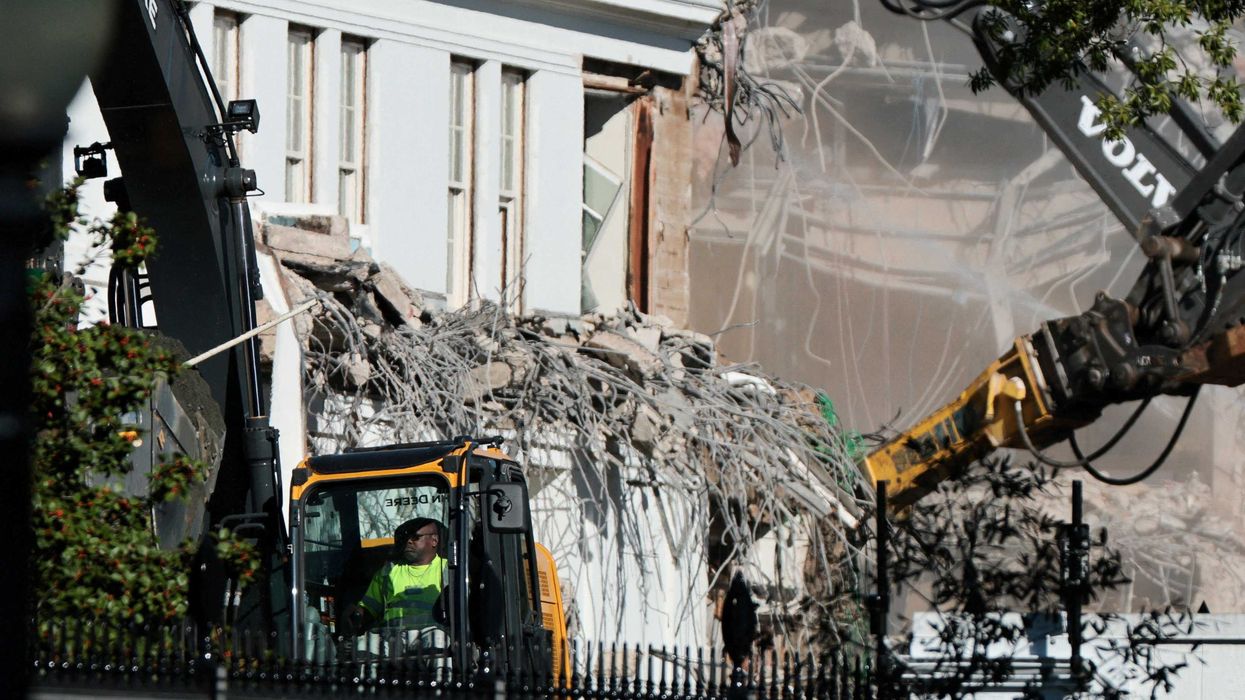
A demolition crew takes apart the facade of the East Wing of the White House, where U.S. President Donald Trump's proposed ballroom is being built, in Washington, D.C., U.S., October 21, 2025. REUTERS/Jonathan Ernst
In the first Gilded Age, which ran from the 1890s through the 1920s, captains of American industry were dubbed “robber barons” for using their baronial wealth to bribe lawmakers, monopolize industry, and rob average Americans of the productivity of their labors.
Now, in a second Gilded Age, a new generation of robber barons is using their wealth to do the same — and to entrench their power.
The first Gilded Age was an era of conspicuous consumption. The second is an era of conspicuous influence.
The new robber barons are having their names etched into the pediments of the giant new ostentatious ballroom Trump is adding to the White House.
They already own — and influence — much of the news Americans receive. And they are eager to promote their views.
Marc Benioff, the billionaire founder and CEO of Salesforce, told The New York Times that Trump should send the National Guard to San Francisco. (After his remarks drew condemnation from many of the city’s civic leaders, he apologized. He seems about to get his wish nonetheless.)
Marc Rowan, the billionaire chief executive of Apollo Global Management, is the force behind Trump’s recent “compact” calling on universities to limit international students, protect conservative speech, require standardized testing for admissions, and adopt policies recognizing “that academic freedom is not absolute,” among other conditions. The Trump regime dangled “substantial and meaningful federal grants” for universities that agree.
(It didn’t work. Seven of the nine universities approached rejected the deal.)
Billionaire Stephen A. Schwarzman, the chief executive of Blackstone, is also shaping the Trump regime’s campaign to upend American higher education. Schwarzman has emerged as a key intermediary between Trump and Harvard University.
Other of America’s new robber barons are rapidly consolidating their control over what Americans read, hear, and learn about what’s occurring in our country and the world. They include Jeff Bezos; Larry Ellison and his son, David; Mark Andreessen; Rupert Murdoch; Charles Koch; Tim Cook; Mark Zuckerberg; and, of course, Elon Musk.
Perhaps the new robber baron’s most lasting impression on the U.S. government will be the lavish White House ballroom Trump is constructing — a 90,000-square-foot, gold-leafed, glass-walled banquet room that will literally overshadow the so-called People’s House.
It will not be an assembly hall, dance hall, music hall, dining hall, village hall, or town hall. It will be a giant banquet and ballroom designed to accommodate 650 wealthy VIPs.
Trump claims that the East Room, the largest room in the White House, is too small. Its capacity is 200 people. He doesn’t like the idea of hosting kings, queens, and prime ministers in pavilions on the South Lawn.
Trump’s real intention is to have the White House resemble Versailles.
Potential billionaire donors have already received pledge agreements for “The Donald J. Trump Ballroom at the White House.” In return for donations, contributors are eligible for “recognition associated with the White House Ballroom.”
Their names will be etched in the ballroom’s brick or stone edifice.
Trump last week hosted a dinner at the White House for the project’s donors, which included representatives from Microsoft, Google, Palantir, and other companies, as well as Schwarzman, Cameron and Tyler Winklevoss, and other billionaires.
Meredith O’Rourke, a top political fundraiser for Trump, is leading the effort, paired with the Trust for the National Mall, an organization that supports the National Park Service.
The trust’s nonprofit status means donations come with a federal tax write-off.
Construction began Monday. Trump is now literally taking a wrecking ball to the White House — sending parts of the East Wing’s roof, the building’s exterior, and portions of its interior crumbling to the ground.
It seems fitting that in this second Gilded Age — an age of conspicuous influence and affluent access — the People’s House will be replaced by the Billionaire’s House.
Robert Reich is a professor of public policy at Berkeley and former secretary of labor. His writings can be found at https://robertreich.substack.com/.
Trump's new gilded ballroom is perfect
A demolition crew takes apart the facade of the East Wing of the White House, where U.S. President Donald Trump's proposed ballroom is being built, in Washington, D.C., U.S., October 21, 2025. REUTERS/Jonathan Ernst
October 23, 2025 | ALTERNET
In the first Gilded Age, which ran from the 1890s through the 1920s, captains of American industry were dubbed “robber barons” for using their baronial wealth to bribe lawmakers, monopolize industry, and rob average Americans of the productivity of their labors.
Now, in a second Gilded Age, a new generation of robber barons is using their wealth to do the same — and to entrench their power.
The first Gilded Age was an era of conspicuous consumption. The second is an era of conspicuous influence.
The new robber barons are having their names etched into the pediments of the giant new ostentatious ballroom Trump is adding to the White House.
They already own — and influence — much of the news Americans receive. And they are eager to promote their views.
Marc Benioff, the billionaire founder and CEO of Salesforce, told The New York Times that Trump should send the National Guard to San Francisco. (After his remarks drew condemnation from many of the city’s civic leaders, he apologized. He seems about to get his wish nonetheless.)
Marc Rowan, the billionaire chief executive of Apollo Global Management, is the force behind Trump’s recent “compact” calling on universities to limit international students, protect conservative speech, require standardized testing for admissions, and adopt policies recognizing “that academic freedom is not absolute,” among other conditions. The Trump regime dangled “substantial and meaningful federal grants” for universities that agree.
(It didn’t work. Seven of the nine universities approached rejected the deal.)
Billionaire Stephen A. Schwarzman, the chief executive of Blackstone, is also shaping the Trump regime’s campaign to upend American higher education. Schwarzman has emerged as a key intermediary between Trump and Harvard University.
Other of America’s new robber barons are rapidly consolidating their control over what Americans read, hear, and learn about what’s occurring in our country and the world. They include Jeff Bezos; Larry Ellison and his son, David; Mark Andreessen; Rupert Murdoch; Charles Koch; Tim Cook; Mark Zuckerberg; and, of course, Elon Musk.
Perhaps the new robber baron’s most lasting impression on the U.S. government will be the lavish White House ballroom Trump is constructing — a 90,000-square-foot, gold-leafed, glass-walled banquet room that will literally overshadow the so-called People’s House.
It will not be an assembly hall, dance hall, music hall, dining hall, village hall, or town hall. It will be a giant banquet and ballroom designed to accommodate 650 wealthy VIPs.
Trump claims that the East Room, the largest room in the White House, is too small. Its capacity is 200 people. He doesn’t like the idea of hosting kings, queens, and prime ministers in pavilions on the South Lawn.
Trump’s real intention is to have the White House resemble Versailles.
Potential billionaire donors have already received pledge agreements for “The Donald J. Trump Ballroom at the White House.” In return for donations, contributors are eligible for “recognition associated with the White House Ballroom.”
Their names will be etched in the ballroom’s brick or stone edifice.
Trump last week hosted a dinner at the White House for the project’s donors, which included representatives from Microsoft, Google, Palantir, and other companies, as well as Schwarzman, Cameron and Tyler Winklevoss, and other billionaires.
Meredith O’Rourke, a top political fundraiser for Trump, is leading the effort, paired with the Trust for the National Mall, an organization that supports the National Park Service.
The trust’s nonprofit status means donations come with a federal tax write-off.
Construction began Monday. Trump is now literally taking a wrecking ball to the White House — sending parts of the East Wing’s roof, the building’s exterior, and portions of its interior crumbling to the ground.
It seems fitting that in this second Gilded Age — an age of conspicuous influence and affluent access — the People’s House will be replaced by the Billionaire’s House.
Robert Reich is a professor of public policy at Berkeley and former secretary of labor. His writings can be found at https://robertreich.substack.com/.

No comments:
Post a Comment