US hits Colombia's leader with drug sanctions, sparking sharp rebuke
Washington (AFP) – Washington slapped unprecedented sanctions on Colombia's leftist president, his wife, son and a top aide Friday, accusing them of enabling drug cartels -- and rocking a decades-old alliance.
25/10/2025 - FRANCE24
Washington (AFP) – Washington slapped unprecedented sanctions on Colombia's leftist president, his wife, son and a top aide Friday, accusing them of enabling drug cartels -- and rocking a decades-old alliance.
25/10/2025 - FRANCE24
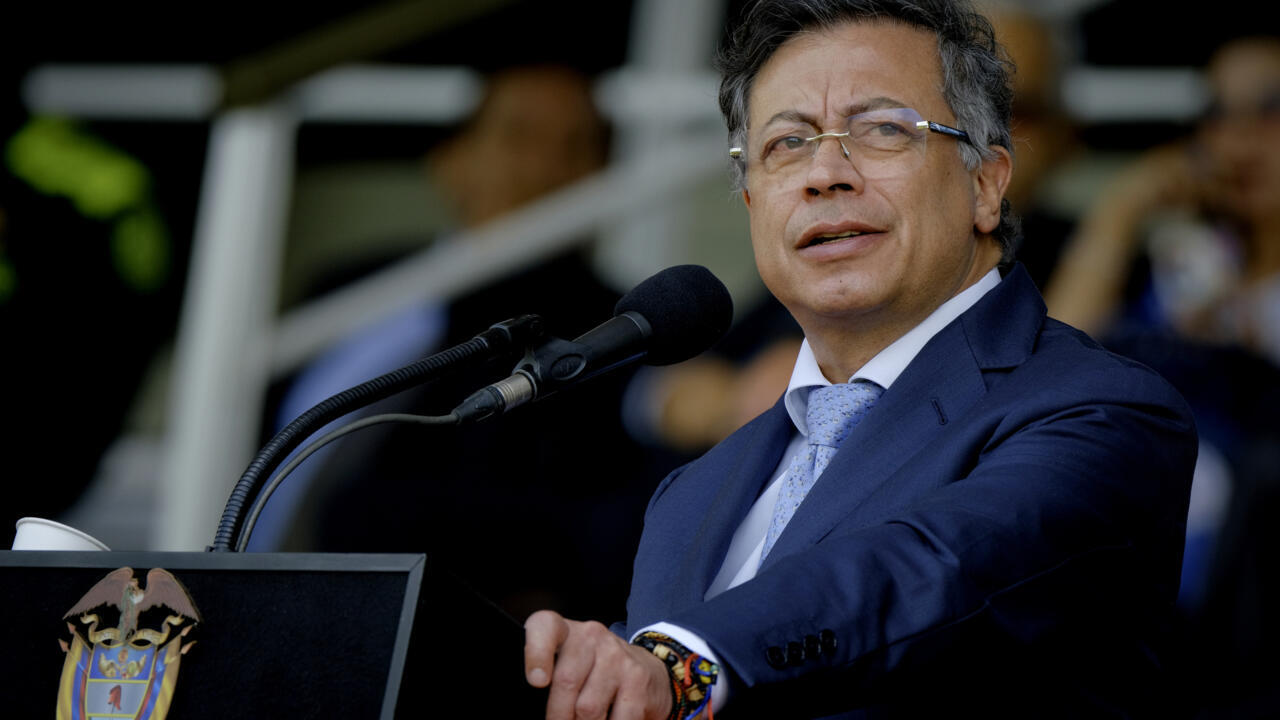
Colombia's President Gustavo Petro is now under US sanctions -- rocking a decades-old alliance between Washington and Bogota © Ovidio GONZALEZ / Colombian Presidency/AFP
The US Treasury blacklisted Gustavo Petro, first lady Veronica Alcocer, his eldest son Nicolas, and Interior Minister Armando Benedetti, banning them from travel to the United States and freezing any US assets they hold.
It was an unusual move. The US sanctions list is usually reserved for drug kingpins, terror operatives and dictators involved in widespread human rights abuses.
The rupture caps months of personal friction between President Donald Trump and Petro over US deportations and strikes on suspected drug boats off the coast of South America.
"President Petro has allowed drug cartels to flourish and refused to stop this activity," claimed US Treasury Secretary Scott Bessent.
Since taking power in 2022, Petro has opted to engage well-armed cocaine-producing groups in talks, rather than conduct open warfare.
Critics say the policy has allowed cartels and guerrilla groups to flourish, seizing territory and producing record amounts of cocaine.
Much of the cocaine ends up in the United States -- the world's biggest consumer.
The US government provided no evidence linking Petro directly to drug trafficking.
Petro's son is accused of accepting money from an alleged drug trafficker for his father's campaign, but the case has not yet been decided in court.
'Gringos go home'
The US Treasury blacklisted Gustavo Petro, first lady Veronica Alcocer, his eldest son Nicolas, and Interior Minister Armando Benedetti, banning them from travel to the United States and freezing any US assets they hold.
It was an unusual move. The US sanctions list is usually reserved for drug kingpins, terror operatives and dictators involved in widespread human rights abuses.
The rupture caps months of personal friction between President Donald Trump and Petro over US deportations and strikes on suspected drug boats off the coast of South America.
"President Petro has allowed drug cartels to flourish and refused to stop this activity," claimed US Treasury Secretary Scott Bessent.
Since taking power in 2022, Petro has opted to engage well-armed cocaine-producing groups in talks, rather than conduct open warfare.
Critics say the policy has allowed cartels and guerrilla groups to flourish, seizing territory and producing record amounts of cocaine.
Much of the cocaine ends up in the United States -- the world's biggest consumer.
The US government provided no evidence linking Petro directly to drug trafficking.
Petro's son is accused of accepting money from an alleged drug trafficker for his father's campaign, but the case has not yet been decided in court.
'Gringos go home'
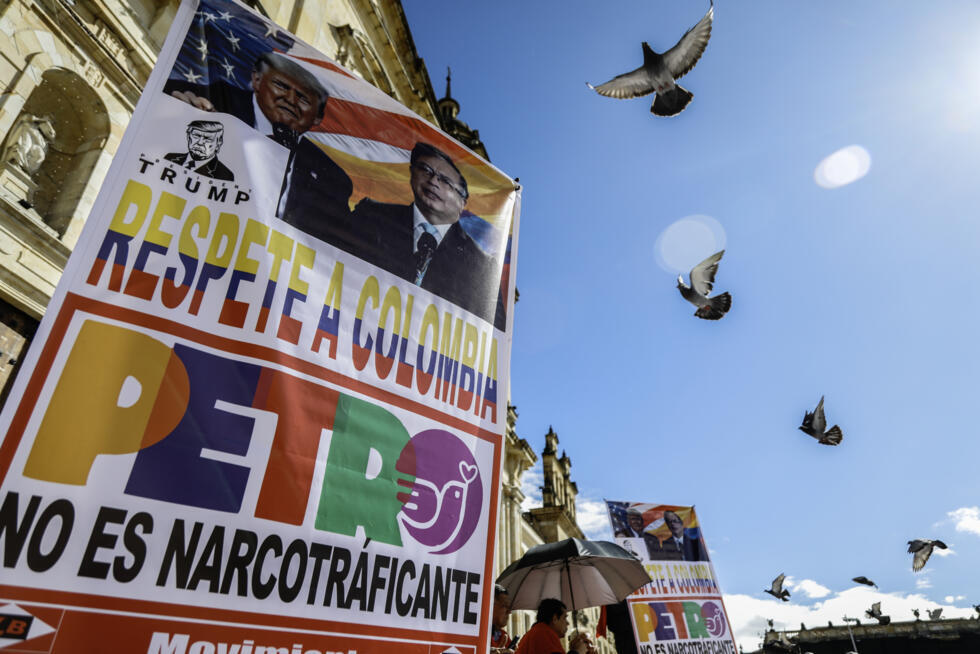
A poster reading 'Trump, respect Colombia, Petro is not a drug trafficker' is pictured during a rally called by Colombia's President Gustavo Petro in Bogota © John Vizcaino / AFP
The sanctions announcement was met with a furious response in Bogota.
Petro, a former guerrilla, channelled the defiant messages of famed Latin American revolutionaries.
"Not one step back and never on my knees," he posted on social media.
Benedetti, the powerful interior minister, was even more defiant, lobbing anti-US slogans and denunciations.
"This proves that every empire is unjust," Benedetti said in a social media tirade against the decision.
"For the US, a nonviolent statement is the same as being a drug trafficker. Gringos go home."
Petro had already called for a mass protest against Trump's policies to be held in Bogota on Friday.
The United States has destroyed 10 vessels and killed at least 43 people in under two months of strikes off South America, according to an AFP tally based on US figures.
Petro has called the operations "extrajudicial killings" and used a recent trip to New York to call on US soldiers to disobey Trump's orders.
Trump has bristled at Petro's open criticism of his policies and fiery anti-Washington rhetoric.
Saying Petro was "a thug" with a "fresh mouth," Trump announced a freeze on hundreds of millions of dollars in aid to Colombia.
He had already stripped Petro of his US visa before Friday's announcement.
Analysts warn the spat between the two mercurial leaders could have a profound impact on security in the hemisphere.
Colombia has long been a US bulwark against cocaine flows and leftist insurgencies, and Washington's chief ally in South America.
© 2025 AFP
The sanctions announcement was met with a furious response in Bogota.
Petro, a former guerrilla, channelled the defiant messages of famed Latin American revolutionaries.
"Not one step back and never on my knees," he posted on social media.
Benedetti, the powerful interior minister, was even more defiant, lobbing anti-US slogans and denunciations.
"This proves that every empire is unjust," Benedetti said in a social media tirade against the decision.
"For the US, a nonviolent statement is the same as being a drug trafficker. Gringos go home."
Petro had already called for a mass protest against Trump's policies to be held in Bogota on Friday.
The United States has destroyed 10 vessels and killed at least 43 people in under two months of strikes off South America, according to an AFP tally based on US figures.
Petro has called the operations "extrajudicial killings" and used a recent trip to New York to call on US soldiers to disobey Trump's orders.
Trump has bristled at Petro's open criticism of his policies and fiery anti-Washington rhetoric.
Saying Petro was "a thug" with a "fresh mouth," Trump announced a freeze on hundreds of millions of dollars in aid to Colombia.
He had already stripped Petro of his US visa before Friday's announcement.
Analysts warn the spat between the two mercurial leaders could have a profound impact on security in the hemisphere.
Colombia has long been a US bulwark against cocaine flows and leftist insurgencies, and Washington's chief ally in South America.
© 2025 AFP
“The gravity of the present signals demands that we use all existing channels for dialogue to perpetuate a Zone of Peace,” said the elder statesmen in a joint letter.
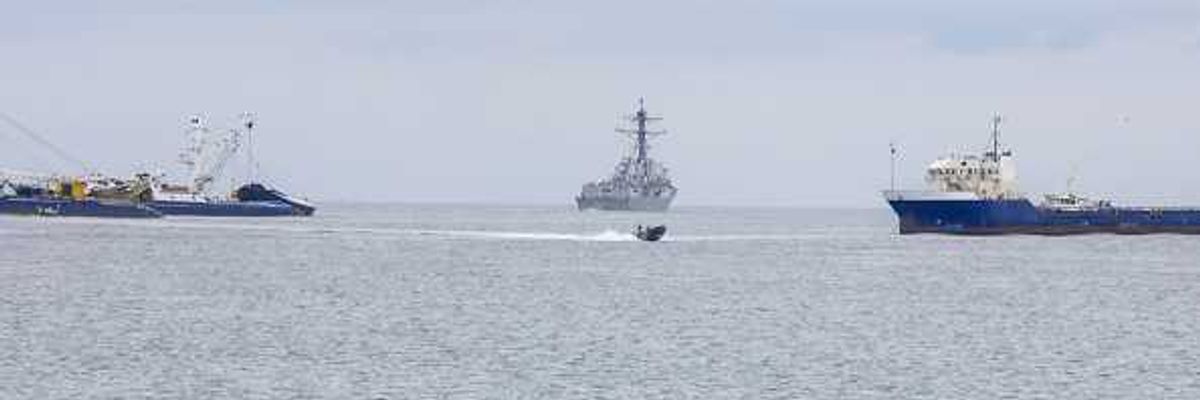
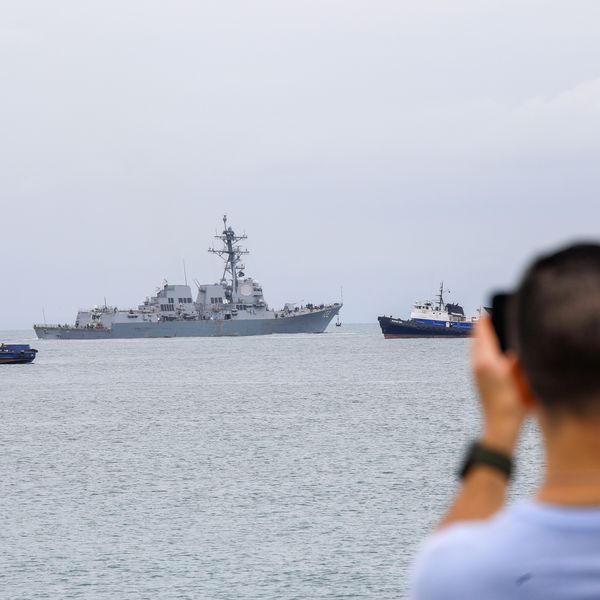
The USS Sampson, a US Navy missile destroyer, docks at the Amador International Cruise Terminal in Panama City, Panama, on September 2, 2025.
(Photo by Daniel Gonzalez/Anadolu via Getty Images)
Julia Conley
Oct 24, 2025
COMMON DREAMS
Ten former leaders of Caribbean nations on Friday called on the current governments across the region to unite in a diplomatic effort to counter President Donald Trump’s unprovoked escalation, in which the US has struck at least 10 vessels in less than two months—claiming without evidence that the Trump administration is fighting “narco-terrorists” from Venezuela.
Former prime ministers of Antigua and Barbuda, Belize, Barbados, Dominica, Grenada, Guyana, Jamaica, and St. Lucia signed a joint statement titled “Caribbean Space: A Zone of Peace on Land, Sea and Airspace Where the Rule of Law Prevails,” and called on current leaders to recall the 1972 regional meeting at Chaguaramas, Trinidad and Tobago.
‘We Have Lived This Nightmare Before’: Latin American Lawmakers Condemn Trump Extrajudicial Killings
UN Experts Decry Trump Warmongering Against Venezuela as ‘Extremely Dangerous Escalation’
At the summit, noted the St. Vincent Times, “peace was enshrined as the guiding principle of Caribbean development.”
The former leaders wrote that “from this platform our region has always maintained that international law and conventions not war and military might must prevail in finding solutions to global challenges.”
“We are impelled to urge a pullback from military buildup to avoid any diminution of peace, stability, and development within our regional space,” the statement reads. “Our region must never become a pawn in the rivalries of others.”
They called on Caribbean leaders to avoid hosting foreign military assets.
“Our cooperation with international partners must never override our collective sovereignty or the principles of international law.”
“The gravity of the present signals demands that we use all existing channels for dialogue to perpetuate a Zone of Peace,” the leaders said. “We fully support our current heads of government in assisting the peaceful resolution of all conflicts and disputes.”
“We must not endanger our citizens in any crossfire, nor risk economic and human loss from wars that are not ours,” they added.
They noted that Caribbean nations have Shiprider Agreements with the US to “ensure that illicit drug traffickers could be tracked, pursued, searched, and lawfully apprehended without extrajudicial killing and the destruction of that which could provide conclusive evidence of criminal operation.”
“Our cooperation with international partners must never override our collective sovereignty or the principles of international law,” they wrote.
Since early September, the Trump administration has killed at least 43 people by striking vessels in the Caribbean and Pacific. Officials have claimed the boats have been operated by drug traffickers with the Venezuelan gang Tren de Aragua and other groups, but have provided no evidence for the claims. Fentanyl, which kills thousands of people per year in the US from overdoses, is not trafficked out of Venezuela, according to US and international drug and crime agencies.
“Although the United States Coast Guard interdicts staggering quantities of illegal drugs in the Caribbean each year, it does not encounter fentanyl on the high seas,” wrote Nick Miroff at The Atlantic. “South American cocaine and marijuana account for the overwhelming majority of maritime seizures, according to Coast Guard data, and there isn’t a single instance of a fentanyl seizure—let alone ‘bags’ of the drug—in the agency’s press releases.”
On Friday, the Pentagon revealed that it had deployed the USS Gerald Ford, an aircraft carrier, to the southern Caribbean Sea to “disrupt narcotics trafficking.”
Venezuelan President Nicolás Maduro has accused Trump of seeking regime change in his country, and the former officials urged regional leaders to reject any such efforts.
“We have remained steadfast in our repudiation of external intervention to effect regime change,” they wrote. “Military action in our maritime waters must always be governed by international law—not might.”
Don’t Let a Fascist Like Trump Act as Judge, Jury, and Executioner
What makes these strikes so appealing to President Donald Trump is that it gives him the godlike power to look down from above and smite anyone who displeases him. But that won’t stop the flow of drugs.

President Donald Trump announced a US military strike on a fifth boat in the Caribbean on October 14, 2025.
(Image: screenshot/Donald Trump/Truth Social)
Sanho Tree
Oct 24, 2025
What makes these strikes so appealing to President Donald Trump is that it gives him the godlike power to look down from above and smite anyone who displeases him. But that won’t stop the flow of drugs.
President Donald Trump announced a US military strike on a fifth boat in the Caribbean on October 14, 2025.
(Image: screenshot/Donald Trump/Truth Social)
Sanho Tree
Oct 24, 2025
OtherWords
The Trump administration has been blowing up fishing boats in the Caribbean—and now one in the Pacific—claiming without evidence that they’re “drug boats.”
These are extrajudicial executions outside any system of law. And there’s a reason we shouldn’t allow drug warriors to act as judge, jury, and executioner: because over the years, they’ve made many, many tragic mistakes and killed lots of civilians.
I’ve seen countless tragedies like these in my decades studying drug policy. Two were particularly egregious.
In 2001, the United States was using local air forces to shoot down alleged trafficking planes over the Peruvian Amazon. In this case, a surveillance plane flown by CIA contractors misidentified a pontoon plane and had it shot down. Instead of traffickers, they killed a missionary from Michigan named Veronica Bowers and her infant daughter.
Would it be okay for the Mexican military to blow up a US fishing boat because they believed it was smuggling deadly guns into Mexico, even if they offered no evidence? Would that be acceptable to this administration?
The second case was an incident in Honduras in 2012, where the Drug Enforcement Administration and local forces mistakenly opened fire on a water taxi, killing four people—including two pregnant women—and then tried to cover it up.
What makes these strikes so appealing to President Donald Trump is that it gives him the godlike power to look down from above and smite anyone who displeases him, without consequence. He’s even told sick jokes about local fishermen in the Caribbean now being afraid to get in their boats.
If he’s allowed to normalize this kind of international extrajudicial killing, I don’t think it’s a far leap for him to try it domestically.
Imagine a cop chasing a guy down the street, getting hot and tired, and shooting the suspect in the back. The cop probably wouldn’t tell a judge, “Well your honor, I didn’t want to chase him, so I just shot him.” But here’s the president declaring on the international stage: We’re not going to do police work. We’re just going to kill people.
Now imagine the shoe’s on the other foot. Most of the killings in Mexico are done by guns smuggled from the United States. They call it the “River of Iron,” and it’s responsible for literally hundreds of thousands of killings in the country in the past 20 years.
So would it be okay for the Mexican military to blow up a US fishing boat because they believed it was smuggling deadly guns into Mexico, even if they offered no evidence? Would that be acceptable to this administration?
The drug war acts as a price support for drug dealers. That’s why no one wants the drug war to continue more than the smugglers themselves.
Here’s what drug warriors don’t understand: The US isn’t under armed attack from drug traffickers. It’s actually the opposite.
Most drugs cost pennies per dose to manufacture. But the higher the risk to the individual smuggler—like the risk of getting arrested, shut down, or blown up—the more they can charge as drugs move down the smuggling chain.
By the time drugs reach users, they’ve snowballed in value. But consumers in the US have proven more than willing to pay hyper-inflated prices, and even risk arrest, for drugs—just as drinkers were once willing to pay bootleggers huge sums for booze during Prohibition.
In short, our policies create tremendous value for substances that are relatively cheap. We’re making trafficking more profitable, not less.
So if the US bombs a trafficker—or an alleged trafficker—we escalate the risk premium for everyone else in that industry. It’s a bad deal for you if you’re the one who’s killed, but it creates a “job opening” for others in the operation, or a rival cartel, to take over that turf—which is now more lucrative.
The drug war acts as a price support for drug dealers. That’s why no one wants the drug war to continue more than the smugglers themselves. This was ultimately why the US ended alcohol prohibition.
Addiction is a public health problem and requires public health solutions, not allowing someone like Trump to play judge, jury, and executioner—at home or abroad.
The Trump administration has been blowing up fishing boats in the Caribbean—and now one in the Pacific—claiming without evidence that they’re “drug boats.”
These are extrajudicial executions outside any system of law. And there’s a reason we shouldn’t allow drug warriors to act as judge, jury, and executioner: because over the years, they’ve made many, many tragic mistakes and killed lots of civilians.
I’ve seen countless tragedies like these in my decades studying drug policy. Two were particularly egregious.
In 2001, the United States was using local air forces to shoot down alleged trafficking planes over the Peruvian Amazon. In this case, a surveillance plane flown by CIA contractors misidentified a pontoon plane and had it shot down. Instead of traffickers, they killed a missionary from Michigan named Veronica Bowers and her infant daughter.
Would it be okay for the Mexican military to blow up a US fishing boat because they believed it was smuggling deadly guns into Mexico, even if they offered no evidence? Would that be acceptable to this administration?
The second case was an incident in Honduras in 2012, where the Drug Enforcement Administration and local forces mistakenly opened fire on a water taxi, killing four people—including two pregnant women—and then tried to cover it up.
What makes these strikes so appealing to President Donald Trump is that it gives him the godlike power to look down from above and smite anyone who displeases him, without consequence. He’s even told sick jokes about local fishermen in the Caribbean now being afraid to get in their boats.
If he’s allowed to normalize this kind of international extrajudicial killing, I don’t think it’s a far leap for him to try it domestically.
Imagine a cop chasing a guy down the street, getting hot and tired, and shooting the suspect in the back. The cop probably wouldn’t tell a judge, “Well your honor, I didn’t want to chase him, so I just shot him.” But here’s the president declaring on the international stage: We’re not going to do police work. We’re just going to kill people.
Now imagine the shoe’s on the other foot. Most of the killings in Mexico are done by guns smuggled from the United States. They call it the “River of Iron,” and it’s responsible for literally hundreds of thousands of killings in the country in the past 20 years.
So would it be okay for the Mexican military to blow up a US fishing boat because they believed it was smuggling deadly guns into Mexico, even if they offered no evidence? Would that be acceptable to this administration?
The drug war acts as a price support for drug dealers. That’s why no one wants the drug war to continue more than the smugglers themselves.
Here’s what drug warriors don’t understand: The US isn’t under armed attack from drug traffickers. It’s actually the opposite.
Most drugs cost pennies per dose to manufacture. But the higher the risk to the individual smuggler—like the risk of getting arrested, shut down, or blown up—the more they can charge as drugs move down the smuggling chain.
By the time drugs reach users, they’ve snowballed in value. But consumers in the US have proven more than willing to pay hyper-inflated prices, and even risk arrest, for drugs—just as drinkers were once willing to pay bootleggers huge sums for booze during Prohibition.
In short, our policies create tremendous value for substances that are relatively cheap. We’re making trafficking more profitable, not less.
So if the US bombs a trafficker—or an alleged trafficker—we escalate the risk premium for everyone else in that industry. It’s a bad deal for you if you’re the one who’s killed, but it creates a “job opening” for others in the operation, or a rival cartel, to take over that turf—which is now more lucrative.
The drug war acts as a price support for drug dealers. That’s why no one wants the drug war to continue more than the smugglers themselves. This was ultimately why the US ended alcohol prohibition.
Addiction is a public health problem and requires public health solutions, not allowing someone like Trump to play judge, jury, and executioner—at home or abroad.
Tensions rise in Caribbean as families of fallen men accuse Trump of unjust killings
Issued on: 24/10/2025 - FRANCE24
Relatives of a Trinidadian man who say he was killed in a US military strike in the Caribbean are demanding evidence to back up Trump's allegations that those who died were trafficking drugs. Alice Brogat and Siobhan Silke tell us more.
Issued on: 24/10/2025 - FRANCE24
Relatives of a Trinidadian man who say he was killed in a US military strike in the Caribbean are demanding evidence to back up Trump's allegations that those who died were trafficking drugs. Alice Brogat and Siobhan Silke tell us more.

No comments:
Post a Comment